PART 2: The Message I Left Behind 027
Part 2 – The Message I Left Behind
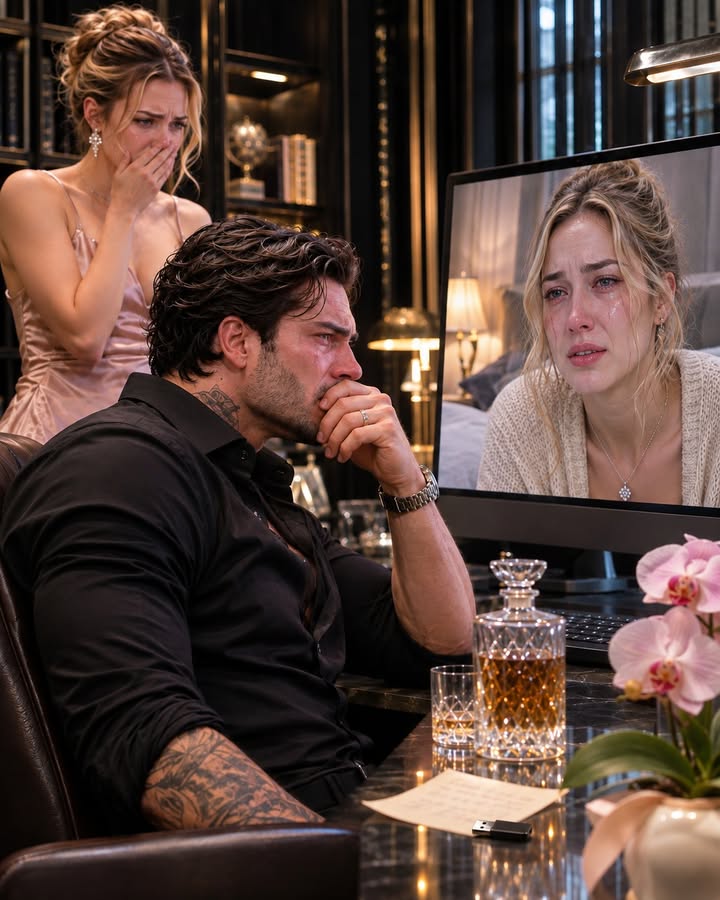
On the screen, my recorded face was pale beneath the soft light of the guest room where I had filmed it, my hands folded tightly in my lap.
For several seconds, I said nothing.
Alexander leaned closer to the monitor, as if proximity could make the silence easier to bear.
Then I looked into the camera.
“If you’re watching this, I’ve already left.”
Behind him, the mansion held its breath.
Sophia stood near the doorway, the orchid cradled against her chest, while Alexander remained seated before the computer with one hand gripping the edge of the desk.
My recorded voice continued, quiet but steady.
“I’m not making this because I want you to feel guilty, and I’m not asking you to come looking for me.”
Alexander’s jaw tightened.
“I need you to hear me without trying to explain what I mean before I finish.”
He drew a shallow breath, but did not speak.
“I know what you think this is about,” I said on the screen. “You think I’m jealous of Sophia. You think I’m angry about the yacht, or the jacket, or the keychain.”
Sophia’s eyes lowered to the tiny crystal strawberry dangling from the keys still on the desk.
“But this isn’t about an affair,” I continued. “I don’t know what you and Sophia are to each other beyond what I’ve seen, and I’m not going to invent an answer just because I’m hurt.”
Alexander looked toward Sophia.
She shook her head once, almost imperceptibly, as if silently asking him to keep listening.
My recorded hands tightened together.
“This is about how alone I’ve felt while sitting right beside you.”
The words seemed to change the room.
Alexander’s face, still rigid with shock, began to lose the certainty he usually wore like another tailored layer.
“For three years, I’ve tried to explain what happens to me when the depression gets bad,” I said. “I’ve tried to tell you that some mornings it feels as if lifting my head from the pillow takes more strength than I have. I’ve tried to tell you that at night, when my thoughts become frighteningly loud, I call because I don’t know how to quiet them by myself.”
Sophia lowered the orchid onto the console table.
Alexander watched my face on the screen.
“I know you have a demanding life,” I said. “I know people depend on you, and I know the company can feel like a thing that will collapse if you look away. But when you told me to stop pretending to be sick, when you asked whether I thought I was the only person with problems, I learned something.”
My eyes glistened, though no tears fell.
“I learned that you didn’t want to know what was happening inside me.”
Alexander’s fingers slipped from the edge of the desk.
“I began hiding it,” I continued. “Not because I got better, and not because I stopped needing help. I hid it because I couldn’t bear to ask again and hear that I was making your life harder.”
He looked down at the desk.
The recorded version of me paused, gathering herself.
“I’m not telling you this to punish you. I’m telling you because I don’t want you to turn my leaving into another story about jealousy, or moodiness, or a bad week.”
A small sound escaped Sophia, something between a breath and a sob.
Alexander did not turn toward her.
“I am safe,” I said. “I’m staying with my sister. She knows where I am, and my attorney knows too. Please don’t come to the house, and don’t send anyone to find me.”
He sat very still.
“I need space without calls, surprise visits, gifts, or promises made because you’re afraid I might disappear. If we speak again, I want it to happen when I’m ready, with the people I’ve asked to be there.”
The recording seemed to grow quieter, though the volume had not changed.
“I don’t know what happens next,” I said. “I only know I can’t go back to a life where I’m afraid to tell my husband I’m unwell.”
The image flickered slightly as I shifted in my chair.
Then I leaned toward the camera, my expression no longer composed.
“I used to think if I explained it the right way, you would hear me.”
Alexander’s eyes shut.
“I’m sorry I kept trying to find the perfect words,” I whispered. “I’m sorry I kept thinking that if I were calmer, prettier, easier, less sad, you might finally understand.”
A tear traced the side of my face.
“I shouldn’t have had to become easier to love.”
The screen went black.
For a long moment, neither of them moved.
Then the computer dimmed, and the reflection of Alexander’s face appeared in the dark glass.
He looked older than he had when he came through the door.
Sophia approached the desk but stopped a few feet away.
“Alexander,” she said quietly.
He raised one hand, not sharply, but as though he needed a moment before he could bear another voice.
She waited.
When he finally looked at her, the anger had gone from his face, leaving something more uncertain in its place.
“Did you know she was leaving?”
“No.”
“Did you know she was staying with her sister?”
“No,” Sophia answered. “I didn’t know Claire had decided to go.”
He looked back at the dark screen.
“She said she wasn’t asking me to find her.”
“She asked you to respect her space,” Sophia replied. “That seems clear.”
His eyes lifted to her, and for a moment she appeared ready for him to snap at her.
Instead, he turned away.
The orchid sat on the console table beneath the tall windows, its pale petals nearly luminous in the low light.
Alexander looked at it as if he had only just noticed what Sophia was holding.
“Why did you bring that?”
Sophia’s brows drew together.
“You asked me to.”
“I did?”
“Last week, after you saw it on the side terrace.” She gave him a searching look. “You said it had probably been moved there during the landscaping and asked me to bring it inside when we came back tonight.”
He looked at the orchid.
“You knew it was Claire’s.”
“No.” Sophia’s voice tightened, not in anger but in distress. “I didn’t know it belonged to her. I thought it was one of the plants from the conservatory.”
“She kept it for three years.”
Sophia’s gaze returned to the flower.
“I’m sorry. I would never have carried it in if I’d known.”
The apology was simple, and that seemed to leave Alexander with nowhere to put the suspicion he had been carrying.
He had imagined betrayal because it gave him something clear to blame.
But Sophia stood in front of him, embarrassed and worried, not triumphant.
“The jacket,” he said.
She blinked. “What about it?”
“The one you wore at the hospital.”
Her expression changed with recognition.
“Your birthday gift,” she said. “The jacket Claire picked out for you?”
“Yes.”
“I borrowed it from the wardrobe room because I had spilled coffee on mine before the event. I thought you knew.”
“I didn’t.”
“You were in the middle of the awards dinner when it happened.” She hesitated. “I should have asked first.”
“And the strawberries?”
Sophia’s mouth tightened.
“They were from the company event. Everyone made little crystal charms at the workshop. Mine was a strawberry, and yours was too because you said it looked like the one on the table centerpiece.”
He stared at her.
“You posted a picture.”
“I did. Of the workshop.” She folded her arms loosely across herself. “I didn’t realize how it would look from the outside.”
Neither of them spoke for a moment.
The explanations were ordinary.
That was what made them hurt.
They did not erase Claire’s pain, but they stripped away the convenient story Alexander had already begun to assemble.
“I’m sorry,” he said.
Sophia looked startled.
“I should have told you,” he continued. “I made assumptions, and I let them sit there until they became something else.”
“You don’t need to apologize to me for that.”
“I do.”
She glanced toward the dark screen.
“Whatever happened between you and Claire, I wasn’t part of it.”
“I know.”
“Do you?” she asked, with more sadness than challenge. “Because the way you’ve talked about her lately, you seem to think her hurt is something you can solve by buying her the right thing.”
The words landed with a quietness that made them harder to dismiss.
Alexander looked at the keys beside the computer.
The crystal strawberry flashed in the reflected light.
“The studio,” he said.
Sophia followed his gaze. “She wanted that for a long time, didn’t she?”
“I thought she did.”
“What do you mean?”
He picked up the keys, then lowered them again without turning them over in his hand.
“I had the rooftop studio arranged months ago.”
Sophia said nothing.
He had never told her that.
The truth had been sitting in him, tucked away behind the polished explanation he had given himself: that he was a man who remembered what his wife loved, a man who took care of things, a man who could repair a distance with the right gesture.
“I’d seen her drawing at the kitchen table,” he continued. “She’d stopped using the upstairs room because the windows needed work. I thought if I gave her a place of her own, she’d understand I was paying attention.”
“Were you?”
He looked at Sophia.
The question was gentle, but he could not answer it honestly without looking back at the recording.
“I thought I was.”
She stepped nearer the console, careful not to touch the orchid.
“Did you ever ask her what she wanted?”
“No.”
The word sounded unfamiliar in his mouth.
Sophia’s expression softened.
“Maybe she wanted you there more than she wanted a room.”
He let out a breath that did not become a laugh.
“I told myself the room was a way of being there.”
“Then perhaps it was a way of avoiding the conversation.”
The clock above the mantel marked the passing of another minute.
Alexander stood abruptly, pushing his chair back.
“Where are you going?” Sophia asked.
“To find her.”
The answer came too quickly.
He heard Claire’s voice in his memory: Please don’t come to the house, and don’t send anyone to find me.
He stopped.
The impulse had risen from panic, and the recording had named exactly what she feared.
He gripped the edge of the desk.
“No,” he said, more to himself than to Sophia. “I can’t.”
Sophia remained quiet.
“I need to call her.”
“She asked for no calls.”
“Then what am I supposed to do?”
“Listen to what she asked you to do.”
He stared at the black screen.
Her words had been clear.
Not an invitation to persuade her.
Not a challenge to prove how much he cared.
A boundary.
He had never thought of boundaries as something a husband might need to respect from his wife. He had thought of them as a distance to overcome, an obstacle to remove before the problem could be considered solved.
Now he wondered how many times Claire had asked for something simple and watched him replace it with something grand.
The mansion’s quiet grew louder around them.
“What should I do with the orchid?” he asked.
Sophia glanced at the flower.
“I think that’s a question for Claire.”
“I can’t ask her.”
“Then leave it where it is for now.”
He looked at the delicate stem, then at the keychain.
Two objects that had once seemed like evidence of other people’s attention now felt like small pieces of his own carelessness.
Sophia collected her coat from the back of a chair.
“I should go.”
“I’ll have the driver take you.”
“Thank you, but I can call a car.”
He nodded.
At the door, she paused.
“Alexander, I’m sorry she felt alone.”
He looked at her, and the simple kindness in her face made him feel more exposed than accusation would have.
“So am I,” he said.
Sophia left, closing the door quietly behind her.
He remained in the study until the house’s lights began switching off automatically, one room at a time.
At some point, the orchid’s shadow stretched across the wall.
He finally went upstairs, carrying neither the keys nor the flower.
Claire’s side of the bedroom was empty.
The wardrobe doors stood open, revealing clean, pale shelves and an absence so complete it looked deliberate.
He placed one hand against the edge of the dresser.
For years, he had thought of their life as stable because the house was stable, the company was growing, and the same routines continued each morning.
He had mistaken routine for closeness.
The note lay where he had left it, beside the computer.
He picked it up again.
Alexander, watch this. Afterward, you’ll understand.
He read the sentence until the words blurred.
Then he returned downstairs and found the medical records she had left behind.
They had been stacked neatly in a folder near the note, their dates arranged in order.
He opened the first envelope.
A treatment summary.
Then another, with the name of a specialist he did not recognize.
There were appointment records, prescription histories, notes about follow-up visits, and a page covered in the careful language of clinicians describing symptoms Claire had spent years struggling to name at home.
He moved through them slowly, afraid of what each page might say and more afraid that he might turn away before he reached the truth.
A date near the top of one file caught his attention.
Three years earlier.
The month her sleep had changed.
The month she had stopped drawing at breakfast.
The month she had begun calling him at night.
The records continued for years, documenting visits he had never known about, medications he had never asked her about, and notes about periods when her condition had worsened.
She had not hidden one difficult season from him.
She had hidden a long, painful struggle because she had learned he did not want to hear about it.
The shame did not arrive all at once.
It settled slowly, filling the spaces where he had stored his excuses.
He had thought she was exaggerating.
He had thought she was trying to make him feel responsible.
He had thought the tears would pass if he refused to reward them with attention.
He had called her illness a performance because he could not bear to admit that he had no idea how to help her.
And when she reached for him anyway, he had made her feel foolish for asking.
The next morning, Alexander sat alone at the dining table with the records spread before him.
The mansion’s staff returned at seven.
No one asked where Claire was.
Perhaps they had already learned not to ask questions that might make him uncomfortable.
His sister, Elena, called shortly before nine.
“Alexander,” she said after he answered. “Is Claire with you?”
“No.”
There was a pause.
“Is she all right?”
“She’s safe. She’s staying with her sister.”
“How do you know?”
“She said it in a recording.”
Elena was silent.
“You watched it?”
“Yes.”
“What did she say?”
He looked at the folder.
“That I made her feel alone.”
The line stayed quiet for a few seconds.
Then Elena said, “She told me that years ago.”
His throat tightened.
“She did?”
“She tried to tell you more than once, Alex.”
He shut his eyes.
“I didn’t understand.”
“You didn’t want to understand,” Elena replied, and then her voice softened. “I’m not saying that to hurt you. I’m saying it because you’ve always found a way to turn her pain into something you could dismiss.”
He rubbed a thumb over the edge of the folder.
“I thought I was helping.”
“You thought buying something meant you didn’t have to sit with her when she was hurting.”
He looked toward the window.
The orchid stood in a glass pot on the console, its roots visible beneath the bark.
“I gave her the studio keys.”
“I know.”
“She used to talk about wanting a place to draw.”
“She did,” Elena said. “But I don’t think she wanted you to guess what she needed. She wanted you to ask.”
He could not find an answer.
Elena sighed.
“Is there anything else on the recording?”
“She says she doesn’t want me to contact her.”
“Then don’t.”
“I know.”
“Do you?” she asked.
“Yes.”
“Because I love you, but I have watched you confuse persistence with devotion for a long time.”
He did not defend himself.
The truth had become too visible for that.
“I’m going to respect it,” he said.
“Good.”
After the call ended, Alexander returned to the records.
Beneath one of the folders, he found a document from the hospital where Claire had been treated after the accident.
The first page listed her injuries as minor, just as she had told him.
A second page noted that the attending nurse had offered to contact her husband.
Claire had declined.
At the bottom, a typed note recorded that her husband had been in the building.
He remembered the moment now: the sterile corridor, the nurse’s careful tone, the way Claire kept her eyes on the blanket when he entered.
You were in an accident, Claire. Why didn’t you call me?
They were minor injuries. Nothing worth wasting Mr. Moretti’s time over.
He had heard the words as a rebuke.
Now he understood they had been an attempt to protect herself from needing him.
The memory shifted, and he saw her face when he had dropped the keys beside her bed.
He had called it an apology.
She had not asked for the studio.
He had never asked what she needed.
He had only delivered what he thought should be enough, then waited for her to be grateful.
Alexander pushed back from the table and stood by the window.
Beyond the glass, Chicago moved through its morning routine, traffic flowing between buildings that reflected the gray sky.
The city had always made him feel capable.
Every problem seemed to have a price, a plan, a deadline, or a person he could call.
This was different.
He could not send a letter that would undo the years in those records.
He could not replace the nights Claire had called and received irritation in return.
He could not make her believe he had heard her now by saying he had finally listened.
At the far end of the table, the folder remained open.
A folded sheet slipped from between two medical summaries and landed on the polished wood.
It was not another report.
It was a clinic confirmation for a family therapy appointment, dated more than two years earlier.
The time and address were printed at the top.
Beneath them, in Claire’s handwriting, were four words.
Alexander said he would come.
He read them twice.
The date was familiar.
He remembered that day: a crisis at the company, a meeting that had run late, a call from his legal team, a decision he had treated as urgent.
He remembered sending Claire a message that he would make it up to her.
He did not remember asking what the appointment had been for.
Elena’s voice returned in his memory.
She tried to tell you more than once.
The clinic confirmation lay in his hand, light as paper and heavy as a door he had never opened.
At the bottom of the page, beside the printed appointment time, someone had added a short note in blue ink.
A note that made him realize the recording he had just watched was not the first time Claire had tried to tell him she was afraid.
**–END OF PART 2–CLICK “NEXT” AT THE BOTTOM OF THE PAGE TO CONTINUE READING**
* * *
[NEXT: PART 3](https://puretales.idolsgift.com/blog/part-3-the-message-i-left-behind-027)
✓ Lynn R. Adams
Part 2 – The Message I Left Behind On the screen, my recorded face was pale beneath the soft light of the guest room where I had filmed it, my hands folded tightly in my lap. For several seconds, I …