PART 2: The Memory Inside the Crystal 041
Part 2 – The Memory Inside the Crystal
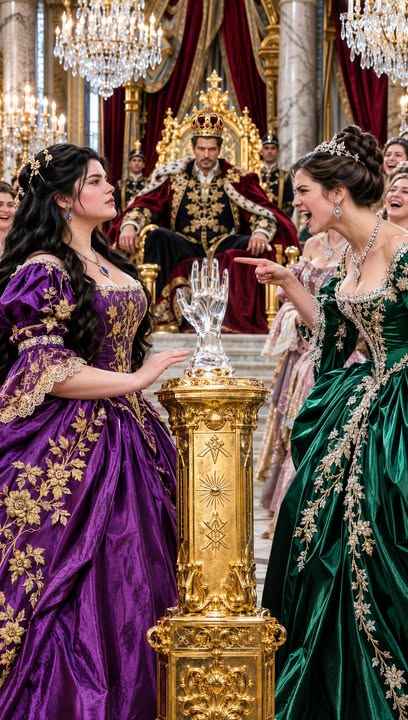
And then the crystal began revealing something no living monarch was supposed to see.
A pale blue light gathered beneath my fingertips, not blazing like the red flashes that had rejected the other women, but shining with the quiet steadiness of a moon reflected in deep water.
The roar in the palace faded.
In its place came a sound like a lullaby hummed from a great distance, so gentle that the hush it left behind seemed almost sacred.
Images stirred within the crystal.
At first, I saw only a room lit by fire.
Its walls were painted with golden branches, and tall windows opened onto a night sky the color of ink.
A woman stood beside a cradle, her dark hair braided with silver thread and her face drawn with exhaustion.
Though I had never seen her before, I knew who she was.
The recognition came not from memory, but from the strange certainty that rose in my chest when she turned toward the light.
Queen Elara.
The last ruler of the dynasty the histories called lost.
The vision shifted, and the woman bent over the cradle.
A newborn slept beneath a pale blanket, its tiny hand curled against its cheek.
Queen Elara lifted a sapphire pendant from her own neck.
My breath caught.
It was my pendant.
Its deep blue stone flashed as she tucked it carefully into the folds of the blanket, then pressed her lips to the child’s brow.
Behind her, the firelight trembled.
Someone called her name from beyond the room, and Queen Elara looked toward the door with the expression of a woman who had just understood that the life she loved was about to change.
She leaned over the cradle once more.
“I will find you,” she whispered.
The crystal went dark.
For a heartbeat, no one moved.
Then the murmurs returned all at once, swelling through the throne room like wind through a forest.
I pulled my hand away, though I could still feel warmth tingling in my fingers.
My knees threatened to buckle.
Prince Victor reached me before I could fall, his hand hovering at my elbow, uncertain whether I would welcome the help.
I let him steady me.
“Are you hurt?” he asked, and for once there was no amusement in his voice.
“I don’t know,” I said.
The answer sounded small, even to me.
The court had begun to press forward, each face bright with curiosity or alarm.
Lady Victoria stood among them, her jeweled hands clasped before her, her expression no longer triumphant.
The king descended the steps from his throne.
“Everyone leave the chamber,” Gabriel ordered.
He did not shout, but his voice carried the weight of a command learned in childhood and never questioned.
The courtiers hesitated.
“Your Majesty,” one of the older lords began, “the crystal has shown—”
“Nothing that can be understood in a crowd,” the king said.
His gaze met mine, and beneath the authority in it I saw something more fragile.
Fear.
Not fear of me, I realized.
Fear for what the vision meant.
The guards opened the great doors, and the nobles began filing out in uneasy silence.
As Lady Victoria passed, she glanced at me.
For the first time that morning, I saw no mockery in her face.
Only questions she had no way to ask.
Prince Victor remained beside me until the last courtier had gone.
“I should apologize,” he said.
I looked at him, still unsteady.
“For what?”
His jaw tightened.
“For calling you a name and inviting everyone to laugh at you.”
The memory of his words pricked more sharply now that the room was quiet.
“‘Little round lady’?” I asked.
His cheeks colored.
“Yes.”
“You seemed very certain I was there to entertain you.”
“I was certain I had nothing to learn from you,” he said. “That is not the same thing, but it is worse.”
I had expected another joke, perhaps an elegant excuse.
His plain admission disarmed me more than either would have.
“I don’t know whether I can forgive you yet,” I said.
“You don’t have to decide now.”
He lowered his hand from my elbow and stepped back, giving me room.
It was a small courtesy, but I noticed it.
King Gabriel motioned for us to follow him through a side door.
The passage beyond the throne room was cool and dim, lined with portraits whose painted eyes seemed to watch us go.
We entered a private receiving room where a low fire burned beneath a carved stone mantel.
The king dismissed the attendant who had been waiting there.
When the door closed, he remained standing with one hand braced on its back.
For several seconds, he said nothing.
I had spent my life around nobles who used silence to make others uncomfortable.
This silence seemed to be hurting him.
“You recognized the pendant,” I said.
Gabriel looked up.
“Yes.”
“Why?”
His gaze fell to the sapphire at my throat.
“That pendant belonged to Queen Elara.”
The truth settled over me with a weight I could not yet measure.
“My father told me it had been in our family for generations.”
“He may have been telling the truth,” Gabriel said carefully. “Or he may have been protecting you with the only story he could safely give.”
I touched the stone.
My father’s face rose in my mind as clearly as if he were standing beside the fire: his patient smile, his ink-stained fingers, the way he had held my hand when I was small and frightened of storms.
He had never spoken of a queen.
He had never spoken of a royal child.
“Who was the baby?” I asked.
The king’s face changed.
“I do not know.”
It was the first answer he had given that sounded like a locked door rather than an explanation.
I searched his eyes.
“You recognized the pendant, and you knew the symbols beneath the pedestal. You knew the Trial would react to me. What did you think would happen?”
“I thought the crystal was dormant,” he replied. “I thought it had been for generations.”
“That isn’t what I asked.”
“No,” he said. “It isn’t.”
Victor shifted near the window, watching his father with a troubled expression.
Gabriel finally sank into a chair.
“When I was a boy,” he said, “my family came to power after a period of unrest. The official account says the old royal line disappeared in the fire at Elara’s palace. It says no child survived.”
“And the unofficial account?”
The king’s hands closed together.
“There are fragments. Names removed from records. Household staff who vanished from the court. Letters that were never entered into the royal archive.”
“Who removed them?”
“My predecessor ordered the histories rewritten.”
“Your predecessor was king?”
“My mother was regent then,” Gabriel said. “She acted in the name of the crown.”
He spoke without defending her, but there was a weariness in his voice that made me understand the subject had shadowed him for years.
“Why would she erase an entire family?” I asked.
“She believed it was the only way to end the conflict and prevent the kingdom from dividing between rival claims.”
“Did she know the child had survived?”
“I was a child. I cannot tell you what she knew.”
The carefulness of his answer unsettled me more than a denial would have.
I studied him, trying to separate a king’s restraint from a man’s fear.
“Did you help someone escape?”
Victor’s attention sharpened.
Gabriel looked toward the fire.
“I helped a man leave the palace,” he said at last. “That is all I can tell you tonight.”
“That man could have been my father.”
“He could have been.”
“Could he have been carrying the baby from the vision?”
The king’s silence was answer enough to make my heart beat harder, though it was not an answer at all.
“Why didn’t you say something sooner?” I asked.
“I didn’t know you existed.”
“You knew my father?”
“I knew a man who may have been your father.”
“You have spent the whole day looking at me as though you were waiting for this moment.”
“I was looking at the pendant.”
“Those are not the same thing.”
“No,” Gabriel admitted. “They are not.”
Victor moved away from the window.
“Father, she deserves more than fragments.”
“So do you,” the king said, and the words seemed to surprise them both.
Victor held his gaze.
“Then tell us what you can.”
Gabriel’s expression softened, but only for an instant.
“The past is not a story that belongs to me alone,” he said. “If the crystal has awakened, there may be records we can trust more than my memory.”
“What records?” I asked.
“The official archives have been searched many times. The older collections beneath the palace have not.”
He stopped himself.
I noticed.
“Why not?”
“Because the lower archive was sealed after the fire.”
“By whom?”
“By the regent’s council.”
“And you have a key?”
“I have access to the outer door.”
The distinction sounded deliberate.
I stood and went to the window, needing a little distance from the king’s face and the fire and all the things he would not say.
Outside, the palace gardens lay bright beneath the late morning sun.
Servants moved along the gravel paths, carrying baskets of clipped roses, their ordinary tasks continuing beneath the weight of a history that had just opened its eyes.
“My father raised me alone,” I said. “He never made me feel unwanted. He taught me to read old maps, to ask why a record had been altered, to keep a promise even when no one could see me keeping it.”
My throat tightened.
“He never said I was royal.”
“Perhaps he was trying to make certain that you could be a child before you became an answer to anyone else’s question,” Gabriel said.
I turned back to him.
For the first time, the king looked less like a ruler and more like a man standing at the edge of a room he had avoided entering for half his life.
“Or perhaps he was ashamed of me.”
“No,” Victor said quickly.
The certainty in his voice startled me.
He seemed to realize it, because he took a breath before continuing.
“Forgive me. I didn’t know your father, and I have no right to tell you what he felt. But a man who kept a dangerous secret to protect a child would not be ashamed of that child.”
The words found a tender place in me.
I thought of the years when I had wondered why my father’s family had seemed so distant, why he never took me to visit certain estates, why he changed the subject whenever I asked about my mother.
I had always assumed there were disappointments he could not bear to explain.
The possibility that he had kept silent out of love made my chest ache in a different way.
“What if he protected me from the truth,” I said, “but also left me alone with it?”
“Then we will try to understand both things,” Victor replied.
He did not promise that the truth would be kind.
I appreciated that.
The king rose and crossed to a narrow cabinet. From it, he took a glass of water and offered it to me.
My hand trembled as I accepted it.
“Thank you,” I murmured.
His eyes remained on the pendant.
“Queen Elara was known for wearing it at court,” he said. “The stone was set in a silver clasp shaped like a star. I saw it in the portrait gallery when I was a boy.”
“Does that portrait still exist?”
“It was removed.”
“By your mother?”
“By the council, I believe.”
“You believe?”
“I was not present when it was taken down.”
I studied his face again.
There was an explanation beneath every answer, and beneath each explanation another question.
“You said your predecessor ordered the histories rewritten,” I said. “But now you say it was your mother.”
“The wording in the official records is deliberately vague.”
“Then you have known for years that the history was false.”
“I have known that it was incomplete.”
“That is a convenient distinction.”
“Yes,” he said quietly. “It is.”
The admission surprised me.
He did not ask me to trust him.
He did not insist that he had done the right thing.
Instead, he let the accusation stand between us, as though it were a debt he had no right to avoid.
Victor looked at me.
“I was cruel to you in the throne room,” he said. “And before that, I never thought about what it meant to be a lady-in-waiting with no powerful family behind you.”
“You thought about me enough to make a joke.”
“I did.”
“Why should I believe you’ll help now?”
“You shouldn’t have to believe me because I said so.” His voice was steady. “Give me something useful to do, and judge me by whether I do it.”
I had spent years watching powerful people offer help in exchange for gratitude, silence, or obedience.
Victor offered none of those things.
“You can start by not deciding what I should do,” I said.
“I can do that.”
“And don’t call me a curiosity.”
“I won’t.”
“Even if the crystal turns me into one.”
“Especially then.”
Despite myself, I almost smiled.
The king watched our exchange with an expression I could not read.
“Will you let us examine the pendant?” he asked.
I closed my hand around it.
“Not yet.”
He nodded, accepting my refusal without argument.
The gentleness of that response unsettled me in its own way.
I was used to being pressed, corrected, or dismissed.
“I need time,” I said.
“You will have it.”
“Will the court be told what the crystal showed?”
“Not until we understand it better.”
“They saw the queen and the baby.”
“They saw a vision they may not interpret accurately.”
“They saw the pendant.”
“The court will remember what it chooses to remember,” Gabriel said. “That is why we must be careful.”
I heard the truth in that, but I also heard the possibility of another silence.
“And if careful becomes another word for hiding?”
The king lowered his eyes.
“Then you will have to remind me.”
It was not enough to absolve him.
It was enough to make me pause.
A knock sounded at the door.
The attendant returned with a small, folded note on a silver tray.
“Your Majesty,” she said, “this was brought from the royal library. It bears no signature.”
Gabriel opened it.
His expression tightened as he read.
“What is it?” Victor asked.
The king folded the note again and held it between his fingers.
“The crystal has awakened a mechanism in the lower palace.”
“What mechanism?” I asked.
“I don’t know.”
“Then we should find out.”
“Not today,” Gabriel said. “The guards need to secure the passage, and I need time to confirm the message.”
I looked at the folded paper.
“Who sent it?”
“It bears no signature.”
“That wasn’t what I asked.”
He met my gaze.
“I don’t know.”
I could tell he was holding something back, but I could not tell whether it was knowledge or fear.
Before I could press him, another knock sounded, this time sharper.
The guard who entered carried a narrow wooden box.
“Found beneath the pedestal, Your Majesty,” he reported. “It appeared after the light faded.”
Gabriel glanced at me, then at Victor.
The box was no longer than my hand.
Its dark wood was scored with the same ancient symbols I had noticed on the crystal base.
“May I?” I asked.
The king hesitated.
Then he passed it to me.
The lid was unlatched.
Inside lay a small, tarnished silver clasp shaped like a star.
I knew it before I lifted it.
My fingers began to shake.
It was the clasp that had once held my sapphire pendant.
My father had shown it to me when I was a child, telling me it had broken long ago and that he had kept the pieces.
I had never seen it since.
On the underside, almost hidden beneath the tarnish, was a line of engraving.
I turned it toward the window and read the words aloud.
“For the child whose name the kingdom must forget.”
The room seemed to tilt.
Gabriel closed his eyes.
Victor went very still beside me.
Then the king opened his eyes and whispered, “Your father did not merely inherit that pendant.”
He looked at me as if the truth had finally found him, too.
“He carried the child out of the palace.”
**–END OF PART 2–CLICK “NEXT” AT THE BOTTOM OF THE PAGE TO CONTINUE READING**
* * *
[NEXT: PART 3](https://echoesofstories.idolsgift.com/blog/part-3-the-memory-inside-the-crystal-041)
✓ Lynn R. Adams
Part 2 – The Memory Inside the Crystal And then the crystal began revealing something no living monarch was supposed to see. A pale blue light gathered beneath my fingertips, not blazing like the re…