PART 2: The Mark in the Oak 046
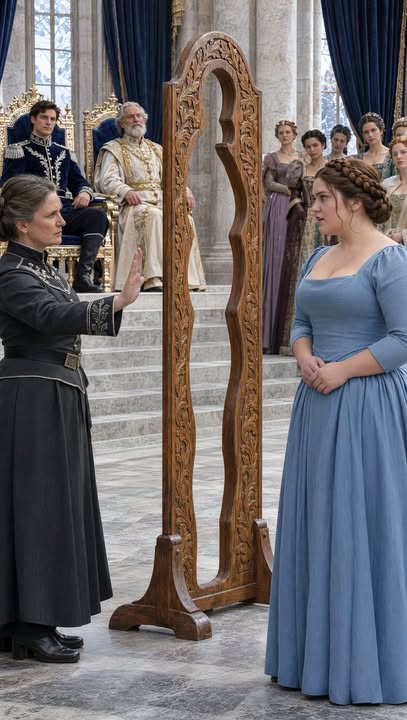
His hand stopped just short of the shallow mark.
For a moment, Alexander seemed to forget the crowded hall, his father on the dais, and the women watching from behind their fans.
He looked not at me but at the wood, as if it had spoken in a voice only he could hear.
“Your Highness?” the attendant asked.
Alexander lifted his eyes to mine.
“May I?”
I didn’t know what he intended to touch, or why the question seemed to matter so much to him.
But I nodded.
He reached past my shoulder and placed one finger against the notch.
The mark was small, no longer than the width of my thumbnail, and cut into the oak at about the height of my collarbone.
His fingertip followed its shallow edge.
“I know this,” he said.
The words carried farther than he seemed to intend.
King William sat straighter on the throne.
“Know what?” he asked.
Alexander’s hand stayed on the frame.
“This notch.”
The attendant glanced at the carved opening, then at the prince.
“It’s only a mark in the wood,” she said, with the careful patience of someone trying to return an awkward moment to its proper place.
“It isn’t only that.”
Alexander’s voice softened, but it did not lose its certainty.
The room had grown still again, though this time the silence felt different.
The women’s whispers had stopped.
I could feel the attention gathering around me, heavy as the wool shawl I had left in the carriage.
“Do you know when it was made?” I asked.
He turned to me, and something like surprise crossed his face, perhaps because I was the first to speak directly to him.
“No,” he said. “But I remember it.”
He looked down at the notch again.
“My mother used to measure the children who came to the palace.”
I wasn’t sure I had heard him correctly.
“The children?”
“Children of the staff, visiting families, anyone who happened to be here long enough for her to make a fuss over them.”
The faintest smile touched his mouth.
“She kept a pencil in her pocket and insisted that every new mark deserved a date.”
“Did you have one?”
“I did.”
He ran his finger along the oak, stopping just above the notch.
“There were several. I was a very determined child, and I liked to stand on my toes.”
The smile faded before it could become a laugh.
“My mother would make me start again.”
The word mother seemed to settle between us more quietly than the others.
I knew something of losing a mother.
I knew the way a room could hold her absence without offering any explanation for it.
Alexander’s gaze remained fixed on the frame, but I could see the ache behind his composure.
“Is this part of a doorway?” I asked.
“It used to be.”
He straightened, looking at the oak as though he were seeing more than its polished surface.
“This frame came from the old west wing. The passage there led from the family rooms toward the garden. It was taken down years ago when that wing was renovated.”
“So the test wasn’t designed for us?”
A few of the women shifted at the word test.
Alexander glanced toward them, then back to me.
“No. It was not made for this.”
The attendant folded her hands.
“Your Highness, the frame was selected because the candidates were asked to demonstrate poise and composure.”
“I know what the explanation was.”
His tone held no anger, but the attendant’s cheeks colored.
The king rose from his chair.
“Perhaps we should conclude the evaluation,” he said. “We have had quite enough discussion about a piece of old wood.”
“Not quite,” Alexander replied.
It was the first time I had heard him contradict his father in front of us.
The king’s expression did not change, though his jaw set in a way I recognized from my own father when he was trying not to show disappointment.
Alexander turned back to the frame.
“Emily, would you step out for a moment?”
I lowered one foot over the sill and then the other.
The attendant reached to steady me, but I had already found my balance.
Alexander moved aside to give me room.
When I stood beside him, the notch was just below his shoulder.
He leaned close to examine it, then pointed to a second mark nearly hidden in the grain.
I followed his gesture.
There, beside the shallow notch, someone had carved a tiny flower.
Its petals were uneven, more like the quick work of a child than a formal decoration.
My breath caught.
I knew that flower.
Not the exact carving, of course, but its simple shape: five narrow petals around a little center, one side slightly longer than the other.
I had seen it stitched in blue thread on the corner of my mother’s handkerchief.
The handkerchief was folded inside my traveling bag, wrapped in tissue to protect its fraying edges.
I carried it everywhere, though I rarely took it out.
“How long has that been there?” I asked.
Alexander leaned closer.
“I never noticed it before.”
“Perhaps it was hidden by the paint.”
The attendant stepped near enough to see.
“There was no paint on the frame when it was stored,” she said. “Only a coat of oil, I believe.”
King William came down one step.
“Are you saying the mark has some significance?”
“I don’t know,” Alexander said.
He looked to me.
“Does it mean something to you?”
I could have said no.
The hall was watching, and I had spent the morning trying to make myself small enough not to draw attention.
But the flower had unsettled something deep in me.
“It resembles a flower my mother used to sew.”
“Your mother?”
“Yes.”
I kept my voice steady, though my fingers had begun to curl into my palms.
“She worked at the palace for a little while, years ago.”
The words came out before I had decided whether I wanted to say them.
Alexander’s expression sharpened with interest, not suspicion.
“What was her name?”
“Margaret Carter.”
The king’s gaze moved to his son.
For the briefest instant, something passed between them.
It was not recognition, exactly.
It was closer to the awareness that a name had landed where it might matter.
Alexander noticed it too.
“Father?”
King William rested one hand on the carved rail.
“I may have heard it,” he said. “There were many people employed here.”
His answer sounded ordinary enough, but the pause before it did not.
I looked again at the flower.
My mother had never told me much about her time at the palace.
When I was young, I asked once whether she had liked working here.
She had smiled in a way that suggested the answer was complicated.
“Some days were kind,” she had said. “And some days I was glad to come home.”
Then she had changed the subject.
After she died, I found a few old things in her sewing basket, including the handkerchief.
There had been no note or explanation, only the flower stitched in one corner and a faint trace of lavender soap.
I had kept it because it was hers.
Now I wondered whether she had once stood beside this very frame, thread in hand, marking the oak with the same small bloom.
“Your mother knew my mother?” Alexander asked.
“I don’t know.”
The answer was honest, and somehow more painful for being so.
“She never spoke of the queen by name. She didn’t speak much about the palace at all.”
Alexander looked at the carved flower as if it had become something fragile.
“My mother died when I was young,” he said. “There are many things I wish I had asked her.”
His words did not sound prepared.
They were not a prince’s polished expression of grief, offered because the room expected one.
They sounded like the truth he had been carrying for years.
I understood then that he was not merely curious about an old mark.
He was remembering a person he had loved and could no longer ask.
“I’m sorry,” I said.
He turned his head toward me.
“So am I.”
The small exchange should have been swallowed by the grand hall.
Instead it seemed to make the room smaller, drawing the two of us into a quiet neither of us had expected to find.
Behind us, the candidates waited in their careful rows.
One of them, a dark-haired young woman with a composed smile, had been the only person to offer me a kind word before the evaluations began.
Beatrice, I remembered.
She had complimented my dress without looking at the other women to see whether they approved.
Now she stood with her hands clasped, watching us with concern rather than curiosity.
Alexander noticed my glance.
“Have you been uncomfortable here?” he asked.
The question surprised me.
“Some of the other candidates have been.”
“I asked about you.”
I could feel the attendant listening.
“I’ve had worse mornings,” I said.
“Was it the test?”
“It was part of it.”
The answer came out more sharply than I meant it to.
I looked down at my hands and made myself open them.
“I didn’t come here expecting anyone to make room for me. I came because the invitation was real, and I wanted to try.”
The prince did not rush to reassure me.
That was one reason I believed him when he answered.
“I saw how they treated you.”
“Then you know why I wanted to try.”
He looked toward the other candidates.
Some lowered their eyes.
Others held his gaze, waiting to see what he would say next.
“I’m sorry,” he said.
The apology was quiet, but it reached me more deeply than a grand speech would have.
“You didn’t tell them to laugh.”
“No,” he said. “But I was standing where I could have stopped it.”
I had not expected him to say that.
A prince could have blamed the attendant, the rules, or the women who had whispered.
He did none of those things.
He simply acknowledged what he had seen and what he had failed to do.
“I know what it’s like to be judged by people who have already decided what you are,” he added.
The words sounded too personal to belong in a room full of witnesses.
I searched his face.
“Because you keep turning down the women your father brings you?”
A faint, surprised smile appeared.
“Something like that.”
The king’s expression tightened again.
“Alexander,” he said, “the proceedings are not a private conversation.”
“No,” the prince replied. “They are not.”
He looked at the candidates.
“I owe you all an apology. This test has asked you to perform for an object whose purpose we no longer understand, and it has made it easier for people to judge one another before they have been heard.”
No one answered.
The silence was not hostile.
It was simply the silence of people who had expected a different sort of prince.
King William came down another step.
“The evaluation will be concluded,” he said. “The remaining candidates will be escorted to the west salon. There will be no further tests today.”
A few shoulders loosened.
The attendant stepped forward to guide the women away.
Beatrice passed me with a brief, encouraging look.
“I hope you find out what the flower means,” she whispered.
“I hope so too.”
Then she was gone with the others, her dark hair disappearing beyond the tall doors.
I remained beside the frame.
The king spoke to the steward, asking him to ensure that the candidates were provided with warmth and tea before their departure.
For a moment, the room returned to its usual order.
People moved.
The attendant gathered her papers.
A servant opened one of the windows, and cold air slipped into the hall carrying the clean scent of snow.
Alexander did not move away from the oak.
“Could I see the handkerchief?” he asked.
The question was gentle.
I hesitated.
It was not that I thought he meant harm.
It was simply the only thing I had left that still belonged to my mother’s hands, and showing it to him made the past feel suddenly exposed.
He saw my hesitation.
“You don’t have to.”
“I know.”
I looked toward the doors, where the other candidates had gone.
Then I looked at the flower in the oak.
“I don’t have it with me.”
“That’s all right.”
“I keep it in my bag when I travel.”
His gaze flickered to the small leather case the attendant had placed near the wall.
“I could bring it,” I said, though I was not sure why I had decided to.
“Only if you wish to.”
I crossed the room and opened the case.
The handkerchief was wrapped in white tissue between my gloves and a small notebook.
I unfolded the cloth carefully.
The blue thread had faded to the color of winter sky, but the flower was still clear.
I carried it back to the frame and held it beside the carving.
The likeness was plain enough to make my chest tighten.
The uneven petal.
The small, slightly crooked center.
Even the short stitch at the base of the stem seemed to match the shallow line beside the carved bloom.
Alexander stared at it.
For the first time since he had come down from the dais, he looked truly uncertain.
“Your mother made this?” he asked.
“I think so. It was in her sewing basket.”
“May I?”
I let him take the handkerchief, and he held it carefully by two corners, as though the cloth might come apart under the weight of a careless touch.
The king had drawn closer without my noticing.
He saw the stitched flower and stopped.
“Margaret Carter,” he murmured.
I turned toward him.
“You remember her?”
The king looked at me for several seconds, and in that pause I felt the old distance between my mother’s life and my own beginning to close.
“I remember the name,” he said. “But not enough to tell you what you deserve to know.”
“What does that mean?”
He glanced at Alexander, then at the steward near the doors.
The steward was an older man with silver hair and a straight-backed way of standing that suggested he had served the royal family longer than anyone else in the room.
“Your Majesty,” he said, in a low voice, “perhaps this is a matter best discussed after the candidates have left.”
The king’s eyes rested on him.
“Perhaps you’re right.”
The steward looked at me.
There was something in his face I could not read.
Not fear.
Not quite recognition.
It was the look of someone opening a drawer in his mind and finding it empty where a name should have been.
“Miss Carter,” he said, “your mother worked here?”
“For a short time, I was told.”
“I see.”
He did not say more.
Alexander returned the handkerchief to me with care.
“I would like to hear about her,” he said.
“I can’t tell you much.”
“Then perhaps we can start with what you do know.”
The king’s mouth tightened, though his voice remained even.
“Alexander, the candidates are waiting. We should not detain Miss Carter.”
“I’m not being detained,” I said.
My own voice surprised me.
The king looked at me, and I stood a little straighter.
“I came here to try,” I added. “I’ve done that. But if there is something about my mother that I should know, I would like to hear it.”
No one spoke for a moment.
Then Alexander nodded.
“Would you stay after the proceedings?”
His request was not a command.
It was not even a promise that he could answer my questions.
It was an invitation to remain in the one place where I had been made to feel I did not belong.
I thought of my mother’s handkerchief in my palm, of the tiny flower stitched into its corner, and of the mark in the old oak.
“I’ll stay,” I said.
The king’s expression softened by a fraction.
“I will ask the steward to look through the records,” he said. “If your mother worked here, there may be something we can find.”
The steward inclined his head.
“I will do what I can, Your Majesty.”
Alexander looked at the frame once more.
“I used to stand here while my mother marked my height,” he said. “I’d forgotten that until today.”
“Maybe it’s easier to forget some things when you’re young,” I said.
“Or when the people who remember them are gone.”
I held the handkerchief close.
For the first time since I entered the palace, I no longer felt as though every person in the room had already decided what I was.
Alexander had not chosen me.
He had not promised anything.
But he had listened, and I had seen grief in him that did not ask to be admired.
That was enough to make the palace feel different.
The steward approached the oak frame and bent to inspect the flower.
“Your Majesty,” he said, “the frame was in storage for many years. It was brought back only recently.”
The king turned toward him.
“Why?”
The steward looked from the carving to the king, then to Alexander.
“I’m not certain. The order came through the household office.”
“From whom?” Alexander asked.
The steward’s eyes settled on the old mark, and his answer took a moment to arrive.
“Someone requested that this particular frame be used for the final test.”
**–END OF PART 2–CLICK “NEXT” AT THE BOTTOM OF THE PAGE TO CONTINUE READING**
* * *
[NEXT: PART 3](https://echoesofstories.idolsgift.com/blog/part-3-the-mark-in-the-oak-046)
✓ Lynn R. Adams
His hand stopped just short of the shallow mark. For a moment, Alexander seemed to forget the crowded hall, his father on the dais, and the women watching from behind their fans. He looked not at me…