PART 2: The Mark Beneath the Silver 057
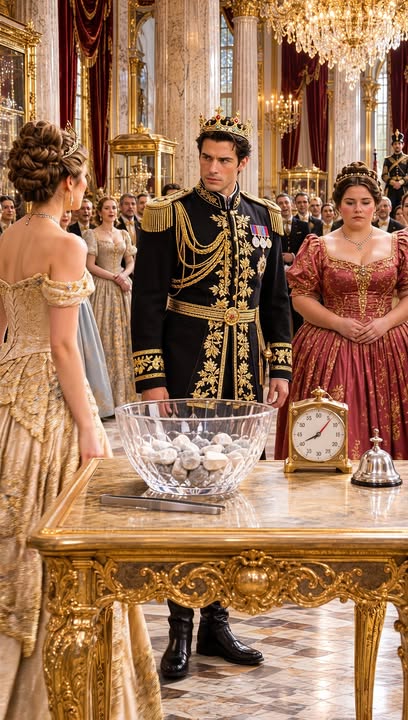
The silver tips slipped between the pale stones, and Emma steadied her hand against the rim of the crystal bowl.
A quiet scrape sounded as she moved one stone aside.
Then the ring appeared.
It was no larger than the tip of her smallest finger, its silver surface dulled by time, its narrow band almost hidden beneath the stones.
For a heartbeat, no one in the gallery spoke.
Emma eased the tweezers around it and lifted it carefully into the afternoon light.
A faint gleam traveled along the ring’s inner edge—not the bright flash of a jewel, but a delicate change in the light, as if a tiny line had been cut into the silver.
Prince Alexander drew in a sharp breath.
The sound was slight, but Emma heard it.
She looked up.
His attention was fixed on the ring, and the composure that had carried him through the contest seemed to have vanished.
“You recognize it,” she said.
Alexander did not answer at once.
Victoria, standing beside the golden table, watched his face with a new and uncertain expression.
The aristocrats had begun to whisper, yet Alexander barely seemed to notice them.
“Yes,” he said finally.
His voice was low, almost private, though the hush in the room carried it to every corner.
Emma lowered the ring into her open palm.
“Was it really your mother’s?”
“It was.”
He stepped closer, stopping just short of the table.
For the first time since the challenge began, he seemed less like a prince presenting a test and more like a son standing before a memory he had not expected to find.
The timekeeper glanced at the small clock beside him.
“Your Highness, the challenge—”
“Is complete,” Alexander said.
His gaze remained on the ring.
“Miss Emma found it.”
A ripple of applause began, hesitant at first, then spreading through the gallery.
Emma barely heard it.
She was looking at Alexander, who seemed to be trying to summon words from somewhere deep within himself.
“What did you notice?” he asked.
“The light changed when it passed through the bowl,” Emma replied. “The stones reflected it differently near the bottom.”
She paused, studying the ring again.
“But that wasn’t the only thing.”
She turned it slowly between her fingers, careful not to let it slip.
The inside of the band bore a faint engraving, nearly worn smooth.
It was not a name.
It looked more like a sequence of tiny, deliberate marks, too fine to read from where they stood.
Alexander leaned nearer, his expression tightening.
“I have never seen that.”
“Neither have I,” Emma said.
Victoria came around the table, her earlier confidence replaced by a guarded curiosity.
“Perhaps it is only a decoration,” she said.
Emma did not reply.
She turned the ring over.
Beneath the band, so small that it could have been mistaken for a scratch, was a stamped symbol: a little three-petaled flower above a curved line.
The moment Emma saw it, her fingers stopped moving.
The gallery’s applause faded around her.
She knew that mark.
Her mother had once shown her a brass button bearing the same flower, explaining that it had been made in the village where Emma grew up.
The stamp belonged to a workshop that had been closed for years, but its shape was familiar enough to make Emma’s chest tighten.
“This came from my village,” she whispered.
Alexander looked at her.
“What did you say?”
Emma brought the ring closer to the light.
“I recognize the maker’s mark. It was used by a silversmith near my home.”
Victoria’s brows lifted.
“That seems a remarkable coincidence.”
“It might be,” Emma said, though she was no longer sure.
Alexander held out his hand, then stopped before touching the ring.
“May I?”
Emma placed it in his palm.
He examined the tiny flower, and the color drained from his face.
“I knew this ring,” he murmured. “I knew its shape, its weight, the little notch near the band.”
He turned it gently, as if some part of him expected the silver to change beneath his touch.
“But I never knew where it was made.”
Emma watched his thumb pass over the old stamp.
“Where did you last see it?”
“In my mother’s jewelry box,” he said. “I was young, but I remember asking her about it.”
“What did she tell you?”
“That it was an old family piece.”
He swallowed.
“She said it had been with her for a long time, and that it reminded her that kindness could travel farther than anyone expected.”
The sentence seemed to surprise him as he spoke it.
He lowered his hand, still holding the ring.
“I had forgotten those words until now.”
A hush settled over the gallery again, less theatrical than before, and far more tender.
Emma felt the attention of the room pressing around them.
She wished the moment could belong only to the two people who understood its weight.
“Your Highness,” said the royal timekeeper softly, “the contest has a schedule.”
Alexander seemed to remember where he was.
He straightened, but his eyes remained troubled.
“The ring has been found,” he said. “The result stands.”
A fresh wave of applause followed, stronger this time.
Some of the nobles smiled at Emma.
Others looked as though they were already turning the discovery into a story to repeat at dinner.
Emma offered a small, composed smile, though a flush had risen beneath her cheeks.
Victoria stepped back from the table.
For an instant, Emma thought she might offer congratulations.
Instead, Victoria looked down at the crystal bowl.
“I suppose I should have studied the light more carefully,” she said.
Her voice was restrained, but the words were not unkind.
Emma glanced at her.
“You were searching quickly,” she replied. “It was easy to lose track of what you had already turned over.”
Victoria’s mouth tightened, as if she could not decide whether to accept the kindness or reject it.
“I did not lose track,” she said. “I simply ran out of time.”
It sounded like an explanation she was giving to herself.
Alexander returned the ring to Emma, closing her fingers around it for a brief moment.
“I would like to speak with you somewhere quieter,” he said. “If you are willing.”
Emma looked toward the grand gallery doors.
The crowd had begun to break into smaller knots of conversation, but its attention still followed them.
“I am willing,” she said.
Alexander turned to Victoria.
“You may join us, if you wish.”
Victoria’s expression changed, surprise briefly softening her guardedness.
“I think I would rather speak with the other contestants,” she said. “They will be wondering what happened.”
It was difficult to tell whether she meant to be courteous or simply wanted distance.
Perhaps she did not know herself.
Alexander nodded.
Emma returned the ring to him, and the three of them left the gallery by a side passage lined with portraits of former queens.
In the quieter corridor, the noise of the court diminished behind them.
Sunlight lay in long pale bars across the polished floor.
Alexander walked slowly, turning the ring over in his hand as if afraid that setting it down would make the discovery unreal.
Emma fell into step beside him.
“You said your mother’s jewelry box,” she said. “Do you know how the ring came to be among her things?”
“No.”
His answer came quickly, then he drew a breath and tried again.
“I thought I did.”
He glanced at the old portraits.
“When I was small, I believed everything in the palace had a simple history. The records were kept, the servants knew their duties, and the royal family’s past could be found in books.”
“And now?”
“Now I know that records can be incomplete, and that silence can be mistaken for an answer.”
Emma considered him.
The words carried the weariness of someone who had been turning over the same question for years.
“Did your mother leave the palace often?” she asked.
Alexander’s hand tightened around the ring.
“Once,” he said. “For several months.”
Emma stopped walking.
The prince stopped with her.
“Several months?”
“The official account says she traveled alone for her health,” Alexander replied. “The dates are listed in the household records. She left in the spring and returned near the end of summer.”
He looked down at the ring.
“I was very young. I remember being told she was ill, but not where she had gone.”
“Did she come back well?”
“She was different. Quieter, perhaps. But she was still my mother.”
His face softened for a moment, and the young prince beneath the uniform appeared again.
“I remember her sitting beside my bed and brushing my hair from my forehead. I remember the smell of rain on her cloak when she returned. I remember her laughing at something I said, though I cannot recall what it was.”
He paused.
“Then, years later, when I asked about that journey, the palace records offered only a brief note. A private trip. No companion. No details.”
“And you never believed she traveled alone?”
“I believed it was possible.”
He looked at Emma, his eyes steady but vulnerable.
“I never believed it was the whole truth.”
Emma felt the ring’s faint warmth through the cloth of her glove.
“My mother kept a sketch,” she said.
Alexander’s attention sharpened.
“What sort of sketch?”
“It was on a piece of thick paper, folded inside a sewing box. A woman stood near a window, wearing a long cloak and a ring on her hand.”
“Did you recognize the woman?”
“No. The drawing was simple, and the face was mostly in shadow.”
She searched her memory, recalling the worn paper and the careful lines.
“My mother said it had belonged to her mother. I asked about it once, and she told me it was only a keepsake.”
“Did she say where it came from?”
Emma shook her head.
“She was not one for long explanations when she thought a child was asking out of curiosity.”
“Do you still have it?”
“I believe so. It is among my family’s things at home.”
The corridor seemed to narrow around the possibility.
Alexander looked down at the ring, then at Emma.
“Your mother’s sketch showed a ring like this?”
“Not clearly enough to be certain,” Emma said. “But I remember a narrow band and a small mark beside the setting.”
There was no jewel in the ring they held.
Only the engraved line inside, the village stamp beneath the band, and a history neither of them could yet understand.
Alexander’s expression grew thoughtful.
“I should not ask you to make sense of my mother’s past from a sketch and a maker’s mark.”
“You are not asking me to,” Emma replied. “I am telling you what I remember.”
He gave her a grateful nod.
They continued to a small sitting room overlooking the palace gardens.
It was not an ornate chamber, but a comfortable one, with a pale green sofa, a writing desk, and windows open to the gentle sound of water from a fountain below.
A footman brought tea and then withdrew.
For a moment, neither Emma nor Alexander spoke.
The ring rested on the table between them.
Emma found herself looking at it more than at the prince.
Its surface was plain, almost modest, and yet it seemed to hold a secret that had waited patiently for someone to recognize it.
“I have spent years thinking the journey meant she wished to be away from me,” Alexander said at last.
Emma raised her eyes.
“Did someone tell you that?”
“No. That was the conclusion I reached when no one could tell me anything else.”
His voice held no accusation, only a quiet ache.
“When she died, I was old enough to ask questions and too young to know how to challenge the answers. Everyone spoke of her with affection, but no one spoke about those months.”
“Perhaps they did not know.”
“Perhaps.”
He lifted the ring and studied its inner engraving.
“Or perhaps they knew and believed silence would protect me.”
Emma understood the temptation to fill an empty place with a painful explanation.
When her mother died, relatives had tried to soften the loss with gentle phrases, yet the absence had remained exactly where it was.
“I am sorry,” she said.
Alexander looked at her.
“I did not bring you here to make you comfort me.”
“I know.”
“Then why did you?”
“Because you sounded like a son, not a prince.”
For a long moment, he said nothing.
Then a small, surprised smile appeared.
“I have not been called that in a very long time.”
“It seems a useful thing to remember.”
His smile lingered, and something in the room eased.
Outside, a breeze stirred the garden trees.
Emma reached for her teacup, grateful for the simple interruption.
“I should tell you something,” she said. “When Victoria mocked me, I thought of leaving.”
Alexander’s smile faded.
“I am sorry she said that.”
“She was trying to make me feel small.”
“You did not look small.”
“I did not feel brave either,” Emma admitted. “I was embarrassed, and I wanted everyone to stop looking at me.”
“Yet you stayed.”
“I wanted to know whether the light had changed for a reason.”
He considered this.
“Curiosity can be a form of courage.”
“Perhaps,” Emma said. “Or perhaps I simply wanted to prove her wrong.”
“There is no shame in that.”
A quiet laugh escaped her.
“You are generous to the person who found your mother’s ring.”
“I am grateful to the person who found it.”
The difference between those words settled gently between them.
Emma turned her teacup in her hands.
“I do not want to be mistaken for someone who thinks this makes me important.”
“Finding the ring does make you important to the contest,” he said. “But that is not the same as knowing you.”
“And the contest?”
He looked toward the windows.
“My advisers believe a royal marriage should be decided through a formal process. The contest was meant to reveal patience, judgment, and character.”
“Can a challenge in a gallery reveal all that?”
“No,” he said. “Not on its own.”
His honesty surprised her.
“It can reveal what people do when they are being watched,” he continued. “And sometimes that is worth noticing. But it can never tell me everything I need to know.”
Emma thought of the aristocrats who had laughed at her, then of Alexander stepping forward to ask that they let her try.
She had been grateful, though she did not want gratitude to become the beginning and end of what he saw in her.
“What happens now?” she asked.
“The other contestants will continue through the next stages.”
“And I?”
“You have passed this one.”
He said it gently, without the flourish of an announcement.
“I would be glad if you remained in the competition,” he added. “But not because of the ring.”
Emma studied him.
“Then why?”
“Because when the room laughed, you chose to look at the bowl instead of the people who wanted you to feel ashamed.”
“That may not be a fair reason to choose someone.”
“I am not choosing anyone yet.”
His reply was careful, and she appreciated that he had not turned the discovery into an instant promise.
The door opened a little, and Victoria appeared at the threshold.
She had removed her jeweled tiara, which she held in one hand.
“Am I interrupting?” she asked.
“No,” Alexander replied. “Come in.”
Victoria stepped inside, but did not take the chair nearest the table.
Her gaze rested on the ring.
“I wanted to see it once more,” she said. “If that is permitted.”
Alexander looked to Emma.
Emma nodded.
Victoria approached the table and leaned closer without touching it.
“I thought it would be more ornate,” she said.
“So did I,” Alexander replied. “I remembered it as something grander.”
“Memory has a way of adding shine to what we miss,” Emma said.
Victoria looked at her.
For a moment, Emma expected another sharp remark.
Instead, Victoria’s gaze dropped to the floor.
“I should not have said what I said in the gallery.”
“No,” Emma agreed.
Victoria’s fingers tightened around the tiara.
“I was angry that I had failed, and I wanted to make sure no one noticed how embarrassed I was.”
Emma said nothing.
It was not an excuse, but it was the first honest thing Victoria had offered her.
“I do not expect you to forgive me,” Victoria added.
“I don’t know you well enough to decide what to forgive,” Emma said. “But you can choose what you say next time.”
Victoria held her gaze.
A faint, humorless smile touched her mouth.
“You make that sound simple.”
“It is not always simple. It is still a choice.”
Alexander watched them without intervening.
Victoria looked back at him.
“Are you going to let the contest continue as planned?”
“I intend to.”
“And Emma will remain?”
“That is her decision.”
Victoria gave Emma a searching look.
“You could leave with everyone speaking of how you found the ring.”
“I could,” Emma said. “But I would rather know why it carries the mark of my village.”
Victoria’s expression shifted.
For the first time, the question seemed to matter to her beyond the competition.
“What if the answer has nothing to do with you?” she asked.
“Then I will have learned that, too.”
The room fell quiet.
Victoria set her tiara on the edge of the table.
“I suppose that is better than inventing an answer because the truth is inconvenient.”
Alexander’s eyes met hers.
“Have you heard something about my mother’s journey?”
Victoria looked startled.
“No. Why would I?”
“I did not know whether the other families had studied the palace records.”
“Some of us read whatever history we can find,” she said. “But the official story is clear enough: she traveled alone.”
Alexander’s jaw tightened.
“Clear enough is not the same as true.”
Victoria glanced at the ring.
“Perhaps not.”
She turned toward the door, then paused.
“I am sorry,” she said to Emma, more plainly this time. “For the words in the gallery.”
Emma nodded.
“Thank you.”
Victoria left without waiting for another reply.
The door closed softly behind her.
Alexander looked at Emma.
“She has never apologized to anyone during a contest.”
“Perhaps she has never been forced to listen to herself.”
“That is a generous interpretation.”
“It is only an observation.”
He smiled faintly.
Emma stood and walked toward the window.
From there, she could see the palace gardens, their paths bordered by clipped hedges and pale flowers.
Beyond the walls lay the roads that led to her home, to the workshop stamp she remembered, and to the sewing box where her mother’s old sketch might still be folded.
The ring lay on the table behind her.
“I thought coming here would be about meeting a prince,” she said. “I did not expect to find a piece of my family’s history.”
“Neither did I.”
She turned back toward him.
“Do you want to know the truth, even if it changes what you believe about her?”
His answer took a moment.
“Yes.”
“Even if it is painful?”
“I would rather know the truth than keep mistaking silence for an answer.”
Emma understood.
The ring had crossed an unknown distance between two families, and its small maker’s mark had carried the past into the palace.
She looked at Alexander, and for the first time she saw not only the prince who had offered her a place in the contest, but the boy who had waited for his mother to return.
“I will look for the sketch when I go home,” she said.
“And I will ask the archivist to search for anything beyond the brief account of her journey.”
“Perhaps there is nothing.”
“Perhaps,” Alexander said. “But I would like to know.”
He wrapped the ring in a square of soft cloth and tucked it into a small case.
Before closing the lid, he looked once more at the faint mark beneath the band.
“Three petals above a curved line,” he said. “Does that symbol appear anywhere else in your village?”
Emma searched her memory.
“On old silver pieces, perhaps. My grandmother used to keep a thimble with the same stamp.”
Alexander’s hand stopped.
“Your grandmother?”
“She was a midwife,” Emma said. “She died before I was born, but my mother spoke of her often.”
The room seemed to grow still.
Alexander closed the case, though his gaze remained on Emma.
“What was her name?”
“Rose Bell.”
He repeated it quietly, as if the name had touched something buried.
“I have heard that name before.”
“From whom?”
“I do not know.”
For a moment, he looked as though he might remember.
Then the memory slipped away, leaving only the ring’s small silver shape and the troubling sense that it had not entered the palace by chance.
Outside, the fountain continued its steady song.
Inside, neither of them reached for the tea.
Emma looked toward the case.
“If the palace records say my grandmother never came here,” she said, “then where did you hear her name?”
Alexander met her eyes.
“I am beginning to wonder whether the palace records are missing more than a journey.”
**–END OF PART 2–CLICK “NEXT” AT THE BOTTOM OF THE PAGE TO CONTINUE READING**
* * *
[NEXT: PART 3](https://storyly.idolsgift.com/blog/part-3-the-mark-beneath-the-silver-057)
✓ Lynn R. Adams
The silver tips slipped between the pale stones, and Emma steadied her hand against the rim of the crystal bowl. A quiet scrape sounded as she moved one stone aside. Then the ring appeared. It was …