PART 2: The Mark Beneath the Gold 046
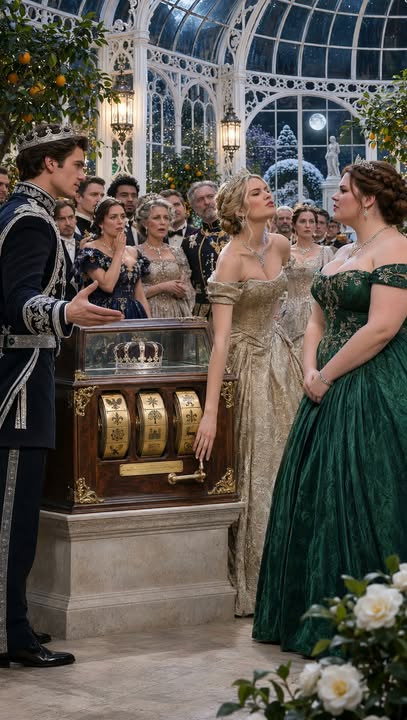
“Where did you learn to look for that?”
Alexander’s question seemed to reach Emma from a great distance.
She lowered her hand, careful not to touch the wheel.
“My father,” she said.
For the first time since she had entered the conservatory, the prince looked less like a prince than a man who had heard a name he did not expect.
“Your father?”
“He was a locksmith.”
Victoria’s brows lifted.
“A locksmith taught you to solve a royal riddle?”
“He taught me to look closely,” Emma replied. “The rest is only practice.”
The prince’s attention shifted to the brass plaque, then back to the worn mark beside the middle wheel.
A hush gathered beneath the glass roof.
Behind the guests, the snow continued its slow descent, blurring the palace grounds until the conservatory seemed suspended in a bright, silent world of its own.
Alexander stepped nearer to the chest.
“Can you explain what you’ve noticed?”
Emma looked at him, measuring the question.
It did not sound like a challenge.
It sounded like he already knew the answer and feared what it meant.
“The plaque is a riddle,” she said. “But whoever made this chest left a mark beside the mechanism that doesn’t belong to the combination.”
Victoria exhaled impatiently.
“You expect us to believe the maker carved a random mark next to the lock?”
“No,” Emma said. “I expect you to believe a mark can have a purpose without being part of the code.”
She pointed toward the plaque, stopping just short of touching it.
“Here, beneath the word ‘measure,’ there’s a short engraved stroke. It’s small enough to look like damage, but the line is too clean.”
The palace curator, who had been standing beside the pedestal with his hands folded, leaned in to inspect it.
“Remarkable,” he murmured.
Emma turned toward the wheels.
“The same stroke appears beside the middle wheel, though it’s worn down. I think it’s a maker’s mark.”
The curator’s face changed.
“An old royal maker’s sign,” he said. “I’ve seen it on the hinges of the east gallery cabinets.”
Alexander glanced sharply at him.
“Are you certain?”
“I believe so, Your Highness. It was used by a workshop that served the palace several generations ago.”
A whisper passed through the guests, swelling and fading like wind among the orange trees.
Victoria studied the mark again, her earlier confidence replaced by wary curiosity.
“But if it’s only the maker’s sign,” she said, “what does it have to do with solving the riddle?”
“It tells us what not to do,” Emma answered. “We shouldn’t treat every unusual symbol as an answer.”
She turned back to the plaque.
“The riddle asks what a ruler must carry when the crown is heavy, what must be weighed before a decision, and what remains when power is gone.”
Alexander’s eyes rested on the engraved lines.
“Wisdom,” he said quietly.
“Justice,” Emma replied.
“And compassion,” he added.
His voice was almost too low for the nearest guests to hear.
Emma looked at the eight symbols on each wheel.
There were crowns and swords, falcons and roses, lions and stars. The court’s history had been arranged around the wheels as if a person’s eyes were meant to settle on the familiar emblems first.
“The symbols aren’t asking who has the most royal blood,” Emma said. “They’re asking what kind of person should hold power.”
She placed her fingers on the first wheel.
Before she turned it, she looked to Alexander.
“May I?”
He gave a small nod.
Emma rotated the wheel until the symbol for wisdom faced the crystal window.
The mechanism moved with a soft click.
She turned the second to justice.
Another click answered.
The third wheel resisted.
Emma paused, studying the symbols again.
A small open hand appeared between a silver dove and a blooming branch. It was not the prettiest emblem, nor the one most often painted in the royal portraits.
It was simply a hand, extended without a crown or weapon.
“Compassion,” she said.
She set it into place.
The three wheels settled.
For a breath, nothing happened.
Emma kept her hand on the final wheel, listening.
Her father had taught her that a lock never truly went silent. Metal shifted against metal. Springs held their breath. A good mechanism told you what it was willing to do, if you gave it the time.
The chest gave a faint, almost private click.
Emma reached for the handle.
“Wait,” Victoria said.
The word carried farther than she seemed to intend.
Everyone turned toward her.
Victoria looked from the handle to Emma’s face.
“If it opens, the crown is yours,” she said. “And the prince’s promise stands.”
Alexander’s jaw tightened.
Emma felt the old familiar weight of being turned into a conclusion before anyone had asked her a question.
“I’m not sure the crown is the point,” she said.
“Of course it is,” Victoria replied, though her voice had softened. “It’s why we’re all here.”
Emma glanced at Alexander.
“Is it?”
He did not answer at once.
The silence that followed felt more honest than any quick reassurance would have.
Then he said, “The challenge was meant to reveal judgment.”
“Then let the result be about judgment,” Emma said. “Not ownership.”
She turned the handle.
The chest opened with a resonant click.
A seam appeared along the front, and the heavy oak lid lifted a few inches before the curator hurried forward to assist.
When it rose fully, the crown gleamed beneath the lanterns.
A breath went through the crowd.
The stones caught the light in quiet colors: blue as winter twilight, red as a banked ember, green as the leaves of the orange trees.
The guests applauded, but their clapping came unevenly, as if no one knew whether they were celebrating the crown, Emma, or the sudden change in the evening’s expectations.
Victoria’s hands remained at her sides.
Alexander did not look at the crown.
He was watching Emma.
She stepped away from the pedestal.
“I did what the riddle asked,” she said. “I haven’t agreed to anything beyond that.”
The applause thinned.
A courtier near the back cleared his throat.
“Your Highness, surely the meaning of the contest is clear.”
“Is it?” Alexander asked.
The courtier’s smile faltered.
“You announced that the one who opened the chest would become your bride.”
“I announced that she would become my bride,” Alexander said. “I did not announce that she would be obliged to accept.”
The correction settled over the room.
Emma studied him, surprised by the steadiness in his voice.
He looked as though he had not expected to say those words aloud.
The curator closed the chest carefully, protecting the crown from the press of curious bodies.
“Perhaps we should give the guests a moment,” he suggested.
The words were tactful, but the people nearest the pedestal were already turning toward Emma with questions in their eyes.
Alexander moved to her side without touching her.
“Would you walk with me?” he asked. “Somewhere quieter.”
She should have said no.
She was still uncertain what the evening had become, and his name had the weight of an entire court behind it.
But his voice carried no command.
“All right,” she said. “For a moment.”
They passed through a narrow doorway into a tiled gallery that ran beside the conservatory.
The air was cooler there, scented with stone and the faint sweetness of winter citrus.
The guests’ voices faded behind them.
Alexander stopped near a tall window, where the snow made pale lines against the dark gardens.
“Thank you,” he said.
“For opening the chest?”
“For reminding everyone there was a person standing beside it.”
Emma rested her hands against the folds of her gown.
“You seemed to remember.”
“Eventually.”
“That isn’t the same as being sure.”
“No,” he said. “It isn’t.”
He did not try to excuse himself, and the absence of an excuse made her look at him more carefully.
Up close, she could see that his polished expression cost him something. His shoulders were held at the exact angle expected of a royal portrait, but his hands were clasped too tightly behind his back.
“You asked where I learned to notice the mark,” Emma said. “It wasn’t a difficult question.”
“It wasn’t.” He glanced toward the conservatory doors. “I’m sorry I asked it in front of everyone.”
“Why did you?”
He looked down at the tiled floor.
“Because I recognized the mark.”
The answer changed the space between them.
“From where?”
“My mother’s family used it.”
Emma’s fingers stilled against the gown.
“The old royal workshop?”
“Not exactly. The mark belonged to one branch of her family. They weren’t sovereigns, but they made instruments and mechanisms for the palace. Locks, clocks, things that needed to work quietly and last a long time.”
He spoke with care, as if each detail had been kept somewhere private for years.
“My mother said the mark meant a piece had been made to serve, not to impress.”
Emma thought of the tiny stroke beneath the word on the plaque.
“Then the clue wasn’t there by accident.”
“No.”
“Do you know who put it there?”
“I know who might have.”
He did not offer more.
The silence was not empty. It held the shape of a door he had not decided whether to open.
Emma glanced back toward the conservatory.
“They’re waiting for you to name me your bride.”
“They are.”
“And what do you want?”
Alexander looked out at the snow.
“I want to know what I want before it becomes another announcement.”
The honesty in his answer unsettled her more than a grand declaration would have.
“I don’t want to be a prize for solving a puzzle,” she said.
“I know.”
“Do you?”
He turned to face her.
“I’m trying to.”
The words came without the polish she had expected from him.
Emma felt her guard shift, but not fall.
“My father used to tell me that a lock is a conversation between the person who made it and the person trying to open it,” she said. “You can force the mechanism, but then you learn nothing about it. If you listen, it tells you how it was built.”
Alexander’s gaze held hers.
“That sounds like something worth remembering.”
“He was a patient man.”
“Was?”
Emma felt the old ache stir, familiar and still capable of surprising her.
“He died when I was nineteen,” she said. “He taught me to notice tiny details when I was a child. He would bring home broken locks and let me sit beside him while he repaired them.”
“What did he say when you found something he had missed?”
“He asked me what it meant.”
Alexander smiled faintly.
“That sounds like a good teacher.”
“He was. He also knew how to make me feel useful without making me feel as though I had to prove I deserved to be there.”
The prince’s smile disappeared.
“I don’t think many people have done that for you tonight.”
“Not many people have tried.”
The answer was sharper than she intended.
She expected him to retreat behind courtesy.
Instead, he accepted the edge of it.
“They should have,” he said.
For a moment, Emma could see the person beneath the title: someone who knew the difference between being watched and being seen, and had perhaps been waiting too long to experience the latter.
Then voices rose beyond the gallery.
A courtier was calling for the prince.
Alexander’s face rearranged itself into its public composure.
“They’ll want a statement,” he said.
“Then you should give them one.”
“What would you like me to say?”
Emma shook her head.
“I don’t want to write your words for you.”
He studied her, as though the answer had reminded him of something important.
They returned to the conservatory.
The guests had gathered in a broad semicircle, leaving the chest untouched at the center.
Victoria stood near a cluster of women who had failed before Emma. She seemed less pleased with the spectacle than she had been at the start, but she had not left.
A royal adviser stepped forward.
“Your Highness, the challenge has been completed. The court is eager to learn what follows.”
Alexander looked around the conservatory.
Emma could feel the attention returning to her, a hundred small judgments waiting to be made.
“The challenge is complete,” he said. “Miss Carter has shown insight and judgment.”
The adviser glanced at the open chest.
“And the marriage?”
“I will not make that decision for her.”
A quiet murmur passed through the guests.
“I will not ask her to accept a promise simply because she solved a riddle,” Alexander continued. “Nor will I confuse success in a contest with consent to a life.”
The adviser’s lips pressed together.
Victoria looked at Emma, then at the prince.
For once, she seemed unable to decide whether to object or approve.
Emma was grateful for his words.
She was also wary of how easily they could become another story told about her without her permission.
“I appreciate that,” she said. “But I still have questions.”
“Of course,” Alexander replied.
“Your mother’s family mark was on the chest. You recognized it before I explained.”
His attention sharpened.
“Yes.”
“Why?”
“Because my mother showed it to me when I was young.”
“Why would she have done that?”
The question landed between them.
Alexander glanced at the chest.
For the first time, his composure seemed less like ceremony and more like an effort to hold a thought in place.
“I don’t know,” he said.
It was not the answer Emma wanted, but she believed him.
The curator approached, carrying a small velvet tray.
“Your Highness, I found this beneath the open lid. It may have slipped loose when the chest was restored.”
A narrow piece of aged brass lay on the tray.
Its surface was scratched, and its edges were dark with time.
The curator turned it carefully.
A set of initials had been engraved along one side, nearly concealed beneath a coat of old lacquer.
Alexander took a step closer.
Emma watched recognition move across his face.
“What is it?” she asked.
The prince did not answer right away.
He looked at the initials again, then at the worn maker’s sign beside the middle wheel.
“My mother kept a similar piece in her writing desk,” he said. “She told me it belonged to the family workshop.”
“Do the initials mean something to you?”
He lifted his eyes to Emma.
“They’re hers.”
Before either of them could ask how his mother’s initials had ended up inside a chest that was supposed to hold only a crown, the curator turned the brass piece over.
On its reverse, nearly erased by time, was a second line of engraving.
Alexander read it silently.
Then his hand closed around the tray’s edge.
“What does it say?” Emma asked.
He looked at her, and the guardedness in his face had shifted into something deeper.
“It’s my mother’s private mark,” he said. “The one she used on letters she never meant the court to see.”
**–END OF PART 2–CLICK “NEXT” AT THE BOTTOM OF THE PAGE TO CONTINUE READING**
* * *
[NEXT: PART 3](https://echoesofstories.idolsgift.com/blog/part-3-the-mark-beneath-the-gold-046)
✓ Lynn R. Adams
“Where did you learn to look for that?” Alexander’s question seemed to reach Emma from a great distance. She lowered her hand, careful not to touch the wheel. “My father,” she said. For the first …