PART 2: The Mark Beneath the Glass 069
Part 2 – The Mark Beneath the Glass
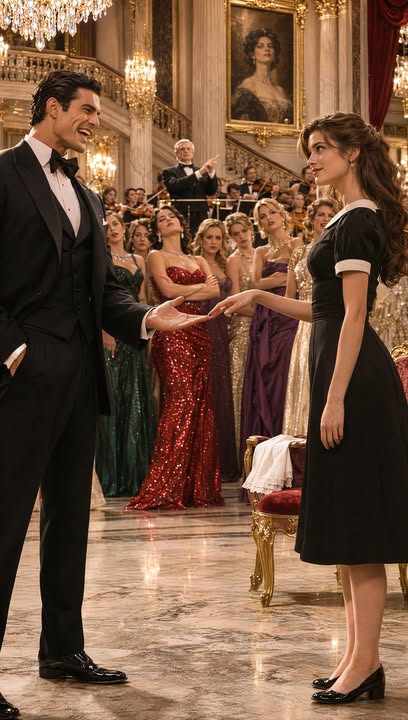
Olivia looked directly into Alexander’s eyes, and for a moment the ballroom seemed to hold its breath with her.
Then she eased her hand from his.
“I didn’t see your plans, sir,” she said.
Alexander’s gaze remained fixed on her face, searching for a crack in her composure.
“Then tell me how you knew where to step.”
A hundred guests were listening.
Olivia glanced at the ring of shining faces around them, at the heiresses who had failed, and at the musicians standing silent beside their instruments.
“I would rather explain somewhere quieter.”
The request was simple, but it changed the room.
Alexander’s expression tightened, not with anger, but with the effort of containing a dozen questions.
“Everyone, enjoy the rest of the evening,” he said at last.
His voice had regained its usual command, yet the unease beneath it was unmistakable.
The guests began talking again, though their attention stayed trained on Olivia and Alexander as the two of them crossed the ballroom.
A few of the heiresses watched Olivia with open resentment.
One, a graceful red-haired woman in a silver gown, seemed more curious than offended.
“You were remarkable,” she said as Olivia passed.
“Thank you,” Olivia answered quietly.
Alexander led her through a tall doorway into a small music room lined with dark wood and framed photographs.
He closed the door, and the muffled noise of the gala faded to a distant murmur.
For the first time since the dance began, Olivia let out a slow breath.
Alexander noticed.
“You were nervous.”
“Of course I was.”
“You didn’t look nervous.”
“I was trying not to let the guests decide what I felt before I did.”
The answer caught him off guard.
He moved to the sideboard and poured two glasses of water instead of champagne.
The small courtesy seemed to surprise Olivia more than the questions had.
“Sit, if you like,” he said.
She remained standing.
“I’ll stand.”
Alexander set one glass down on a table between them.
“Very well.”
He rested both hands against the edge of the sideboard, his posture controlled, his face unreadable.
“Who taught you the movement pattern?”
“My mother.”
A pause followed, brief but heavy.
“Your mother?”
“Her name was Elena.”
Alexander’s eyes narrowed slightly.
“Was she a dancer?”
“No, sir.”
“An architect?”
“Not exactly.”
Olivia looked down at the water glass, then back at him.
“She worked as an architectural draftsman for the company that built this mansion.”
For the first time, Alexander’s composure slipped in a way Olivia could plainly see.
He straightened.
“When?”
“Long before I started working here.”
“Did she work on this house?”
“She said she did.”
“That isn’t an answer.”
“It’s the only one I can give you without pretending to know more than I do.”
His gaze sharpened at her honesty, though it did not soften.
“What did she tell you about the floor?”
Olivia drew a careful breath.
“When I was a child, she used to show me sketches. Not the finished plans, just little exercises she made for me. She’d draw a room, then ask me how someone might cross it without stepping on a certain pattern.”
“You learned to read the lines.”
“I learned to notice what they were doing.”
She spoke slowly, choosing each word with care.
“Most people look at the gold boundaries as separate squares. My mother taught me to look at the spaces between them, and at the way one space leads to the next.”
Alexander glanced toward the closed door, beyond which lay the ballroom and its impossible floor.
“That doesn’t explain how you anticipated my turns.”
“Your steps gave me information.”
“My steps?”
“You were leading me, but you kept returning to the same angles. Each time you changed direction, your weight shifted a moment before your hand did.”
He studied her as if she had just described a language he had never known he was speaking.
“You noticed all that while dancing?”
“I’ve had a lot of practice noticing small things.”
A hint of sadness passed across her expression.
It was gone almost immediately, but Alexander had seen it.
He reached for his water and took a sip.
“You said you never saw my plans.”
“I didn’t.”
“Not in your mother’s papers?”
“No.”
“Not in a sketchbook?”
Olivia hesitated.
The hesitation was slight, but it was enough.
Alexander’s attention sharpened.
“My mother kept a sketchbook,” she said. “It was old and worn by the time I was grown. I saw drawings of rooms, stairs, and windows. I never saw anything that looked like a private plan of this house.”
“Where is it now?”
“At my apartment.”
“May I see it?”
“No.”
The answer came faster than either of them expected.
Olivia’s chin lifted, as if bracing for the displeasure she was used to receiving from people with power.
Alexander’s face remained still.
“Why not?”
“Because it belonged to her.”
“I’m not asking to take it.”
“You asked to see it. I don’t know what that would mean.”
For a moment, neither spoke.
Alexander could have reminded her that she worked for him, that the house and its secrets were his responsibility.
Instead, he drew his hands away from the sideboard.
“You’re right,” he said. “You don’t know what it would mean.”
Olivia blinked, surprised.
“I won’t ask again tonight.”
The words seemed to leave both of them uncertain of what came next.
Alexander looked toward a portrait on the far wall, an older photograph of his father beside a younger version of himself.
“I’ve spent years assuming every mystery in this house was put here for me to solve,” he said. “I suppose I forget that other people have histories of their own.”
The admission sounded unfamiliar in his mouth.
Olivia studied him with a caution that had not been there before.
“You may have a history with my mother’s work,” she said. “That doesn’t mean you have a right to everything she left behind.”
“No,” he replied. “It doesn’t.”
Outside the music room, laughter rose and faded.
Neither of them made a move to return.
Alexander walked to the photograph and stopped beneath it.
“My father had the mansion built,” he said. “He was particular about every room. He used to say a house should reveal its character slowly.”
“Did he say why he wanted the glass floor?”
“He said he wanted something no one could mistake for ordinary.”
“Did he ever tell you who designed it?”
“He told me the floor was mine to finish.”
Alexander turned back to her.
“I was young enough to believe that meant the original design was his.”
“Was it?”
“I don’t know.”
The answer seemed to frustrate him more than the questions.
Olivia leaned slightly toward the glass in her hand, though she did not pick it up.
“When I was younger, my mother told me there was a mark beneath the floor.”
Alexander went still.
“What kind of mark?”
“A small brass one. Not part of the gold lines. She said it was hidden under the glass near the western edge.”
“You’re sure?”
“She described it more than once.”
“What did it look like?”
“A narrow crescent with a short line crossing through it.”
The color shifted in Alexander’s face.
He moved away from the photograph and crossed to a desk near the window.
“What?” Olivia asked.
“I’ve seen something like that.”
He opened a drawer and removed a small flashlight.
Then he stopped, as if remembering that the mansion was his but the conversation was not.
“Would you show me where she said it was?”
Olivia looked from the flashlight to his face.
“You’re asking me to go back into the ballroom?”
“I’m asking you to tell me whether the mark is there.”
She considered him for a moment.
“Not while everyone is watching.”
“I can clear the room.”
“No,” she said. “You don’t need to send people away for my sake.”
“It wouldn’t be for your sake.”
“That’s not how it would look.”
A trace of warmth entered Alexander’s expression.
“You think carefully about how things look.”
“I’ve learned that the way something looks can become more important than what actually happened.”
The words lingered between them.
Alexander did not ask what she meant.
He only nodded.
“Then we’ll wait until the guests have left.”
The gala continued for another hour.
Alexander returned to the ballroom alone and behaved as though nothing unusual had occurred.
He spoke with donors, congratulated the musicians, and accepted the red-haired heiress’s gracious remark that she had never expected the challenge to end with a maid outperforming everyone.
Olivia went back to her duties.
She cleared glasses, collected folded napkins, and answered questions from staff who had heard about the dance.
Some congratulated her.
Others asked whether Alexander had promised to marry her.
“He was making a spectacle,” Olivia said. “It wasn’t a real promise.”
The explanation sounded reasonable, but it did not quiet the questions.
Near midnight, the last guests began to leave.
The orchestra packed away its instruments, and the ballroom emptied until only a few members of the household staff remained.
Alexander waited until the doors were closed before approaching Olivia.
“Are you ready?”
She glanced at the immense glass floor.
Under the dimmed chandeliers, it seemed less like a stage and more like a frozen lake, its golden lines catching faint threads of light.
“I’m ready.”
They crossed to the western edge.
Alexander knelt and directed the flashlight along the narrow border where glass met dark stone.
“There,” Olivia said.
The beam passed over a panel, then returned.
Beneath the glass, barely visible through a fine haze of reflected light, was a small brass shape.
A crescent crossed by a short line.
Alexander crouched lower.
“I’ve walked over this for years.”
“You weren’t looking for it.”
“Neither were most people.”
He inspected the area without touching the glass.
“Does this mark mean something to you?”
“My mother used it to identify her own work.”
Alexander raised his eyes to hers.
“You’re certain?”
“She told me she had a mark she could place on a drawing without a client noticing. It wasn’t a signature. It was more like a reminder to herself.”
“Why would it be under this floor?”
“I don’t know.”
“Could she have put it there?”
“She died before I ever started working here.”
Alexander glanced across the empty ballroom, his expression troubled.
“When did she die?”
“Six years ago.”
“I’m sorry.”
“Thank you.”
The words were quiet, but he said them without the practiced polish of a host offering condolences.
Olivia looked down at the brass mark again.
“I don’t think she expected anyone else to see it.”
“Why hide it?”
“Perhaps she didn’t want it to be seen.”
“Or perhaps she wanted someone to find it.”
Olivia considered that, then shook her head.
“My mother wasn’t fond of leaving riddles.”
“People sometimes leave them without meaning to.”
“You sound as though you know that.”
“I know what it is to live in a house full of unanswered questions.”
The honesty in his voice made her look at him.
For all his influence, Alexander seemed suddenly less like the man who had commanded a ballroom and more like someone standing before a locked door.
“What questions?” she asked.
He looked down at the floor.
“Why my father kept certain things from me. Why some people who worked for him vanished from the records. Why he left me a house that feels as though it remembers more than he did.”
“You think the floor remembers?”
“I think people put meaning into things and then pretend they didn’t.”
Olivia’s gaze softened.
“My mother did that, too.”
“Put meaning into things?”
“Sometimes she’d finish a drawing, fold it away, and tell me it was only work. But she would keep looking at it after she said that.”
Alexander held the flashlight still.
“Did she ever mention my family?”
“She mentioned the Moretti name.”
The beam shifted slightly.
“What did she say?”
“Not much.”
“What did she say?”
Olivia did not answer immediately.
She had spent years trying to fit her mother’s few words into a story that made sense.
“He asked her to make something beautiful,” she said at last. “That was what she told me.”
“Who asked her?”
“I assumed you knew.”
“I don’t.”
“She never gave me a name.”
Alexander’s jaw tightened, though his voice remained calm.
“Did she say anything else?”
“That a design could outlive the person who made it.”
He looked again at the brass mark.
“And did she say why she stopped working for the company?”
“No.”
“Did she leave because she wanted to?”
“I don’t know.”
The answer carried more than uncertainty.
Alexander stood, turning the flashlight off.
“I won’t ask you to decide what your mother meant tonight.”
“Thank you.”
“But I need to understand why her mark is beneath my floor.”
“I know.”
“Will you help me?”
Olivia’s first instinct was to say no.
She remembered her mother at the kitchen table, sketchbook open beneath a small lamp, one hand resting over the page whenever someone came near.
She remembered how Elena had folded the drawings away whenever Olivia asked what they were for.
And she remembered the few times her mother had woken from a dream and sat silently beside the window until morning.
Olivia had never learned what she feared.
“Not because you’re my employer,” she said.
“I wouldn’t ask you to.”
“And not because you think I owe you an explanation.”
“I don’t.”
“Then I’ll help you find out what the mark means.”
Alexander’s shoulders eased, almost imperceptibly.
“Thank you.”
“Don’t thank me yet.”
“I wasn’t.”
For the first time that evening, Olivia smiled.
It was small, but it reached her eyes.
Alexander seemed surprised by the sight of it.
He looked away first.
They returned to the ballroom doors together.
At the threshold, Olivia paused.
“Mr. Moretti?”
“Yes?”
“About your challenge.”
His expression shifted.
“You don’t have to worry. I won’t claim you promised anything.”
“I didn’t think you would.”
“I shouldn’t have made the offer that way.”
Olivia studied him.
“Why did you?”
The question was not sharp, but it left him nowhere to hide.
Alexander looked back at the empty glass floor.
“I thought it would be entertaining.”
“And now?”
“Now I think I used a room full of people to avoid saying what I actually wanted.”
“What did you actually want?”
He seemed to consider answering.
Then he chose not to.
“I don’t know yet.”
Olivia nodded as if she respected the uncertainty more than a polished confession.
“Then you should find out before asking anyone to change her life.”
She stepped into the corridor.
Alexander remained by the door, watching her go.
For the next several days, he did not mention the dance or the mark.
Olivia continued her work in the mansion, and he returned to the measured routine that kept his life orderly.
Yet when they crossed paths, he no longer looked through her as if she were part of the house.
Sometimes he asked how her day had gone.
Sometimes she asked whether he had learned anything about the floor.
His answers were always brief.
“No.”
“Not yet.”
“I’m still looking.”
One afternoon, he found her in the small conservatory, replacing a cracked pot on a shelf of herbs.
He held out a cup of tea.
“I thought you might take a break.”
Olivia looked at the cup, then at him.
“Is this a reward for solving your mystery?”
“It’s tea.”
“Those aren’t always the same thing in this house.”
His mouth twitched with the beginning of a smile.
“I’ll try to keep the terms clear.”
She accepted the cup.
For a little while, they sat on opposite sides of a narrow table while rain traced the glass roof overhead.
Alexander told her that his mother had died when he was young, and that his father had raised him through tutors, schedules, and expectations.
“He taught you how to run a business,” Olivia said.
“He taught me how to look as if I knew what I was doing.”
“And did you?”
“Usually.”
She smiled into her tea.
He asked about Elena, and Olivia told him how her mother could draw a staircase after seeing it once, how she saved bits of ribbon and paper because she believed beautiful things should not be wasted.
“She sounds as if she noticed everything,” he said.
“She did.”
“Is that where you learned?”
“Some of it.”
“What did she notice about you?”
Olivia took a moment to think.
“She used to say I became quiet when I was afraid someone might misunderstand me.”
“And was she right?”
“Yes.”
“What are you afraid I’ll misunderstand?”
“That I’m trying to take something from you.”
Alexander’s brow furrowed.
“I don’t think that.”
“Not now.”
“Did you think I would?”
“I didn’t know you well enough to think anything.”
He accepted the answer without taking offense.
Then he said, “I’ve spent a long time assuming people approach me with an intention.”
“Because of your position?”
“Because of what my name can offer them.”
“Or because of what it can take away?”
The question settled between them.
Alexander’s fingers closed around his teacup.
“Both.”
Olivia looked at him with quiet sympathy, but she did not try to comfort him with easy words.
“That must be lonely.”
“It’s efficient.”
“That isn’t the same thing.”
“No,” he said. “It isn’t.”
When the rain stopped, Olivia returned to her duties, and Alexander went back to his study.
That evening, she found a note outside the staff corridor.
It was written in a firm, precise hand.
I found an old inventory ledger in the east archive.
Your mother’s name appears in it.
Would you come down when you’ve finished work?
—A. Moretti
Olivia read the note twice.
The mention of Elena’s name stirred unease in her, though she could not have said why.
She found Alexander in the archive, surrounded by shelves of bound records and boxes marked with faded dates.
He stood beside a wide table with an open ledger before him.
“I haven’t found an explanation,” he said. “Only a record.”
Olivia approached.
The page was yellowed and brittle at the edges.
Several names had been written in a careful hand beside dates and brief descriptions of work.
Her mother’s name appeared halfway down the page.
Elena Varga.
Olivia’s throat tightened.
Below the name, someone had written a short note in dark ink.
Dismissed following suspected removal of confidential design documents.
She stared at the words until the room seemed to grow very still.
“My mother never told me this.”
“I’m sorry,” Alexander said.
“Did she steal something?”
“I don’t know.”
“Did your family accuse her?”
“The ledger says suspected. It doesn’t say what happened afterward.”
“That’s not the same as clearing her.”
“No,” he said. “It isn’t.”
Olivia looked at him, searching his face for a defense of the family name.
He gave her none.
“Could this be a mistake?”
“It could.”
“Could someone have written it to make her look guilty?”
“It could.”
“Do you believe she stole those documents?”
Alexander met her eyes.
“I don’t know your mother. But I know an old accusation isn’t proof.”
Olivia drew a careful breath.
It was the first answer that let her breathe.
She lowered her gaze to the ledger again.
Beside Elena’s name was a faint pencil notation, nearly erased by time.
A small crescent crossed by a short line.
The same mark hidden beneath the glass floor.
Olivia looked up.
“Alexander,” she whispered. “Why would the company put her mark beside an accusation?”
Before he could answer, a voice came from the archive doorway.
“Because Elena Varga didn’t just leave behind a mark,” Victor said. “She left behind a scandal.”
**–END OF PART 2–CLICK “NEXT” AT THE BOTTOM OF THE PAGE TO CONTINUE READING**
* * *
[NEXT: PART 3](https://storyly.idolsgift.com/blog/part-3-the-mark-beneath-the-glass-069)
✓ Lynn R. Adams
Part 2 – The Mark Beneath the Glass Olivia looked directly into Alexander’s eyes, and for a moment the ballroom seemed to hold its breath with her. Then she eased her hand from his. “I didn’t see y…