PART 2: The Mark Beneath the Crown 057
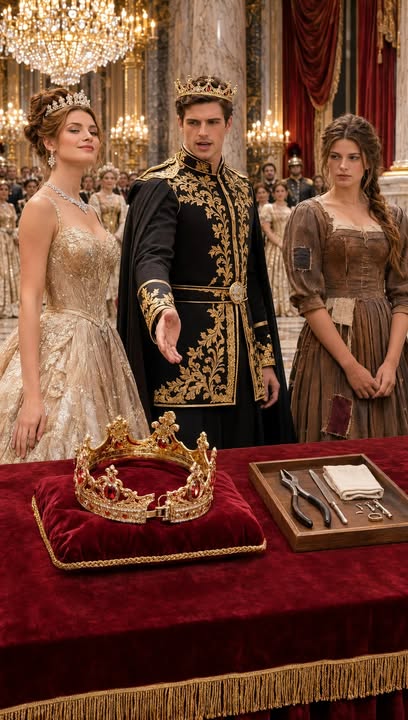
The file’s narrow tip touched the hidden hinge, and Elara held her breath.
She did not press.
Instead, she angled the tool until its edge rested against the tiny pin, then eased it inward by the smallest measure.
A faint click sounded beneath the crown’s golden band.
Around the ballroom, the gathered nobles leaned closer, but Elara barely heard them.
She was watching the pin.
It had shifted, though not enough to settle into its channel.
“Stop,” Adrian said, his voice quiet but clear.
Elara withdrew the file at once and lifted her eyes to him.
The prince stepped nearer, studying the hinge from above without touching it.
“Tell me what you see.”
“The pin is crooked,” Elara answered. “The clasp may have been bent because the hinge could not turn properly.”
She glanced at the broken fragment on the velvet.
“If I force the clasp closed now, the pin could slip farther out—or the remaining metal could break.”
Celestine’s folded arms loosened.
“Then what do you intend to do?” she asked, no longer laughing.
“I would like to guide the pin back into its channel,” Elara said. “But I cannot make the clasp safe to close without a fastener that matches the missing piece.”
The word cannot seemed to travel farther through the room than the earlier crack.
Adrian looked at the crown, then at the tiny piece Celestine had broken.
“You are saying you cannot restore it within the challenge.”
“I am saying I should not pretend I can,” Elara replied.
For a moment, there was only the soft flutter of a curtain stirring near the high windows.
Then Adrian nodded.
“Proceed with the pin, and nothing more.”
Elara bent over the crown again.
This time she used the file like a lever, applying no more force than she might have used to lift a loose thread from cloth.
The pin moved by a hair’s breadth.
She paused, changed the angle, and tried once more.
A second faint click followed.
The pin slid into the channel.
Elara set down the file and examined the hinge without touching it.
“It is resting where it should,” she said. “But the clasp must remain open until the missing fastener is replaced.”
Adrian lowered the crown carefully onto its cushion.
“You have not repaired it,” he said.
“No, Your Highness.”
“But you have prevented it from becoming worse.”
Elara’s fingers curled against her palms, still remembering the fragile resistance of the metal.
“That seemed the most important thing I could do.”
One of the older courtiers murmured that the challenge had been to restore the fastening mechanism, not merely to inspect it.
Adrian turned toward the room.
“The challenge was to demonstrate patience and judgment,” he said. “Miss Elara has shown both.”
The words were measured, neither a declaration of victory nor a rebuke to anyone.
Even so, they changed the air between them.
Celestine looked down at the broken fragment lying on the velvet.
“I should have stopped when the metal resisted,” she said.
Her voice had lost its earlier brightness, but it had not become a performance.
Adrian met her gaze.
“Yes,” he said. “You should have.”
She accepted the answer with a small, stiff nod.
Elara began putting the tools back in order.
She wiped the file with the soft cloth and returned it to the wooden tray, careful to place it where she had found it.
The cloth had been folded around the tools when she picked them up.
As she turned it over, its corner slipped free.
A tiny woven mark showed in the faded linen: three small crossing stitches shaped like a sprig of leaves.
Elara’s hand stopped.
The room continued around her, full of murmured conversation and the rustle of silk, but the mark seemed to draw the sound away.
She traced the stitched leaves with one finger.
She had seen them before.
Not on this cloth.
In the west wing, in the quiet room that had once belonged to Adrian’s grandmother.
Elara lowered her hand.
The prince had noticed her stillness.
“Is something wrong?”
“No, Your Highness,” she said, folding the cloth over the mark again. “It is only a familiar stitch.”
“Familiar from where?”
The question was gentle, but Elara felt every nearby ear turn toward them.
“From home.”
A brief silence followed.
Adrian looked from her face to the cloth.
“May I see it?”
Elara hesitated.
The linen was ordinary, worn soft at the edges, and scarcely worth notice to anyone else.
Yet she had kept it for years, not because it was fine, but because it had belonged to her mother.
She unfolded the corner and held it out.
Adrian did not take it immediately.
He leaned close enough to see the stitched sprig, then carefully lifted the cloth by its edge.
The color left his expression.
“Where did you get this?”
“My mother made it.”
Adrian turned the cloth slightly, examining the tiny leaves.
“I have seen this mark before.”
Elara searched his face.
“Where?”
“In a box of my grandmother’s things,” he said. “There was a mending cloth in it, marked exactly the same way.”
The crowd’s attention gathered around them again, quieter now.
Celestine stood beside the table, her eyes fixed not on Elara but on the linen.
Adrian passed the cloth back.
“Did your mother ever work in the palace?”
Elara held the cloth as if it had suddenly become more precious.
“She did, Your Highness. Many years ago, before I was old enough to remember much of it.”
“What was her name?”
“Mara.”
Adrian repeated it under his breath, as though testing the sound against a memory.
Elara wondered why the question had unsettled him, but the prince looked as if he, too, were searching for something he could not quite name.
“She taught me to mend,” Elara continued. “Not only cloth. She said the first thing to learn was where not to pull.”
A faint, unexpected smile touched Adrian’s mouth.
“That is sound advice for more than sewing.”
“It was sound advice for nearly everything she did.”
The words escaped Elara before she could soften them.
For an instant, she forgot the ballroom, the crown, and the nobles listening nearby.
She remembered a small kitchen warmed by an iron stove, her mother’s hands guiding a needle through a torn cuff, and the quiet patience with which Mara had shown her how to make a repair almost invisible.
Her mother had never spoken of the palace as a place of grandeur.
She spoke of it as a place where garments wore thin, hinges loosened, and people sometimes needed someone to notice.
Adrian returned his attention to the crown.
“Your mother’s stitch,” he said. “Was she a seamstress?”
“She was good with her hands. She repaired clothes, gloves, curtains—whatever people brought her.”
“And objects?”
“Sometimes,” Elara answered. “She would say that many things only looked beyond repair because no one had taken the time to understand how they were made.”
Adrian’s gaze rested on the open clasp.
“That sounds familiar.”
Elara wondered whether he meant the crown or something else.
A chamberlain approached, reminding the prince that the guests were waiting for him to conclude the demonstration.
Adrian straightened.
“The crown will remain open until the correct fastener is found,” he announced. “No further attempt will be made tonight.”
It was a practical decision, but Elara heard the relief in his voice.
The risk had not been removed, only contained.
The ceremony’s guests began to drift into small clusters again.
Some spoke of Celestine’s mistake, though in lower voices than before.
Others asked how Elara had recognized the crooked pin.
She answered briefly, explaining what she had observed and nothing more.
It felt important not to turn uncertainty into a claim.
Celestine remained near the table.
When the other guests had moved away, she looked at Elara with an expression Elara could not easily read.
“You might have said you could fix it,” Celestine said.
“I might have.”
“Most people would have.”
Elara folded the cloth once, then again.
“I would rather be thought unskilled than leave the crown worse than I found it.”
Celestine’s gaze shifted to the broken fragment.
“I thought I understood the task,” she said. “The crown was damaged, and I believed confidence would be enough to mend it.”
“It is difficult to know when to stop,” Elara said.
Celestine gave a short, humorless laugh.
“Especially when everyone expects you to succeed.”
For a heartbeat, the two women stood without speaking.
Elara had expected another cutting remark.
Instead, she saw in Celestine’s face something more complicated than pride: embarrassment, perhaps, and the effort to keep it from showing.
“I am sorry for laughing at you,” Celestine said at last.
Elara was too surprised to answer immediately.
Celestine seemed to regret the apology as soon as it was offered, but she did not withdraw it.
“Thank you,” Elara said.
The reply was simple, and it left little room for either triumph or resentment.
Adrian approached them, carrying the crown’s cushion.
“Miss Elara, the household needs someone to help record what happened to the clasp and prepare a description for the goldsmith.”
He paused, as if weighing the request.
“Would you be willing to assist?”
Elara glanced toward the chamberlain, who looked uncertain about a maid being invited into a task usually reserved for palace staff of higher rank.
“If my duties allow it, Your Highness.”
“I will see that they do.”
Celestine watched the exchange.
Her mouth tightened, not quite in anger, though the sight of Adrian’s interest clearly troubled her.
Elara noticed and felt a flicker of discomfort.
She had not asked to be noticed.
She had only asked to help.
“I must return to the servants’ corridor,” she said. “The supper trays are due to be cleared.”
“Of course,” Adrian replied.
He made no attempt to detain her.
That, more than the invitation, eased her unease.
Elara bowed and left the ballroom, carrying the folded cloth in her apron pocket.
Behind her, she heard the nobles return to their conversations, though the crown’s damaged clasp remained at the center of them.
The servants’ passage was cooler than the ballroom.
The smells of wax and roses gave way to the familiar scent of soap, polished wood, and warm bread from the kitchens.
Elara moved quickly, collecting the trays she had been assigned to clear.
Her mind, however, stayed with the mark on the cloth.
Three little leaves.
Her mother had stitched it into everything she wanted to keep track of: a workbag, an apron, a small square of linen that had once wrapped the letters Mara treasured.
Elara had asked about the mark when she was young.
Her mother had told her it meant only that the work was hers.
A maker’s signature, she had called it, though she had never spoken as if the world needed to know.
At the kitchen door, Elara nearly collided with Mrs. Vale, the head housekeeper.
The older woman steadied the tray before the cups could rattle.
“You look as if you have carried the crown here in your thoughts,” she said.
“I have only been thinking about the hinge.”
“That is still more attention than most people give a hinge.”
Mrs. Vale’s smile softened as she glanced at the pocket where the cloth rested.
“Was that Mara’s stitching?”
Elara looked up.
“You remember it?”
“I remember her hands,” Mrs. Vale said. “Your mother mended a torn sleeve for me once, and I wore it for years afterward.”
Elara felt a small warmth spread through her chest.
“She rarely spoke about her time here.”
“Some people leave quietly,” Mrs. Vale replied. “It does not mean they were forgotten by everyone.”
The words followed Elara as she finished her duties.
Later, when the servants’ corridor had settled and the last of the dishes had been carried away, she was summoned to the small office adjoining the royal library.
Adrian stood by a desk, the crown resting on a nearby table beneath a protective cloth.
A lamp burned beside him, warming the dark wood and the pale pages spread before him.
The room was private, but the door remained open.
The chamberlain waited just outside, a discreet reminder that Elara had been called for work, not summoned into secrecy.
“I hope I am not keeping you from your duties,” Adrian said.
“Mrs. Vale has given me time, Your Highness.”
He indicated a chair beside the desk.
Elara remained standing.
“The goldsmith will come tomorrow,” Adrian explained. “I would like the condition of the clasp written down before anyone tries to repair it.”
“I can describe what I saw.”
“That would be helpful.”
He placed a clean sheet before her and offered a pen.
Elara wrote slowly, choosing each word with care.
She described the crooked pin, the movement that had returned it to its channel, and the broken fragment that had fallen onto the velvet.
She wrote that the clasp should remain open until a matching fastener was found.
When she finished, Adrian read the page.
“You have been precise.”
“My mother taught me that small details matter most when someone else will have to continue the work.”
Adrian’s attention lifted from the paper.
“Your mother sounds as though she knew how to teach.”
“She did.”
There was affection in Elara’s answer, but it carried a quiet ache too.
She had been gone five years, and even now Elara sometimes found herself turning to share a small discovery, only to remember that the kitchen would not answer.
Adrian noticed the shift in her expression and did not press her to explain it.
Instead, he drew a narrow wooden box from a shelf beside the desk.
It was an old box, darkened at the corners by time.
“My grandmother kept a collection of sewing things,” he said. “I found it after she died, among her papers.”
He opened the lid.
Inside lay several worn needles, a spool of pale thread, a thimble, and a square of mending cloth.
Elara’s breath caught.
The cloth bore the same small woven sprig.
It was not merely similar.
The three crossing leaves were placed in the same corner, with one green thread slightly darker than the others.
“That is my mother’s mark,” Elara whispered.
Adrian watched her carefully.
“Do you recognize the cloth?”
“I recognize how she made it.”
Elara leaned closer without touching.
Along one edge, the hem had been turned twice and secured with tiny, even stitches.
Her mother had always done that when she wanted a piece of cloth to last.
“She made this,” Elara said. “I know the way she closes a hem.”
Adrian’s face changed, not with certainty but with a kind of startled wonder.
“Then she may have worked for my grandmother.”
“She did,” Elara replied. “She told me once that she had been asked to repair clothes in the royal household.”
He looked down at the cloth in the box.
“Did she ever mention repairing anything else?”
Elara hesitated.
She had not expected the question, and something in Adrian’s careful tone warned her that the answer might matter.
“She never told me she worked on the crown,” she said. “If that is what you mean.”
“I do not know what I mean yet.”
He sat back, his eyes still on the old mending cloth.
For a moment, the prince seemed less like the heir to a kingdom than a grandson standing before the last small trace of someone he had loved.
“My grandmother kept everything that meant something to her,” he said. “She kept this cloth, but I never knew why.”
Elara looked at the careful stitches.
“Perhaps it reminded her of the person who made it.”
“Perhaps.”
The answer seemed to open a door neither of them had expected to find.
Elara thought of her mother’s workbasket, the careful way she sorted scraps by color, and the stories she had told only when she believed no one was asking for more than she wished to give.
There had been one story about a note.
Mara had kept it folded in a small tin with the needles, not because it was valuable, but because she said gratitude should not be thrown away.
Elara remembered the words her mother had read aloud once, on an evening when rain tapped the window.
You saved what others thought beyond repair.
Elara had always assumed the note referred to a coat or a household treasure.
Now, looking at the mending cloth from the prince’s grandmother, she wondered.
“Your Highness,” she said, “my mother kept a note from someone in the palace.”
Adrian’s attention sharpened.
“What did it say?”
“I only remember one line. She read it to me years ago.” Elara searched her memory, hearing her mother’s voice as clearly as if she stood beside her. “It said, ‘You saved what others thought beyond repair.’”
Adrian did not move.
The lamplight caught the old cloth between them, illuminating the tiny stitched leaves.
Then he reached into the wooden box and unfolded the paper that had been tucked beneath it.
At the bottom of the page, in the same hand as the line Elara remembered, was her mother’s name.
**–END OF PART 2–CLICK “NEXT” AT THE BOTTOM OF THE PAGE TO CONTINUE READING**
* * *
[NEXT: PART 3](https://storyly.idolsgift.com/blog/part-3-the-mark-beneath-the-crown-057)
✓ Lynn R. Adams
The file’s narrow tip touched the hidden hinge, and Elara held her breath. She did not press. Instead, she angled the tool until its edge rested against the tiny pin, then eased it inward by the sma…