PART 2: The Mark Beneath the Chair 057
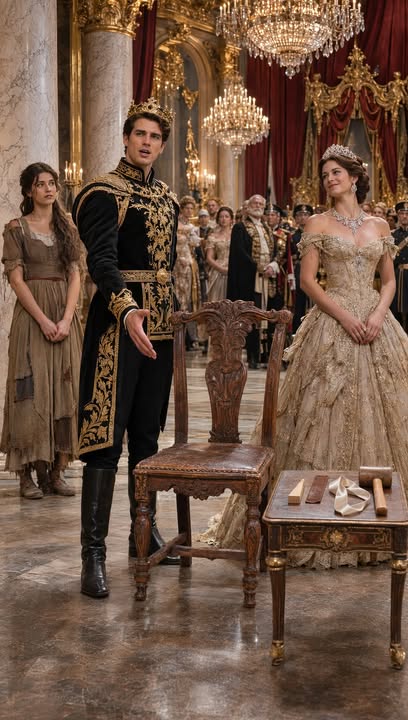
Mara slid the wooden wedge toward the narrow gap beneath the chair’s rear frame, careful not to touch the loose-looking joint.
“Not under the support?” the prince asked.
“Not yet, Your Highness,” she replied, keeping her eyes on the chair. “If I brace the joint before I know why it moves, I might only hide the real problem.”
Lady Eveline folded her arms, though her fingers curled tightly against the gold embroidery at her sleeves.
The ballroom had grown so quiet that Mara could hear the small scrape of the wedge against the marble.
She set it beneath the rear frame, then rose and stepped away.
“Your Highness, would you press the seat once more?”
The prince glanced at Eveline, then at Mara.
“Are you certain?”
“No, Your Highness,” Mara said honestly. “But I think we will learn more by trying.”
A murmur passed through the gathered nobles.
The prince placed one hand on the seat and pressed down.
The chair rocked.
Mara watched the feet, not the seat, following each slight movement with her gaze.
When the prince lifted his hand, she adjusted the wedge by no more than the width of a fingernail.
“Again, please.”
He pressed once more.
This time, the chair held steady.
A few people drew in breath, then released it in soft, astonished whispers.
Mara did not smile.
She crouched beside the rear leg, studying the thin wedge now visible beneath the frame.
“The chair is sound,” she said. “At least, its legs and supports are. One leg is simply too short for this spot.”
Lady Eveline’s chin lifted.
“That cannot be right. The floor is marble.”
“Marble can still dip,” Mara answered gently. “The floor slopes just a little here.”
She pointed to the faint scrape beneath the rear leg.
“This mark shows where the chair has been rocking. The leg kept sliding across the low place, so it seemed as if the support were loose.”
The prince leaned closer.
“And the joint?”
“It is loose, Your Highness,” Mara said. “Lady Eveline was not wrong to notice it. But it is not what makes the chair rock.”
Eveline’s face had gone pale beneath the warm light of the chandeliers.
For a moment, she seemed ready to answer sharply.
Then she looked down at the silk ribbon still wrapped around the polished support.
Her hands fell to her sides.
“I mistook the first thing I noticed for the cause,” she said.
Her voice was quiet, but it carried across the still room.
Mara met her eyes.
“It was an easy mistake to make. The joint did need attention.”
The prince tested the seat again, pressing harder this time.
The chair remained steady.
He released it and studied the wedge.
“Simple,” he said, “but not careless.”
Mara lowered her gaze.
“I only looked at what was moving, Your Highness.”
A different sort of silence followed, one that held less surprise and more consideration.
The prince turned toward the assembled guests.
“This was the challenge,” he said. “Not to make the chair look repaired, but to understand what it needed.”
The words were measured, not triumphant.
Still, several people glanced toward Eveline.
She saw them.
Her shoulders stiffened, and the color rose in her cheeks.
The prince noticed, and his voice softened.
“Lady Eveline, you were the first to recognize that something was wrong with the support. That observation mattered.”
Eveline’s expression flickered, though she did not look up.
“And the maid found the reason the whole chair moved,” he continued. “Both things are true.”
Mara looked at the floor, wishing the room would stop turning her into the center of it.
The prince had asked her to try.
She had tried.
That should have been enough.
But the guests had begun to whisper again, and this time their glances lingered on her patched dress, her worn shoes, and the hands she had worked hard to keep clean.
Eveline’s gaze followed theirs.
For the briefest moment, Mara saw not anger in her face, but something closer to embarrassment.
The prince addressed Mara.
“What is your name?”
“Mara, Your Highness.”
“And you have experience with furniture?”
“A little, Your Highness.”
“That is a modest answer.”
“It is the truthful one.”
A smile touched the prince’s mouth.
“Then I will ask a truthful question. How did you know to look beneath all four legs?”
Mara hesitated.
She could feel the room waiting for a clever answer.
Instead, she glanced at the scrape on the marble.
“Because of the mark,” she said. “It was older than the ribbon, and it began under the foot. I thought the chair might be following a path rather than breaking.”
The prince looked down at the scrape again.
“You saw what everyone else passed over.”
“I was looking for it, Your Highness.”
That earned a low, thoughtful laugh from him.
Eveline bent to remove the silk ribbon.
The knot resisted her fingers, and for a moment she tugged too quickly.
“Allow me,” Mara said.
Eveline looked up, startled.
Then she held the ribbon out.
Mara loosened the knot with a small turn of her thumb and returned it to her.
“Thank you,” Eveline said.
It was not warm, exactly, but it was sincere.
Mara dipped her head.
The prince inspected the loosened support without touching it.
“Can it be repaired properly?”
“Yes, Your Highness. The joint should be tightened, but the floor still needs the wedge beneath this leg if the chair is to stay here.”
“And if it is moved?”
“We should test it again. The floor may be level elsewhere.”
The prince considered this.
“Then we will not declare it fixed until it has been examined in its proper place.”
A few nobles exchanged looks at the unexpected care in his words.
He had begun the competition with a question about a future queen.
Now he was asking about a floor.
“Very well,” he said. “The chair will be moved after the gathering, and the palace carpenter can inspect the support. For today, it is safe.”
His gaze returned to Mara.
“You have my thanks.”
Mara’s throat tightened.
She had not expected a thank-you from a prince.
“Thank you, Your Highness.”
“And my consideration,” he added. “Not as a promise, but as recognition of your judgment.”
The words landed gently, yet they seemed to change the shape of the room.
Mara had never imagined that a royal gathering might turn toward her.
She had certainly never imagined being considered for anything beyond the work assigned to her.
She glanced at Eveline.
The noblewoman had lowered her eyes to the ribbon in her hands.
Mara knew what it meant to be seen as an answer before anyone bothered to ask a question.
She did not want Eveline to be made into a lesson for the room.
“Your Highness,” Mara said, “Lady Eveline did notice the loose support.”
The prince looked at her.
“She saw a real problem,” Mara continued. “She only needed to know that it was not the first one.”
Eveline’s head lifted.
For the first time since the chair had lurched, she looked directly at Mara.
The prince’s expression softened.
“That is fair.”
He turned to the guests.
“The gathering will continue,” he announced. “And I expect the rest of the evening to be kinder than the last few minutes.”
His tone held no threat, only a reminder.
The nobles began to stir, their voices returning in careful waves.
Musicians, who had waited near the curtained alcove, resumed their gentle melody.
The chair remained beside the small table, steady on the wedge.
Mara stepped back toward the servants’ side of the ballroom.
She felt the prince’s attention follow her, but she did not turn around.
The first person to reach her was not Julian, the prince, but an elderly footman who had watched from near the doors.
“You noticed the scrape,” he murmured. “I’ve passed that chair a hundred times and never looked beneath it.”
“I only happened to be standing near enough,” Mara replied.
“Some people are near enough all their lives and still don’t see.”
She did not know how to answer that, so she offered him a small smile and returned to her duties.
For the next hour she carried trays, cleared empty glasses, and kept her eyes lowered whenever the guests turned her way.
Yet the ballroom felt different.
The chair seemed to draw glances whenever someone passed it.
The wedge was small and plain, nearly invisible beneath the dark wood.
Still, it had changed what the room believed it knew.
As the gathering began to thin, Mara was sent to help in the service corridor.
She was stacking cups when a soft voice came from behind her.
“Is that what you always do?”
Mara turned.
Lady Eveline stood at the open doorway, her magnificent gown held slightly above the floor.
Without the crowd around her, she seemed less like a figure from a painted portrait and more like a young woman who had spent the evening holding herself perfectly still.
“What do you mean?” Mara asked.
“You look at what everyone else overlooks.”
Mara set down the cup in her hands.
“I don’t always.”
“You did tonight.”
Eveline’s fingers tightened around the edge of her skirt.
“I was certain I had found the answer.”
“You found part of it.”
“That is a generous way to put it.”
“It is also true.”
Eveline watched Mara for a moment.
Then she glanced toward the ballroom, where the chair could still be seen through the open doors.
“I thought if I appeared certain, people would believe I was capable.”
Mara was surprised by the confession.
“Did your family tell you that?”
“They taught me to be prepared,” Eveline said. “To speak well, to remember names, to make every room feel as if I belonged in it.”
She gave a brief, humorless smile.
“They did not teach me what to do when I was wrong.”
Mara leaned against the worktable.
“My father used to say that being wrong was only dangerous if you stopped looking.”
Eveline’s expression changed.
“Your father taught you about chairs?”
“About chairs, tables, doors, and anything that might fall on someone if it was made badly.”
“Was he a carpenter?”
“He worked in the palace workshops for many years.”
Mara’s voice grew softer.
“He died when I was young.”
“I’m sorry.”
“Thank you.”
Eveline’s gaze moved to Mara’s hands.
“They look like a carpenter’s hands.”
Mara turned them over, noticing the small pale scars and the faint calluses at the base of her fingers.
“They look like a servant’s hands now.”
“Perhaps they can be both.”
The words seemed to surprise Eveline as much as they surprised Mara.
Before Mara could respond, a bell rang from the adjoining passage.
Eveline straightened.
“I should return to my family.”
“Yes.”
She paused at the doorway.
“I am sorry I laughed at you.”
Mara did not want to make the apology harder by pretending it had not mattered.
“It did hurt,” she said.
Eveline’s face colored.
“I know.”
“But I accept your apology.”
Eveline nodded, then left without adding anything more.
Mara watched her go, hearing the hush of her skirts fade into the ballroom.
The rest of the evening passed in a blur of polishing, carrying, and clearing.
By the time Mara was released from duty, the grand rooms had quieted.
The chandeliers still burned, but the light seemed softer without the crowd beneath them.
She walked the narrow service stair toward the small rooms where she and her younger siblings lived.
Her younger brother, Thomas, had left a candle burning in the window.
He was waiting for her at the top of the stairs, trying to look as though he had not been worried.
“You’re late,” he said.
“The gathering ran long.”
“Did anything happen?”
Mara smiled.
“A chair moved.”
Thomas frowned.
“That is not much of a story.”
“It was a very important chair.”
Inside, her younger sister Nell sat beside the small hearth, mending one of the sleeves of Mara’s brown dress.
The candlelight caught the careful stitches in her hands.
Nell looked up.
“You’re smiling.”
“Am I?”
“You usually come home too tired to smile.”
Mara took off her worn shoes and set them by the wall.
“I met the prince.”
Thomas’s eyes widened.
“You spoke to him?”
“He asked me to repair a chair.”
“And you did?”
“I found out it wasn’t broken in the way everyone thought.”
Thomas leaned forward, eager now.
“Tell us.”
Mara described the rocking chair, the loose support, and the scrape beneath its leg.
She told them how she had slid the wedge into place and asked the prince to press the seat again.
She did not tell them that the room had turned its attention to her dress.
She did not mention Eveline’s laugh until Nell asked whether the noblewoman had been kind.
“She wasn’t at first,” Mara said. “But she apologized.”
Nell’s needle paused.
“Did you forgive her?”
“I think so.”
Thomas leaned back against the wall.
“Were you frightened?”
Mara considered the question.
“Not of the chair.”
They all laughed, and the sound eased something inside her.
Then Thomas asked, “How did you know where to put the wedge?”
Mara looked toward the small wooden chest at the foot of her bed.
She had carried the chest with her from one room to another after their father died, never letting anyone use it for firewood or storage.
“I learned by watching Father,” she said.
“He used to let us help in the workshop,” Nell replied.
“He let you help,” Thomas said. “He told me I was more likely to break the tools.”
“You were more likely to throw them,” Mara said.
Thomas grinned.
“He said tools were for work, not for seeing how far they could fly.”
The memory settled among them like a familiar blanket.
Their father had been a quiet man, often smelling of sawdust and oil, with a way of turning any piece of wood in his hands before deciding what to do with it.
He never began by forcing two pieces together.
First he measured, checked the grain, and listened for movement.
“A sound repair begins with careful observation,” Mara said, repeating the words he had taught her.
Nell’s eyes softened.
“I remember.”
Mara went to the chest and opened it.
Inside lay folded cloth, a few keepsakes, and an old measuring gauge made of dark wood.
Its brass edge had dulled with age.
Two small initials had been carved near the end: E. H.
Thomas peered over her shoulder.
“You still have it.”
“I told you I did.”
“You never use it.”
“I use it in my head.”
She lifted the gauge carefully.
It had belonged to their father, and its worn marks were more familiar to her than many faces she saw every day.
Mara ran her thumb over the initials.
Her father had shown her how to read the small divisions along its edge, how to compare angles, and how to know when a piece was only pretending to fit.
“Did he teach you all that in the palace workshop?” Nell asked.
“Some of it. Some at home.”
Mara’s voice grew quiet.
“He said good work should be judged by whether it held, not by who had made it.”
For a while, none of them spoke.
Beyond their little window, the palace corridors were dim and still.
Thomas reached for a piece of bread on the table.
“You might be a royal chair fixer now.”
“I am a maid who fixed one chair.”
“Still sounds important.”
“It was important because someone might have fallen.”
Nell finished the stitch and laid the dress across her lap.
“Do you think Father would have liked that you helped?”
Mara looked down at the gauge.
“I think he would have asked me if I checked the other legs.”
Thomas laughed.
“He would have.”
Mara smiled, but her eyes stung.
She had spent years keeping the gauge tucked away, not because she had forgotten him, but because remembering could be a luxury when each day demanded something practical.
That night, she set it beside her bed instead of returning it to the chest.
In the morning, the palace corridors were already awake.
Mara had barely finished her first tray of cups when a young page found her near the kitchens.
“Miss Mara,” he said, “His Royal Highness asks whether you can come to the ballroom.”
She wiped her hands on her apron.
“Did something happen to the chair?”
“I don’t know. He only said to ask you.”
Mara followed him through the marble passage, her steps measured and her thoughts racing.
The ballroom was empty except for the prince and Lady Eveline.
The chair stood near the center of the room.
A palace carpenter had not yet been called, and the wooden wedge remained beneath the rear frame.
The prince looked up when Mara entered.
“Thank you for coming.”
“Of course, Your Highness.”
He motioned toward the chair.
“I wanted you to show me where you saw the scrape.”
Mara crouched and pointed beneath the rear leg.
“This mark begins here.”
The prince leaned down beside her, taking care not to disturb the chair.
“I can see it now.”
Eveline stood on the other side, holding a small leather-bound book.
“I asked to come,” she said. “If you don’t mind.”
Mara glanced at her.
“I don’t mind.”
Eveline looked toward the chair.
“My family keeps an inventory of furnishings once owned or supplied by my grandfather. I thought it might be useful to check whether this one appears in it.”
The prince’s brow furrowed.
“Why would your family have an inventory of a royal chair?”
“Some furnishings were purchased through his household before they were transferred to the palace,” Eveline replied. “He was involved in supplying several rooms.”
She opened the book and began turning the thin pages.
Mara returned her attention to the chair.
She set the wedge aside and peered beneath the seat, tracing the carved edge with her eyes.
There, close to the inner frame, was a narrow mark in the wood.
It was barely visible beneath a darkened patch, as if a later hand had tried to cover it.
Mara’s breath caught.
“Your Highness,” she said. “There’s something here.”
Julian came closer.
Eveline closed the inventory and stepped around the chair.
“What is it?”
Mara turned her father’s measuring gauge in her palm, though she had not meant to bring it with her that morning.
The initials carved into the old wood seemed suddenly heavier.
She held the gauge near the faint mark beneath the seat.
The shapes were nearly the same.
Eveline leaned in, her expression shifting from curiosity to recognition.
“That mark,” she whispered. “I’ve seen it in my family’s records.”
She opened the book again and searched a page near the back.
“There is an entry for a carved chair delivered to the palace under my family’s name,” she said. “But the maker was never recorded.”
The prince’s gaze moved from the hidden mark to Mara’s gauge.
“Are you saying your father made this chair?”
“I don’t know,” Mara said, though her voice had gone unsteady.
Eveline looked between the book and the mark beneath the seat.
“My grandfather’s inventory only says it was received and passed on,” she said. “Nothing about who built it.”
Julian straightened, his easy confidence giving way to concern.
“I was told this was an ordinary royal purchase.”
The three of them stood around the chair, looking at a mark that someone had tried to conceal.
Mara touched the initials on her father’s gauge.
For the first time, she wondered whether the chair had been waiting all these years to be recognized.
**–END OF PART 2–CLICK “NEXT” AT THE BOTTOM OF THE PAGE TO CONTINUE READING**
* * *
[NEXT: PART 3](https://storyly.idolsgift.com/blog/part-3-the-mark-beneath-the-chair-057)
✓ Lynn R. Adams
Mara slid the wooden wedge toward the narrow gap beneath the chair’s rear frame, careful not to touch the loose-looking joint. “Not under the support?” the prince asked. “Not yet, Your Highness,” sh…