PART 2: The Mark Beneath the Carpet 046
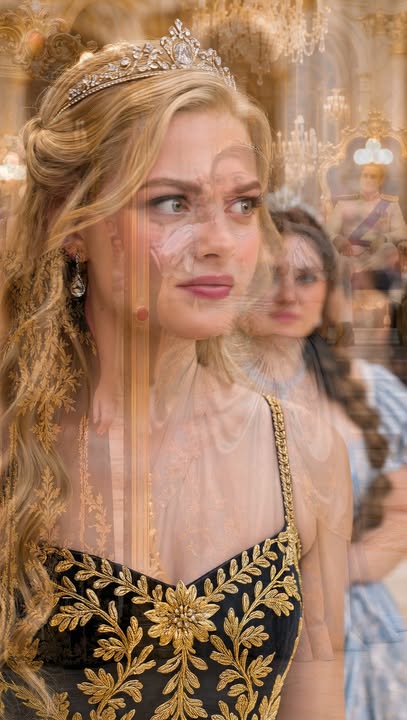
Part 2 – The Mark Beneath the Carpet
The official’s fingers hovered above the brass wheel.
“Stop,” I said.
My voice sounded smaller than I wanted, but it carried across the ballroom.
The man jerked his hand away as if the metal had burned him.
For one suspended moment, nobody moved.
Then Prince Adrian rose from his chair.
“Hold the test,” he ordered.
The official straightened his cuffs, gathering his composure with practiced care.
“Your Highness, I was only checking the mechanism.”
“Checking it for what?” Adrian asked.
The official glanced at the frame.
“To ensure it is properly set.”
“Then why did you wait until Miss Williams was about to step through?”
A murmur passed through the guests, soft as a draft under a door.
Vanessa lowered her folded arms, though her expression remained guarded.
The official’s smile appeared a moment too late.
“The mechanism has not been touched, Your Highness.”
I looked at the wheel.
A pair of bright scratches cut through the dull brass around its edge, fresh enough to catch the chandelier light.
I stepped away from the platform and crouched beside the carpet.
“May I?” I asked.
Adrian nodded.
The carpet was thick and dark red, woven with a pattern of gold leaves that hid more than it revealed.
I brushed my fingertips over the nap near the right column.
A narrow line ran beneath the fibers, almost straight, almost invisible.
I had seen that mark before, just moments ago.
The guests leaned forward as I traced it with my eyes.
“Miss Williams,” the official said, “there is no need to delay the proceedings.”
“I’m not trying to delay them,” I replied, keeping my voice calm. “I’m asking that the frame be tested before anyone adjusts it.”
Adrian descended the short steps from his dais.
“That seems reasonable.”
The official’s jaw tightened.
“Your Highness, the frame has served the court for generations.”
“Then it should withstand a careful inspection.”
Adrian’s tone was even, but the room quieted around it.
The official bowed his head.
“As you wish.”
A few attendants were summoned, and the crowd shifted back to make room.
I rose, brushing dust from my palm.
My mother stood near the edge of the ballroom, both hands clasped tightly around her evening purse.
Her face held the same expression she wore when I was a girl and had come home from school pretending that nobody’s words had hurt me.
She knew me well enough to see that I was frightened.
She also knew I would not step away.
Vanessa came closer, her black-and-gold skirt whispering across the floor.
“You could have simply tried,” she murmured.
“I could have,” I said.
“Then why didn’t you?”
I glanced toward the wheel.
“Because someone was about to change the frame while I was standing beside it.”
Her eyes followed mine.
For a moment, her amusement gave way to something more uncertain.
Then she looked away.
The attendants brought a measuring rod, a small level, and a set of weights used to check the frame’s balance.
One of them, an older man with silver hair, examined the base while another tested the uprights.
I watched the brass wheel without meaning to.
The official watched me watching it.
Prince Adrian noticed both.
“Would you explain what you saw?” he asked me.
I looked at him.
The gold embroidery on his coat caught the light, but his face held no impatience.
He seemed less like a prince waiting for a performance and more like a man asking a genuine question.
“There’s a wheel behind the right column,” I said. “And these scratches weren’t here long enough to gather dust.”
The official gave a short, humorless laugh.
“Brass marks easily.”
“Not like that,” I said.
“And the line on the carpet?” Adrian asked.
“I don’t know what caused it yet. But it seems to match the direction the frame could move.”
The older attendant called for a second level.
I stepped closer, careful not to touch the apparatus.
“Could I see the measurement?” I asked.
The attendant glanced at the official, then at Adrian.
“You may,” the prince said.
The wooden measuring rod was placed against the frame.
I watched the level settle, then tilt slightly.
“Could you check the other side?” I asked.
The attendant did.
His brows drew together.
“The frame is not square,” he said.
The official’s face turned pale beneath his powder.
“It may be the floor.”
“Perhaps,” I said. “But the right column leans inward more than the left.”
The attendant ran the level along the base.
“It is skewed by a fraction.”
A fraction was a small thing.
A fraction could be the difference between a sleeve brushing metal and passing safely through.
The room seemed to understand that all at once.
The laughter that had surrounded me moments earlier had vanished.
In its place came unease, more uncomfortable than laughter because it left everyone with a question they could not easily answer.
The official stepped forward.
“This proves nothing beyond the need for maintenance.”
“That may be true,” Adrian said. “But the test is suspended until the frame has been inspected.”
“Your Highness, we have guests waiting.”
“They can wait.”
His gaze moved briefly to Vanessa, then returned to the apparatus.
“No candidate will be asked to enter it until we know it is safe and operating as intended.”
The official lowered his eyes.
“Of course.”
I felt the tension leave my shoulders slowly, though it did not bring relief.
The frame still stood between us, shining and silent.
The attendants measured the opening from top to bottom, then compared it with the markings on a set of small brass plates attached to the base.
One measurement differed from the other by less than an inch.
To a person looking only at the frame, the difference might have seemed insignificant.
To someone standing before a narrow opening while a room full of strangers watched, it was not insignificant at all.
Adrian turned to me.
“Miss Williams, you said you know something about measurements.”
“My father repairs furniture,” I said. “I grew up watching him fit doors and drawers.”
“And your mother is a seamstress?”
“Yes.”
His eyes warmed with recognition.
“Then you have spent your life noticing where things fail to fit.”
“I suppose I have.”
He gave a quiet smile, but it faded as the older attendant spoke again.
“Your Highness, the right post is slightly out of alignment with the base.”
“Can it be corrected?” Adrian asked.
“Yes, though I would not recommend adjusting it without the original specifications.”
The official cleared his throat.
“The specifications are kept in the records office.”
“Then we will consult them before the test continues,” Adrian said.
The official bowed once more.
This time, the movement looked less like courtesy and more like surrender to an order he could not challenge.
Guests began to whisper among themselves.
A few watched me with curiosity.
Others avoided my eyes.
Vanessa stood beside the frame, looking at the red indicator that had ended her attempt.
Her gown was beautiful, the black silk threaded with gold roses, but she no longer seemed to be wearing it as armor.
“I didn’t touch the bar,” she said quietly.
“I know.”
Her gaze flicked toward me.
“You don’t know that.”
“No,” I admitted. “But I know how fabric can catch on something you barely feel.”
She looked at the bar.
“Everyone thought I failed because I wasn’t careful.”
“Perhaps the frame wasn’t as exact as everyone believed.”
Vanessa’s lips parted, then closed again.
For a moment, I thought she might say something more.
Instead, a court attendant approached her with an apology on behalf of the household.
Vanessa accepted it with a polished nod, then moved away.
The ballroom began to empty as the prince postponed the ceremony.
The strings in the far gallery fell silent.
The guests drifted toward the doors in small, unsettled groups, carrying questions and rumors with them.
I watched the frame remain behind, encircled by attendants.
My mother reached me at last.
“Are you all right?” she whispered.
“I think so.”
She touched my elbow, gentle and proud.
“You were steady.”
“I was terrified.”
“Those things can happen together.”
I smiled, and the tightness in my chest eased.
Prince Adrian approached while the last of the guests were filing out.
“Miss Williams,” he said, “I owe you an apology.”
“For what?”
“For allowing a test to begin before I understood every part of it.”
“You didn’t know someone might touch the mechanism.”
“No,” he said. “But I should have asked more questions before asking anyone to put faith in it.”
His words surprised me.
I had expected a prince to defend the ceremony, or at least to explain why it mattered.
Instead, he seemed troubled by the possibility that the tradition itself might be careless.
“Will the test continue?” I asked.
“Only after the frame is inspected.”
“And if it turns out to be safe?”
He glanced at the golden bars.
“Then we will have to ask whether safe is the same as fair.”
I held his gaze.
There was something in his voice that sounded familiar, though I could not have said why.
“Your Highness,” the official called from across the room, “the records office will need to be informed before any documents are removed.”
“Then inform them,” Adrian said.
He looked back at me.
“You should not have to wait alone. Would you join me for tea while the attendants finish their inspection?”
My mother’s fingers squeezed my arm.
I searched his expression for amusement or pity and found neither.
“I would,” I said.
We crossed the ballroom to a smaller adjoining room with tall windows overlooking the palace gardens.
A tea tray had been laid out beneath a painted ceiling, and a pair of attendants withdrew once Adrian had thanked them.
For the first time that evening, I could hear my own breathing.
Adrian poured tea into a porcelain cup.
“Would you prefer honey?” he asked.
“Yes, please.”
He handed me the cup without making a show of it.
It was a small kindness, but I felt it anyway.
“I imagine tonight has not gone as you expected,” he said.
“I expected people to laugh.”
He looked down at his own cup.
“That is a sad thing to expect.”
“It has happened before.”
“I’m sorry.”
I stirred in the honey, watching it disappear.
“People are quick to decide what someone can do by looking at them.”
“And you have had to spend a great deal of time proving them wrong?”
“Sometimes. Other times, I get tired of proving anything at all.”
He nodded, as if he understood more than the words alone.
“The court has its own habits,” he said. “It confuses familiar customs with good ones.”
“Is that why you invited candidates from so many different backgrounds?”
His eyes lifted to mine.
“You noticed?”
“It was hard not to. I’ve met women tonight whose families come from all over the country, and some who have never been invited into a room like this before.”
“I wanted to know who they were outside their names and family portraits.”
“Did you expect the frame to tell you that?”
“No,” he said. “I expected the frame to be part of a ceremony. I did not think enough about what it was asking people to prove.”
The honesty in his answer unsettled me more than a polished excuse would have.
He seemed to be questioning his own judgment, not simply looking for the right words to soothe me.
“People will say the test is tradition,” I said.
“They already do.”
“And if the tradition is wrong?”
“Then it should be changed.”
He said it softly, without the certainty of someone who had never risked anything.
I wondered what it cost a prince to say that in a palace full of people trained to preserve the old ways.
“You really believe that?” I asked.
“I have to.”
“Why?”
He set his cup down.
“Because a court can become very good at mistaking its own comfort for the public good.”
I thought of my grandmother’s hands, always busy with a needle or a small tool, and the way she used to inspect every chair before sitting down.
“Someone taught you that?” he asked.
“My grandmother taught me to pay attention.”
“What did she do?”
I looked toward the ballroom doors.
Beyond them, the attendants were still working around the frame.
“She repaired furnishings for the royal household,” I said. “A long time ago.”
Adrian’s expression changed.
“Your grandmother worked here?”
“Not in the palace itself all the time. She was a craftswoman, and she took jobs repairing chairs, cabinets, screens, and anything else that needed mending.”
I had not intended to tell him.
The secret had lived quietly in my family for so long that saying it aloud felt like opening a drawer I had never been sure I was allowed to touch.
“She taught me how to notice when a measurement looked too perfect,” I continued. “Or when a joint was meant to move but had been fixed in place.”
“Did she ever tell you why?”
“Because a repair can hide a mistake as easily as it can correct one.”
Adrian listened without interruption.
“My grandmother used to say that if a door sticks, you should check the frame before blaming the person trying to open it.”
“That sounds like good advice.”
“It was also her way of telling me not to believe every judgment people made about me.”
The words settled between us.
I glanced down at my cup.
“She knew what it was like to be overlooked,” I said. “She wasn’t a person the court would have called important.”
“Yet she left you with something important.”
“She left me with questions.”
Adrian smiled faintly.
“Those can be more useful than answers.”
A knock sounded at the door.
The older attendant entered, carrying a folded sheet of paper.
“Your Highness, we have finished the preliminary inspection.”
Adrian stood.
“What did you find?”
“The frame can be shifted on its base, but the adjustment wheel appears to have been turned recently.”
The attendant hesitated before continuing.
“There are also scuff marks beneath the carpet matching the line Miss Williams noticed.”
The tea in my hand had gone cold.
Adrian’s expression hardened, though his voice remained controlled.
“Can you determine who moved it?”
“Not from the marks alone.”
The attendant laid the sheet on the table.
“The measurements indicate the right column can shift the opening by nearly an inch when the wheel is turned.”
“That is enough to alter the test,” I said.
“Yes,” the attendant replied. “But we cannot say when it was adjusted, or by whom.”
The official had not been accused.
The frame had not been proven tampered with.
Yet the scratches around the wheel and the line beneath the carpet now formed a pattern too clear to ignore.
Adrian read the sheet, then folded it carefully.
“No one touches the mechanism until we find the original plans,” he said.
The attendant bowed and left.
I set down my cup.
“Your Highness, I don’t want anyone accused because of what I noticed.”
“Neither do I.”
“And I don’t want the court to decide I’m making trouble because I didn’t want to step into a frame that might have been moved.”
“That will not happen.”
I looked at him, uncertain whether I could trust a promise made so easily.
He seemed to understand.
“I cannot promise there will be no whispers,” he said. “I can promise the inspection will be fair, and that no one will be asked to take a risk while questions remain.”
It was not a sweeping vow.
Somehow, that made it feel more honest.
A second attendant appeared at the doorway.
“Your Highness, the records clerk has sent word. The frame’s earliest plans are not in the main archive.”
“Where are they?” Adrian asked.
The attendant glanced at the paper in his hand.
“The clerk says the original drawings were removed from the collection years ago and replaced by later copies.”
“Removed by whom?”
“We do not know.”
Adrian’s eyes met mine.
For the first time that night, the mystery seemed larger than a wheel turned too recently or a crooked column.
My grandmother had worked for this household.
She had taught me to question measurements.
And somewhere in the palace, the original plans for the frame had vanished.
“Did your grandmother ever speak of a particular piece she repaired here?” Adrian asked.
I tried to remember the stories she had told me in the warm, crowded kitchen of my childhood.
She had spoken of carved chairs and a silver cabinet, of a screen with a cracked hinge and a table that wobbled no matter how carefully it was repaired.
Then I remembered the small sketch she kept folded inside an old sewing tin.
A tall frame, drawn in faded pencil.
A note in her handwriting beneath it: The court’s measurements are wrong.
“I don’t know,” I said slowly. “But she kept an old sketch of something that looked like this frame.”
Adrian’s face went still.
“Do you still have it?”
“I think so.”
“Then it may be the only record we have of what the frame was meant to be.”
The ballroom beyond the door had emptied, but the golden frame remained beneath the chandeliers, waiting in its circle of attendants.
I looked at the prince, then at the folded report in his hand.
The test had been delayed.
The frame had been moved.
And my grandmother might have known more about it than she had ever told me.
What else had she kept hidden inside that old sewing tin?
**–END OF PART 2–CLICK “NEXT” AT THE BOTTOM OF THE PAGE TO CONTINUE READING**
* * *
[NEXT: PART 3](https://echoesofstories.idolsgift.com/blog/part-3-the-mark-beneath-the-carpet-046)
✓ Lynn R. Adams
Part 2 – The Mark Beneath the Carpet The official’s fingers hovered above the brass wheel. “Stop,” I said. My voice sounded smaller than I wanted, but it carried across the ballroom. The man jerke…