PART 2: The Man Who Never Stopped Asking 055
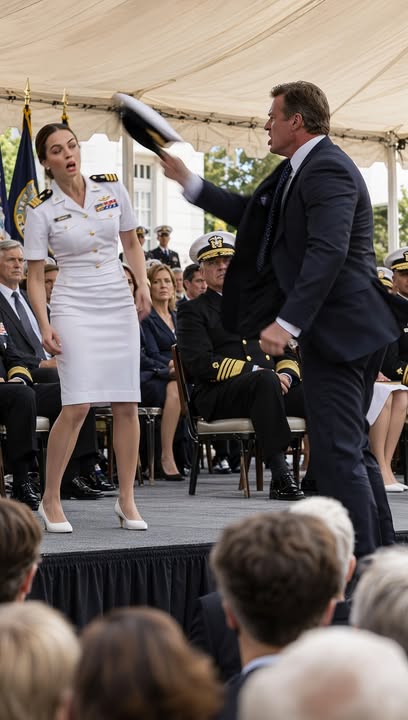
The man who stood was not the judge, the academy president, or anyone from my family.
He was Mr. Hale, my grandfather’s longtime attorney and the independent trustee of the education trust.
For a moment, the courtyard seemed to narrow around him.
The red-wax folder trembled in my hands, though I tried to steady it against the podium.
Mr. Hale crossed the stone courtyard with measured steps, carrying a slim leather case.
He was in his late sixties, with silver hair and the kind of careful expression that made it difficult to tell whether he was worried or simply thinking.
I had seen him twice before, both times in my grandfather’s study, when I was young enough to believe that attorneys existed mainly to make adults speak in quiet voices.
Now he stopped beside the podium and looked first at my face, then at the documents spread across its surface.
“I’m sorry this has happened here,” he said.
His voice was low, but the microphone carried it across the courtyard.
The crowd had gone silent.
Behind him, the academy president lifted one hand, asking everyone to remain where they were.
My father had not moved toward the podium again.
He stood beside the front row with his jaw set and one hand clenched around the program he had been holding.
My mother’s fingers were pressed to her lips.
Julian had sat back down, though he kept staring at the final transfer as if the numbers might rearrange themselves if he looked long enough.
Mr. Hale placed his leather case on the podium.
“Before anyone draws conclusions from these papers,” he said, “I need to make something clear.”
My father gave a humorless laugh.
“Then perhaps you can explain why my daughter is accusing us in front of the entire academy.”
“I’m not accusing anyone of anything,” I said.
My voice sounded steadier than I felt.
“I’m submitting records that don’t match what the trust was told.”
Mr. Hale turned toward me.
“That is an important distinction.”
My mother lowered her hand.
“Audrey, please,” she said, and there was something in her voice I could not name.
Fear, perhaps.
Or exhaustion.
“Not here.”
“I tried to do this quietly,” I answered.
For a second, I thought she might come closer.
Then her gaze fell on the papers, and she seemed to lose the courage to take another step.
Mr. Hale opened his case and removed a packet of documents.
“The five o’clock deadline is real,” he said.
A murmur moved through the people nearest us.
The academy president stepped toward the microphone, but Mr. Hale raised a hand, gently asking for the chance to continue.
“I am required to certify the status of the designated beneficiaries today,” he said.
“If Audrey is certified as having completed her education, the principal held for her will be released according to the trust’s terms.”
My father’s face tightened at the word released.
“If she is certified as having abandoned her education,” Mr. Hale continued, “the trust directs that the principal pass elsewhere.”
“To us,” my father said.
It was not a question.
Mr. Hale looked at him.
“That is what the documents currently indicate.”
“And you intend to change that based on a speech and a stack of papers she could have printed this morning?”
I looked down at the papers I had spent four years gathering.
Some were worn at the edges from being handled too often.
Others had the faint yellowing of old bank records.
“I know what they are,” I said.
“I know who issued them, and I know where each one came from.”
“That is not the same as proving fraud,” Mr. Hale said quietly.
The words were careful, not dismissive.
I had prepared myself for someone to call me bitter, confused, or ungrateful.
I had not prepared myself for the possibility that the truth might not be enough.
“I understand,” I said.
“Then tell me what you need.”
Mr. Hale studied me for a moment.
“Original records, not just copies, where available.”
“I brought them.”
“Bank statements, payment authorizations, and the academy’s own records.”
“I have those too.”
“And evidence that the signatures were not yours.”
I drew a breath.
“I requested my signature samples from the academy registrar last month, and I brought copies of my scholarship applications from before the first withdrawal.”
He glanced at the folder.
“Do you also have the records showing that you remained enrolled?”
I looked toward the academy president.
He nodded once.
“We can provide certified enrollment and graduation records,” he said.
My father’s eyes shifted to him.
“Why are you involving the academy in this?”
“Because Audrey’s academic status is part of the record I am required to certify,” the president replied.
“And because we will not pretend she did not graduate.”
The words landed more softly than a speech, but they steadied something in me.
I set my diploma on the podium, beside the balance statement showing zero.
For a moment, the two documents seemed to belong to separate lives.
One was proof of what I had achieved.
The other was proof of what had been taken from me.
Mr. Hale drew a chair closer and began examining the papers.
He did not rush.
He read the statements, checked dates, compared the listed account numbers, and asked me which records were originals.
I answered as clearly as I could, though I could feel the audience watching every movement.
My father turned away once, then turned back again.
My mother had stopped crying.
Her face was pale, and her eyes were fixed on the document showing my name beneath a series of withdrawals.
Julian’s hands were clasped tightly between his knees.
When Mr. Hale reached the $42,800 transfer, he paused.
“Is this the payment you believe went to your brother?”
“Yes.”
Julian looked up.
“I didn’t know she had this.”
“You knew the money came from an account,” I said.
“I knew a transfer was made,” he answered.
“That isn’t the same thing.”
“Then what did you think the account was?”
He opened his mouth, but nothing came out.
Mr. Hale set the page aside.
“We’ll need the original authorization and the bank’s underlying record,” he said.
“I have a certified copy of the transfer authorization.”
I pulled it from the folder and slid it across the podium.
There was a faint crease through the middle, where I had folded it into my notebook before I knew how important it would become.
Mr. Hale studied the signature.
His expression did not change, but his thumb rested on the paper longer than it had on the others.
“Where did you get this?”
“From the bank’s records department.”
“Did they verify the account holder’s instructions?”
“They said the transfer was approved through the family account.”
“That doesn’t tell us who approved it.”
“No.”
For the first time since I had opened the folder, I felt the ground shift beneath me.
I had believed the documents would speak with one clear voice.
Instead, they were beginning to form a question.
My father seized on the pause.
“You see?” he said.
“No one has proven anything.”
“I’m not going to certify the distribution in the next few minutes on the basis of an incomplete record,” Mr. Hale replied.
My father’s shoulders eased slightly.
“But I also will not file a certification that contradicts what is now before me,” Mr. Hale added.
The relief vanished from his face.
“What does that mean?”
“It means I am requesting a brief postponement while I verify these records.”
“You can’t simply postpone a trust distribution because Audrey says she stayed in school.”
“I can postpone certification long enough to investigate credible discrepancies.”
My father glanced toward the crowd, as if the silent witnesses might help him.
“You’re turning a family matter into a spectacle.”
“No,” I said.
“You turned it into a spectacle when you told everyone I had abandoned school.”
His face reddened, but this time he did not shout.
The quiet that followed was harder to bear than his anger.
I had spent years imagining what it would feel like to say those words to him.
I had expected satisfaction.
Instead, I felt an ache in my chest, like I had finally reached a door I had been pushing against for too long and discovered that opening it did not bring the person I hoped to find.
Mr. Hale closed the folder carefully.
“I will not complete the certification at five,” he said.
“Not until I verify the evidence and speak with the bank.”
He turned to the academy president.
“I’ll need a private room and access to a secure line.”
The president nodded.
“My office is available.”
My father stepped forward, not toward me but toward Mr. Hale.
“Your decision has consequences for all of us.”
“I understand.”
“If the trust is frozen, there will be expenses, delays, legal fees.”
“I understand that too.”
“You’re acting as if this is an ordinary dispute.”
“I’m acting as trustee,” Mr. Hale said.
His tone never rose.
The restraint made my father look suddenly louder than he had before.
My mother came toward me at last.
She stopped just beyond the podium, close enough that I could see the small tremor in her fingers.
“You should have spoken to me,” she whispered.
I looked at her.
“I tried to ask you about the tuition statements.”
“You asked questions when your father was already under pressure.”
“So you knew?”
Her eyes flicked down to the papers.
“I knew there were financial problems.”
“That isn’t what I asked.”
She swallowed.
“Not here, Audrey.”
The answer was not an answer.
For a brief moment, I wanted to reach for her hand.
I remembered her sitting beside my bed when I was eight, smoothing my hair after a fever.
I remembered her packing extra sandwiches for the academy when she thought I would forget to eat.
I also remembered every email she had read and never answered when I asked about the trust.
I did not know which memory to trust.
“Then when?” I asked.
She closed her eyes.
“Soon.”
Julian stood.
“I can explain the transfer.”
My mother turned sharply toward him.
“Not now.”
He looked at her, then at me.
“I should have said something earlier.”
“You should have,” I said.
His eyes dropped.
I wanted him to deny it.
I wanted him to tell me that the transfer was a mistake, that he had not known, that the money had never paid for the things I had gone without.
Instead, he said nothing.
Mr. Hale gathered the records into a neat stack.
“I need to take these with me for examination.”
I nodded.
“I made copies.”
“Good.”
“I want a receipt for every original.”
“You’ll have one.”
He began listing the documents as I handed them over.
The tuition statements.
The bank records.
The scholarship forms bearing my actual signature.
The transfer authorization.
The trust summary.
Each page left my hands with a quiet rustle, and I felt less prepared with every one.
Paige was waiting beside the academy steps.
She had been there since the opening ceremony, wearing the navy uniform of a graduating cadet and a narrow gold pin at her collar.
She had stood close enough to see my father’s hand strike my face, but far enough away not to make the moment about her.
When Mr. Hale finished inventorying the documents, Paige approached.
“Do you need anything else?” she asked.
Her eyes were on me, but she spoke to him.
“Perhaps,” Mr. Hale said.
“Do you have the copies Audrey mentioned?”
“Yes.”
She had kept them in a plain blue folder, not sealed or marked, the way I had kept mine.
“You don’t have to hand them over in the courtyard,” I told her.
“I know.”
She looked at me as she said it.
“I want to.”
There was a gentleness in her expression that made my throat tighten.
Mr. Hale took the blue folder from her.
“What records did you copy?”
“Everything Audrey gave me,” Paige said.
“And a few things she didn’t realize I had.”
I turned toward her.
“What does that mean?”
She hesitated.
For the first time all day, she looked uncertain.
“I found some old letters in the archive box you kept in your room.”
My brow furrowed.
“The box with my grandfather’s papers?”
“Yes.”
“I thought you only copied the bank records.”
“I did, at first.”
She opened the folder to a smaller sleeve tucked inside the back.
“I saw these when I was checking the dates on your documents.”
My father looked from Paige to the sleeve.
“What letters?”
Paige did not answer him.
She drew out three folded pages, each carefully protected in a clear cover.
The paper had softened with age.
The writing on the first envelope was familiar, though I had not seen it in years.
My grandfather’s handwriting leaned forward across the page, as if even his letters had been in a hurry to reach me.
I recognized the academy’s name in the address line.
My fingers went cold.
“Where did you get those?” I asked.
“From the box in your dorm room,” Paige said.
“You told me you’d put everything from the house in there.”
“I did.”
“I didn’t know these were inside.”
“I know.”
The first envelope bore a date from the spring of my sophomore year.
The second was dated a few months later.
The third had been sent the following winter.
I had been living at the academy during all three periods.
I had received none of them.
Mr. Hale lifted the first letter from its sleeve, careful not to damage the crease.
“May I read it?” he asked.
I nodded, though my voice had gone missing.
He unfolded the page.
“My dear Audrey,” he began.
The words passed through the microphone, quiet and clear.
“I’m told you are making strong progress in your studies, and I hope the work is challenging you in the right way.”
I stared at the page.
My grandfather had never seen me in uniform.
He had died before my first year at Westbridge ended.
But he had known I was still there.
“Your mother says you have been working hard,” Mr. Hale continued.
“I hope you are giving yourself time to rest as well.”
My mother made a small sound.
It was not quite a sob.
I looked at her, but she had turned her face away.
Mr. Hale lowered the letter.
“This was sent to the academy?”
Paige nodded.
“That is the address on the envelope.”
The academy president leaned closer, his expression troubled.
“We can check the old correspondence logs.”
“Please do,” Mr. Hale said.
I reached for the letter.
“Can I see it?”
He placed it in my hands.
The paper smelled faintly of dust and the cedar chest where I had kept the box.
My grandfather’s signature stood at the bottom, unmistakable.
I traced the first letter of his name with my eyes.
For years, I had believed he had been disappointed in me.
I thought he had heard the story that I quit and decided I was no longer worth the trouble of asking.
The silence had felt like judgment.
Now there was a letter addressed to me, asking about my classes, my progress, and whether I was resting.
A simple question had survived years of neglect.
I pressed the page against the podium to keep my hand from shaking.
“He wrote to you more than once,” Paige said.
“I found four.”
Mr. Hale took the second letter.
Its opening was different, but the care was the same.
He asked whether I had settled into my new term.
He mentioned that he had spoken to the academy and wanted to know if I was still enjoying mathematics.
I remembered telling him, years earlier, that numbers made more sense to me than people.
The letter ended with a line about how proud he was that I had chosen a difficult path for reasons of my own.
My eyes blurred.
I could still picture him sitting at the kitchen table with a yellow legal pad, listening while I explained the parts of school I loved and the parts that frightened me.
He had been the only adult in my family who never told me what I ought to want.
“I thought he forgot about me,” I whispered.
Paige moved closer.
“He didn’t.”
“I thought he knew I had left.”
“I don’t think he did.”
Mr. Hale looked toward the sealed folder on the podium.
“Did you find any reply from the academy?”
Paige shook her head.
“Only the letters.”
The courtyard had gone silent again.
Even my father seemed to have no words prepared for this.
My mother stood with her arms wrapped tightly around herself.
Julian looked at the three pages in my hands, then at me.
I could not tell whether he was ashamed or simply frightened of what the letters might mean.
Mr. Hale read the date on the third envelope.
“This one was sent several months before your grandfather died.”
“He knew about the trust,” I said.
“He knew about everything.”
Mr. Hale’s expression softened.
“He knew what he had established.”
“But if he believed I’d dropped out, why didn’t he call?”
My voice cracked on the last word.
“Why didn’t he come find me?”
Mr. Hale looked down at the letters.
“I don’t know yet.”
It was an honest answer, and somehow that hurt more than a guess.
He turned the envelope over and checked the front again.
The address had been written in my grandfather’s careful hand.
Westbridge Military Academy.
My name.
The barracks address.
The date.
Nothing on the envelope suggested it had been returned.
I had spent four years believing no one had looked for me.
Now I was holding proof that someone had tried.
Mr. Hale slipped the letters back into their sleeves.
“I’ll need these for the record too.”
I did not want to let them go.
They were the first evidence I had seen that did not feel like a weapon.
They were not a transaction, a forged signature, or a calculation of what had been taken.
They were a voice from a room I could no longer enter.
Still, I handed them to him.
He placed them in the blue folder beside the copies Paige had brought.
“Why did you keep them?” I asked her.
“Because they mattered.”
“I didn’t even know they existed.”
“Your grandfather mattered to you,” she said.
“So I thought you should have the chance to decide what to do with them.”
She had known I might never open that box.
She had known the letters could change nothing about the missing money.
She had saved them anyway.
I looked at her, and the gratitude in me was too large for a simple thank-you.
“I thought I had to keep everything by myself,” I said.
“You did keep a lot by yourself.”
“I wanted to protect you from it.”
“I know.”
She squeezed my hand once, brief and steady.
“But you don’t have to do that anymore.”
Mr. Hale closed both folders.
“I’m taking the original evidence to my office,” he said.
“I’ll contact the bank and the academy before I make any determination.”
“What happens at five?” I asked.
“At five, I will not file the distribution certification.”
“Will the money be frozen?”
“For now, I can delay disbursement while I verify whether the trust’s records were accurate.”
“And if they weren’t?”
“Then I will take the matter to the court with the evidence.”
My father’s voice cut in.
“Are you saying you’re freezing the inheritance?”
“I’m saying I am not releasing it today.”
“That is not the same as proving my family did anything wrong.”
“No,” Mr. Hale said.
“It isn’t.”
The measured answer left no room for argument, but it also offered no comfort.
The academy president asked the crowd to give us space.
People began to move slowly toward the courtyard gates, though I could still feel their attention following me.
Some looked sympathetic.
Others looked confused.
I wished I could gather the papers and the letters and return to the beginning of the day, before the slap and the microphone and the words that could not be taken back.
Then I remembered that before the day began, I had been living inside a lie.
The courtyard was almost empty when Mr. Hale turned to me.
“I’ll need to speak with you privately after I contact the bank.”
“Today?”
“Yes.”
“Before the deadline?”
He glanced at the clock above the academy entrance.
“It will be close.”
My mother stepped toward us.
“Audrey, we need to talk.”
I looked at her.
“About the money?”
“About all of it.”
“Then start with the truth.”
She pressed her lips together.
“I’m not ready to say something I may regret.”
“I’m not asking you to say anything you don’t know.”
Her gaze dropped to the letters in Mr. Hale’s folder.
For the first time, she looked as though she might be afraid of what my grandfather had left behind.
My father walked away toward the academy steps without another word.
He did not ask whether I was hurt.
He did not look at my diploma.
Julian remained beside the empty front row.
When I glanced at him, he started to speak, then stopped.
His silence was no longer something I could pretend not to understand.
Mr. Hale tucked the evidence folders beneath his arm.
“I’ll call you as soon as I have more information,” he said.
“You’ll have the documents by then?”
“Yes.”
He gave me a copy of the inventory he had made, with every original listed and signed for.
I read the page twice, checking each item.
At the bottom, beneath the records I had gathered, he had added one final line.
Four letters from Elias Vance to Audrey Vance, addressed to Westbridge Military Academy.
I touched the words with my thumb.
The letters had found their way into the record.
Maybe, at last, the rest of the truth would follow them.
Mr. Hale left through the side entrance with the folders.
Paige remained beside me.
My mother stood several feet away, waiting for me to decide whether I would come closer.
I could not do it yet.
“I’m going to call you tonight,” I told her.
She nodded.
“I’ll answer.”
It was the first promise she had made that day, and I did not know whether I believed it.
When the clock above the entrance struck four forty-seven, my phone began to ring.
The number was unfamiliar, but the area code was local.
I answered.
“Miss Vance?” a woman asked.
“Yes.”
“This is the records supervisor at Northbridge Bank.”
I looked toward the academy doors.
“We received a request from Mr. Hale regarding the trust account,” she continued.
“I’ve found an older communication attached to the first withdrawal authorization.”
My grip tightened around the phone.
“What kind of communication?”
“A written warning from the trustee.”
I turned to Paige.
She saw my face change and reached for my arm.
“What did it say?” I asked.
There was a pause on the line.
“It appears your grandfather contacted the bank before the transfer was made,” the woman said.
“He specifically stated that no money in your education account could be released without independent verification.”
Across the courtyard, my mother had gone very still.
My father, halfway down the steps, stopped walking.
I looked at the folder Mr. Hale had carried away, picturing the letters my grandfather had sent and the warning he had written.
Then the bank supervisor added, “There’s something else, Miss Vance.”
“What?”
“Your grandfather asked us to keep a copy of every future authorization, because he believed someone might try to make your signature look like yours.”
**–END OF PART 2–CLICK “NEXT” AT THE BOTTOM OF THE PAGE TO CONTINUE READING**
* * *
[NEXT: PART 3](https://storyly.idolsgift.com/blog/part-3-the-man-who-never-stopped-asking-055)
✓ Lynn R. Adams
The man who stood was not the judge, the academy president, or anyone from my family. He was Mr. Hale, my grandfather’s longtime attorney and the independent trustee of the education trust. For a mo…