PART 2: The Locket Beneath the Greenhouse 058
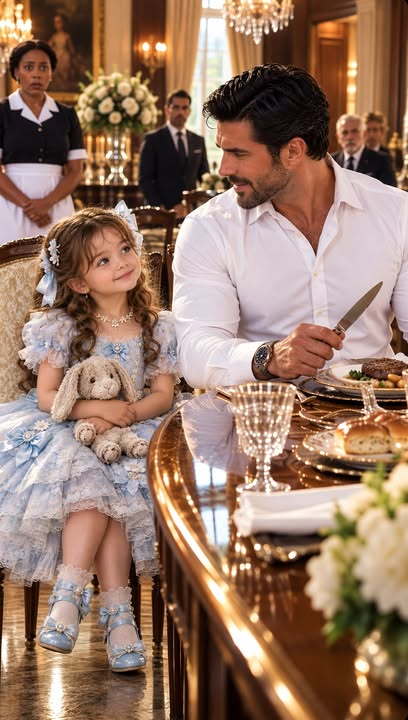
Part 2 – The Locket Beneath the Greenhouse
Alessandro stared at the small object resting in Lily’s palm as if the whole world had narrowed to the space between his hand and hers.
The morning air hung cold around us, and a faint ribbon of mist drifted over the driveway.
“Where did you find that?” he asked.
His voice was quiet, but it had lost the distant calm he used to keep everyone at a safe distance.
Lily looked up at him, then at me.
“By the glass house,” she said, squeezing her stuffed rabbit beneath one arm.
I blinked.
“The old greenhouse?”
Lily nodded.
“I was looking for a ladybug, Mommy.”
Alessandro’s gaze remained fixed on the object.
It was a small silver locket, no bigger than a coin, its surface dulled by age and marked with a shallow dent along one edge.
A thin chain hung from it, tangled around Lily’s fingers.
“May I?” he asked.
He held out his hand, then paused before touching her, waiting for her to decide.
Lily glanced at me.
I gave her a small nod.
She placed the locket in his open palm.
The instant his fingers closed around it, something in his face gave way.
His eyes shut.
His shoulders drew inward, and when he opened them again, they shone with a grief so unguarded that I felt I had stumbled into a room where I did not belong.
“Alessandro?” Marco said softly from behind him.
The name seemed to pull him back, though only a little.
He turned the locket over with his thumb.
Then, almost too quietly to hear, he whispered, “Elena.”
I had heard the name before, but never from Alessandro himself.
The servants spoke of his late wife in hushed fragments, as if even her memory might be dangerous to disturb.
Now I understood that the silence around her had not been indifference.
It had been a kind of shelter.
Lily leaned closer to see what he held.
“Is it yours?” she asked.
Alessandro looked down at her.
“No,” he said. “It belonged to someone I loved very much.”
“Your wife?”
The question escaped her without hesitation.
Marco’s expression tightened, but Alessandro did not scold her.
“Yes,” he answered. “Her name was Elena.”
Lily considered that.
“Did she like rabbits?”
For a moment, Alessandro’s mouth moved as if he might smile.
“I think she would have liked yours.”
Lily hugged the rabbit close.
“His name is Button.”
“That is a good name,” Alessandro said.
The words seemed to surprise him as much as they did me.
He turned the locket over again, careful as if it were made of something more fragile than silver.
“Could you open it?” I asked.
Alessandro looked at me.
There was caution in his eyes, but beneath it something else—perhaps a question he was not yet ready to ask.
He pressed a tiny catch at the edge.
The locket opened with a soft click.
Inside was a faded photograph of a young woman with dark, shining hair and a thoughtful smile.
Even beneath the worn surface, her eyes seemed alive.
A small folded scrap of paper rested behind the photograph.
Alessandro drew in a sharp breath.
The sound was so slight that I might have missed it if the driveway had not been utterly quiet.
He lifted the paper with two careful fingers.
It had yellowed with time, and the ink had faded, but the handwriting remained clear enough to read.
Sandro.
Only that one word.
Alessandro sat back on his heels, his eyes fixed on the note.
For a moment, he looked younger than I had ever seen him, stripped of the power that seemed to follow him into every room.
The locket trembled in his hand.
“I thought this was buried with her,” he murmured.
The words were meant for himself, but I heard them all the same.
Lily’s brow furrowed.
“Why was it in the garden?”
“I don’t know,” he said.
He closed the locket slowly.
The chain slipped through his fingers, catching the pale morning light.
I suddenly became aware of how close we stood to the estate gates, the suitcase beside my leg, and the road beyond them waiting for us.
“Mr. Romano,” I said, “I didn’t know she had found anything important.”
He looked at me, and some of the rawness in his expression settled into guarded thought.
“I believe you.”
“She was only playing near the greenhouse.”
“I heard her.”
“I’m sorry we disturbed you.”
“Clara.”
It was the first time he had said my name without an order following it.
I stopped.
He glanced at the suitcase, then at Lily, who had begun rubbing sleep from one eye with the back of her mitten.
“Are you leaving because of what happened last night?”
“I thought it would be best.”
“For whom?”
I searched for an answer that would not sound like fear.
“I don’t want Lily to cause trouble for you.”
“She did not.”
“She broke one of your rules.”
“She sat in a chair and said something a child says when she likes someone.”
“That was not an ordinary thing to say to the man everyone is afraid of.”
A faint crease appeared between his brows.
“Everyone?”
The word held no anger, only a weariness that made me regret speaking so plainly.
I lowered my eyes.
“People are careful around you.”
“Perhaps they have reason to be careful.”
That did not reassure me.
Before I could reply, Alessandro looked down at Lily.
“Would you like to go inside and get warm?”
Lily turned to me.
I had taught her never to accept an invitation without checking with me, no matter who offered it.
The lesson had been given for ordinary reasons, but the mansion had taught me how important it was.
“Can Mommy come too?” she asked.
“Yes,” Alessandro said.
“And Button?”
“Of course.”
Lily reached for my hand.
I looked at the gate again.
Leaving would be simpler than staying.
But the truth was, we had nowhere waiting for us, and the morning chill had already begun to seep through Lily’s coat.
Still, I would not let necessity make the decision for me without understanding what I was agreeing to.
“Only for breakfast,” I said.
Alessandro nodded once.
“Only breakfast.”
He did not ask us to unpack.
He did not tell me I owed him anything.
He simply turned toward the mansion, holding the locket with a care I had never seen him give any object.
Marco followed a few paces behind, silent as ever.
Lily kept one hand in mine and the other wrapped around Button.
We walked back through the entrance together.
The great doors opened, and warm air met us, scented faintly with coffee, polished wood, and the bread the kitchen staff had begun baking before dawn.
A maid hurried over to take our suitcase.
I kept my hand on the handle.
“I’ll carry it upstairs myself,” I said.
She glanced at Alessandro.
He did not correct me.
“Of course,” she said gently.
That small permission mattered more than it should have.
The dining room looked different in the morning.
Sunlight spread across the long table, softening the shine of the silver and warming the empty chairs.
Alessandro chose a place at one end, but when Lily tugged at my sleeve, he moved to a smaller table near the window instead.
It was still far larger than any table we had eaten at in our little apartment, but it felt less like a throne and more like a place where someone might sit.
Lily climbed into her chair.
Button was placed beside her plate, facing forward.
A member of the staff brought oatmeal, sliced pears, and toast.
Alessandro sat opposite us with a cup of coffee he barely touched.
The locket rested beside his hand.
I noticed that he kept looking at it, then forcing himself to look away.
“Do you want to know what she was like?” he asked after a long silence.
I did not know whether he meant me or Lily.
Both of us waited.
“She used to come to the greenhouse when she couldn’t sleep,” he said.
“Not because she liked the flowers particularly.”
“What did she like?” Lily asked.
“Rain,” Alessandro replied.
“Rain?” Lily echoed.
“She said it made every place feel new again.”
Lily stirred her oatmeal with her spoon.
“I like puddles.”
“Then you might have understood her.”
He spoke carefully, each sentence seeming to cost him something.
The grief in his voice was not dramatic.
It was quieter than that, worn smooth by years of being carried alone.
I thought of him at dinner the night before, seated beneath the heavy chandeliers with a roomful of people afraid to interrupt his silence.
For the first time, I wondered what it meant to be surrounded by people and still be alone.
“Did she like children?” Lily asked.
Alessandro looked at the locket.
“Yes,” he said. “Very much.”
“Then why don’t you have any?”
I almost reached across the table to stop her, but Alessandro lifted one hand slightly.
“It’s all right,” he said.
He took a breath.
“We were going to have a child.”
Lily paused with her spoon halfway to her mouth.
“What happened?”
“Sometimes,” he answered, his voice low, “the things we hope for don’t happen the way we imagined.”
It was an answer too large for a three-year-old, but she listened as though she understood its shape.
Alessandro’s gaze returned to the locket.
“I’m sorry,” she whispered.
He looked at her.
Something changed in his expression, something almost like surprise.
“Thank you.”
Lily reached for a pear slice, then hesitated.
“You can have mine if you’re sad.”
A soft, unsteady breath left him.
“I’m all right.”
“You can still have it.”
She pushed the pear slice across the table.
Alessandro stared at it for a long moment before picking it up.
He ate it with solemn care, as if accepting the gift meant more than the food.
I watched him, unable to reconcile this man with the one whose name had made me tremble the night before.
But one kind moment did not erase what I knew.
He was still powerful.
He was still a stranger.
And Lily was still a child who trusted people faster than I could afford to.
When breakfast was over, I carried the suitcase upstairs to the small room we had been given.
I had not unpacked much the night before, so it took only a few minutes to settle Lily’s clothes back into the dresser.
I left my own things folded in the suitcase.
A knock sounded at the door.
I opened it to find Alessandro standing in the corridor.
The locket was no longer in his hand.
“May I come in?” he asked.
I stepped aside, but I remained near the doorway.
He noticed.
“I wanted to thank Lily for finding the locket.”
“You don’t have to thank her. She didn’t know what it was.”
“That may be why she was able to find it.”
He glanced toward the room.
Lily was on the floor, making Button hop over a row of wooden blocks.
Alessandro watched her quietly.
“She has your eyes,” he said.
“I’ve been told that.”
“Her father?”
The question was not intrusive in its tone, but it touched a part of my life I kept carefully closed.
“He died when she was very young,” I said.
Alessandro lowered his gaze.
“I’m sorry.”
“Thank you.”
There was a pause.
“Does she remember him?”
“Not really.”
I had once tried showing her a photograph, but she had been too young to understand why I cried while explaining who the man was.
Now, when she asked where her father had gone, I told her he had died and that she was loved by people she could see and by someone she could not.
It was the gentlest truth I could manage.
Alessandro nodded as if he understood that some truths needed to be given only a little at a time.
“Does she have family nearby?” he asked.
“No.”
“Any family at all?”
The question carried no judgment, but I hesitated.
“Some relatives on her father’s side, though we have never been close.”
His attention sharpened at the mention of them.
“Do they know where she is?”
“They know she exists.”
I had not told him more because there was not much more to tell.
After Lily’s father died, his family had made a few calls, sent condolences, and offered help that never quite became real.
We had not quarreled.
We had simply drifted apart, each of us carrying a different understanding of what the other could manage.
Alessandro accepted my answer without pressing.
“I won’t ask you to explain what you don’t wish to explain.”
The words startled me.
Perhaps he saw it.
He shifted his weight, uncomfortable with the quiet he had created.
“You may stay,” he said. “You and Lily. I won’t punish you for last night, and I won’t ask you to leave because she found something that belongs to me.”
“I don’t want you to make that decision because you feel you owe us.”
“I don’t.”
“Or because she was kind to you.”
“I’m not that easily persuaded.”
A faint, humorless smile touched my face.
“That’s what I was afraid of.”
For the first time, the corner of his mouth lifted in reply.
It was not a smile that transformed him.
It was only a brief easing of the lines around his eyes.
But it was there.
“I can offer you different work if you’d prefer not to serve in the dining room,” he said.
“I’m fine with the work I have.”
“Then keep it.”
“And Lily?”
“She can remain in the staff nursery when you’re working.”
I studied him.
“Are you sure?”
“Yes.”
“Last night, you seemed to think she was a problem.”
“I was surprised.”
“That’s not quite the same thing.”
“No,” he agreed. “It isn’t.”
His honesty left me with no argument.
He looked again at Lily, who had arranged the blocks into a crooked little house.
“She may come say hello when she likes,” he said. “But I won’t ask her to.”
“Thank you.”
He nodded, then began to turn away.
“Mr. Romano?”
He stopped.
“Why did you think the locket was buried with Elena?”
His hand tightened briefly at his side.
“I gave it to her years ago,” he said. “She wore it every day.”
“Did you see it with her when she died?”
“No.”
The answer was clipped, but not unkind.
“I was told her personal things had been gathered and placed with her.”
He looked down the corridor toward the tall windows.
“I believed the locket was among them.”
I did not ask who had told him or why it had taken seven years for the locket to appear.
There was too much grief in the room for a question that sharp.
Alessandro left a moment later, and I watched him go until he disappeared around the corner.
That afternoon, I went to the old greenhouse with Lily.
The path leading there was half hidden by winter-bare shrubs, and the glass structure stood at the far end of the garden, its panes clouded with age.
Lily pointed toward the side door.
“That’s where I found the necklace.”
“You mean the locket.”
She corrected herself carefully.
“The locket.”
Inside, the air smelled of wet soil and old leaves.
Many of the planters were empty, though a few stubborn vines still clung to the iron frames.
I could see where a section of ivy had been pulled away near the base of a cracked stone bench.
It was easy to imagine the locket sliding beneath it, hidden by dust and fallen leaves.
“Did you find it right here?” I asked.
Lily crouched beside the bench.
“Yes. It was shiny.”
“That is a very good reason to pick something up.”
She looked pleased.
I brushed the leaves aside, searching for anything else that might have been caught beneath them.
There was only soil, a piece of broken terracotta, and a thin silver glint that turned out to be a loose link from the chain.
I tucked it into my pocket.
Then a voice came from the doorway.
“Clara.”
I straightened.
Marco stood beneath the arched entrance, his hands folded in front of him.
“I’m sorry,” he said. “I didn’t mean to startle you.”
“You didn’t.”
He looked at Lily.
“Mr. Romano asked me to see whether you needed anything.”
“We’re all right.”
Marco glanced at the bench, then at the ground around it.
“Did Lily find the locket here?”
“Yes.”
His eyes moved briefly toward the spot where I had found the loose link.
“How long ago?”
“Yesterday, I think. She didn’t mention it until this morning.”
Marco nodded, but his face had gone thoughtful.
“Did you know the locket was missing?” I asked.
He took a moment to answer.
“I knew Elena wore it.”
“That isn’t what I asked.”
“No,” he said. “I didn’t know it was missing.”
The greenhouse seemed to quiet around us.
“Is there something strange about finding it here?” I asked.
“I don’t know.”
He looked toward the garden beyond the glass.
“I only know that I never saw it again after Elena died.”
It was the first time I had heard him speak of her so plainly.
I wanted to ask whether he had been there when she died, whether he had known what was in the locket, whether the note had been written before or after Alessandro gave it to her.
But his expression warned me that the questions belonged to another day.
Instead, I said, “Alessandro told me she liked the greenhouse.”
“She did.”
“Did she come here often?”
“Whenever she wanted to be alone,” Marco said. “Or whenever she wanted to pretend she was.”
A small, sad smile appeared and vanished.
“Why pretend?” Lily asked.
Marco lowered himself slightly so he could meet her eyes.
“Because sometimes people want company but don’t know how to ask for it.”
Lily thought about that.
“I ask Mommy.”
“You’re wiser than most grown-ups,” Marco said.
She beamed.
When we returned to the mansion, Alessandro was in his study.
The door was open, but I did not go in.
I caught a glimpse of him standing by the window with the locket in his hand.
The afternoon light fell across his face, leaving one side bright and the other in shadow.
He seemed to be reading the little note again.
I carried on with my work.
For the next few days, the house did not change all at once.
It changed in small ways, the kind one might miss if one were not paying attention.
Alessandro began eating breakfast in the smaller room near the window whenever Lily was there.
He still spoke little, but he listened when she told him about Button’s adventures.
He learned that she disliked carrots but liked pear slices, that she wanted the rain to come back, and that she thought all birds were named Charlie until someone corrected her.
He did not invite her into his private rooms.
He did not ask her to sit beside him unless she chose to.
And when she wandered into a hall where staff were working, he asked someone to walk her back to me rather than letting her roam the mansion alone.
The rules remained, but they felt less like walls and more like careful boundaries.
That mattered to me.
One afternoon, I found Alessandro sitting at the smaller table while Lily colored beside him.
She had drawn three people beneath a large yellow sun.
The tallest figure had dark hair and a square black jacket.
The smallest figure wore a red dress and had two long, uneven arms.
The third figure was me, with a blue apron and what looked like a broom sticking out of my head.
“Who is this?” Alessandro asked, pointing to the figure with the black jacket.
“You,” Lily said.
“And this?”
“Mommy.”
“And the little one?”
“Me.”
He examined the drawing.
“Why is Mommy holding a broom?”
“She works here.”
“Of course.”
Lily put another crayon in his hand.
“Draw your shoes.”
Alessandro looked at the crayon as if it were an unfamiliar tool.
“I’m not very good at drawing.”
“You can try.”
He glanced toward me.
I was standing by the sideboard, pretending to arrange cups.
For a second, I thought he might hand the crayon back.
Instead, he bent over the paper and drew two dark shapes beneath his figure.
Lily studied them.
“Those are too big.”
“I have large shoes.”
She shook her head with deep disappointment.
“Not that big.”
I turned away before my smile became obvious.
Later, after Lily had gone to the nursery, Alessandro came to find me in the corridor.
“She talks about her father sometimes,” he said.
“Not often.”
“Does it trouble her?”
“She’s too young to understand all of it yet.”
He nodded, and we stood in the quiet hall with the last light of day stretching across the floor.
“Children can be gentle without knowing what they’re touching,” he said.
“Sometimes,” I replied. “Sometimes they touch what adults have spent years avoiding.”
He absorbed that.
“I don’t want her to feel responsible for me.”
“Then don’t let her believe she has to make you happy.”
The sentence came out more sharply than I intended.
Alessandro did not take offense.
“You’re right,” he said.
I had expected defensiveness.
Instead, he lowered his head slightly, as though he had been given something important and wanted to understand its weight.
That night, when I went to check on Lily, I found a folded sheet of paper tucked beneath her pillow.
It was a drawing from the morning, the three of us beneath the sun.
Alessandro’s shoes were still too large.
On the back, in Lily’s careful, uneven letters, she had written his name with my help.
I stood beside her bed, the paper warm from where she had held it.
In the hallway, a floorboard creaked.
I turned and saw Alessandro at the far end, looking toward the open doorway.
Neither of us spoke.
He glanced at the drawing in my hand, then toward Lily, asleep with Button tucked beneath her chin.
For the first time since I had come to the mansion, I saw no effort in his stillness.
He looked neither feared nor powerful.
He looked like a man standing outside a room he did not know whether he was allowed to enter.
I stepped into the hallway and closed the door partway, leaving it open just enough for the night light to spill through.
“She’s asleep,” I whispered.
“I can see that.”
He looked down at his hands.
“I used to think the worst thing was losing someone.”
“And now?”
“Now I think it may be believing you know the whole story when you don’t.”
I did not know what to say to that.
His gaze drifted toward the garden windows, where the greenhouse lay hidden in darkness beyond the glass.
Then he looked back at me.
“Clara, when Elena died, I thought I understood everything about the life we had planned.”
His voice faltered, and he stopped there.
I waited.
But he did not continue.
Instead, he turned toward his study, carrying the silence with him.
The next morning, Marco came to the kitchen while I was pouring tea.
He had a small photograph in his hand.
“Would you look at this?” he asked.
I wiped my fingers and took it from him.
The picture was old and slightly faded, its edges curled from years of being handled.
It showed Elena standing in the greenhouse beside a younger girl.
The girl’s face was partly turned from the camera, but one detail caught my eye at once.
Around her neck was a thin chain with a small silver locket.
Not identical, perhaps, but close enough that my breath caught.
Marco watched my expression.
“Have you seen this before?” I asked.
“No.”
“Where did you find it?”
“In a box of Elena’s things. I wasn’t looking for it.”
I looked again at the photograph.
Elena’s hand rested lightly on the girl’s shoulder.
She was smiling, but her eyes seemed fixed on something beyond the camera.
“Who is she?” I asked.
Marco’s gaze shifted toward the dining room, where Alessandro sat alone with the locket on the table beside him.
“That,” he said, “is the question I don’t think he wants to hear.”
**–END OF PART 2–CLICK “NEXT” AT THE BOTTOM OF THE PAGE TO CONTINUE READING**
* * *
[NEXT: PART 3](https://storyly.idolsgift.com/blog/part-3-the-locket-beneath-the-greenhouse-058)
✓ Lynn R. Adams
Part 2 – The Locket Beneath the Greenhouse Alessandro stared at the small object resting in Lily’s palm as if the whole world had narrowed to the space between his hand and hers. The morning air hun…