PART 2: The Life She Had Been Quietly Saving 029
Part 2 – The Life She Had Been Quietly Saving
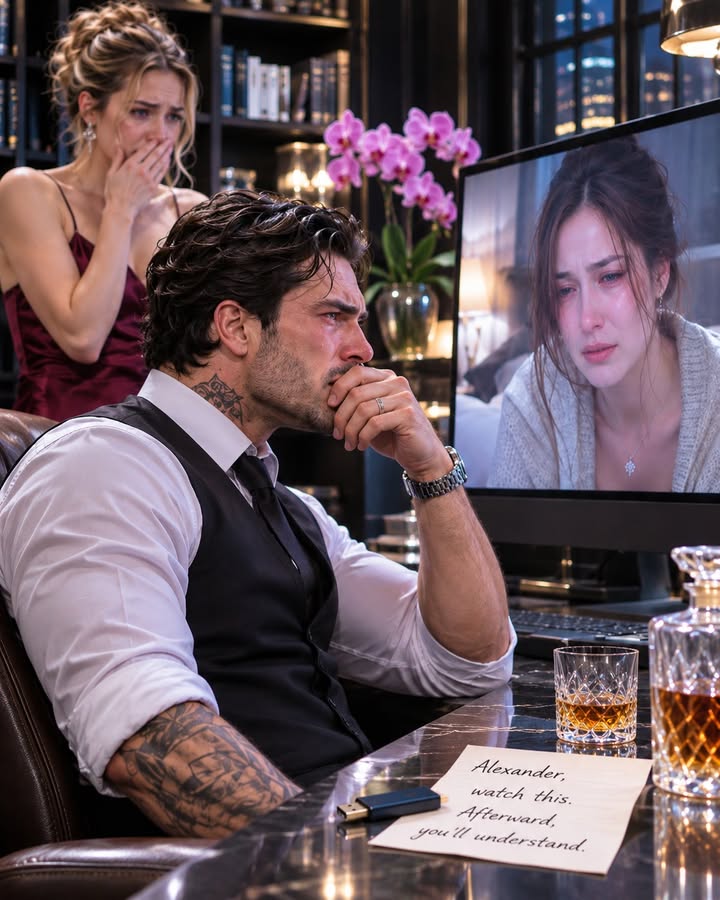
The first thing Alexander heard in the recording was the sound of my own breathing.
It was uneven, restrained, as if I had been trying to make myself smaller even inside the frame.
For several seconds, I said nothing.
I sat at the desk in the room we had once called our library, wearing a gray sweater and no makeup, my hair tucked behind one ear.
The orchid stood behind me on the windowsill, its pale blooms leaning toward the glass.
“I don’t know how to begin,” I said at last.
Alexander leaned closer to the screen.
Sophia was gone, but the sound of the front door closing had not yet faded from the house.
He was alone with my face, and for once there was no meeting waiting, no phone buzzing, no one in the room to tell him what he wanted to hear.
“I suppose I should start with the nights you called me dramatic,” I continued.
My voice held no accusation.
That was what made it so difficult to listen to.
“There were nights when I called because I couldn’t slow my breathing down, and I didn’t know how to make the room feel safe again.”
“I wasn’t asking you to solve anything, Alexander.”
“I just wanted to hear you say you were coming home.”
He looked down at his hands.
He remembered one of those nights, though not the way I did.
He had been in a conference room in New York, impatient with the interruption, already thinking about the next morning’s negotiations.
He remembered saying, “Claire, I can’t do this every time you feel overwhelmed.”
He had forgotten the silence that followed.
I had not.
“After a while, I learned to wait until morning,” I said.
“Then I learned not to call at all.”
A small pause passed in the recording.
I glanced down, perhaps at notes just beyond the camera.
“When you didn’t come home, I told myself it was because you were busy.”
“When you forgot things I had told you, I told myself you had too much on your mind.”
“When I saw the perfume on your shirts, I told myself I was imagining what it meant.”
Alexander closed his eyes.
The orchid’s shadow moved against the wall as the evening light shifted behind me.
“I’m not making this video to punish you,” I said.
“I don’t want you to feel guilty enough to chase me.”
“I want you to understand why I couldn’t stay.”
He pressed one hand against his mouth.
The words had always been there, only now they were arriving in a form he could not interrupt.
“When I stopped asking where you were, it wasn’t because I trusted you more.”
“It was because I had run out of strength to ask questions that made me feel foolish.”
“I don’t know whether you were having an affair.”
“I stopped trying to solve that, too.”
“I was already losing the part of myself that knew how to take care of me.”
Alexander’s gaze lifted sharply.
The video continued, steady and unhurried.
“After the first year of the depression, I began seeing Dr. Patel.”
“I didn’t tell you how bad it had become because the last time I tried to explain, you said you couldn’t handle another crisis.”
He froze.
He remembered the words now, though he had never thought of them as a promise or a warning.
A board member had resigned that morning, one of the company’s divisions was under review, and he had walked into the bedroom with his phone still in his hand.
Claire had been sitting on the edge of the bed, pale and frightened.
He had told her he couldn’t handle another crisis.
He had meant the company.
She had heard herself.
“I’m not saying you caused my depression,” I said.
“I know it’s more complicated than that.”
“But when I tried to tell you I was sinking, you made it sound as though my pain were one more demand you had to manage.”
Alexander lowered his head.
The room around him seemed suddenly too large.
“I kept thinking that if I could get well quickly, I could tell you later.”
“Then later became weeks.”
“Then months.”
“Then I was afraid that if I asked for help again, you would look at me with that same exhausted expression.”
My fingers folded together in the recording.
“I’m sorry I hid how bad things were.”
“But I was trying to survive in the only way I knew how.”
For a moment, Alexander stared at the orchid rather than my face.
He had brought it home once after a business trip, pleased by how rare it was and how carefully its blooms had been wrapped.
I had taken it from him with a smile and spent three years learning how much light it needed, when to water it, and how to trim the roots.
He had called it one of her little projects.
He had never asked why she kept it alive.
“I thought you would be safe here,” I said.
“I thought the house, the doctors, the people who worked for us, the things you bought me—all of that meant I could endure until I felt better.”
“I was wrong.”
The camera shifted slightly, and the frame showed a stack of sketchbooks beside me.
Some were old, their corners worn soft.
Others were tied with a ribbon.
On top sat a small notebook covered in my handwriting.
“I’m taking my drawings,” I said.
“And the pencils my grandmother left me.”
“I’m taking my documents and the clothes I need.”
“I’m leaving the things that were gifts because I don’t want to carry every memory as if it were a debt.”
Alexander’s eyes moved to the empty place where the sketchbooks had been.
The room had looked bare when he searched it.
Now he understood that I had not left in a rush.
I had chosen what still belonged to me.
“I made arrangements with my attorney,” I continued.
“She helped me find a place where I can stay without having to explain myself to everyone who works here.”
“She also helped me arrange treatment.”
“I’m not telling you where it is because I need you to respect that this is a separation, not an invitation to come find me.”
His breath caught.
The instinct to stand, to seize his keys, to drive through the city until he found me, rose so fast he was already halfway out of the chair.
Then my voice stopped him.
“I know you’ll want to fix this immediately.”
“You’ll want to call people and offer money and make a plan.”
“But I need you to understand that I’m not a problem you can solve for me.”
“You may be able to make everything happen quickly.”
“You can’t make me feel safe before I’m ready.”
Alexander sat back down.
His hand hovered near his phone, then withdrew.
The screen showed me reaching for a glass of water.
My hands were steady, though the effort of speaking had made me look tired.
“I have a doctor’s appointment tomorrow,” I said.
“I’m going to keep it.”
“I’m going to try to draw again.”
“I’m going to learn how to sleep without listening for the front door.”
The last sentence landed with quiet force.
Alexander looked toward the hallway, where he had come in carrying the orchid and keys as if those things could restore the evening to what he wanted it to be.
“I hope one day we can speak without hurting each other,” I said.
“But I can’t promise that day will come.”
“I’m not asking you to forgive me for leaving.”
“I’m asking you not to turn my leaving into a reason to come after me.”
The recording held on my face for a few seconds.
Then the screen went dark.
Alexander stayed still.
The house was so quiet that he could hear the computer fan humming.
The orchid rested on the side table where Sophia had set it down before she left.
Its leaves were glossy and unmarked.
He rose slowly and walked toward it, then stopped short of touching it.
For years, he had thought my silence meant peace.
He had mistaken the absence of an argument for proof that nothing was wrong.
His phone lay where he had left it.
He reached for it, opened my contact, and stared at my name.
Then he remembered the last thing I had asked.
He set the phone down.
The decision lasted less than a minute before he picked it up again, but this time he called my attorney.
She answered after the second ring.
“Mr. Moretti,” she said, her voice careful.
“Where is Claire?”
“I can’t give you that information.”
“She’s alone.”
“She isn’t.”
The reply was immediate and certain.
Alexander tightened his grip on the phone.
“She was in an accident today.”
“I know.”
“How do you know?”
“Because I was there when she called me from the hospital.”
The words struck him with a different kind of force.
“She called you?”
“She needed help making sure her paperwork and arrangements were in order.”
“Why didn’t she call me?”
His attorney paused.
“Because she didn’t want to.”
He turned toward the dark window.
Outside, Chicago glittered in the distance, each light appearing precise and unreachable.
“I want to know if she’s all right.”
“Her injuries were minor, and she has medical care.”
“I can pay for anything she needs.”
“She already has what she needs,” the attorney replied.
“Mr. Moretti, Claire asked for space.”
“I heard the video.”
“Then you heard her ask you not to come looking for her.”
He shut his eyes.
The urge to argue did not disappear, but for the first time he recognized it for what it was: not concern alone, but fear of being left without the ability to decide what happened next.
“I’m not going to her,” he said.
“Good.”
“I just need to know what to do.”
“Start by doing nothing that makes her boundary harder to hold.”
The attorney’s tone softened, though it did not become less firm.
“If she wants to speak with you, she will.”
“What if she never does?”
“That is a question you’ll have to sit with.”
After they ended the call, Alexander remained by the window.
For a long time, he watched the city without seeing it.
Then he returned to the computer and sat before the blank screen.
The small progress bar showed that the video had ended, but a folder was visible beside it.
He had not noticed it before.
The folder was labeled “For me.”
Inside were three files.
One was a short video titled “The orchid.”
One was a scanned document with no title.
And the last was a simple audio recording.
Alexander did not open the document.
He started with the video, which showed my hands adjusting a small handwritten card beside the orchid’s pot.
The writing was mine.
It listed the watering schedule, the position where the plant received morning light, and the signs that its roots needed attention.
At the bottom, I had written, “If it looks tired, don’t throw it away before you know what it needs.”
Alexander watched the card for a long moment.
Then he opened the audio file.
At first there was only a soft rustle, followed by my voice, quieter than in the main recording.
“If you’re watching this, it means I couldn’t say this while you were looking at me.”
A breath passed.
“There is something I haven’t told you.”
Alexander leaned toward the screen.
The recording continued, but the next words were too faint to hear clearly.
He adjusted the volume and listened again.
“I’ve been preparing to leave for months,” I said.
“Not because I wanted to punish you.”
“Because Dr. Patel told me that staying in this marriage, as it was, was making my depression worse.”
The room seemed to tilt around him.
He braced one hand against the desk.
The hidden file carried on, each sentence measured as though I had rehearsed it until it no longer shook.
“My attorney helped me find somewhere safe to stay and arrange treatment.”
“I kept putting it off because I wanted to believe things could change.”
“I didn’t know how to tell you without letting you turn it into another promise we would never get time to keep.”
Alexander stared at the audio bar as it reached its end.
He did not reach for his phone.
Instead, he sat very still, hearing the quiet certainty in my voice and understanding, at last, that my departure had begun long before the night he came home with Sophia.
The next morning, he called his assistant and canceled the meetings he had planned.
Not to search for me.
To make room for the first counseling appointment he had ever arranged for himself.
Then he looked again at the folder on the screen and saw that the scanned document had a date stamped at the top.
It was from the day of my accident.
And beside it, in my handwriting, was one sentence he had never seen before:
“If Alexander asks why I didn’t call him, tell him the truth.”
**–END OF PART 2–CLICK “NEXT” AT THE BOTTOM OF THE PAGE TO CONTINUE READING**
* * *
[NEXT: PART 3](https://puretales.idolsgift.com/blog/part-3-the-life-she-had-been-quietly-saving-029)
✓ Lynn R. Adams
Part 2 – The Life She Had Been Quietly Saving The first thing Alexander heard in the recording was the sound of my own breathing. It was uneven, restrained, as if I had been trying to make myself sm…