PART 2: The Letter He Was Never Meant to Find 034
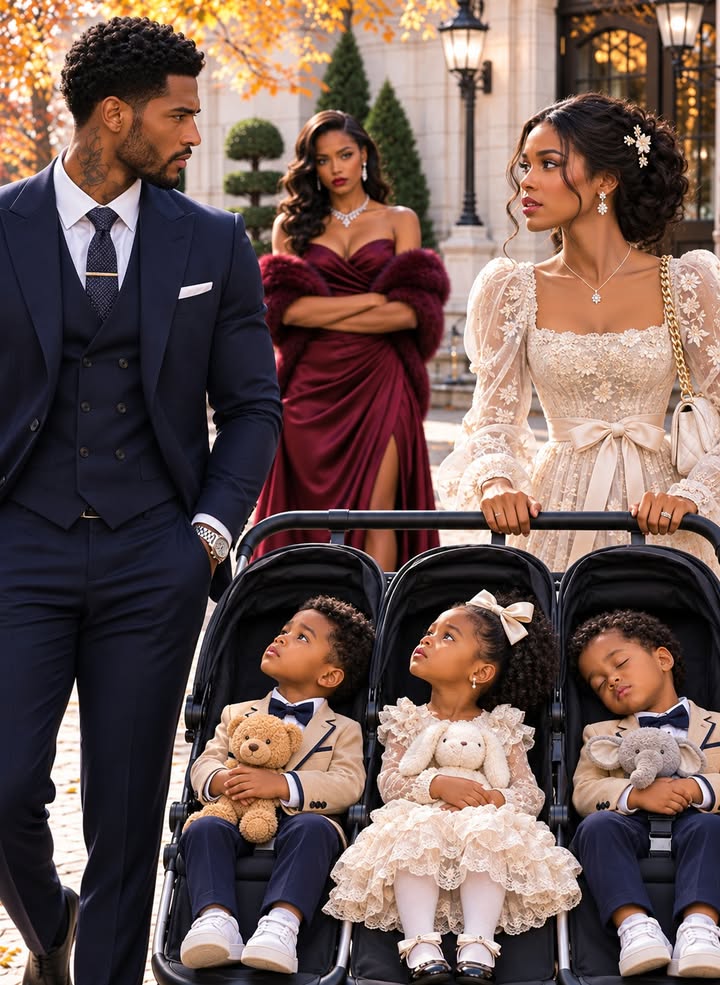
“My grandfather knew.”
Rhys’s words seemed to hang between us, cold and fragile as the November air.
I looked down at my children, because their faces were easier to meet than his.
Finn had stopped arguing with Tessa, and even Jasper’s small hand had gone still around the worn ear of his toy dog.
Children noticed the shape of silence long before they understood what had caused it.
“Don’t say things like that in front of them,” I murmured.
Rhys’s expression changed at once, the shock in his eyes giving way to something more careful.
“You’re right,” he said. “I’m sorry.”
Brooke had come to stand beside him, but she did not reach for his arm or try to pull him away.
She studied the children, then me, with a concern that seemed genuine and a confusion she had every right to feel.
“Rhys,” she said quietly, “perhaps we should give Josephine some space.”
“I agree,” he replied, though his gaze remained fixed on me. “But I need to speak with her.”
“You don’t need anything from me,” I said.
The words came out sharper than I intended, but I had learned that softness could be mistaken for permission.
Rhys lowered his eyes for a moment.
“No,” he said. “I don’t. You don’t owe me a conversation, or an explanation, or even the chance to see them.”
The restraint in his voice unsettled me more than anger would have.
I had prepared myself for accusations, for the familiar Ashford certainty that every problem could be settled by deciding who had the right to give orders.
I had not prepared myself for Rhys to acknowledge that I could refuse him.
Finn peered at him from the stroller, his brows drawn together in a serious little frown.
“Are you the man from the picture?” he asked.
My heart tightened.
Rhys went very still.
“What picture, sweetheart?” I asked, keeping my voice gentle.
“The one in the blue box,” Finn said. “The man with the funny hair.”
Tessa leaned around her brother.
“His hair isn’t funny,” she said. “It’s just very neat.”
Jasper hugged his toy dog closer and looked from Rhys to me.
I had kept one photograph from the short, bright beginning of my marriage, a picture of Rhys laughing on a ferry before we had learned how much pride and silence could cost us.
I had tucked it into a box of things I could not bring myself to discard, never imagining that Finn would find it.
Rhys’s face had softened, but he did not move closer.
“Maybe I am,” he told Finn. “I used to have less neat hair.”
Finn appeared to consider this.
“Did you know my mama?”
“Yes,” Rhys said, his voice roughening. “I did.”
“Are you her friend?”
A breath passed before Rhys answered.
“I’m someone who hurt her,” he said. “And I’m sorry for that.”
I looked at him then, unwillingly, and saw that he had not tried to make the answer easier for himself.
Jasper leaned toward me.
“Can we go home now?”
“Yes,” I said, and the relief that flickered across his face made the decision simple.
Rhys stepped back to clear our path.
“I’ll leave you alone,” he said. “But if you’re willing, I’d like to speak somewhere public, without the children, and only when you decide it’s all right.”
“You don’t get to decide what happens next.”
“I know.”
His answer was immediate, almost too quiet to hear over the rustle of bare branches.
Brooke looked at me with an expression I could not quite read.
“I’m sorry this is happening in front of you,” she said.
“You didn’t cause it,” I replied, though I did not know whether I believed that.
She glanced toward Rhys, then back at me.
“I hope you’ll be careful,” she said.
The remark was ambiguous enough to trouble me all the way home.
I did not know whether she meant careful with Rhys, with the children, or with the Ashford family name that had already taken so much from me.
For the next two days, I heard Rhys’s voice whenever the apartment went quiet.
My grandfather knew.
The words returned while I packed lunches and searched for Jasper’s missing mitten, while I coaxed Tessa through a tantrum over the wrong color cup, and while Finn asked whether the man in the park was going to visit us.
I told the children that Rhys was their father.
I had not planned to tell them that way, in the middle of an ordinary evening with pasta cooling on their plates and a cartoon paused on the television.
But Finn had asked again, and Tessa had heard him, and Jasper had watched my face with the solemn focus of a child who understood that a truth was approaching.
“Yes,” I said finally. “Rhys is your father.”
Finn blinked.
“Does he know that?”
“He knows now.”
“Why didn’t he come before?”
I had no answer that would not place a burden on them.
“I don’t know all the reasons,” I said. “But none of this is because of you.”
Tessa reached across the table and touched my hand.
“Will he take us away?”
“No,” I said, more firmly than I had felt. “No one is taking you anywhere.”
Jasper’s chin trembled, and I gathered him into my arms.
“Everything will happen slowly,” I promised them. “And I’ll be with you.”
That night, after the children were asleep, I sat by the kitchen window and watched the city lights blur in the rain.
I had spent four years building a life that did not depend on Rhys returning to it.
The thought of him near the children frightened me, but the thought of keeping the truth from them frightened me too.
When his message arrived the next morning, I read it twice before answering.
It was brief and contained no demand, no appeal to family rights, and no suggestion that I owed him forgiveness.
He asked if I would meet at the café beside the public library, a busy place with large windows, at a time I chose.
He added that I could bring someone with me, and that he would not ask to see the children unless I raised the subject.
I stared at the screen for a long time.
Then I chose a late morning, when the café would be full and the children would be with my neighbor for an hour.
I told myself I was agreeing to hear him, not to trust him.
The distinction mattered.
Rhys was already seated near the windows when I arrived, his coat folded beside him and a cup of coffee untouched in front of him.
He stood when he saw me, then stopped himself from coming around the table.
“I wasn’t sure you’d come,” he said.
“Neither was I.”
He pulled out the chair across from him but waited until I sat before taking his own.
The small courtesy felt unfamiliar in a man I remembered as someone who could fill every room without asking permission.
For a few seconds, neither of us spoke.
Outside, people crossed the wet pavement beneath umbrellas, their faces turned toward the weather and away from our private past.
Rhys had brought a slim leather folder.
He kept one hand resting on it, as if he were reminding himself not to push it toward me too quickly.
“You said your grandfather knew,” I began. “What made you think that?”
“Because I never received your letters,” he said. “And because I knew nothing about the children until yesterday.”
“That doesn’t prove Cornelius knew.”
“No. It doesn’t.”
His willingness to admit that surprised me.
He drew a slow breath.
“I was at the family office yesterday, going through records my grandfather left behind when he stepped away from day-to-day management,” he said. “There were boxes of correspondence mixed in with his old files. I found one envelope with your name on it.”
My fingers tightened around the paper napkin beside my cup.
“An envelope addressed to you?”
“To me,” he said. “It was from you.”
The café noise seemed to recede, leaving only the low thrum of a milk steamer behind the counter.
“Was it open?”
“No.”
My mouth went dry.
Rhys opened the folder, but he did not take anything out yet.
“I haven’t read it,” he said. “I saw the date and the address, and I thought you should decide whether you want it.”
“Why bring it here?”
“Because it belongs to you.”
“And because you want me to believe your grandfather intercepted it.”
“I want to know what happened,” he said. “But I understand why you don’t trust my explanation.”
I watched his face, searching for the defensiveness I had once learned to expect whenever the Ashfords were questioned.
I found grief there, and exhaustion, but no easy certainty.
“Show me,” I said.
Rhys removed a cream-colored envelope from the folder and set it on the table between us.
My name was written across the front in my own handwriting.
The sight of it was so intimate that for a moment I could not move.
I remembered the letter.
I had written it during the fifth month of my pregnancy, after waiting weeks for an answer that never came.
I had told Rhys that I was afraid, that I loved him, and that our child had begun to move beneath my ribs.
I had begged him to tell me whether he wanted to be part of our baby’s life, even if he no longer wanted to be part of mine.
The envelope had no postmark.
Instead, a faded routing stamp ran across one corner, followed by a sequence of letters and numbers I did not recognize.
“This came from your grandfather’s files?” I asked.
“Yes.”
“How do you know it was never delivered?”
“I don’t. But it was among his papers, and it was still sealed.”
I stared at the envelope.
Four years earlier, I had mailed it to the address he had given me, the private office where his assistant used to receive personal correspondence when he traveled.
It had never occurred to me that a letter could reach that building and still fail to reach Rhys.
“May I?” I asked.
Rhys nodded.
I turned the envelope over.
The flap was intact, its edges faintly yellowed with age.
My throat closed as I traced my finger over the seal.
“I remember writing this,” I whispered. “I thought maybe it had been lost.”
“I’m sorry.”
“You keep saying that.”
“I know it doesn’t fix anything.”
“No,” I said. “It doesn’t.”
I slipped a finger under the flap and opened it carefully.
The paper inside was folded in thirds, just as I had folded it at my kitchen table while trying not to cry.
My handwriting filled the page, hurried and uneven in places.
I read only the first few lines before my vision blurred.
Rhys looked away, giving me the privacy he could still offer, even with the letter between us.
“I won’t read it unless you want me to,” he said.
“You don’t need to.”
I folded the letter along its old creases and placed it back in the envelope.
Then I turned it over again, searching the routing stamp.
The mark was faint, but a small line of text remained legible beneath the numbers.
ASHFORD TOWER — PRIVATE CORRESPONDENCE.
I felt the blood drain from my face.
Rhys noticed.
“What is it?”
I slid the envelope toward him and pointed to the stamp.
His eyes fixed on the words.
For a long moment, he did not speak.
“I’ve never seen that mark before,” he said at last.
“Neither have I.”
He lifted the envelope by its edges, careful not to smudge the faded ink.
“I’ll find out what the code means.”
“You cannot turn this into another Ashford investigation where everyone closes ranks and I’m told to be patient.”
“I won’t ask you to wait for me,” he said. “I’ll find out, and I’ll tell you what I learn. You can decide whether you want to hear it.”
I searched his face.
“Why should I believe you?”
“You shouldn’t have to,” he answered. “Not yet.”
A silence settled between us, less sharp than the one in the park but heavier with all the things we had not said.
Rhys pushed the envelope back toward me.
“It’s yours,” he said. “I won’t keep it.”
I took it and tucked it into my bag.
The gesture was small, but it felt like reclaiming a piece of myself from a house I had never been allowed to enter.
“About the children,” Rhys began, then stopped. “I don’t want to rush them. If you ever think they’re ready to meet me, I’ll follow your lead.”
“They have a right to know who you are,” I said. “That doesn’t mean they’re ready to have you in their lives.”
“I understand.”
“Do you?”
“I’m trying to.”
There was something painful in the honesty of that answer.
I had once imagined that Rhys would be a devoted father, the sort who remembered every small detail and made the children feel safe simply by being there.
That imagined future had died with our marriage.
Now I could see no use in giving him a role he had not earned, even if the children had inherited his eyes.
“Start by not making promises you can’t keep,” I said.
“I won’t.”
“And don’t contact them directly.”
“I won’t.”
“If I agree to a visit someday, it will be supervised, and it will end when they’ve had enough.”
“Of course.”
His face held no resentment, only a sorrow that seemed to deepen when I made the rules clear.
I wondered whether he was beginning to understand that the children were not a lost possession he could simply claim.
They were small people who had already built a world without him.
“Brooke knows about us?” I asked.
“She knows you’re my former wife and that I just learned about the children.”
“Does she know you came here?”
“Yes.”
“Is she comfortable with it?”
Rhys hesitated.
“I haven’t asked her to decide what I’m allowed to do,” he said. “But I know this affects her too.”
I looked down at the coffee I had not touched.
“I don’t want to be the reason another woman is blindsided.”
“You’re not responsible for what I didn’t tell her.”
“And you?”
“I’ll speak to her honestly,” he said. “She deserves that.”
I could not tell whether the answer comforted me or made everything more complicated.
When I stood to leave, Rhys rose too, but he did not ask to walk me out.
“Thank you for meeting me,” he said.
“I haven’t agreed to anything else.”
“I know.”
I reached the doorway before I heard him speak again.
“Josephine.”
I turned.
He looked as though the words cost him something.
“I’m sorry I said there was never an us,” he told me. “I believed you had left me and wanted our marriage erased, but that doesn’t excuse what I said. I knew it would hurt you, and I said it anyway.”
My hand tightened around the strap of my bag.
For years I had replayed that sentence, trying to decide whether he had meant it or had only wanted me to suffer.
His apology did not erase the memory, but it changed the shape of it.
“I need you to understand that being wrong about what happened doesn’t give you back those years,” I said.
“I do.”
“No, Rhys. You’re just beginning to understand.”
He lowered his head.
“You’re right.”
I left before either of us could say anything else.
The letter weighed almost nothing inside my bag, yet I carried it home as carefully as if the words might still be alive.
That evening, after the children were asleep, I placed it on the kitchen table and read it from beginning to end.
My younger self had sounded frightened, but still hopeful.
She had written that the baby was growing well and that she had begun to feel a flutter beneath her ribs.
She had said that she did not expect Rhys to love her again, only that she could not bear the thought of their child growing up believing he had never been wanted.
At the bottom, beneath my name, I had added one more sentence in a smaller hand.
Please tell me the truth, even if it hurts.
I folded the page and pressed my palm against it.
Rhys had not received it.
That much, at least, seemed certain.
But the routing mark meant someone inside Ashford Tower had handled it.
I was still staring at the stamp when my phone buzzed with a message from Rhys.
I found the records office where your letter was routed.
A second message followed before I could answer.
The code is linked to the private correspondence room, not the general mail desk.
Then, after a pause, he sent one more.
There’s an entry in the visitor log with your name on it, dated the week you went to Ashford Tower. The summary says you left without asking to see me.
My hands went cold around the phone.
I had not left without asking.
I had stood in that lobby, five months pregnant and shaking, and begged the security director to let me see Rhys.
I had been told he knew I was there and had refused.
Another message appeared.
I’m going to find out who entered that summary.
I looked at my letter, at the routing mark that had passed through a room I had never been allowed to reach, and then at the dark window reflecting my own face.
For the first time, I wondered whether the lie that had separated us had been written down somewhere—and whether the person who wrote it was still close enough to change the record again.
**–END OF PART 2–CLICK “NEXT” AT THE BOTTOM OF THE PAGE TO CONTINUE READING**
* * *
[NEXT: PART 3](https://puretales.idolsgift.com/blog/part-3-the-letter-he-was-never-meant-to-find-034)
✓ Lynn R. Adams
“My grandfather knew.” Rhys’s words seemed to hang between us, cold and fragile as the November air. I looked down at my children, because their faces were easier to meet than his. Finn had stopped…