PART 2: The Label That Didn’t Belong 041
Part 2 – The Label That Didn’t Belong
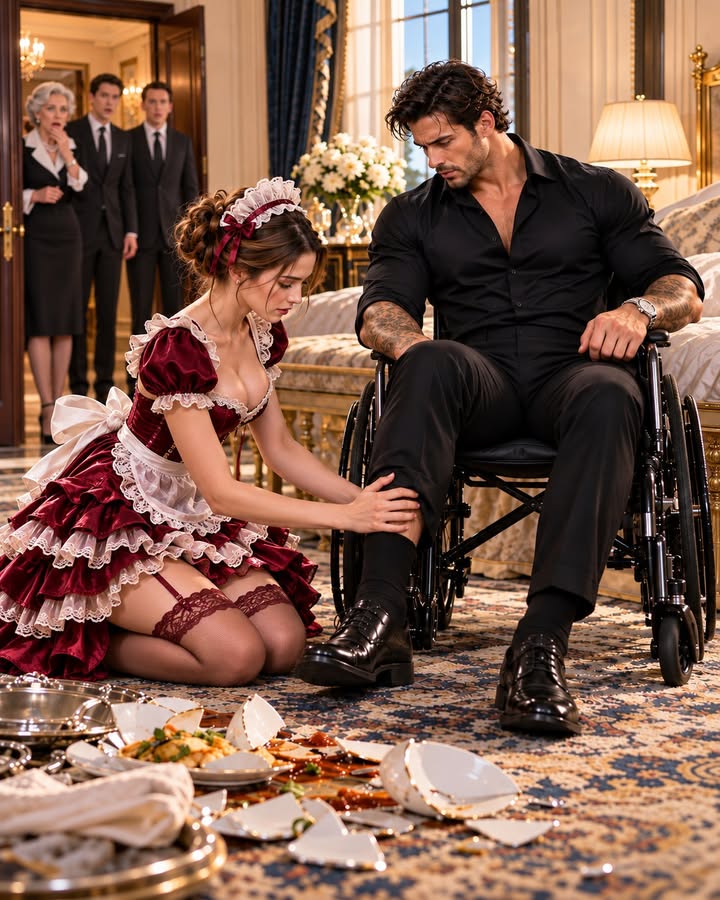
Faith turned back toward me, one hand resting on the bedroom door.
For a moment, neither of us spoke.
The guards had gone still behind her, and Mrs. Gable watched me with an expression I couldn’t read.
“Tomorrow,” I repeated, as if the word had surprised me on its way out.
Faith studied my face, perhaps waiting for me to turn the request into an order.
“I’ll come back,” she said at last.
Something in my chest eased, though I refused to call it relief.
“But I’m here to do a job, Mr. Carter,” she added. “Not to flatter you, and not to tell you that throwing things is acceptable.”
Carmine shifted near the doorway.
I glanced at him, and he looked away before I could decide whether I was annoyed by Faith’s answer or grateful for it.
“I didn’t ask for a lecture,” I said.
“No,” she replied. “You asked me to come back.”
Then she left the room.
The silence she left behind felt larger than the noise of the broken dishes.
Mrs. Gable came in to help me settle my legs beneath the blanket, moving with the patient care of someone who had learned to expect resistance.
I gave her none.
She seemed to notice.
“You did well,” she said quietly.
“I had a spasm, Mrs. Gable, not a medal ceremony.”
“I wasn’t talking about the spasm.”
I looked toward the doorway where Faith had disappeared.
“Don’t make a story out of it.”
“I wouldn’t dare,” she said, but there was warmth in her voice.
When she finished adjusting the blanket, she nodded to the guards and went to find Faith.
Carmine remained.
He had been with me long enough to understand that my silence could be more dangerous than my temper, and he still stood there as if he were waiting for a verdict.
“What?” I asked.
“Nothing.”
“You’ve been standing there for ten minutes. Say it.”
“She has a steady hand.”
“That’s what you wanted to tell me?”
“I wanted to tell you that you looked like you were in pain.”
“I was.”
“And she helped.”
I turned my head toward the window.
Rain trailed down the glass in thin, crooked lines, blurring the bare trees beyond the drive.
“I know what happened.”
“Good.”
“Now leave.”
Carmine hesitated, then obeyed.
For the rest of the day, I tried not to think about Faith.
I failed.
I remembered her kneeling beside my chair, her palms steady against my leg while I shouted at her.
I remembered that she had used my name.
And I remembered how quickly the pain had stopped after she told me to breathe.
By evening, the room smelled of rain-soaked wool and the dinner tray Mrs. Gable had set beside my bed.
I stared at the covered plate until the food went cold.
My hands worked the controls on my chair, and I rolled toward the window, hoping that movement might distract me from the feeling of being trapped inside a body that no longer followed my commands.
The pain in my thigh had dulled, but a restless tightness remained.
I hated waiting for someone to help me.
I hated needing help at all.
When Mrs. Gable came to take the untouched meal, she stopped at the sight of it.
“You need to eat something.”
“I’m not hungry.”
“You’ve said that for three meals.”
“Then I’m consistent.”
She didn’t argue.
She only took the tray and left the door open behind her.
A few minutes later, Faith appeared in the doorway carrying a glass of water.
“I thought you were leaving,” I said.
“I am.”
She set the water on the table beside me.
“Mrs. Gable said you hadn’t eaten.”
“Mrs. Gable talks too much.”
“She worries.”
“Then she should find something more useful to do.”
Faith glanced at the untouched plate.
“You could start with a few bites.”
“You’ve been here one day, and you already think you can tell me what to do?”
“No,” she said. “I think food is better when it’s warm.”
She pulled the chair beside the table closer and lifted the cover.
The meal had been replaced with a fresh plate, and steam rose from a bowl of soup.
I watched her set it down.
“You don’t have to stay,” I said.
“I know.”
She took a step toward the door.
The words came out before I could reconsider them.
“Stay.”
Faith paused.
I looked away, irritated at myself for making the request sound like a confession.
“If you’re going to fuss about the food, you may as well see that I eat it.”
“Fair enough.”
She sat across from me, not too close, and folded her hands in her lap.
For a few minutes, the only sound was the rain ticking against the windows and the quiet clink of my spoon against the bowl.
The soup was bland.
It was also warm.
I kept eating.
Faith didn’t praise me for it, which made it easier.
When I had finished half the bowl, she leaned back.
“Better?”
“It’s soup.”
“That’s not an answer.”
“It’s the only one you’re getting.”
She accepted that without pressing.
The quiet between us no longer felt quite as sharp as it had that morning.
I noticed the worn seam at the cuff of her sweater and the small, neat stitches where it had been mended.
“You really need this job?” I asked.
“Yes.”
“Why?”
Her eyes lifted to mine.
“I have rent due Friday.”
“You already told me that.”
“I thought you might have forgotten.”
“I don’t forget things.”
“Then you know why I need it.”
There was no self-pity in her voice, only a simple fact.
I found that more difficult to dismiss than an appeal for sympathy.
“Most people who need money are more careful about upsetting the person paying them.”
“Most people don’t get to choose how someone treats them.”
The words landed quietly, but they stayed with me.
I turned the spoon in my fingers.
“And you think I treat you badly.”
“I think you’re angry,” she said. “I think you’ve been hurt, and I think you’ve decided that making other people uncomfortable will keep them from getting close enough to see it.”
I stared at her.
“You’ve known me for a day.”
“Long enough to watch you throw breakfast across a room.”
“Maybe I simply don’t like oatmeal.”
“Then you could have said that.”
A reluctant breath escaped me, close enough to a laugh that I caught it before it became one.
Faith noticed, but she didn’t comment.
After a moment, I asked, “Why didn’t you flinch when I shouted?”
“I did.”
“You didn’t.”
“I was afraid,” she said. “I just didn’t want fear to make the decision for me.”
I set the spoon down.
“That sounds practiced.”
“It is.”
Something in the way she said it made me look at her more carefully.
She folded one thumb beneath the other, as though deciding whether she wanted to continue.
“My younger brother had an accident when he was a teenager,” she said. “He couldn’t walk for a while.”
I waited.
“Was it serious?”
“It was serious enough that the doctors didn’t know how long he’d need a wheelchair, but they couldn’t promise anything beyond the next few months.”
Her voice softened, though it never became unsteady.
“I helped take care of him at home after the hospital. His therapist showed us some basic exercises and how to move his legs without hurting him.”
I remembered her hands against my thigh, firm but careful.
“That’s why you knew what to do today.”
“I knew how to stay calm,” she said. “That isn’t the same thing as knowing what was wrong with you.”
“Did it work?”
“My brother recovered most of his mobility. It took time, therapy, and a lot of stubbornness on his part.”
“And you think I can recover?”
“I don’t know,” she said. “I’m not your doctor, and I won’t pretend I can promise you anything.”
The honesty of it was almost a relief.
“Your brother got better.”
“He did. That doesn’t mean your situation is the same.”
I stared down at the soup.
For six months, people had used the word recovery as if it were something they could hand me if I behaved well.
Faith hadn’t offered me hope.
She had offered me the truth, with no ribbon around it.
“What happened to your brother?” I asked.
“His car was hit on a wet road. He was lucky.”
“Lucky.”
“Lucky to live, lucky to have a good therapist, lucky to have family nearby,” she said. “There was a lot of hard work in the middle, but luck mattered too.”
I looked toward the rain.
“What if it doesn’t happen for me?”
She didn’t answer right away.
When I looked back, she was watching me without pity.
“Then you’ll still be you,” she said. “Even if you don’t feel like yourself right now.”
I wanted to tell her she was wrong.
Instead, I said, “That’s easy to say when your body works.”
“Yes,” she replied. “It is.”
Her voice carried no defense, only acknowledgment.
It made the words I’d prepared feel mean and unnecessary.
Faith rose and gathered the empty bowl.
“Do you want me to come back tomorrow?”
I was surprised she had asked.
“You already said you would.”
“I said I’d return for the job. I’m asking whether you still want me in this room.”
I could have told her no.
It would have been simpler than admitting that the thought of another day alone with my anger had begun to feel worse than the thought of letting her stay.
“Yes,” I said.
“All right.”
“But don’t expect me to be pleasant.”
“I won’t.”
She carried the bowl toward the door.
“Faith.”
She turned.
“Thank you.”
The words sounded unfamiliar in my mouth.
She nodded once, as though accepting them without making a ceremony of it.
“You’re welcome, Dominic.”
The next morning, she returned with a small notebook tucked into her pocket.
I saw it when she placed my breakfast on the table.
“What’s that for?”
“Keeping track of your meals and the things you need.”
“Mrs. Gable already does that.”
“She does. This is for what I notice while I’m here.”
“You’re a caretaker, not a detective.”
“I’m not trying to investigate anything,” she said. “I just don’t want to forget details that might matter to your care.”
I almost told her to put it away.
Instead, I watched as she wrote down the time I’d taken my morning medication.
The morning passed quietly.
At lunch, I ate a few bites of chicken and told her the sauce tasted like something a hospital would serve to punish its patients.
She answered that at least the soup was better.
By the third day, our conversations had grown long enough to fill the silences between meals.
She told me her brother was back at work, though he still avoided wet roads.
I told her the house had been built by a man who believed every room should be twice as large as it needed to be.
She said that explained why the mansion felt as though it was waiting for a crowd that never came.
I asked whether she had always planned to become a caretaker.
“No,” she said. “I was studying to be a medical assistant when my brother got hurt. I put school on hold so I could help at home.”
“Do you plan to go back?”
“If I can afford it.”
It was the first time I had thought about what happened to her after the shift ended.
At first, I had seen her as a person who appeared when I needed something and disappeared when she was done.
Now I found myself wondering whether she had eaten, whether her boots had dried, and whether the rain had stopped before she walked to the bus.
I didn’t ask.
I had no idea how to do it without sounding as though I were issuing an order.
That afternoon, one of the spasms came without warning.
It began as a hard, sudden tightening in my thigh, then spread down toward my knee.
My hand clamped around the armrest.
Faith was at the dresser, replacing a stack of folded towels.
She turned as soon as she heard my breath catch.
“Is it starting?”
I nodded, unable to answer.
She moved closer but stopped just beyond arm’s reach.
“Do you want me to help?”
The question surprised me more than the pain.
No one had asked before touching me.
“Yes,” I managed.
She came to my side and guided me through the slow breathing she had used the first time.
She didn’t force my leg or pretend she could make the pain vanish.
She waited until my muscles loosened enough for me to settle back.
When it passed, sweat dampened the collar of my shirt.
Faith handed me a glass of water.
“How often does that happen?”
“Not always this bad.”
“Does it happen more after a particular treatment?”
“I don’t know.”
“Have you noticed a pattern?”
I started to answer, then stopped.
The spasms had been worse on some days than others.
I had assumed that meant my body was becoming less predictable, another way it had betrayed me.
“I’m not sure,” I said.
Faith opened her notebook.
“Would you mind if I wrote down when it happens and what you’ve had before?”
“You’ve been keeping notes already.”
“Only meals and what you’ve told me. I’m asking before I start adding things about your pain.”
I studied her face.
She wasn’t trying to take control.
She was asking to help me notice.
“Write it down,” I said.
She marked the time, then asked what I had received that morning.
“Therapy. Medication. The usual.”
“Do you know what medication?”
“No.”
“You don’t know what they give you?”
“I know what I’m told.”
Her pen paused over the page.
I saw the hesitation, slight but unmistakable.
“What?”
“Nothing yet,” she said. “I’d like to check your care notes before I make assumptions.”
The words irritated me because they sounded reasonable.
“Ask Mrs. Gable.”
“I will.”
That evening, after I had eaten more than half my meal, Mrs. Gable brought in the folder with my care notes.
She laid it on the desk and opened to the medication schedule.
Faith stood beside her, reading the entries without touching anything.
Carmine was in the hall, speaking quietly with one of the guards.
Faith’s eyes moved down the list, then stopped.
“What is it?” I asked.
She looked at Mrs. Gable before answering.
“I don’t want to make a conclusion from one detail.”
“Then tell me the detail.”
She pointed to a line in the notes.
“The medication listed here is supposed to come from Bellwood Pharmacy.”
Mrs. Gable leaned closer.
“Yes. That’s the pharmacy the doctors prescribed.”
Faith’s gaze shifted to the small bottle beside the water glass.
The label had been turned partly toward the wall.
She picked it up, careful not to disturb the cap, and read the printed information.
“This says Northside Community Pharmacy.”
Mrs. Gable took the bottle from her and checked the label herself.
Her expression changed.
“Perhaps the pharmacy transferred the prescription,” she said, though she sounded less certain than before.
“Would that change the label?” Faith asked.
“I don’t know.”
I looked from one woman to the other.
“What does it mean?”
“It may mean nothing,” Faith said. “But it doesn’t match the care notes.”
“Has this happened before?”
“I haven’t checked every bottle,” Mrs. Gable replied.
She turned the bottle in her hands, then looked toward the open doorway.
Carmine had stopped speaking.
He stood at the far end of the hall, watching us.
“How long has that bottle been here?” I asked.
Mrs. Gable glanced at the date printed beneath the pharmacy name.
“Three days.”
Faith’s fingers tightened around her notebook.
“That’s when the spasms started getting worse,” she said.
The room seemed to grow colder around us.
Carmine stepped inside, his face controlled, his eyes fixed on the bottle.
“What’s going on?”
Mrs. Gable held it up.
“This label doesn’t match the pharmacy in Dominic’s care notes.”
For a moment, Carmine said nothing.
Then he looked at the schedule, and the color drained from his face.
“That prescription wasn’t supposed to come from Northside.”
**–END OF PART 2–CLICK “NEXT” AT THE BOTTOM OF THE PAGE TO CONTINUE READING**
* * *
[NEXT: PART 3](https://echoesofstories.idolsgift.com/blog/part-3-the-label-that-didn-t-belong-041)
✓ Lynn R. Adams
Part 2 – The Label That Didn’t Belong Faith turned back toward me, one hand resting on the bedroom door. For a moment, neither of us spoke. The guards had gone still behind her, and Mrs. Gable watc…