PART 2: The Knot That Rang the Bell 058
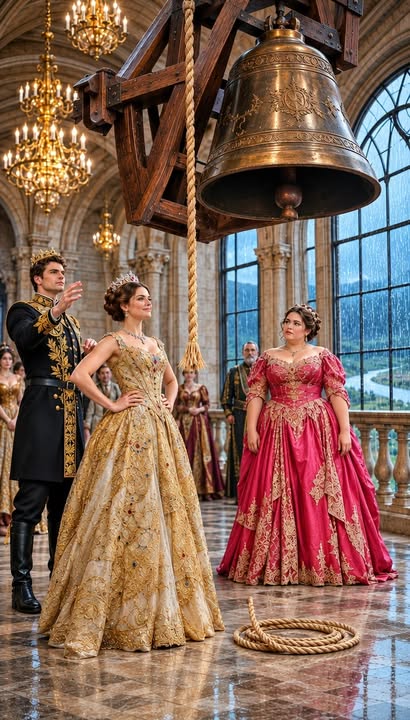
…her fingers still moving when the room fell silent.
She brought the thin end around the back of the doubled thick rope, then tucked it beneath the turn she had made, leaving a generous curve rather than pulling it tight at once.
“Not a square knot,” the prince murmured.
“No,” she replied, keeping her eyes on the fibers. “A bend.”
She threaded the thin end through the loop again, this time following the path that would make the two turns settle against each other instead of slipping apart.
The knot was not pretty in the polished, symmetrical way the noblewoman’s had been.
It was broad and slightly uneven, with the thinner rope wrapped snugly around the thicker one, each turn laid carefully beside the last.
The younger woman paused to dress the strands, easing one crossing into place with her thumb and checking that no loop had twisted against its neighbor.
She tested it with a measured pull.
The ropes held.
The servant who had whispered earlier drew in a quiet breath.
“Now,” the prince said, though his voice carried less command than expectation.
The young woman took hold of the lower length and looked once at the bell wheel above.
“If the rope is going to fail, I want to know before I put my weight on it.”
“You have the same chance as everyone else,” he said.
“I know.”
She braced her feet on the marble and pulled downward.
The knot tightened with a low creak.
The old hemp groaned against the newer line, and the wheel turned a fraction.
Then the bronze bell gave a deep, resonant note that rolled through the gallery and trembled against the windows.
A second note followed, fuller than the first.
The sound seemed to settle into the stone itself.
Outside, beyond the rain-streaked glass, a cluster of staff in the courtyard looked up toward the tower.
The younger woman held the rope until the bell’s last vibration faded.
Then she released it carefully, as if the silence afterward deserved the same attention as the sound.
For a moment, no one spoke.
The prince’s expression had changed.
The formal composure remained, but behind it was something unguarded: relief, perhaps, or the shock of hearing a sound he had feared might never come.
“You passed,” he said.
The younger woman rubbed her palms together, brushing away bits of hemp. “The knot passed.”
A few guests laughed softly, relieved to have permission.
The prince glanced at the noblewoman.
“She passed the test,” the noblewoman said before he could speak. Her cheeks were still flushed, but her voice had steadied. “The bell sounded. The knot held.”
The younger woman looked at her.
It was not an apology, and it did not erase the sharpness of the remark made moments before.
But it was fair, and fairness seemed to cost the noblewoman something.
“Thank you,” the younger woman said.
The noblewoman gave a small nod, then looked away toward the bell.
The prince stepped closer to the ropes.
“Tell me why you chose that bend.”
The younger woman glanced at the guests, who had begun to shift and whisper again.
“Because the ropes weren’t the same size,” she said. “The square knot works best when both sides are similar. The thin line had room to travel through the thick one, especially once the weight went on.”
“And the extra turn?”
“It gives the smaller rope more grip. But the turns have to sit properly. If you leave them crossed or loose, they can still slip.”
The prince crouched to inspect her work.
He did not touch the knot at first.
Instead, he studied it as though it were a page of writing he had not expected to read.
“You noticed the newer rope,” he said.
“I noticed the difference in texture.”
“Most people would have assumed they were the same.”
“Most people were invited to look at the bell.”
A brief smile crossed his face.
Then it vanished.
“Your name?” he asked.
“Lena Hart.”
She had given her name to the prince at the beginning of the gathering, but the answer felt different now, stripped of ceremony.
“Thank you, Lena.”
The gathering loosened around them.
Guests who had been silent during the test began speaking again, their voices bright with relief and speculation.
One of the older ladies praised the bell’s tone.
A man near the windows declared that the sound could be heard all the way to the lower gardens.
The noblewoman remained beside the ropes, studying the knot.
Her beautiful gown had a faint streak of dust along its hem where she had knelt.
She noticed Lena noticing it and smoothed the fabric with one hand.
“I suppose I should have examined the rope before trusting what I knew,” she said.
“You knew a useful knot,” Lena replied. “You just had a different problem.”
“That is a gracious way to put it.”
“It’s also true.”
The noblewoman studied her face, searching for mockery and finding none.
“My name is Amara Vale,” she said. “My family has been invited to these gatherings since before my grandmother was born.”
“Then you’ve had a lot of practice at being watched.”
“More than I’d recommend.”
A hint of humor touched her mouth.
Lena’s smile answered it, small but genuine.
The prince glanced between them, and for a moment the three of them seemed less like contestants and judges than people who had found themselves on the same side of an unexpected problem.
Then a court official approached, reminding the prince that the guests were waiting to be received in the gallery’s adjoining salon.
The prince nodded.
“Please join us,” he said to Lena and Amara.
Amara’s eyes flicked toward the bell.
“Are we finished here?”
“For the test,” he answered.
The distinction lingered.
Before she could ask what he meant, the official opened the carved doors, and the guests began filing out in a rustle of silks and damp coats.
Lena followed at a slower pace.
She had been invited to the palace as a guest of one of the valley’s civic committees, not as a member of the court, and the gallery felt more familiar to her than the bright rooms beyond it.
She had spent much of her life around things people relied on without thinking about them: pumps, gates, ladders, ropes, doors that needed their hinges tightened before someone got hurt.
No one had ever asked her to demonstrate that knowledge in a palace.
In the salon, the prince spoke briefly with the guests, thanked them for coming, and promised that the flood bell would be inspected.
He said nothing about a queen.
He said nothing about why the test had been arranged.
When the room began to empty, Amara stayed near one of the tall windows.
Lena noticed she had not gone to find her family.
Instead, she stood with her hands folded, watching rain trail down the glass.
“You don’t have to stay,” Lena said.
Amara turned.
“Neither do you.”
“I was waiting to see whether the bell needed anything else.”
“And I was waiting to see whether I could say something without an audience.”
The answer surprised Lena.
Amara glanced toward the doorway, where the last of the guests were leaving.
“I was rude to you,” she said.
“You were embarrassed.”
“That doesn’t make it less rude.”
“No,” Lena agreed. “But it helps me understand it.”
Amara lowered her eyes.
The glittering stones at her throat caught the gray daylight.
“I had convinced myself that this was a test of what I knew,” she said. “That I could prepare for it, perform well, and leave with everyone believing I deserved to stand beside the prince.”
“And now?”
“Now I’m not sure what I was meant to prove.”
Lena considered the question.
The prince’s words returned to her: a queen may have to face it.
“I don’t think it was only about the knot,” she said.
Amara gave a quiet, rueful laugh. “That would be convenient. I failed the knot.”
“You noticed the rope was defective.”
“I noticed it after the knot failed.”
“You could have blamed the rope and walked away.”
“I nearly did.”
“But you didn’t.”
Amara looked back toward the gallery.
The bell’s bronze mouth was visible through the open doors, dark against the pale stone.
“I’ve spent years learning how to enter a room,” she said. “How to stand, when to speak, what people will expect from me. No one ever taught me what to do when I’m wrong in front of them.”
“Most people aren’t taught that.”
“Perhaps they should be.”
Lena did not answer at once.
It was easier to be kind when kindness cost nothing.
It was harder when she could still hear Amara’s earlier question: And you expect her to fix what an entire tower staff couldn’t?
Yet the embarrassment in Amara’s face had been real, and so had the care with which she had acknowledged Lena’s success.
“You don’t have to know the right thing immediately,” Lena said at last. “Sometimes you just have to look again.”
Amara studied her.
“That sounds like something you learned the hard way.”
“Most useful things are.”
They stood together in a quiet that was not quite comfortable, but no longer hostile.
From the gallery came the scrape of a chair and the prince’s low voice, speaking to one of the attendants.
Lena could not make out the words.
Amara followed the sound.
“He looked relieved when the bell rang,” she said.
“He did.”
“More relieved than a man should be over a test.”
Lena’s gaze shifted toward the adjoining room.
The prince had been watching the bell before she pulled the rope.
Not the guests.
Not Amara’s failed knot.
The bell.
“I thought so too,” Lena said.
A footman appeared at the doorway.
“His Highness asks if Miss Hart and Lady Vale would join him in the west gallery.”
Amara exchanged a look with Lena.
“Do you know why?” she asked.
“No,” Lena said.
But she had begun to suspect that the answer had nothing to do with crowns.
The prince waited beside the bell wheel when they returned.
The other attendants had gone.
Only a thin line of afternoon light remained between the storm clouds and the horizon, illuminating the old woodwork and the two ropes now resting in a careful coil.
The prince had removed his crown.
He held it loosely in one hand, as though it had become an object he did not know where to put.
“I owe you both an explanation,” he said.
Amara stood at his left, her posture precise.
Lena remained near the rope, where she could see the knot.
“The test was presented as a question of judgment,” the prince continued. “That was true, but incomplete.”
“Why incomplete?” Amara asked.
“Because I wanted to see whether someone would take time to understand the problem before acting.”
He looked at Lena.
“Your first choice was to inspect the materials. You didn’t assume that the ropes were equal because they had been placed together.”
“I’ve seen too many things fail because someone treated them as though they were.”
“And you,” he said to Amara, “recognized the failure when it happened. You didn’t try to hide it.”
She gave him a steady look.
“Not before I blamed the rope.”
“You did not hide that either.”
A small silence followed.
The prince turned to face the bell.
“The lower valley depends on this alarm when the river rises. There are other warnings now, of course, but the bell is part of the system. It should be tested regularly. The records say it is.”
Lena heard the care with which he said the records say.
“Do they?” she asked.
He looked down at the rope.
“No,” he admitted. “That is the problem.”
Amara’s expression sharpened.
“How long has the bell been neglected?”
“I don’t know yet.”
“You arranged a public test without knowing whether the mechanism worked?”
“I arranged a test because I suspected it did not.”
The answer changed the air in the gallery.
Lena looked again at the uneven ropes, the old hemp and the newer line.
“Why not simply have the tower staff repair it?” she asked.
“I asked for an inspection. I was told the bell was in good order.”
“And you didn’t believe them?”
“I believed they might have believed it.”
That was not quite an answer, but it sounded honest.
The prince walked to the window and watched rain run over the stone ledge outside.
“Last spring, a maintenance report described the bell as reliable,” he said. “The month before that, a note from the lower valley mentioned that its sound was difficult to hear during heavy rain. The note was filed, but no repair was recorded.”
“Perhaps the bell was tested on a clear day,” Amara said.
“Perhaps.”
“And the rope?” Lena asked.
“The replacement was recent. Someone made an effort to fix it.”
“But not the whole system.”
“No.”
He looked ashamed of the admission, though the neglect had begun before he had taken responsibility for the palace.
“My father died before I inherited the work of this office,” he said. “He was careful in many ways. But I have found that care can become a word people use when they mean routine.”
Amara’s face softened.
“Your father’s reputation is still part of every decision you make,” she said.
The prince turned toward her.
“Yes.”
“And you thought this test might tell you who could stand beside you while you looked into it.”
“I thought it might tell me who would look at the problem rather than at the people watching.”
“Then you should have said so,” Amara replied.
“I should have.”
Her answer carried no cruelty, only the clean edge of truth.
The prince accepted it with a slight bow of his head.
“Why didn’t you?” Lena asked.
He took a moment before answering.
“Because if I had told everyone the bell might fail, they would have wanted a name for the failure before anyone knew what had happened. I thought I could test it quietly.”
“Quietly?” Amara asked, glancing toward the open gallery doors. “You invited half the court.”
“I wanted witnesses who would not be part of the maintenance staff.”
“That is not the same as quiet.”
“No,” he said. “It isn’t.”
For the first time, Lena saw how alone he was in the room.
The uniform made him look certain, and the small gold crown had made him look older than twenty-eight.
Without it, he seemed like a man who had inherited a problem along with a title and could not decide whether admitting uncertainty would make matters better or worse.
“You asked me to make a knot,” Lena said. “You didn’t ask me to investigate the palace.”
“I know.”
“Then don’t decide that I can fix it just because I know how rope works.”
“I won’t.”
She held his gaze until she believed he meant it.
“I can tell you what I see,” she said. “If you want that.”
“I do.”
Amara moved closer to the bell.
“What would you need?” she asked.
“Someone to inspect the wheel, the rope, and the records of repairs,” Lena said. “Not only to see whether this knot holds. We should find out why the rope was replaced and whether the bell itself is sound.”
The prince’s eyes moved to Amara.
“And what would you need?”
“To know whether you intend to hear what the records say,” she answered.
He seemed to understand that the question was not about courage alone.
“I do,” he said.
Amara glanced at Lena.
Her expression had changed since the test.
There was still embarrassment there, but also curiosity, as if she had discovered a room in the palace she had never been shown.
“I know something about the old household accounts,” she said. “My family supplied the palace for generations. I have seen records most people never bother to read.”
“Would you help us inspect them?” the prince asked.
“I said I know something about them. I did not say I trusted them.”
“Neither do I.”
A pause passed between them.
It was the first agreement they had made without either pretending it was easy.
The prince set his crown on a stone ledge.
“I’ll ask the archivist to bring the maintenance ledgers tomorrow morning. You may both come, if you wish.”
Lena looked once more at the knot.
“I’ll come.”
Amara did not answer immediately.
Her gaze rested on the fibers where the thin rope had been drawn tight around the thick one.
“I’d like to see how you made it,” she said to Lena. “Not because I think I can repair the whole bell. I want to understand what I missed.”
“You want me to teach you?”
“If you’re willing.”
Lena had expected another polished excuse, or a graceful way to return to familiar ground.
Instead, Amara looked uncomfortable and sincere.
“I’m willing,” Lena said.
The noblewoman exhaled, as though she had been holding her breath since the failed pull.
“Then I’ll come tomorrow.”
The prince replaced his crown but did not immediately put it on.
“Thank you,” he said. “Both of you.”
It was getting late when they left the gallery.
At the outer doors, Amara paused beside Lena.
“I meant what I said about the knot,” she said. “I don’t want to be taught how to look as though I understand it.”
“I wouldn’t know how to teach that.”
“Good.”
They shared another small smile, still tentative, but less guarded than before.
Then Amara’s attendant joined her, and the two women went down opposite corridors.
Lena remained in the entrance hall long enough to hear the flood bell give a faint metallic click behind her.
She turned back.
The prince was standing alone beside the wheel, one hand lifted as though he had almost touched it.
“Is something wrong?” she asked.
He listened.
“I don’t know.”
The wheel had settled after the bell’s ringing, but a small chain near its upper bracket was swaying gently, though the air in the gallery was still.
Lena stepped closer.
“Did it do that before?”
“I don’t think so.”
She crouched beside the support and examined the joint where the chain met the old wooden frame.
There was no obvious break.
But tucked behind the bracket was a narrow strip of paper, browned at the edges and folded twice.
It might have been an old label, or a piece of waste caught in the wood.
Lena reached toward it, then stopped.
“Should I leave it?”
The prince came to stand beside her.
For several seconds, neither of them moved.
Then he said, “No. Take it out carefully.”
She eased the paper free.
A few grains of dust fell to the floor.
The fold was brittle, but it opened without tearing.
There were only a handful of lines, written in faded ink.
The prince read them over her shoulder.
His face went still.
“What does it say?” Lena asked.
He did not answer at once.
The paper trembled slightly in his hand.
At the bottom was a date, written in a clerk’s neat script: the date the new rope had supposedly been ordered.
Above it, beside a blurred seal, was the signature of his father.
The prince’s eyes remained on the name.
“That cannot be right,” he whispered.
But the date on the paper came months before his father had died.
**–END OF PART 2–CLICK “NEXT” AT THE BOTTOM OF THE PAGE TO CONTINUE READING**
* * *
[NEXT: PART 3](https://storyly.idolsgift.com/blog/part-3-the-knot-that-rang-the-bell-058)
✓ Lynn R. Adams
…her fingers still moving when the room fell silent. She brought the thin end around the back of the doubled thick rope, then tucked it beneath the turn she had made, leaving a generous curve rather …