PART 2: The Key Brenda Couldn’t Explain 035
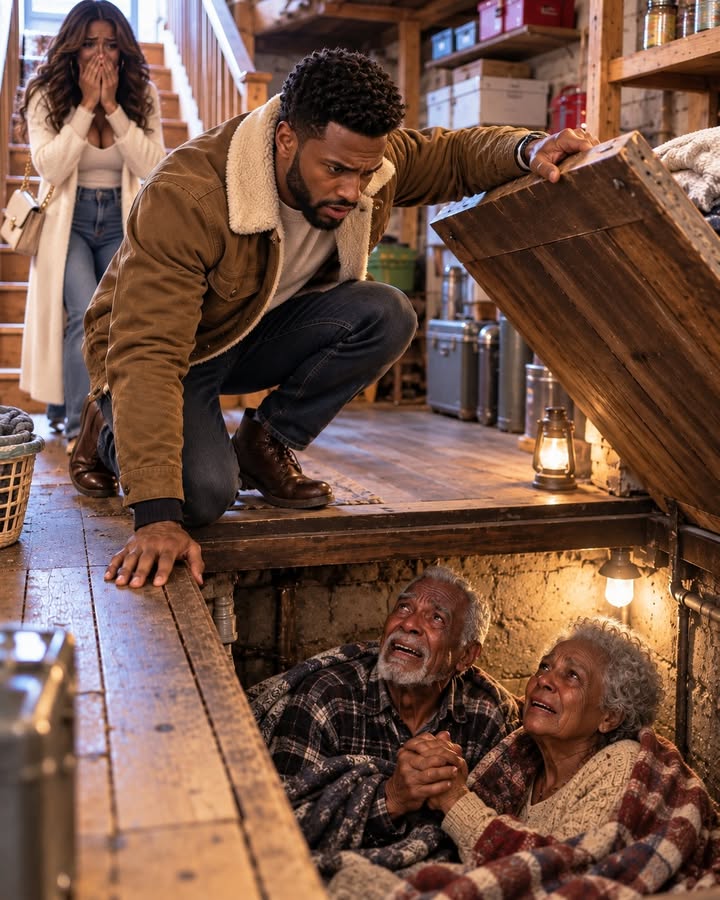
Part 2 – The Key Brenda Couldn’t Explain
Brenda stood in the hallway with the basement key clenched in her trembling hand.
For a moment, neither of us spoke.
The old house seemed to hold its breath around us, every shadow fixed in place beneath the dim light over the stove.
Then Brenda glanced at my phone.
“Don’t call anyone,” she said.
Her voice wasn’t angry, exactly.
It sounded frightened.
I lowered the phone but kept it in my hand.
“Why not?”
She swallowed and looked toward the basement door.
“Because there’s nothing down there.”
I let the silence stretch between us.
“There were three knocks,” I said.
“Old pipes,” she answered quickly.
“Pipes don’t knock three times and stop.”
“They do in this house.”
She moved past me and reached for the light switch, but her fingers missed it once before she found it.
The kitchen brightened, revealing the steel padlock and the key in her hand.
I looked from one to the other.
“Why do you have the key?”
Brenda’s face tightened.
“I told you, I’m handling everything now.”
“That doesn’t answer my question.”
She shifted her weight, then folded her arms as if the gesture could protect her from the words she wasn’t ready to say.
“The basement has always been cluttered,” she said. “Dad kept tools down there, old paint, boxes nobody needs. I locked it because the steps are uneven.”
“Then why did you say there was nothing down there?”
“Because there is nothing that concerns you.”
The answer landed harder than she seemed to intend.
I looked at her carefully, searching for the sister I had known before the twelve years between us grew into a wall.
When we were young, Brenda used to follow me through the woods behind our house with a flashlight and a paper map, even though she always insisted she knew the way better than I did.
She hated being left behind.
I had never thought about how often I had left her behind anyway.
“Brenda,” I said quietly, “where are Mom and Dad?”
Her eyes moved to mine, then away.
“They’re safe.”
“Where?”
“Shawn, it’s two in the morning.”
“That doesn’t tell me where they are.”
She stepped closer, the key still curled in her palm.
“Please don’t turn this into something it isn’t.”
I wanted to press her, to demand that she open the door, to ask what kind of person let her brother stand over a locked basement while their parents might be below him.
But her face had gone pale, and the tremor in her hand seemed to spread into her shoulders.
I remembered what George had said about Nancy leaving in tears.
I remembered our father’s bent glasses and the gray sweater lying outside in the dust.
And I remembered how easily my family had taught me to accept explanations when I was young, because asking another question felt too much like accusing someone I loved.
So I made myself breathe.
“I’m not trying to hurt you,” I said.
She gave a faint, humorless laugh.
“You show up after twelve years and think you can fix everything in one night.”
“I know I can’t fix everything.”
“Then why are you standing here like I’m on trial?”
“Because I heard someone knock from beneath the kitchen floor.”
“You heard pipes.”
“And you had the key.”
She looked down at it as if she had forgotten it was in her hand.
For a brief second, I thought she might tell me the truth.
Instead, she closed her fingers around the key and tucked it into the pocket of her cardigan.
“You should go back to bed,” she said. “We’ll talk in the morning.”
“I’m not going anywhere until I know they’re safe.”
“They are safe.”
“Let me speak to them.”
Her mouth opened, but no answer came.
That small pause was more frightening than anything she could have said.
“Brenda,” I whispered, “please.”
She looked past me toward the darkened window over the sink.
“They’re asleep.”
“Where?”
“Somewhere quiet.”
“Why can’t I see them?”
“Because they need rest.”
“Then let me see them in the morning.”
“I said we’ll talk in the morning.”
The certainty in her voice had returned, but something underneath it had changed.
She sounded less like a sister defending a decision and more like someone guarding a door she did not know how to open.
I slid my phone into my pocket.
“All right,” I said. “In the morning.”
Her shoulders loosened just slightly.
It was a small concession, but I could see the relief it brought her.
“I’ll make coffee,” she said.
“Not tonight.”
“Shawn, please don’t make this harder.”
I studied her face.
The expensive clothes, the polished nails, the careful smile from earlier that evening all seemed to belong to another person.
Underneath them was my sister, tired and frightened, though I couldn’t tell whether she feared what I might find or what I might think of her.
“I’m going upstairs,” I told her. “But I’m not done asking.”
She nodded once.
I climbed the stairs slowly, aware that she remained in the kitchen below me.
At the top, I turned and looked down.
Brenda was standing beside the basement door with her hand over the pocket where she had hidden the key.
She did not look up.
In the guest room, I sat on the edge of the bed and listened.
For a long while, there was only the hum of the refrigerator and the steady tick of the clock in the hallway.
Then I heard a door close downstairs.
I waited another ten minutes before I picked up my phone.
George answered on the second ring.
“Shawn?”
“I’m sorry to wake you.”
“You sound like you need something.”
“I do.”
I pressed my voice low, though I was alone in the room.
“Can you stay nearby tomorrow?”
There was a pause on the other end.
“Is something wrong?”
“I don’t know yet.”
“That’s not the same as nothing being wrong.”
“I heard knocks from the basement.”
George’s silence changed.
“I see.”
“Brenda says it was the pipes.”
“And you don’t believe her?”
“I don’t know what I believe.”
George exhaled softly.
“Don’t do anything reckless, Shawn.”
“I won’t.”
“I mean it.”
“So do I.”
He asked where I was, and I told him I was in the guest room.
“I’ll be at the house before lunch,” he said. “If you need me sooner, call.”
“Thank you.”
“And Shawn?”
“Yeah?”
“Whatever you find, remember Brenda has been there alone with it longer than you have.”
The words stayed with me after the call ended.
I lay down without changing my clothes.
Sleep came only in brief, uneasy stretches, and each time I woke, I found myself listening for another knock.
None came.
At dawn, the house smelled of coffee and toast.
I went downstairs to find Brenda standing at the kitchen counter, dressed for the day.
The basement door was shut, and the padlock was gone.
My eyes caught the difference immediately.
“Where’s the lock?”
“Put away.”
“Why?”
“Because I’m not leaving a lock hanging on the basement door if you’re going to keep staring at it.”
She set a mug on the counter, though neither of us had asked for one.
Her attempt at normalcy felt like a thin sheet laid over something broken.
I took the mug but didn’t drink.
“Can I see Mom and Dad now?”
Brenda turned toward the coffee maker.
“Not yet.”
“Why not?”
“They had a difficult night.”
“I did too.”
“That’s not the same.”
“No,” I said. “It isn’t.”
She looked back at me, and for the first time that morning, her expression softened.
“I know you’re worried.”
“Then help me understand.”
She rested both hands on the counter.
“I’m trying to keep things from getting worse.”
“For whom?”
“For everyone.”
I waited.
She stared into the coffee, where a thin spiral of steam rose and disappeared.
“Dad fell,” she said.
The kitchen seemed to tilt beneath me.
“When?”
“Months ago.”
“How many months?”
“Seven.”
I set the mug down.
“Seven months ago, Dad fell, and nobody told me?”
“It wasn’t as simple as that.”
“Did he go to the hospital?”
Her gaze stayed on the coffee.
“Not then.”
“Brenda.”
“He hit his head, but he seemed all right afterward.”
“Seemed?”
“He was confused for a few days. Then he got better.”
“Did a doctor see him?”
“He refused.”
“Did Mom see a doctor?”
“She was worried about him.”
“That’s not an answer.”
Brenda’s shoulders drew inward.
“He wasn’t badly hurt.”
“You don’t get to decide that without an examination.”
“I know that now.”
The quiet admission took some of the force from my anger.
I pulled out a chair but didn’t sit.
“Why didn’t you call me?”
“I thought I could manage it.”
“You could have called.”
“I was afraid you’d come home and take over.”
I stared at her.
“Take over?”
“You have your business, your life, your own plans. I thought if I told you Dad had fallen, you’d come back and decide he couldn’t stay here anymore.”
“You don’t know what I would have done.”
“I know what I was afraid you’d do.”
“Brenda, I send money every month so they can get help when they need it.”
“You send money because it makes you feel close without having to be here.”
The words struck a tender place because they were not entirely false.
For years, I had believed that the transfers meant I was doing my part.
I had imagined Mom using the money for groceries, Dad paying a handyman to fix the porch, and the two of them sitting comfortably in a house where nothing important was missing.
I had never asked to see a receipt.
I had never asked whether they needed more.
“You’re right,” I said.
Brenda looked up, surprised.
“I should have been here more.”
She pressed her lips together.
“I didn’t say that so you’d agree with me.”
“I know. But I should have asked more than I did.”
For a moment, neither of us moved.
Then I asked the question that had been waiting between us since the night before.
“What happened to Nancy?”
Brenda picked up her mug and held it with both hands.
“She interfered.”
“George said she was worried about Dad.”
“She was always telling me to call doctors, to take him to specialists, to consider moving them somewhere with more support.”
“Maybe she was right.”
“I know she was right.”
That surprised me.
Brenda lowered her eyes.
“She kept saying I couldn’t handle everything by myself.”
“Were you?”
“No.”
Her voice broke slightly on the single word, and she turned away before I could respond.
“I let her go because I thought she was judging me,” she continued. “She said I was putting Dad at risk.”
“Was he at risk?”
“I thought if I got him proper care, they would say he couldn’t come home.”
“Who would say that?”
“Doctors. Social workers. Whoever got involved.”
“That’s not how it works.”
“You say that now.”
I heard the years of fear in her voice, though I still could not understand what it had led her to do.
I leaned against the counter.
“Why did you think they wouldn’t let him come home?”
“He was getting forgetful, even before the fall. He’d leave the stove on. He’d lose things and blame Mom. After the fall, it got worse.”
“Why didn’t you tell me that?”
“Because he didn’t want you to know.”
My hands tightened around the edge of the counter.
“Dad told you to keep his memory problems from me?”
“He told me he didn’t want to be treated like he was already gone.”
“That doesn’t mean he wanted to be hidden from us.”
“I know.”
“Does Mom know?”
“She was there.”
“And she agreed?”
“Not at first.”
Brenda paused, choosing her words.
“She thought we should call you. She said you’d want to know. Dad begged her not to.”
The picture in my mind shifted, but it did not become clearer.
Our father had always been proud, sometimes stubborn enough to turn a simple offer of help into an argument.
I remembered him refusing a new pair of glasses for two years because the old ones still “mostly worked.”
But I could not imagine him asking his daughters to carry the weight of his fear alone.
“Did he tell you to lock them downstairs?” I asked.
Brenda’s face changed.
“No.”
The answer came too quickly to be rehearsed.
“Then why is there a lock on the basement door?”
She looked toward it.
“It’s complicated.”
“Tell me anyway.”
“I wanted them to stay somewhere quiet.”
“That’s not an explanation.”
“It was temporary.”
“Where are they?”
“They’re safe.”
“Brenda, I’m asking you to tell me where our parents are.”
She set down the mug.
“If I tell you, you’ll go straight to them.”
“Yes.”
“And you’ll look at me like I’m some kind of monster.”
“I don’t know what I’ll think until I understand what happened.”
“Maybe that’s exactly what you’re afraid of.”
“Maybe,” I said. “But you can’t ask me to pretend I don’t hear them.”
Her eyes lifted to mine.
For the first time, I saw something like shame.
“I never wanted you to find out this way.”
“Then tell me another way.”
She looked as though she might speak.
Instead, she turned toward the hallway.
A soft sound came from beyond the kitchen.
Not a knock.
A faint scrape, followed by a pause.
Brenda’s whole body stiffened.
I took one step toward the basement door.
She moved between me and it.
“No,” she said.
“I heard something.”
“The house is settling.”
“Brenda.”
“Please.”
Her voice was so quiet that it stopped me more effectively than a shout would have.
I could see the strain in her face now, the fear of a person who had reached the edge of a decision and found no path back.
“Are they in the basement?” I asked.
She did not answer.
The silence became its own answer, but it was not enough.
I let my gaze rest on her for a long moment.
Then I stepped back.
“All right.”
She looked at me as if she had expected a fight.
“I’ll wait,” I said. “But I’m not going to stop looking for a way to help them.”
“I never asked you to stop.”
“You’re asking me not to open that door.”
“Yes.”
“And you still won’t tell me why.”
Her eyes shone, though no tears fell.
“I’m asking you to trust me for one more day.”
Trust was a small word for what she wanted.
It asked me to place our parents’ safety in the hands of the sister who had hidden them from me, and to accept that her fear mattered more than the sound beneath the floor.
Still, I could see that she was not proud of what she had done.
She was trying to keep the pieces of her life from scattering, and she had convinced herself that silence was the only thing holding them together.
“I’ll give you today,” I said.
Brenda closed her eyes briefly.
“Thank you.”
“Not because I trust the story you’re telling me.”
She opened them.
“Because I still trust that you’re my sister.”
Her face crumpled for an instant before she looked away.
“I don’t know if I deserve that.”
“Neither do I,” I said. “But it’s what I have.”
She went upstairs a few minutes later, saying she needed to get dressed.
I remained in the kitchen, staring at the basement door.
By midmorning, I had checked every room on the ground floor, though I knew I wouldn’t find my parents there.
I found their bedroom locked, just as it had been the night before.
I found Dad’s old coat still hanging by the back door and Mom’s gardening gloves beside the sink.
The more ordinary objects I noticed, the harder it became to believe they had gone on any trip.
I took the mug of cold coffee to the sink and saw a small stack of envelopes near the windowsill.
The top one was addressed to me in my mother’s handwriting.
My name was written carefully, the letters slanting in the familiar way they always had on birthday cards.
The envelope had no stamp.
It had never been mailed.
I turned it over, but there was no date or message on the back.
Before I could open it, Brenda came down the stairs.
She saw the envelope in my hand and stopped.
“Where did you find that?”
“By the sink.”
“Put it down.”
“Why?”
“Because it’s private.”
“It’s addressed to me.”
“That doesn’t mean you should read it.”
I looked at her, and the question rose before I could soften it.
“Did Mom write this?”
Brenda’s mouth tightened.
“Yes.”
“What does it say?”
“I don’t know.”
“Then why are you worried about me reading it?”
“Because it’s old.”
She reached for the envelope, but I held it out of reach.
“Old how?”
“I don’t remember.”
“You don’t remember whether you read a letter addressed to your brother?”
“I didn’t say I read it.”
A note of irritation crept into her voice, but beneath it I heard panic.
I lowered the envelope without opening it.
“Did they try to contact me?”
Brenda looked away.
“Not that I know of.”
The answer did not settle anything.
It left another question behind.
She moved toward the sink and turned on the tap.
Water rushed over her hands though there was nothing on them to wash.
I set the envelope back on the windowsill.
“George is coming by today,” I said.
Her hands stopped beneath the running water.
“Why?”
“I asked him to stay nearby.”
“You called George?”
“He’s worried about Mom and Dad.”
“So am I.”
“Then let him help.”
“He has no right to be involved in this.”
“He’s their friend.”
“He’s a neighbor.”
“He’s been here more than I have.”
The water kept running.
Brenda turned off the tap.
For a moment, her back remained toward me.
Then she said, “You don’t know what it’s been like.”
“No,” I said. “I don’t.”
She faced me again, and the anger in her eyes had softened into exhaustion.
“I stayed when you left.”
“I know.”
“I handled the bills, the appointments, the arguments, the things neither of them wanted to talk about.”
“I know.”
“You don’t know, Shawn. You know the version I can explain in a kitchen.”
I had no reply.
The truth in her words did not make the lock disappear, but it made my certainty feel less comfortable.
I wanted to believe I had returned as the son who could solve a problem, pay for care, and restore order.
But there was no version of this in which I had not already failed to notice how much my sister was carrying.
“I should have asked you how you were doing,” I said.
She stared at me, almost suspicious of the apology.
“Maybe,” she replied.
“I’m sorry.”
“Don’t say it because you think it will get me to open the door.”
“I’m not.”
“Then don’t ask me to explain everything before I’m ready.”
“I can wait for an explanation. I can’t wait forever to know whether our parents are safe.”
She looked down at the counter.
“They’re safe,” she repeated.
This time the words sounded less certain.
A car passed slowly outside, tires crunching across the frozen road.
Brenda glanced toward the window.
When she saw that it was only a delivery van, her shoulders eased.
I noticed the reaction and understood that she had been expecting someone, or fearing someone, though I did not know which.
“Who are you waiting for?” I asked.
“No one.”
“Brenda.”
“I have errands.”
“What errands?”
“Things I need to take care of.”
“Can I come with you?”
“No.”
“Why not?”
“Because I need to do them alone.”
She reached for her coat, then stopped when she saw me looking at her pocket.
The key was there.
“You’re leaving the key with me?” I asked.
“No.”
“Then take it out of your pocket.”
“I’m not going anywhere.”
“You just said you had errands.”
She stared at me, caught between the words she had already spoken and the story she was trying to hold together.
Finally, she pulled the key from her pocket and set it on the counter.
The metal made a small, hard sound.
“Here,” she said. “Are you satisfied?”
“No.”
Her mouth tightened.
“Neither am I.”
She took the key again and slipped it into her coat.
“I’ll be back before dinner.”
“Brenda.”
She reached the doorway.
“I’ll be back,” she said, without turning around.
The front door closed behind her.
I stood alone in the quiet kitchen, listening to her footsteps fade across the porch.
For several seconds, I did nothing.
Then I went to the basement door.
There was no padlock now, only a metal latch and a keyhole.
I bent down and listened against the wood.
The house was silent.
I could have forced the door open, but that was not the kind of choice I wanted to make.
I had promised myself I would help, not frighten our parents or turn their home into another place where nobody trusted anyone.
Instead, I checked the latch and found it locked from the other side.
That discovery chilled me more than the padlock had.
If Brenda had removed the lock, she had done so to make the door look less guarded.
But it was still secured.
I backed away and returned to the kitchen.
My mother’s envelope remained on the windowsill.
I picked it up again, turning it gently in my hands.
The paper was worn at the corners, as though it had been moved from one place to another many times.
A faint date had been written under my name, nearly six months earlier.
I knew the month immediately.
It was the same month George said Nancy had been fired.
My thumb rested on the sealed edge.
I could open it and learn whether my mother had tried to reach me.
But I did not want to discover another truth by taking something from her without permission.
So I set it down again and took a photograph of the date.
Then I texted George.
Brenda has left the house.
The basement door is still locked from the inside.
A few seconds later, his reply appeared.
I’m nearby.
I typed back, Don’t come in unless I call.
Then I stood in the kitchen and waited.
The minutes stretched slowly.
Once, I heard a faint movement below the floor, so light I might have mistaken it for the house settling.
I went to the basement door and placed my palm against it.
The wood felt cold.
“Mom?” I whispered.
No answer came.
“Dad?”
The silence held.
Then, from somewhere below, I heard a soft scrape.
A moment later, the door’s inner latch shifted once.
Not enough to open.
Just enough to tell me someone was there.
I stepped back, my heart beating hard.
Brenda had said they were safe.
She had also asked me to wait one more day.
But beneath my hand, the door had moved from the other side, and I could no longer tell whether waiting was an act of trust or another way of leaving my parents alone.
A quiet voice rose through the wood.
“Shawn?”
I dropped to my knees.
It was my mother.
And before I could answer, she whispered, “Don’t let Brenda take the key.”
**–END OF PART 2–CLICK “NEXT” AT THE BOTTOM OF THE PAGE TO CONTINUE READING**
* * *
[NEXT: PART 3](https://puretales.idolsgift.com/blog/part-3-the-key-brenda-couldn-t-explain-035)
✓ Lynn R. Adams
Part 2 – The Key Brenda Couldn’t Explain Brenda stood in the hallway with the basement key clenched in her trembling hand. For a moment, neither of us spoke. The old house seemed to hold its breath…