PART 2: The Key Beneath the Dust 041
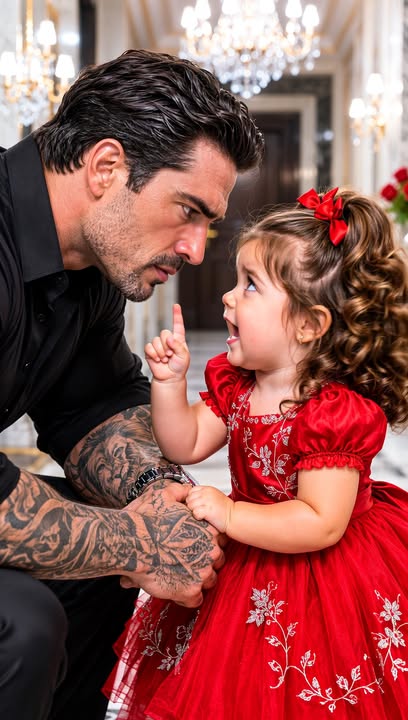
“Vincent stopped breathing.”
For one suspended moment, the house seemed to hold its breath with him.
The silver key lay cold in his palm, its engraved crest catching the soft light from the upstairs hall.
Beyond the open bedroom door, police officers moved through the house, their voices low and measured, while somewhere downstairs a telephone rang and rang.
Sophie watched him with solemn eyes, her stuffed rabbit tucked beneath one arm.
“Daddy’s mommy not dead?” Vincent asked, careful to keep his voice gentle.
Sophie nodded, though her lower lip quivered.
“Sad lady say it,” she murmured.
“Did she tell you anything else?”
The little girl searched his face as if she were trying to remember words that had seemed important when she first heard them.
“Song,” she said at last.
“What song, princess?”
Sophie hummed two small notes, then stopped, frustrated.
“Can’t.”
Vincent eased her against his chest.
“You don’t have to remember right now.”
Her tiny hand closed around the silver key, and she looked up at him.
“You help her?”
“I will,” he said.
This time, the promise did not come easily.
He had spent years believing his mother was dead, and the certainty of that belief had become one of the quiet foundations beneath his life.
Now a two-year-old had placed a key in his hand and shifted the ground.
Margaret’s voice came from the hallway.
“Vincent?”
He turned.
She stood with one of the officers beside her, a wool blanket wrapped around her shoulders and a glass of water held between trembling hands.
She looked exhausted, but her eyes were clear.
The moment she saw Sophie, some of the strain left her face.
“That’s your little girl,” she said.
“Yes,” Vincent replied.
Sophie peered at Margaret from the safety of his arms.
“Sad lady.”
Margaret’s expression softened.
“I’m sorry you had to be frightened, sweetheart.”
“You hungry?” Sophie asked.
A faint, surprised laugh escaped Margaret.
“I could be.”
“Daddy get crackers,” Sophie said, as if that settled the matter.
“I’ll see what we have,” Vincent replied.
Margaret studied him, and the brief warmth faded from her face.
“You found the key.”
“I did.”
“You know what it opens?”
“No.”
Her gaze moved to the object in his hand.
“Your father used to keep a small lockbox in his study.”
Vincent’s fingers tightened around the silver.
“I thought the study had been cleared after he died.”
“It was,” Margaret said. “Or so I believed.”
The officer beside her shifted his weight.
“Mrs. Hale, the paramedics are ready to take you for an examination.”
Margaret nodded, but she kept looking at Vincent.
“Please, let me explain what I can before I go.”
He glanced at the officer.
The man gave a small nod.
“I’ll be nearby,” he said.
Vincent led Margaret into the sitting room, carrying Sophie with him.
The girl had begun to droop against his shoulder, but she fought sleep with the stubborn determination of a child who knew something important was happening.
A lamp illuminated the room’s familiar furniture: the leather chairs, the dark shelves, the framed photographs Vincent had never bothered to rearrange.
His father’s portrait still hung over the fireplace.
Sophie stared at it.
“Grandpa,” she whispered.
“Yes,” Vincent said.
“Sad?”
He looked at the stern, handsome face in the frame.
“I don’t know.”
Margaret lowered herself carefully onto the sofa.
“Your father was rarely happy in photographs,” she said. “That didn’t mean he was always sad.”
Vincent sat across from her.
“Tell me about the key.”
“I never saw it before tonight,” Margaret answered. “But I remember the lockbox. Your father kept it in a false-bottom drawer in his study.”
“You knew there was a box and said nothing.”
“I knew there was a box,” she replied. “I didn’t know what was in it, and I was never given the key.”
“You were his accountant.”
“I was his accountant, not the keeper of every secret he had.”
The words landed between them with more force than she intended.
Margaret looked down at the glass in her hands.
“I’m sorry,” she said. “I know how this sounds.”
Vincent’s face remained still, though something in his expression had changed.
“Your father’s secrets have a way of reaching into the present.”
“I know.”
“Do you?”
Her fingers tightened around the glass.
“I helped him with certain records,” she said. “Records that were never meant to be discussed outside this family.”
“That is not an answer.”
“No,” Margaret said quietly. “It isn’t.”
Sophie rested her cheek against Vincent’s shoulder.
“Daddy mad?”
He lowered his gaze to her.
“Not at you.”
She touched the small crease between his brows.
“Here.”
A breath escaped him, nearly a laugh.
“I’ll work on it.”
The paramedics arrived, and Margaret permitted them to check her pulse and offer her a ride to the hospital.
Before she left, Vincent walked with her to the front door.
“I’ll send someone with you,” he said.
“Please don’t make it a guard,” she answered. “I need a nurse, not an escort.”
“You’ll have both, if you want them.”
“I don’t want anyone making me feel like I’m still locked in that room.”
He absorbed that without argument.
“Then you’ll have a nurse.”
Margaret paused beneath the porch light.
“Vincent, whatever you find, don’t assume your father kept something from you because he didn’t love you.”
His jaw tightened.
“Why would you say that?”
“Because I heard him talk about you.”
“When?”
“Many times.”
“What did he say?”
“That he wanted you to have a life that belonged to you.”
The sentence followed Vincent inside after the ambulance pulled away.
By then, Sophie was asleep in his arms, her rabbit’s floppy ear pressed against his collar.
He took her to her room, tucked her beneath the blankets, and left the hall light on as she had requested.
For several seconds, he stood beside her bed and watched the even rise and fall of her breathing.
The house around him was full of people, but the old quiet had returned—the particular hush that came whenever his father’s name rose between one moment and the next.
Vincent closed Sophie’s bedroom door most of the way and walked downstairs.
The police had finished their initial search of the basement.
Vanessa had been taken to the station to answer questions, and Vincent had been told that she was cooperating with the investigators.
He did not know whether that meant she was frightened, clever, or simply waiting for the right moment to turn the story in her favor.
For now, he let the officers handle her.
He had other questions.
The study had been left almost untouched since his father’s funeral.
Dust softened the edges of the desk, and a faint scent of cedar lingered in the shelves.
Vincent had entered the room only a handful of times in the years since he was a boy.
Each visit reminded him of how carefully his father had kept distance between affection and instruction.
The room had always felt less like a place to rest than a place where decisions were made.
Vincent set Sophie’s key on the desk.
He searched the drawers until he found the narrow one Margaret had described.
A seam at the bottom revealed a panel that shifted beneath his fingertips.
Behind it rested a dark wooden lockbox, small enough to fit in both hands.
The silver key turned in its lock with a soft click.
Inside lay a black-and-white photograph, a folded note, and a narrow paper sleeve.
Vincent lifted the photograph first.
A young woman stood beside a garden wall, her dark hair pinned loosely behind her head.
She held a small child against her shoulder.
The boy’s expression was serious, his eyes turned toward the camera, one fist curled into the collar of her dress.
Vincent knew the shape of those eyes.
He knew the line of the child’s mouth.
He was looking at himself.
The woman’s face was warm and open, with a faint smile that seemed to belong to someone who had just heard a private joke.
On the back, in his father’s handwriting, were two words.
Elena, summer of 1991.
Vincent sat down slowly.
His mother’s name had always been spoken in the past tense.
Elena had died when he was young, he had been told, and the details had been folded away beneath an explanation that changed depending on how old he was when he asked.
Sometimes it was an illness.
Sometimes it was an accident.
Once, when he was thirteen, his father had simply said, “She’s gone, Vincent,” and ended the conversation.
He had accepted the answer because there had been no reason to believe it was anything else.
Because a child did not expect the adults he loved to build a lie around him.
The note was folded twice.
Vincent opened it.
The paper was brittle but intact, the ink still dark.
If the key returns, find the woman who remembers the lullaby.
He read the sentence again.
Then he turned the paper over.
There was nothing else.
The paper sleeve held a small scrap of yellowed sheet music, its notes marked with his father’s careful handwriting.
Vincent could not read music well enough to recognize a melody from the page.
He placed the photograph and note on the desk, then stared at Elena’s face.
His phone vibrated.
The hospital had sent word that Margaret was stable and resting.
He called the number they had provided.
“How is she?” he asked when a nurse answered.
“Exhausted, but she’s been checked over,” the nurse said. “She would like to speak with you when she wakes.”
“Tell her I’ll come in the morning.”
“I’ll let her know.”
Vincent ended the call and returned to the lockbox.
The key had not returned by chance.
The sentence made him think of the moment Sophie had taken it from her pocket, as if she had carried it there for weeks.
He had seen that pocket before.
Sophie’s favorite dress had a small sewn compartment under its tulle skirt, a place where she kept smooth stones, toy coins, and any treasure she didn’t want to share.
He could not remember the last time she had worn that dress.
He studied the old photograph once more.
Elena’s hand rested against the child’s back.
Her thumb was curved over the seam of his shirt, protective and familiar.
Something in Vincent’s chest shifted, not yet grief and not yet hope, but a feeling with room for both.
He placed the items back in the box and closed the lid.
A floorboard creaked behind him.
He turned sharply.
Sophie stood in the doorway in her nightdress, clutching her rabbit by one ear.
“I woke up,” she said.
“You’re supposed to be sleeping.”
“I tried.”
He crossed the room and scooped her up.
She rested her head against him, then peered over his shoulder at the open study.
“Picture.”
“You remember that picture?”
Sophie nodded.
“Lady.”
“Did you see her before tonight?”
“Sad lady show me.”
“When?”
Sophie considered the question, rubbing her fingers over the rabbit’s worn ear.
“Downstairs.”
“Before tonight?”
Her eyes wandered toward the hall.
“Long time.”
Vincent held still.
“Did the sad lady sing to you?”
Sophie’s face brightened.
“Mm-hm.”
“What did she sing?”
Sophie hummed again, a few wavering notes that ended in a breathy little sound.
“Can’t do it.”
“That’s all right,” he said.
He carried her into the study and showed her the photograph.
“Was this the woman?”
Sophie touched the glass over Elena’s face.
“Same lady.”
Vincent felt his arms tighten around her.
“What did she call you?”
“Princess.”
“Did she say anything else?”
Sophie frowned, reaching for a memory she could not quite hold.
“Sleepy song.”
“Did she ever tell you her name?”
“No.”
“Did she tell you she was my mother?”
Sophie leaned back, studying his face.
“She say you miss her.”
Vincent looked down at the photograph.
His mother had been gone for most of his life, and he could not remember missing a person he had never truly known.
But he had missed something.
A voice he could not summon.
A face he had been taught not to ask for.
A hand he had imagined only as a shadow in old family stories.
Sophie’s palm rested against his cheek.
“Daddy miss?”
He closed his eyes briefly.
“Yes,” he admitted.
She tucked herself under his chin.
“Find her.”
The words were small, but the certainty in them was not.
Vincent carried her back to bed.
He stayed beside her until she drifted off, then returned to the study with the lockbox in his hand.
The photograph was his now, as were the note and the scrap of music.
But the woman who remembered the lullaby might not be Margaret.
Margaret had been frightened, and she had called Elena a secret without saying why.
Sophie had met someone who sang to her.
Someone who knew what the song meant.
Someone who had called Vincent’s daughter a princess.
The next morning, Vincent went to the hospital alone.
Margaret sat by the window in a pale blue robe, her hair brushed back from her face.
A tray of untouched toast rested beside her.
“Have you eaten?” he asked.
“I’m trying to decide whether hospital toast is a food or a test of character.”
“Could be both.”
A small smile flickered across her face.
He placed the photograph on the table between them.
Margaret’s gaze fell to it.
For a moment, her composure faltered.
“She was young there,” she whispered.
“You know who she is.”
“I know who I believe she is.”
“Do you believe she’s alive?”
Margaret did not answer immediately.
“I never saw proof that Elena died,” she said at last. “I was told it was settled, and I was asked to keep certain records quiet.”
“By my father?”
“Yes.”
“What did he tell you?”
“That the less you knew, the safer you would be.”
“That sounds like him.”
“Perhaps.”
Vincent sat across from her.
“Did you meet her?”
“Once.”
“When?”
“Years after you were told she was gone.”
The room seemed to narrow around him.
“Where?”
“I can’t tell you everything yet.”
His expression hardened.
“You have already kept enough from me.”
“I know.”
“Then why keep doing it?”
“Because I made a promise to your father, and because I was afraid of what might happen if the wrong person learned she was alive.”
“The wrong person being Vanessa?”
Margaret’s eyes lowered.
“I don’t know how much Vanessa knew.”
“But you suspected she knew something.”
“I suspected she was searching for it.”
“Then why didn’t you come to me?”
“Because I didn’t know whether she was working alone, and because I had no proof you would believe me.”
“You could have tried.”
“Yes,” she said, and the quiet acceptance of blame unsettled him more than a defense would have. “I should have.”
Vincent looked at the photograph.
“What did my father ask you to do?”
“To preserve a small set of records and never give them to anyone unless the key appeared again.”
“You knew about the key?”
“No. He told me there was a condition, not what it was.”
“What records?”
“Copies of payments and correspondence connected to Elena’s care.”
He looked back at her.
“You said you never saw proof she died.”
“I didn’t.”
“But you saw records connected to her care.”
“I saw payments made under an assumed name. I knew they were for someone your father wanted protected. I did not know where she was.”
“And you never asked?”
“I did. He told me the answer would put more people at risk.”
“Did you believe him?”
“I believed he was afraid.”
The word landed heavily.
Vincent folded his hands on the table.
“My father wasn’t a man who frightened easily.”
“No,” Margaret said. “That was what frightened me.”
For a while, neither of them spoke.
The hospital’s morning light spread across the floor, pale and clean, with nothing of the past in it.
Margaret reached for her water.
“When I first saw you with Sophie last night, she reminded me of you as a boy.”
“How?”
“She watched you to see whether you would keep your word.”
Vincent’s eyes lifted.
“She did that?”
“She did. You were serious even then.”
“I was a child.”
“You were his son.”
The distinction sat between them, carrying more history than Vincent wanted to unpack.
He rose.
“I’m going to review the old files.”
“Be careful where you look.”
“Why?”
“Because your father did not hide things in a lockbox without a reason.”
Vincent picked up the photograph.
“Neither do I.”
At home, he found Sophie at the kitchen table, coloring on a sheet of paper while her nanny sat nearby.
The blue dress had been washed and laid over the back of a chair.
Sophie glanced up as he entered.
“Lady?”
“Safe,” he said.
She nodded as if she had expected nothing less.
He crouched beside her and noticed the silver key in a small dish on the table.
She had taken it from his coat pocket.
“Were you keeping this safe?”
“Mm-hm.”
“It belongs in my study for now.”
Sophie gave it to him without protest.
“Find mommy?”
“First I’m going to find the woman who remembers the song.”
Her eyebrows rose.
“Sad lady.”
“Maybe.”
Sophie hummed a few notes, more clearly this time.
Vincent recognized the fragment from the sheet music, though he could not have named the tune.
“Do you remember who sang it?”
“Sad lady.”
“Was she kind?”
Sophie gave him a patient look, as if that answer should have been obvious.
“Kind.”
A few hours later, Vincent returned to the study and opened the lockbox again.
He lifted the scrap of music and turned it over.
A faint pencil mark had been drawn in the lower corner, so light it was nearly invisible.
Three letters, followed by a question mark.
M.H.?
Vincent stared at the initials.
Margaret Hale.
His hand closed around the edge of the paper.
The woman who remembered the lullaby might have been Margaret after all, but she had never said the tune belonged to her.
A soft knock came at the door.
Margaret stood in the hallway, having been brought home from the hospital.
She looked pale, but steadier than before.
“I remembered something,” she said.
Vincent showed her the music.
“Do these initials mean anything to you?”
Her eyes fell to the mark.
For the first time since he had known her, Margaret looked truly afraid of the answer.
Then she lifted her gaze to him.
“Your father didn’t write those initials,” she said. “Elena did.”
**–END OF PART 2–CLICK “NEXT” AT THE BOTTOM OF THE PAGE TO CONTINUE READING**
* * *
[NEXT: PART 3](https://echoesofstories.idolsgift.com/blog/part-3-the-key-beneath-the-dust-041)
✓ Lynn R. Adams
“Vincent stopped breathing.” For one suspended moment, the house seemed to hold its breath with him. The silver key lay cold in his palm, its engraved crest catching the soft light from the upstairs…