Part 2 – The House Where No One Left-039
## Part 2 – Seventy-Three Minutes
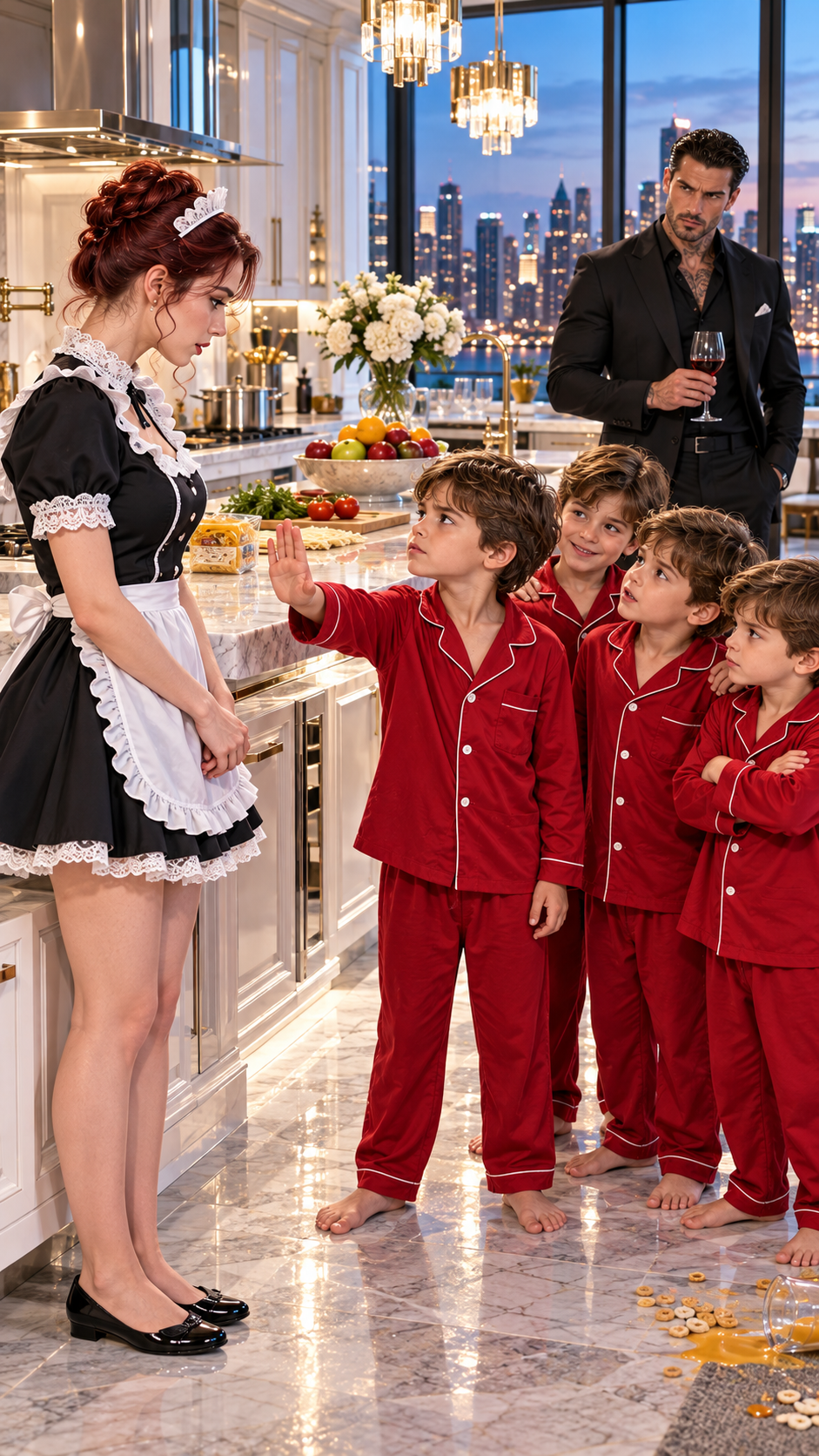
Marco’s mischievous smile slowly disappeared.
For the first time since I had stepped into the Rinaldi mansion, none of the four boys appeared to have a clever answer waiting.
Even Victor lowered his wineglass.
Rain tapped softly against the tall kitchen windows. Somewhere deeper in the house, an antique clock marked another minute with a quiet click.
I turned back to the stove.
“Well?” I asked. “Nobody?”
The smallest of the boys—Nico, if I had correctly matched names to troublemakers—studied his bare feet.
Alessandro climbed onto a counter stool.
Matteo, who hadn’t introduced himself yet, folded his arms.
Marco finally shrugged.
“People always leave.”
He said it as casually as a child might say the sky was blue.
That hurt more than if he’d shouted it.
I looked at Victor.
His expression hardened, but not at me.
At the floor.
At himself, perhaps.
I didn’t know.
“Then we’ll start with tonight,” I said.
Marco frowned. “Start what?”
“Proving that sometimes people don’t.”
Nico glanced toward Victor as though waiting for permission to believe me.
Victor gave none.
So I picked up the pancetta.
“Now,” I continued, “I have exactly—”
I checked the clock.
“Sixty-eight minutes.”
Matteo brightened.
“Until you lose?”
“Until you four eat dinner.”
“Same thing,” Marco said.
“We’ll see.”
I pointed toward the refrigerator.
“I need Parmesan.”
Nobody moved.
“I need eggs.”
Still nothing.
“And somebody has to set the table.”
Four suspicious faces stared at me.
Then Alessandro narrowed his eyes.
“Are you giving us jobs?”
“Absolutely.”
“We don’t work.”
“Then I suppose none of you are qualified for dessert.”
Silence.
Nico gasped.
“You have dessert?”
“I might.”
“What kind?”
“Classified.”
That did it.
Within two minutes, I had accidentally created the least disciplined kitchen brigade in Manhattan.
Matteo carried Parmesan like a priceless diamond.
Alessandro counted eggs aloud and had to restart twice because Nico kept shouting random numbers.
Marco insisted he knew how to set a table, then placed three forks beside one plate and declared the arrangement “European.”
Nico attempted to steal a strawberry.
I caught his wrist without looking.
He froze.
“So close,” I said.
His eyes widened.
Then he giggled.
Behind me, I heard something I hadn’t expected.
A low sound.
I turned.
Victor Rinaldi was almost smiling.
Almost.
The expression disappeared the second he realized I’d noticed.
Interesting.
“Don’t just stand there,” I said.
The entire kitchen stopped.
Victor’s eyebrows rose.
The housekeeper—who had finally introduced herself as Rosa Bellini—made a tiny choking noise.
Marco’s mouth fell open.
“You told Dad what to do,” he whispered.
Apparently people did not tell Victor Rinaldi what to do.
That seemed inconvenient.
“Yes,” I replied.
Victor placed his glass down.
“And what exactly would you like me to do, Miss…?”
“Bennett. Clara Bennett.”
“Miss Bennett.”
“Drain the pasta when the timer rings.”
Marco stared between us.
Rosa looked ready to faint.
Victor looked at the pot.
Then at me.
I wondered whether I’d just lost the job before officially getting it.
Instead, he removed his suit jacket.
The boys went silent.
He rolled his sleeves to his forearms, revealing more dark ink beneath his cuffs, and approached the stove.
“What happens if I refuse?” he asked.
“Then dinner gets soggy.”
A pause.
Matteo whispered, “Dad hates soggy pasta.”
Victor picked up the colander.
“Apparently I have no choice.”
Something changed in the kitchen after that.
Not dramatically.
Nothing magical happened.
The boys didn’t suddenly become perfectly behaved children. Nico still put a strawberry on Alessandro’s chair. Alessandro still replaced it with two when Nico looked away. Matteo spilled grated cheese across the counter. Marco tried to convince me that carbonara traditionally contained chocolate chips.
But the noise changed.
It became laughter instead of warfare.
Mess instead of destruction.
Energy instead of anger.
And Victor watched it happen.
At seven forty-one, I put the bowls on the table.
At seven forty-eight, all four boys were sitting.
At seven fifty-two, Nico stood up because he had forgotten his stuffed dinosaur.
At seven fifty-three, Marco announced that carbonara was probably poisonous.
At seven fifty-four, Victor said one word.
“Marco.”
Marco sat.
At seven fifty-five, Alessandro tasted the pasta.
Everyone watched him.
He chewed dramatically.
Then his eyes widened.
“It’s good.”
“Traitor,” Marco whispered.
Matteo tried his.
Then Nico.
Marco held out longest.
Finally, at seven fifty-eight, he took one reluctant bite.
He stared at me.
I tried not to look hopeful.
He swallowed.
“Acceptable.”
I laughed.
A real laugh.
The first one I’d managed in days.
Victor looked at the grandfather clock.
PM.
Two minutes before eight.
Rosa leaned against the kitchen doorway.
“I’ve worked in this house twelve years,” she murmured. “I’ve never seen that.”
“Seen what?” I asked.
“All five Rinaldi men eating the same meal.”
I looked toward Victor.
He had taken the chair at the head of the table.
He wasn’t eating.
He was watching his sons.
That cold, controlled expression was gone.
Something else had replaced it.
Something painfully human.
Nico held up his fork.
“You’re staying tomorrow, right?”
There it was.
The question beneath every thrown apple.
Every shattered vase.
Every insult.
I sat beside him.
“If your father hires me.”
Four faces swung toward Victor.
Victor looked at them, then at me.
“You’re hired.”
Marco instantly protested.
“She hasn’t passed dessert.”
Victor’s mouth twitched.
“I wasn’t informed there was a dessert examination.”
“There is now.”
I opened the refrigerator.
Inside, four glasses of strawberries waited beneath a mixture of sweetened cream I’d prepared while the pasta boiled.
Marco stared.
“You made those already?”
“I work quickly.”
He pointed accusingly.
“That’s cheating.”
“It’s called planning.”
For the next twenty minutes, the Rinaldi mansion sounded like a home.
I almost forgot why I had come.
Almost.
Then my phone buzzed in my apron.
I didn’t need to look.
The custody hearing.
Two weeks.
Lucy.
The familiar panic returned so suddenly that my hands went cold.
I stepped into the pantry.
My daughter’s photograph was my phone background.
Lucy at the park last summer, missing one front tooth, sunlight tangled in her brown curls.
She was seven now.
Seven years old, and sleeping in my aunt Catherine’s guest room because I hadn’t been able to provide the stability the court wanted after losing my apartment.
Catherine loved her.
That wasn’t the problem.
The problem was that Lucy belonged with me.
I opened the message.
**Reminder: Preliminary home assessment must be completed before the hearing. Proof of income and suitable residence required.**
Residence.
I looked through the pantry doorway at the enormous mansion.
Room and board.
Victor’s offer hadn’t merely given me employment.
It had given me a chance.
“Is that your daughter?”
I jumped.
Marco stood behind me.
I locked my phone immediately.
“You’re quiet when you want to be.”
“I practice.”
His attention stayed on the phone.
“Is she?”
I hesitated.
“Yes.”
“What’s her name?”
“Lucy.”
“Where is she?”
The question was too direct.
Children had a talent for finding the one place adults carefully walked around.
“Staying with family.”
“Why?”
“Because sometimes grown-up life gets complicated.”
He considered that.
“Did she make you leave?”
“No.”
“Did you make her leave?”
My throat tightened.
“No.”
Marco looked genuinely puzzled.
“Then why aren’t you together?”
Before I could answer, Victor appeared.
“Marco.”
His son turned.
“Bedtime.”
“It’s eight nineteen.”
“Exactly.”
Marco walked past his father, then stopped.
He looked back at me.
“If Lucy comes here, she can have my old dinosaur sheets.”
I blinked.
“Thank you.”
“They’re baby sheets,” he added quickly. “I don’t want them.”
Of course.
He left.
Victor remained.
His gaze moved to my phone.
Then to my face.
“You didn’t mention a child.”
“You didn’t ask.”
“Will your employment here interfere with caring for her?”
“No.”
“Then it isn’t my business.”
That answer surprised me.
Most employers who discovered I had a child immediately wanted details.
Schedules.
Problems.
Guarantees.
Victor simply nodded.
Then he turned to leave.
“Mr. Rinaldi?”
He stopped.
“Thank you.”
“For employment?”
“For not asking questions I wasn’t ready to answer.”
Something flickered across his face.
Recognition, perhaps.
“I’ve learned,” he said, “that questions rarely make people ready.”
Then he walked away.
Rosa showed me my room later that evening.
It was larger than my old apartment’s bedroom, with pale walls, a window overlooking the garden, and a small bathroom attached.
Fresh towels waited on the bed.
I stood in the doorway unable to move.
“This is mine?”
“As long as you work here.”
I touched the edge of the dresser.
A room.
Heat.
Electricity.
A lock on the door.
Safety.
I had expected relief.
Instead, tears filled my eyes.
Rosa pretended not to notice.
“Breakfast is at seven,” she said gently.
“Thank you.”
She started toward the hallway.
“Rosa?”
“Yes?”
“Why have so many maids quit?”
She sighed.
“The obvious answer is the boys.”
“And the real one?”
Rosa glanced down the corridor.
“The boys.”
I frowned.
She smiled sadly.
“But not because they’re bad children.”
I waited.
Rosa lowered her voice.
“Mrs. Rinaldi died three years ago.”
My chest tightened.
“Their mother?”
Rosa nodded.
“The boys were only three. They remember pieces. Her perfume. Her singing. The sound of the piano.”
“And dinner?”
Rosa’s expression changed.
“What about dinner?”
“They seem especially determined to ruin it.”
For a long moment, she said nothing.
Then her eyes shifted toward the stairway.
“The night their mother left this house for the final time, the family had dinner at seven.”
A chill traveled through me.
“She was sick?”
“Not that anyone knew.”
“What happened?”
Rosa’s lips parted.
Footsteps sounded above us.
She immediately straightened.
Victor stood at the top of the stairs.
His face revealed nothing.
“Rosa.”
“Sir.”
“Good night.”
It wasn’t a threat.
It wasn’t even harsh.
But the conversation was finished.
Rosa disappeared.
Victor descended slowly.
I stayed by my door.
“I apologize,” I said. “I shouldn’t have—”
“No.”
He stopped a few feet away.
“You should understand the children you’re responsible for.”
His voice was quieter than I had heard it before.
“Their mother, Isabella, died unexpectedly from an undiagnosed heart condition.”
“I’m sorry.”
“They were three years old.”
“And dinner was the last time they saw her?”
He nodded once.
Suddenly everything made sense.
Every ruined meal.
Every maid driven away before eight.
Every desperate test.
Dinner wasn’t dinner to them.
Dinner meant someone disappeared afterward.
My heart hurt.
“Do they know?”
“They know she died.”
“Do they understand?”
Victor looked toward the darkened hall leading to the children’s rooms.
“No.”
Neither do you, I almost said.
But I didn’t know him well enough.
Instead, I whispered, “Maybe that’s why they keep asking people to leave first.”
His gaze returned to mine.
“What?”
“If they can make someone leave before they care about them, it doesn’t hurt as much when they go.”
Victor stared at me.
For once, New York’s supposedly most frightening man had no answer.
Then a small voice came from the staircase.
“Dad?”
Marco stood halfway down.
His face was pale.
Victor immediately moved toward him.
“What happened?”
Marco wasn’t looking at his father.
He was looking at me.
“You said you don’t leave people.”
I swallowed.
“I said sometimes people stay.”
“That’s not the same.”
“No.”
He gripped the railing.
“If Lucy gets to come live with you again…”
He stopped.
My pulse quickened.
“What about Lucy?”
Marco looked at the floor.
Then he asked the question I had been afraid someone in this house would eventually ask.
“When you get your daughter back, are you going to leave us?”
And behind him, three more small faces silently appeared on the stairs.
**–END OF PART 2–CLICK “NEXT” AT THE BOTTOM OF THE PAGE TO CONTINUE READING**
✓ Lynn R. Adams
## Part 2 – Seventy-Three Minutes Marco’s mischievous smile slowly disappeared. For the first time since I had stepped into the Rinaldi mansion, none of the four boys appeared to have a clever answe…