PART 2 The House That Was Never Meant for Me
# MY WIFE TOLD ME SHE DIDN’T LOVE ME ANYMORE—BUT SHE HAD ALREADY PROMISED ANOTHER MAN OUR FUTURE
## The House That Was Never Meant for Me
“Dad, Uncle Mark told me you didn’t want us anymore.”
My twelve-year-old daughter said those words while standing in the kitchen of the house I’d spent eighteen years paying for.
For a moment, I couldn’t breathe.
Across the kitchen island, my wife, Rebecca, stood perfectly still. Her face had gone pale, and her eyes were fixed on our daughter.
“Sophie,” she whispered. “Honey, that’s not what he meant.”
But Sophie wasn’t looking at her mother.
She was looking at me.
“He said you were going to live somewhere else because you wanted to be alone.”
I felt something inside my chest tighten.
“Sweetheart,” I said carefully, “who told you that?”
“Uncle Mark.”
“And when did he tell you?”
She glanced toward Rebecca.
“At the new house.”
The new house.
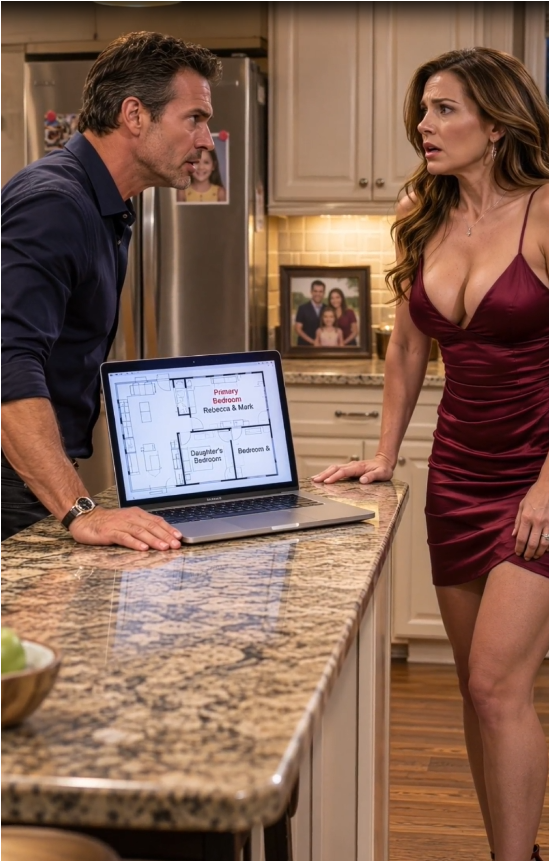
The one I had discovered on my wife’s laptop less than twenty minutes earlier.
Three bedrooms. A backyard. A two-car garage.
A bedroom with Sophie’s name written inside.
And a primary bedroom labeled with two names.
Rebecca and Mark.
My wife and the man she’d introduced to me as her coworker.
I looked at Rebecca.
“You let another man tell our daughter I was abandoning her?”
“David, please,” she said.
“No. I need an answer.”
Sophie began crying.
And suddenly, my anger didn’t matter nearly as much as the frightened little girl standing between us.
I knelt in front of her.
“Listen to me, sweetheart. I am not leaving you. I have never wanted to leave you. Whatever happens between Mom and me, I will always be your dad.”
She threw her arms around my neck.
I held her while she cried into my shoulder.
Behind us, Rebecca started sobbing.
But I couldn’t bring myself to comfort her.
Not anymore.
Because I had just learned that my wife hadn’t simply betrayed our marriage.
She had allowed another man to begin rewriting my daughter’s understanding of her own father.
And the worst part was that I still didn’t know how long it had been happening.
—
## Eighteen Years of Building a Life
My name is David Miller.
I was forty-five years old when my marriage fell apart.
Rebecca and I lived outside Columbus, Ohio, in a four-bedroom suburban house with cream-colored siding, a two-car garage, and a maple tree in the front yard.
It wasn’t anything extraordinary.
But it was ours.
We bought it when we were newly married, back when we could barely afford the mortgage and celebrated every small improvement as if we’d won the lottery.
I remember spending an entire weekend installing kitchen cabinets because hiring someone would have cost more than we could spare.
Rebecca painted the living room herself.
We argued about the color.
She wanted warm gray.
I wanted beige.
She won.
For years, I joked that the living room was the first of many battles I’d happily lost.
We had Sophie six years into our marriage.
I still remember standing beside Rebecca in the hospital, holding our daughter for the first time.
Rebecca was exhausted.
Her hair was tangled, her eyes were red, and she looked more beautiful to me than she ever had.
“We made her,” she whispered.
I kissed her forehead.
“We did.”
For a long time, I believed those two words described everything about our marriage.
We made a family.
We made a home.
We made plans.
And when life became difficult, we found a way through it together.
I worked as an operations manager for a regional distribution company. Rebecca worked in marketing for a commercial property development firm.
Neither of us was wealthy.
But we were comfortable.
We took one family vacation every summer, usually somewhere Sophie could swim.
We attended school concerts, birthday parties, and weekend soccer games.
On Sundays, I made pancakes.
Rebecca complained that I used too much butter.
Then she ate three.
That was our life.
Ordinary.
Predictable.
And, I thought, happy.
Of course, looking back, there were signs.
There always seem to be signs once you know what you’re looking for.
But at the time, every strange behavior had a reasonable explanation.
Rebecca started working late.
She became protective of her phone.
She bought new clothes and began going to the gym more frequently.
I noticed.
I simply didn’t assume the worst.
After eighteen years, I believed trust meant giving your spouse the benefit of the doubt.
I didn’t realize Rebecca had begun treating that trust as something she could use against me.
—
## The Tuesday That Changed Everything
Two weeks before I found the floor plan, Rebecca told me she didn’t love me anymore.
It happened on a Tuesday evening.
Nothing about the day was unusual.
I’d come home from work around six.
Sophie was upstairs doing homework.
The dishwasher was running, and Rebecca stood beside the kitchen counter holding a glass of water.
“David, we need to talk.”
I knew something was wrong immediately.
She had that expression people wear when they’ve already made a decision and are afraid of explaining it.
I pulled out a chair.
“Okay.”
She didn’t sit.
“I don’t think I’m happy anymore.”
I stared at her.
“What do you mean?”
She swallowed.
“I don’t love you the way I used to.”
I remember waiting for her to explain.
Maybe she was depressed.
Maybe we’d grown distant.
Maybe she wanted counseling.
Instead, she said, “I think we need some time apart.”
I asked the question almost every spouse would ask.
“Is there someone else?”
Rebecca looked away for a moment.
Then she met my eyes.
“No.”
I believed her.
That single word kept me from understanding what was actually happening.
Because if she’d told me the truth, I would have known our marriage was facing an entirely different problem.
Instead, I thought we were dealing with emotional distance.
I suggested counseling.
She said she wasn’t ready.
I suggested taking a weekend away together.
She said she needed space.
Finally, I agreed to sleep in the guest room while we considered what separation might look like.
I didn’t want Sophie to experience a sudden upheaval.
Rebecca agreed.
She even thanked me for being understanding.
I remember lying awake that first night, staring at the ceiling, wondering what I could have done differently.
Had I worked too much?
Had I stopped making her feel special?
Had I become boring?
For two weeks, I carried those questions around like stones in my pockets.
Meanwhile, my wife already had another man waiting for her.
And apparently, another house.
—
## The Laptop
The first clue came from Sophie.
It was a Saturday morning.
I was drinking coffee at the kitchen island when she walked downstairs wearing her soccer sweatshirt.
“Dad, why is Mom measuring my furniture?”
I looked up.
“What?”
“She measured my bed yesterday. And my dresser.”
“Maybe she’s rearranging your room.”
Sophie shook her head.
“She said she needed to know if everything would fit.”
I felt uneasy.
Rebecca had mentioned possibly finding an apartment if we separated.
Maybe she was planning ahead.
But she hadn’t discussed anything involving Sophie.
I didn’t say that to our daughter.
Instead, I told her I’d ask.
An hour later, Rebecca left to pick up groceries.
Her laptop was open on the kitchen island.
I wasn’t searching through her messages.
The screen was already displaying a house design.
At first, I assumed it was a work project.
Her company dealt with commercial property, and she occasionally brought presentations home.
Then I noticed the room labels.
Sophie’s Bedroom.
Guest Bedroom.
Primary Bedroom.
Rebecca & Mark.
I stared at those words.
I knew Mark.
Mark Sullivan.
Forty-four years old.
Senior project coordinator at Rebecca’s company.
He had been to our house for dinner twice.
He’d stood beside my grill at a Fourth of July barbecue, drinking lemonade and telling me how lucky I was to have such a wonderful family.
I remembered shaking his hand.
I remembered laughing at his jokes.
And now his name was written beside my wife’s inside the primary bedroom of a house I’d never seen.
I clicked the file details.
The original design had been created eleven months earlier.
Eleven months.
I sat down.
My hands were trembling.
Eleven months earlier, Rebecca and I had celebrated our seventeenth wedding anniversary.
I’d taken her to a restaurant downtown.
She’d worn a black dress and kissed me across the table.
We’d talked about taking Sophie to Florida the following summer.
At some point around that same time, she’d apparently been designing a house with another man.
I opened the attached project notes.
There were furniture measurements.
A backyard patio layout.
A proposed move-in schedule.
One note mentioned keeping the transition comfortable for Sophie.
I read that sentence three times.
Transition.
They had a word for replacing me in my own family.
When Rebecca returned home, I was still sitting at the island.
The laptop remained open.
She stepped inside carrying two grocery bags.
“David? Why are you sitting in the dark?”
I turned the screen toward her.
“Who is Mark?”
She stopped.
The bags slipped slightly in her hands.
“What?”
“Who is Mark, Rebecca?”
She looked at the laptop.
And I watched her realize that the life she’d been hiding was no longer hidden.
—
## The Confrontation
“You planned this a year ago?”
My voice sounded strange even to me.
Rebecca placed the grocery bags on the counter.
“David, please. Let me explain.”
I turned the laptop farther toward her.
“You told me there wasn’t anyone else.”
She didn’t answer.
“You looked me in the eyes and said there wasn’t another man.”
“I didn’t know how to tell you.”
I laughed once.
It wasn’t because anything was funny.
“You didn’t know how to tell me? Rebecca, you designed a house with him.”
She began crying.
“It wasn’t supposed to happen like this.”
“How was it supposed to happen?”
She rubbed her forehead.
“I wanted to find the right time.”
“The right time to do what? Move our daughter into another man’s house?”
“Don’t say it like that.”
I pushed the laptop across the countertop toward her.
“You gave him our future.”
She stepped backward.
For a moment, neither of us spoke.
Then Rebecca whispered, “You weren’t supposed to find that.”
I looked at her.
Those words were worse than any excuse.
She wasn’t shocked by what she’d done.
She was shocked that I’d discovered it.
“How long?” I asked.
She stared at the floor.
“David—”
“How long have you been involved with him?”
“About a year.”
I felt my stomach drop.
“And you’ve been planning to leave me that entire time?”
“Not exactly.”
“What does that mean?”
She wiped her face.
“At first, we were just talking.”
“About what?”
“Work. Life. Things we weren’t happy about.”
“And then?”
She hesitated.
“We became close.”
I looked toward the family photograph on the counter.
Sophie was smiling between us.
We’d taken that picture the previous Christmas.
Rebecca’s arm had been wrapped around my waist.
I remembered thinking how fortunate I was.
“Were you sleeping with him when we took that picture?”
Rebecca covered her mouth.
I didn’t need another answer.
I stood there feeling as though someone had removed the floor beneath me.
Then Sophie appeared in the doorway.
And everything became worse.
—
## What Our Daughter Knew
After Sophie told me what Mark had said, I asked her to sit with me in the living room.
Rebecca followed.
I didn’t want our daughter to feel interrogated.
She was twelve.
She had no responsibility for the decisions adults had made.
I told her that first.
“You’re not in trouble, sweetheart. You haven’t done anything wrong.”
She nodded.
Then I asked about the house.
Sophie explained that Rebecca had taken her there twice.
The first visit had been during spring break.
Rebecca told her they were looking at a property for work.
Mark met them there.
He showed Sophie a bedroom overlooking the backyard.
“He said I could choose the wall color,” she told me.
I swallowed.
“What did you say?”
“I said I liked my room at home.”
She looked embarrassed.
“Then he said sometimes families have to make changes.”
I glanced at Rebecca.
She stared at her hands.
Sophie continued.
“The second time, Mom told me the house might be where we lived someday.”
“Did she tell you why?”
Sophie nodded slowly.
“She said you and Mom were having grown-up problems.”
That part was true.
But what came next wasn’t.
“Uncle Mark said you wanted to live by yourself because you were tired of being a dad.”
I closed my eyes.
For several seconds, I couldn’t speak.
I had worked overtime to pay for Sophie’s braces.
I’d driven through snowstorms to attend her school events.
I’d spent nights beside her bed when she was sick.
I wasn’t a perfect father.
But I had never once considered walking away from her.
“Did you believe him?” I asked.
Sophie began crying again.
“I didn’t want to.”
I pulled her close.
“Then don’t. Because it isn’t true.”
She whispered, “I thought maybe I did something wrong.”
That sentence nearly broke me.
I looked at Rebecca.
“How could you let her believe that?”
Rebecca shook her head.
“I didn’t know Mark said those exact words.”
“But you knew he was talking to her about our separation.”
She remained silent.
“And you knew she was being asked to keep secrets from me.”
Rebecca’s shoulders dropped.
“Yes.”
I nodded slowly.
There it was.
The truth.
Not all of it.
But enough.
I turned back to Sophie.
“Your mother and I are going to handle this. You don’t need to choose between us. And nobody gets to tell you that I don’t want you.”
She held my hand.
“Promise?”
“I promise.”
That night, I slept in the guest room again.
But this time, I wasn’t hoping to repair my marriage.
I was trying to understand how to protect my daughter from the damage already done.
—
## The First Phone Call
The next morning, I called my older sister, Karen.
Karen was forty-nine, divorced, and the kind of person who never confused kindness with weakness.
She lived about forty minutes away.
When I told her what happened, she didn’t interrupt.
After I finished, she asked one question.
“Is Sophie okay?”
“I don’t know.”
“Then start there.”
I told her I was considering confronting Mark.
“Don’t go to his house angry,” she said.
“I want to know why he told my daughter I abandoned her.”
“I understand. But Sophie needs you steady right now.”
She was right.
I hated that she was right.
Karen suggested I speak with a family-law attorney before making any decisions about the house or finances.
She also recommended finding a counselor for Sophie.
Not because Sophie had done anything wrong.
Because she’d been placed in an impossible position.
That Monday, I contacted an attorney named Laura Bennett.
Her office was in downtown Columbus.
I brought the information I’d found on the laptop and explained the situation.
Laura listened carefully.
Then she asked about our finances.
“We have a joint checking account, retirement accounts, and the house,” I said.
“Any major recent withdrawals?”
“Not that I know of.”
“Then review your records. Don’t assume anything, and don’t move or hide marital assets.”
She explained that divorce and parenting arrangements would require proper documentation and legal decisions.
Nothing was going to be solved by one dramatic confrontation.
I appreciated that.
After the chaos of the weekend, I needed someone who dealt in facts.
That evening, I reviewed our joint bank statements.
At first, nothing looked unusual.
Mortgage.
Utilities.
Groceries.
Insurance.
Then I noticed a series of transfers to a savings account I didn’t recognize.
The amounts varied.
Six hundred dollars.
Nine hundred.
Twelve hundred.
They had been occurring for nearly ten months.
The total was a little over fourteen thousand dollars.
I stared at the screen.
Rebecca and I had agreed to save extra money for home repairs and Sophie’s future expenses.
I had assumed those savings remained untouched.
I printed the statements.
Then I called Rebecca into the kitchen.
Again.
The same kitchen where our marriage had ended.
“What’s this account?” I asked.
She looked at the paper.
Her expression changed.
“It’s mine.”
“Where did the money come from?”
“Our joint account.”
“I can see that. What was it for?”
She hesitated.
“The house.”
I nodded.
Of course.
The house.
The place where she intended to begin a new life with Mark.
I looked at the statements.
“You used our family savings to help build a future with him?”
“I was going to replace it.”
“When?”
She had no answer.
For the first time, I understood that the betrayal wasn’t only emotional.
Rebecca had begun moving pieces of our shared life into a future where I didn’t exist.
—
## Meeting Mark
Three days later, Mark called me.
I recognized his voice immediately.
“David, it’s Mark Sullivan.”
I nearly hung up.
Instead, I said, “What do you want?”
“I think we should talk.”
“About what?”
“Everything that’s happened.”
I looked out my office window.
“Did you tell my daughter I didn’t want to be her father anymore?”
Silence.
Then he said, “I think there was a misunderstanding.”
I felt anger rise in my chest.
“That’s not an answer.”
“Rebecca told me you were planning to move out.”
“She told you that?”
“Yes.”
“And you thought that gave you permission to explain my feelings to my daughter?”
“I was trying to make the transition easier.”
There was that word again.
Transition.
As if my family were an office being relocated.
I told him I would meet him at a coffee shop near his office.
A public place.
I wanted answers, not a fight.
When I arrived, Mark was already sitting at a table.
He wore a gray jacket and looked much less confident than I remembered.
I sat across from him.
He started with an apology.
“I never meant to hurt you.”
I looked at him.
“You had an affair with my wife for a year.”
He lowered his eyes.
“I know.”
“You came into my house. Ate dinner with my family. Shook my hand.”
“I know.”
“And then you told my daughter I didn’t want her.”
He rubbed his forehead.
“Rebecca said you were emotionally checked out.”
I leaned forward.
“Did she tell you I was leaving Sophie?”
He hesitated.
“She said you weren’t interested in taking on primary parenting responsibilities.”
I stared at him.
That was completely false.
“I never said that.”
Mark looked uncomfortable.
“She made it sound like you wanted a clean break.”
I sat back.
A clean break.
From my own daughter.
I felt sick.
“Did you ever ask me?”
He shook his head.
“Then you didn’t know anything.”
He looked down at his coffee.
After a moment, he said, “I shouldn’t have spoken to Sophie about it.”
“No. You shouldn’t have.”
I stood.
He called after me.
“David, for what it’s worth, Rebecca told me your marriage had been over for a long time.”
I turned around.
“Then why was she still telling me she loved me?”
Mark didn’t answer.
I walked out.
But as I reached my truck, my phone buzzed.
It was a message from Mark.
A screenshot.
A text Rebecca had sent him eight months earlier.
*David doesn’t know yet. I need more time before I tell him we’re separating.*
I stared at it.
Eight months earlier, Rebecca had been planning our summer vacation with Sophie.
She had asked me to book a hotel near the beach.
She had kissed me goodnight.
And she had been telling another man that our marriage was already ending.
I finally understood something important.
Mark hadn’t invented the entire story on his own.
Rebecca had been giving him a version of our marriage that made her choices easier to justify.
And she’d been giving me another version.
Neither man had been living with the complete truth.
—
## The Woman I Thought I Knew
When I returned home, Rebecca was sitting on the back porch.
Sophie was at Karen’s house for the evening.
I sat across from my wife.
For a long time, neither of us spoke.
Finally, I asked, “Did you tell Mark I didn’t want custody of Sophie?”
Rebecca closed her eyes.
“David—”
“Did you?”
She nodded.
“Why?”
Her voice cracked.
“Because I was afraid you’d fight me about moving.”
I stared at her.
“So you told him I didn’t want my daughter?”
“I didn’t say it exactly like that.”
“Then what did you say?”
She looked at the yard.
“I told him you were more focused on work than family.”
I felt a strange calm settle over me.
“Was that what you believed?”
Rebecca wiped her cheeks.
“Sometimes.”
“Then why didn’t you talk to me?”
“I tried.”
“When?”
She hesitated.
“You were always tired.”
I considered that.
There had been nights when I came home exhausted.
There had been weekends when work interrupted family plans.
I wasn’t going to pretend I’d been a perfect husband.
But there was a difference between being imperfect and being absent.
“Rebecca, I asked you what was wrong. More than once.”
“I know.”
“I offered counseling.”
“I know.”
“You told me everything was fine.”
She began crying harder.
“I didn’t want to hurt you.”
I shook my head.
“You didn’t want to face the consequences.”
She looked at me.
For once, she didn’t argue.
I asked when she first became involved with Mark.
She told me they’d started talking after a difficult project at work.
He listened to her complaints.
He complimented her.
He made her feel interesting again.
At first, she said, she told herself it was harmless.
Then they began meeting for lunch.
Then dinner.
Eventually, their relationship became physical.
I asked why she hadn’t left me then.
She looked ashamed.
“Because I wasn’t sure.”
“About Mark?”
“About everything.”
I stared at her.
“So you kept me while you figured out whether you wanted him.”
She whispered, “I guess that’s what I did.”
I nodded.
It was the first completely honest thing she’d said all evening.
And somehow, it hurt more than the excuses.
—
## The House Twenty Minutes Away
A week later, I drove past the house.
I didn’t go there to confront anyone.
I simply needed to see it.
The address was listed on the project documents.
It stood in a newer development about twenty minutes from our neighborhood.
Two stories.
Light gray siding.
Black shutters.
A wide driveway.
A fenced backyard.
It looked like the kind of place Rebecca and I once dreamed of buying when we were younger.
I parked across the street.
There was a small maple tree near the front walkway.
I thought about the maple tree in our own yard.
The one Sophie had helped me plant when she was five.
I wondered whether Rebecca had noticed the similarity.
A car pulled into the driveway.
Mark got out.
He carried a cardboard box toward the front door.
A few moments later, Rebecca appeared.
She had told me she was spending the afternoon with her sister.
Instead, she was standing on the porch of the house she’d planned with another man.
Mark said something.
Rebecca smiled.
It was a small smile.
Nothing dramatic.
But I recognized it.
It was the smile she used to give me when I came home carrying takeout after a long day.
I sat there for a moment.
Then I started my truck and drove away.
I didn’t take pictures.
I didn’t knock on the door.
I didn’t make a scene.
I already knew enough.
That evening, Rebecca came home around seven.
She found me sitting at the dining room table.
“I drove past the house today,” I said.
She stopped walking.
“David—”
“I saw you.”
She lowered her eyes.
I took a breath.
“I want a divorce.”
She began crying.
“Please don’t decide that while you’re angry.”
I looked at her.
“Rebecca, you’ve been making decisions about our marriage for almost a year without telling me.”
She sat down.
“We can still talk.”
“We have talked.”
“I mean really talk.”
I shook my head.
“I wanted to talk when you told me you were unhappy. I wanted counseling. I wanted to understand what was wrong.”
She reached for my hand.
I pulled it away gently.
“But you were already building a life with someone else.”
She covered her face.
I stood.
“We need to figure out how to tell Sophie and how to handle everything fairly. But I’m not going to compete with Mark for my own wife.”
For the first time, Rebecca seemed to understand that I wasn’t threatening to leave.
I was leaving the marriage.
And I wasn’t asking her permission.
—
## The Hardest Conversation
The hardest part of the divorce wasn’t dividing the money.
It wasn’t discussing the house.
It wasn’t even seeing Rebecca pack her clothes.
It was talking to Sophie.
We arranged for a family counselor to help us explain the separation.
Rebecca and I sat together in the counselor’s office while Sophie held a small pillow in her lap.
I told her that her mother and I were going to live separately.
Rebecca told her we both loved her.
Sophie listened quietly.
Then she asked, “Is this because of Uncle Mark?”
Rebecca looked at the counselor.
I answered carefully.
“Mom and I have adult problems that aren’t your responsibility. Some of the things you’ve heard were confusing and unfair.”
Sophie looked at me.
“Are you still going to be my dad?”
I felt my throat tighten.
“Every single day.”
She nodded.
“Even if I live somewhere else?”
“Yes.”
“Even if Mom marries Mark?”
I took a breath.
“Yes, sweetheart.”
She looked relieved.
Then she asked a question that surprised both of us.
“Can I stop calling him Uncle Mark?”
Rebecca began crying.
I looked at Sophie.
“You can call him Mark.”
She nodded.
“Good. Because he’s not my uncle.”
It was a small moment.
But it mattered.
For weeks, adults had been telling Sophie what her future would look like.
Now she was beginning to understand that she could have feelings and boundaries of her own.
Over the following months, Rebecca and I worked through temporary parenting arrangements with legal guidance.
We agreed Sophie would continue attending the same school.
We also agreed that neither of us would ask her to carry messages, keep secrets, or take sides.
I made it clear that I would not accept Mark speaking for me as her father.
Rebecca agreed.
I wasn’t sure whether she agreed because she understood the damage or because she knew the issue would matter in our parenting discussions.
At that point, I stopped trying to read her mind.
I focused on what she actually did.
—
## What Happened to the Money
The financial discussions were uncomfortable.
Rebecca initially argued that the fourteen thousand dollars transferred from our joint account had been money she intended to repay.
Laura, my attorney, advised me to gather records and let the financial issues be addressed through the divorce process.
I did.
We reviewed statements, account balances, retirement contributions, and the equity in our home.
The transfers had gone into Rebecca’s separate savings account.
Some of that money had been used for deposits and furnishings connected to the new house.
The house itself was owned by Mark.
That distinction mattered.
Rebecca hadn’t secretly purchased a property in both their names.
She had helped plan and furnish a future home she expected to share with him.
The money still needed to be accounted for.
After negotiations, we reached a settlement that addressed the transferred funds as part of the overall division of marital property.
It wasn’t the dramatic victory people imagine when they hear about betrayal.
Nobody stood up in court and announced that Rebecca had lost everything.
Real divorce didn’t work that way.
There were documents.
Deadlines.
Appraisals.
Attorney fees.
And difficult conversations about things we’d once purchased together without imagining we’d ever need to divide them.
The house was the hardest decision.
Rebecca initially wanted to sell it.
I wanted Sophie to have stability.
After reviewing what I could afford, I arranged to refinance and keep the home, with the equity division handled through our settlement.
It wasn’t easy.
My monthly payments increased.
I cut back on expenses.
I postponed replacing my truck.
But when I told Sophie she could keep her bedroom, she smiled for the first time in days.
“Even the purple walls?”
“Especially the purple walls.”
She hugged me.
And for the first time since discovering the laptop, I felt like I was building something again.
Not the life I’d expected.
But a life that was still worth protecting.
—
## Rebecca’s New Beginning
Rebecca moved out three months after our confrontation.
She took her clothes, personal belongings, and several pieces of furniture we had agreed she could keep.
I helped carry a few boxes to her car.
It felt strange.
For eighteen years, we’d moved through life together.
Now we were standing in the driveway dividing the contents of our home.
At one point, she stopped beside the garage.
“David?”
I turned.
“Do you hate me?”
I thought about the question.
There had been days when I wanted to.
Days when anger woke me before my alarm.
Days when I imagined every lie she’d told and wondered how someone could be so comfortable living two different lives.
But hatred was exhausting.
And I had a daughter who needed me.
“No,” I said.
Rebecca began crying.
“I don’t hate you. But I don’t trust you anymore.”
She nodded.
“I know.”
I looked at the boxes in her car.
“I hope someday you understand what this did to Sophie.”
She wiped her eyes.
“I do.”
I didn’t argue.
Maybe she did.
Maybe she was only beginning to.
Either way, understanding would have to show up in her actions.
Rebecca moved into Mark’s house.
The house with the backyard and two-car garage.
The house whose floor plan had ended our marriage.
For a while, she seemed determined to prove that she’d made the right choice.
She posted pictures of dinners and weekend outings.
I didn’t follow them.
I didn’t need to.
Sophie occasionally mentioned things that happened during visits with her mother.
I listened without asking unnecessary questions.
If she wanted to talk, I let her.
If she didn’t, I didn’t push.
Then, about five months after Rebecca moved out, Sophie came home from a weekend visit looking upset.
I asked what happened.
She shrugged.
“Mom and Mark were arguing.”
“About what?”
“I don’t know. He said something about money.”
I felt uneasy.
“Did they argue in front of you?”
She nodded.
I told her she could always call me if she felt uncomfortable.
Later, I spoke with Rebecca.
She admitted that living with Mark had been more difficult than she’d expected.
They disagreed about finances.
They disagreed about household responsibilities.
And they disagreed about how involved Mark should be in Sophie’s life.
I listened.
But I didn’t offer to fix it.
Those problems belonged to the life Rebecca had chosen.
—
## The Call I Never Expected
One Thursday evening, almost seven months after Rebecca moved out, she called me.
Sophie was at a friend’s house.
I was cleaning the kitchen.
“David,” Rebecca said, “can we talk?”
“About Sophie?”
“Not exactly.”
I leaned against the counter.
“What is it?”
She hesitated.
“Things aren’t going well with Mark.”
I closed my eyes.
I had suspected as much.
But hearing her say it brought no satisfaction.
“What happened?”
She explained that Mark had become frustrated with the practical realities of living together.
The excitement of their secret relationship had faded.
There were bills to pay.
Schedules to coordinate.
Dishes in the sink.
Disagreements about parenting boundaries.
Ordinary life had arrived.
And apparently, it didn’t look the way they’d imagined.
“He says everything is more complicated than he expected,” Rebecca whispered.
I almost laughed.
More complicated.
They had spent a year imagining a future without considering the people whose lives they were disrupting.
“What do you want me to say?” I asked.
“I don’t know.”
There was a long silence.
Then she said, “I miss our family.”
I looked around the kitchen.
The cabinets we’d installed together were still there.
Sophie’s school pictures were still on the refrigerator.
The house hadn’t changed much.
But the meaning of everything inside it had.
“Rebecca, you still have a family,” I said. “Sophie is your daughter. You can be a good mother to her.”
She started crying.
“That’s not what I mean.”
“I know.”
“I miss you.”
I stared at the countertop.
There had been a time when those words would have meant everything to me.
For months after she told me she didn’t love me, I had desperately wanted to hear them.
Now they felt like an echo from a life that no longer existed.
“I don’t know what I was thinking,” she whispered.
I took a breath.
“I think you were thinking that something new would make you happier.”
She didn’t answer.
“And maybe for a while, it did.”
“David, I made a terrible mistake.”
I looked toward the staircase.
“I believe you regret what happened.”
“Then is there any chance—”
“No.”
The word came out quietly.
But I meant it.
Rebecca began sobbing.
I didn’t raise my voice.
I didn’t list every betrayal.
I didn’t try to punish her.
I simply told her the truth.
“I spent months trying to understand why you stopped loving me. I blamed myself for things I didn’t even know were happening.”
“I know.”
“And while I was doing that, you were making plans with another man.”
She whispered, “I’m sorry.”
“I believe you’re sorry. But I can’t go back to being the person who trusted you before all this happened.”
We sat in silence.
Finally, I said, “If you need to talk about Sophie, I’m here. But I can’t be the person you turn to when your relationship with Mark gets difficult.”
She understood.
At least, I hoped she did.
We ended the call.
And for the first time, hearing Rebecca cry didn’t make me feel responsible for making everything better.
—
## The Divorce Hearing
Our divorce was finalized a little over a year after that Tuesday evening in the kitchen.
There was no dramatic courtroom speech.
No sudden confession.
No judge delivering a punishment for infidelity.
By then, our attorneys had helped us reach agreements about property, financial matters, and parenting arrangements.
The final hearing was brief.
Rebecca sat across the room from me.
She looked tired.
Mark wasn’t there.
When the hearing ended, I stood and gathered my papers.
Rebecca approached me in the hallway.
“David?”
I stopped.
She looked at the folder in my hand.
“So that’s it.”
I nodded.
“That’s it.”
She wiped her eyes.
“Eighteen years.”
I looked at her.
“Yes.”
For a moment, I thought about all those years.
The apartment we rented before buying our house.
The hospital room where Sophie was born.
The Christmas mornings.
The road trips.
The nights we stayed awake worrying about money.
The ordinary mornings when Rebecca made coffee while I packed Sophie’s lunch.
Those memories were real.
I refused to pretend they weren’t.
But the betrayal was real, too.
And one didn’t erase the other.
Rebecca looked at me.
“I really did love you, David.”
I believed that she had.
Maybe that was what made the ending so sad.
“I loved you, too,” I said.
She began crying.
Then she asked, “Do you think we could ever be friends?”
I considered the question.
“Maybe someday we can be friendly. For Sophie’s sake, I hope we can.”
She nodded.
“But I need distance from everything else.”
“I understand.”
I walked toward the exit.
Rebecca didn’t follow.
Outside, the afternoon sun was shining across the courthouse steps.
I stood there for a moment, breathing.
I wasn’t happy.
I wasn’t celebrating.
But I felt something I hadn’t felt in a long time.
Relief.
The uncertainty was over.
I knew where I stood.
And I knew what I needed to do next.
—
## Learning to Be a Family of Two
The months after the divorce were quieter than I expected.
At first, the silence in the house bothered me.
I had grown used to hearing Rebecca move around upstairs.
I knew the sound of her footsteps.
I knew how she closed the kitchen cabinets.
I knew the way she hummed while folding laundry.
When those sounds disappeared, the house felt unfamiliar.
But gradually, Sophie and I developed our own routines.
We still made pancakes on Sundays.
I still used too much butter.
Sophie started teasing me about it.
“You know Mom was right about one thing,” she said one morning.
I raised an eyebrow.
“Only one?”
She grinned.
“You really do use way too much butter.”
I laughed.
It was the first time we’d joked about Rebecca without feeling sad.
We started having Friday movie nights.
Sometimes Karen joined us.
Sometimes Sophie’s friends came over.
We repainted the guest room and turned part of it into a small office.
I planted flowers along the front walkway.
Sophie helped me choose them.
One Saturday, while we were working in the yard, she asked, “Dad, are you happy?”
I stopped digging.
It was such a simple question.
And I realized I hadn’t thought about happiness in a long time.
“I think I’m getting there,” I said.
She nodded.
“Me too.”
I smiled.
“Good.”
She looked toward the house.
“I like it here.”
“So do I.”
Then she said something that stayed with me.
“It still feels like home.”
I looked at the maple tree in the front yard.
The same tree we’d planted together years earlier.
For a long time, I had believed a home was something two married people built.
Now I understood that it could change shape without losing its meaning.
Our family was smaller.
But it was still a family.
And Sophie still had two parents who loved her, even if they no longer lived together.
—
## What Happened to Mark
I didn’t follow Mark’s life.
I had no interest in turning my divorce into an ongoing competition.
But eventually, I learned that Rebecca had moved out of his house.
She told me during a conversation about Sophie’s school schedule.
“I’m renting an apartment closer to her school,” she said.
I nodded.
“That should make pickups easier.”
She hesitated.
“Mark and I separated.”
I looked at her.
“I’m sorry things didn’t work out.”
She gave a sad smile.
“I suppose you could say I got what I deserved.”
I shook my head.
“I’m not interested in deciding what you deserve.”
She looked surprised.
I continued.
“I just want Sophie to have a stable relationship with both of us.”
Rebecca nodded.
“I want that too.”
I hoped she meant it.
Over time, she became more consistent about communicating school schedules and appointments.
She stopped discussing her personal relationships with Sophie.
She attended counseling.
She apologized to our daughter for involving her in adult secrets.
I didn’t know whether Rebecca had become a different person.
People rarely change overnight.
But I saw her making an effort to become a better parent.
And I was grateful for that.
Not because it repaired our marriage.
Because Sophie deserved it.
As for Mark, I never spoke to him again.
I didn’t need an apology.
I didn’t need to know whether he regretted anything.
He had played a role in destroying my trust.
But Rebecca had been the person who promised to protect our marriage.
That distinction mattered.
It would have been easier to blame everything on Mark.
Easier to imagine that he’d stolen my wife.
But Rebecca wasn’t something that could be stolen.
She was an adult who made choices.
Repeatedly.
Over many months.
And those choices had consequences.
—
## The Conversation Two Years Later
Almost two years after the divorce, Rebecca and I attended Sophie’s middle school awards ceremony.
Sophie had received an award for academic achievement.
She was nervous about walking onto the stage.
Rebecca sat a few seats away from me.
We applauded when Sophie’s name was called.
Afterward, we took pictures outside the school.
Sophie stood between us, smiling.
For a moment, I remembered the family photograph on our kitchen counter.
The one taken before everything fell apart.
But this time, there was no pretending.
We weren’t married.
We weren’t trying to appear perfect.
We were simply two parents celebrating our daughter.
After Sophie went to speak with her friends, Rebecca stood beside me.
“She looks happy,” she said.
“She is.”
Rebecca smiled faintly.
“You’ve done a good job, David.”
“So have you lately.”
She looked down.
“Thank you.”
We stood quietly for a moment.
Then she said, “I’ve been thinking about something.”
I waited.
“The night you found the laptop.”
I felt an old tightness in my chest.
“What about it?”
She looked toward the school building.
“I remember you saying I’d given Mark our future.”
I nodded.
“I remember.”
“At the time, I thought you were being dramatic.”
I looked at her.
She continued.
“But you were right.”
I said nothing.
“I spent so much time imagining a different life that I stopped appreciating the one I already had.”
Her eyes filled with tears.
“And I convinced myself I could move Sophie into that life without hurting her.”
I looked across the parking lot.
Sophie was laughing with her friends.
Rebecca wiped her cheek.
“I was wrong.”
I took a breath.
“Yes. You were.”
She nodded.
For once, she didn’t defend herself.
Then she asked, “Do you think you’ll ever forgive me?”
I considered that question carefully.
For a long time, I’d believed forgiveness meant deciding that what happened no longer mattered.
But I’d come to understand it differently.
“I don’t spend my days angry at you anymore,” I said.
She looked at me.
“I don’t want revenge. I don’t want you to be miserable. I want you to be a good mother to Sophie and find some peace.”
She began crying quietly.
“But that doesn’t mean I want our marriage back.”
“I know.”
“And it doesn’t mean what happened was okay.”
“I know.”
I nodded.
“Then maybe that’s what forgiveness looks like for us.”
Rebecca smiled through her tears.
“Maybe.”
Sophie came running toward us.
“Dad! Mom! Come on! I want another picture!”
We stood beside her.
Rebecca on one side.
Me on the other.
Sophie put her arms around both of us.
And we smiled.
Not because everything had been fixed.
But because we’d finally stopped asking our daughter to live inside the wreckage of our marriage.
—
## The Last Thing I Found
A few months later, I was cleaning out the storage closet.
There were boxes of old holiday decorations, school projects, and photographs.
At the bottom of one box, I found a folder labeled *House Plans.*
For a moment, my heart started beating faster.
I opened it.
Inside were drawings Rebecca and I had made years earlier when we first considered renovating our home.
We’d sketched a larger kitchen.
A screened-in porch.
A small office.
And a backyard deck where we imagined hosting family dinners.
I sat on the floor and looked through the pages.
Rebecca’s handwriting filled the margins.
*More storage.*
*Bigger pantry.*
*Room for Sophie’s friends.*
On one page, she’d written:
*Our forever home.*
I stared at those words.
For a moment, the grief returned.
Not the sharp, furious grief I’d felt when I discovered the other house.
Something quieter.
I was mourning the future we’d once imagined together.
A future that had been real to me, even if it hadn’t survived.
I could have thrown the folder away.
Instead, I placed it back in the box.
Those plans were part of my life.
They didn’t need to be destroyed simply because the marriage had ended.
Then I found a drawing Sophie had made when she was six.
Three stick figures stood in front of our house.
One was labeled Mom.
One was labeled Dad.
The smallest was labeled Me.
Above them, she’d written in uneven letters:
*My Family.*
I smiled sadly.
Then I heard footsteps behind me.
“Dad?”
Sophie stood in the doorway.
“What are you doing?”
“Cleaning out old things.”
She noticed the drawing.
“Oh my gosh. I made that!”
I handed it to her.
She laughed.
“Why did I give you such huge feet?”
“Because I have huge feet.”
She grinned.
Then she looked at the picture more carefully.
“Can I keep this?”
“Of course.”
She held it against her chest.
“It’s a good memory.”
I looked at her.
“Yes, sweetheart. It is.”
And in that moment, I realized something I’d spent years learning.
A marriage can end without every memory becoming a lie.
Rebecca had betrayed me.
She had hidden an affair, planned another home, moved family money, and allowed our daughter to believe something cruel about her father.
Those choices were real.
They had hurt us deeply.
But so were the years when we loved each other.
So was the day Sophie was born.
So were the birthday parties, vacations, Christmas mornings, and ordinary dinners.
I didn’t have to erase the good memories to acknowledge the terrible ending.
And I didn’t have to forgive everything to move forward.
—
## What I Know Now
People sometimes ask whether I would have done anything differently.
I think about that question more than I’d like to admit.
Maybe I could have paid closer attention when Rebecca became distant.
Maybe I could have insisted on counseling sooner.
Maybe I could have asked harder questions when she started spending so much time with Mark.
But I also know something now that I didn’t understand before.
You cannot build a faithful marriage by monitoring another adult closely enough.
You cannot force someone to be honest.
You cannot love someone so perfectly that betrayal becomes impossible.
A marriage requires two people choosing it.
And when one person quietly stops choosing it, the other person cannot save it alone.
For a long time, I blamed myself for not noticing the signs.
Then I realized that Rebecca had worked hard to keep me from noticing.
She had told me there was no one else.
She had continued participating in our family life.
She had allowed me to believe we were struggling through an ordinary rough patch.
The deception was not something I created by trusting her.
It was something she chose while I trusted her.
That distinction helped me heal.
Today, Sophie is doing well.
She has friends, school activities, and a bedroom with purple walls.
She spends time with both parents.
Rebecca and I communicate respectfully about her needs.
Our relationship isn’t perfect.
Sometimes old frustrations surface.
Sometimes a scheduling disagreement reminds me how much trust we lost.
But we handle those moments as adults.
And when Sophie needs us, we show up.
I still live in the house we bought eighteen years ago.
The kitchen cabinets are the same ones I installed when we were newly married.
The maple tree is taller now.
The mortgage is still a monthly responsibility.
And every Sunday morning, I make pancakes.
Usually with too much butter.
Sometimes, when the house is quiet, I think about that Saturday when I discovered the laptop.
I remember staring at the floor plan.
I remember seeing Rebecca’s name beside Mark’s.
I remember realizing that my wife had been imagining a future where I no longer belonged.
At the time, I thought I’d lost everything.
My marriage.
My home.
My family.
My future.
But I hadn’t.
I lost the marriage I believed I had.
I lost the future I’d imagined with Rebecca.
And I lost the trust that had held us together.
Those losses were enormous.
But I didn’t lose my daughter.
I didn’t lose my home.
And eventually, I stopped losing myself to the question of why Rebecca had chosen someone else.
The house she planned with Mark was supposed to be the beginning of her perfect new life.
Instead, it became the place where she discovered that excitement and happiness weren’t the same thing.
As for me, I never needed a second house.
I needed honesty in the one we already had.
And when that honesty disappeared, I had to learn how to build a different future.
One that didn’t depend on Rebecca returning.
One that didn’t require Mark to suffer.
One that allowed Sophie to grow up knowing she was loved.
One that belonged to me.
Last Sunday, Sophie and I were eating breakfast when she looked across the table.
“Dad?”
“Yeah?”
“Do you think you’ll ever get married again?”
I smiled.
“I don’t know.”
“Would you want to?”
I thought about it.
There was a time when I would have said no immediately.
But time had softened some of the fear.
“Maybe someday,” I said. “If I meet the right person.”
Sophie nodded thoughtfully.
Then she grinned.
“Well, she has to like pancakes.”
I laughed.
“That’s a requirement?”
“Absolutely.”
“And what if she doesn’t like too much butter?”
Sophie shook her head.
“Then she’s not the one.”
We both laughed.
And as I sat there looking at my daughter, I realized I wasn’t thinking about Rebecca.
I wasn’t thinking about Mark.
I wasn’t thinking about the floor plan.
I was simply enjoying breakfast in my own kitchen.
For the first time in a long time, that was enough.
**My wife spent nearly a year designing a future without me.**
**What she never understood was that my future didn’t end when she walked away.**
It simply became mine to build.
And this time, I would build it on the truth.
**THE END**
*If you discovered that your spouse had secretly planned a new home with someone else—and had involved your child in keeping it hidden—would you ever consider reconciliation, or would that be the point of no return?*
✓ Lynn R. Adams
# MY WIFE TOLD ME SHE DIDN’T LOVE ME ANYMORE—BUT SHE HAD ALREADY PROMISED ANOTHER MAN OUR FUTURE ## The House That Was Never Meant for Me “Dad, Uncle Mark told me you didn’t want us anymore.” My tw…