PART 2: The Hand That Remembered 057
Part 2 – The Hand That Remembered
Her fingers touched the locking lever, but Elara did not move it at once.
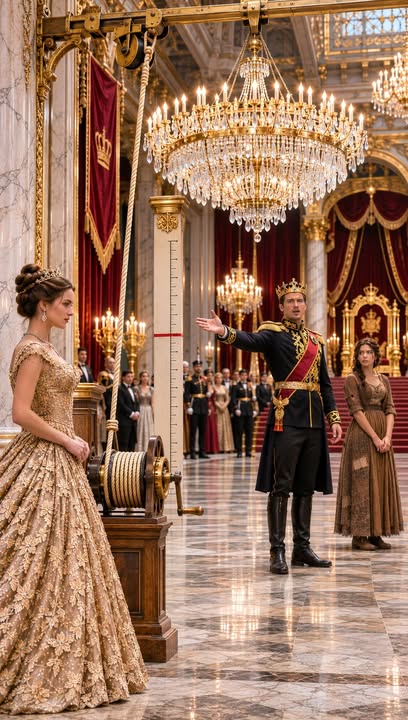
She paused to study the rope wound around the drum, the metal brackets holding the mechanism to the wall, and the thick lines rising toward the great chandelier.
The silence in the throne hall seemed to gather around her.
Even the crystal ornaments had stopped trembling.
“Is something wrong?” Prince Adrian asked.
His voice held no challenge, only careful attention.
Elara glanced at the upper rigging before answering.
“I want to be certain the load is secure before I release the lock, Your Highness.”
A murmur passed through the assembled nobles.
Lady Celestine, still standing near the rope, folded her hands at her waist.
Her cheeks remained flushed from her failed attempt, but the sharpness in her expression had begun to soften into wary curiosity.
“You know how to inspect it?” she asked.
“I know enough to look before I touch,” Elara said.
She heard the plainness of her own reply and wished, for a moment, that she had found a grander one.
Yet the mechanism did not care for grand words.
She stepped closer to the drum and traced the line of the rope with her eyes, following it from the winding axle to the high pulley assembly.
The lifting ropes were taut.
The metal frame held firm against the stone wall.
At the base of the apparatus, a thick pin passed cleanly through the locking plate.
Elara crouched to examine it.
The old brown linen at her knees brushed the polished floor, and she felt the watching court notice every worn patch in her dress.
She kept her gaze on the pin.
“Has the equipment been tested today?” she asked.
One of the engineers, a gray-haired man standing beside the measuring column, stepped forward.
“It has, my lady,” he said, then corrected himself with a glance at her simple clothes.
“Elara, I mean.”
“Thank you,” she replied.
“Did you test the lock with the chandelier under its full weight?”
“We did.”
“And the drum?”
“Twice.”
Elara nodded slowly.
“Then I’ll move only as far as the lock allows.”
Adrian left his place at the center of the hall and approached the mechanism.
His uniform caught the light as he came, but he stopped at a respectful distance, giving her room to work.
“Tell me what you need,” he said.
“For the attendants to keep everyone clear of the rope and the space beneath the chandelier.”
The prince turned to the nearest royal aide.
“Clear the area, please.”
The order was carried out without hurry.
Attendants guided the spectators back from the operating rope and away from the chandelier’s shadow.
A few nobles exchanged impatient looks, but no one objected.
The measure of care in Elara’s request had changed the mood in the room.
This was no longer simply a contest to be won.
The chandelier’s hundreds of crystals seemed to hold every gaze, each one a tiny promise that a careless choice could not be undone.
Elara stood beside the drum again.
She checked the wooden crank for a split in its handle, pressed gently against its mounting, and looked once more at the pin in the locking plate.
Then she set one hand on the crank and the other on the lever.
The engineer started forward.
“Would you like me to—”
“No, thank you,” Elara said, not unkindly.
“I need to feel how the mechanism takes the weight.”
The engineer stopped.
Adrian’s attention remained on her hands.
Elara eased the locking lever upward by the smallest distance.
The pin resisted, then shifted with a quiet metallic click.
She did not pull it free.
Instead, she waited.
The drum held.
The rope remained taut.
Nothing moved overhead.
She glanced at the chandelier’s lowest rim, then at the engineer.
“Still secure?”
He inspected the assembly and nodded.
Elara raised the lever just enough to disengage the lock.
Then she turned the hand crank.
The wooden handle moved a fraction beneath her palm.
Inside the drum, gears answered with a low, steady sound.
Above them, the ropes began to travel.
The chandelier descended so gently that the first sign of movement was a faint, almost imperceptible quiver in the crystals.
Elara stopped.
The hall held its breath.
A crystal near the eastern rim tapped once against its neighbor, a delicate sound that seemed louder than the prince’s earlier command.
Elara kept one hand on the crank and watched the fixture.
It turned by no more than the width of a finger.
Then it grew still.
“Why did you stop?” Celestine asked.
Elara did not look away from the chandelier.
“Because one crystal moved.”
“But it did not break.”
“Not this time.”
There was no accusation in her voice.
Only certainty.
Celestine glanced up at the enormous fixture.
For the first time since she had entered the hall, she seemed to see the danger clearly rather than as a test of skill.
Elara waited until every crystal hung quiet.
Then she resumed turning the crank in a measured rhythm.
One turn.
A pause.
Another turn.
The geared drum lowered the weight with a smooth, controlled patience that the rope alone could not have offered.
The chandelier traveled downward by inches.
The crystals shifted softly, their faint clinking rising and fading like distant rain.
Each time one trembled, Elara stopped.
She listened.
She watched the ropes.
She looked to the engineer for a silent confirmation that the mechanism still held.
Only when the fixture had settled did she continue.
Adrian moved closer, careful to remain outside the rope’s path.
“You’re treating every movement as a question,” he said quietly.
Elara turned the crank once more.
“Every movement has an answer, Your Highness.”
“And what are you listening for?”
“The moment the machine tells me to wait.”
The prince considered this.
Around them, the court had fallen utterly silent.
Even the nobles who had laughed at Elara now watched her with an attention that felt almost like respect.
She did not notice.
Her world had narrowed to the drum beneath her hands, the tension in the rope, and the bright, fragile weight suspended above.
The lowest rim moved closer to the red mark.
The engineer watched the measuring column and lifted his hand.
“Another few inches,” he called.
Elara slowed the crank.
The chandelier descended, steady and level.
A bead of sweat slipped along her temple, though the hall was cool.
The old leather of her shoes pressed against the floor as she braced herself, not against the weight, but against the temptation to move faster.
At last the engineer raised his hand again.
“Hold there.”
Elara stopped.
She eased the crank back by the smallest amount, letting the gears settle without jarring the load.
Then she lowered the locking lever into place.
The pin slid through the plate.
A clear metallic clack sounded as the lock engaged.
No crystal had broken.
The chandelier hung just above the red mark.
The hall remained quiet for one suspended breath.
Then someone applauded.
A second person joined, and then many more.
The sound spread beneath the marble ceiling until it filled the throne hall.
Elara stepped back from the mechanism.
She looked first at the chandelier, then at the engineer, making certain it remained steady.
Only then did she turn toward the prince.
Adrian’s expression held open admiration, but there was something else in it as well: a question he did not yet know how to ask.
“You did what many experienced hands would have struggled to do,” he said.
“I was fortunate the equipment was sound.”
“Fortune did not turn the crank.”
“No, Your Highness.”
“Then tell me,” he said, “how did you know what to do?”
The applause faded.
Elara’s hands, still resting near her waist, curled slightly.
For a moment, she was no longer looking at the throne hall.
She was in the palace storeroom as a child, listening to rain whisper against the high windows while her father bent over a wooden winch.
Tomas had sleeves rolled to his elbows and a small brass key tucked behind one ear.
The storeroom smelled of dust, oil, and folded canvas.
He had set a wooden block on a shelf and asked her to watch.
“Never trust a rope because it looks strong,” he had said.
“Trust what holds it, and trust the lock most of all.”
She had been too young to understand why those words mattered.
She had remembered them anyway.
“My father maintained lifting equipment for the palace,” Elara said.
The admission was small, but it seemed to alter the air around her.
“He taught me to respect the locks.”
Adrian’s face softened.
“He was an engineer?”
“He repaired hoists, winches, and other things that most people only noticed when they stopped working.”
“Was he here at court?”
“Not in the way you mean.”
Elara lowered her gaze.
“He worked in the service rooms and storerooms. I watched him when I was little, when he allowed me to sit quietly nearby.”
“You learned by watching him.”
“And by being told not to touch anything unless I understood what it was meant to do.”
A hint of warmth came into her voice.
“He was very patient about explaining things.”
She had not meant to say so much.
The story had lived quietly inside her for years, protected by the ordinary duties that filled her days.
Yet Adrian’s question had been sincere, and she had answered before she could retreat behind silence.
“Your father must have been proud of you,” he said.
Elara’s fingers pressed against the seam of her skirt.
“He would have been glad that I remembered.”
The distinction was deliberate.
The prince noticed, though he did not press her.
“What was his name?” he asked.
For a heartbeat, the truth hovered behind her teeth.
Then she saw the gray-haired engineer looking at her with a new intensity.
Not curiosity alone.
Recognition, perhaps, or the beginning of it.
Elara’s shoulders tightened.
“He was a good man,” she said.
Adrian heard the boundary in her answer.
He nodded once.
“I believe you.”
Lady Celestine had stood quietly through the exchange.
Now she came a little closer, though she did not approach the mechanism.
“I owe you an apology,” she said.
The hall’s remaining whispers fell away.
Celestine’s gaze dropped to Elara’s worn shoes before returning to her face.
“I judged you by your dress and your place in this palace.”
She paused, gathering herself.
“And I laughed before I understood what you could do.”
“You were frightened the chandelier might break,” Elara said.
“That does not excuse what I said.”
“No,” Elara answered.
The honesty of it seemed to surprise Celestine.
For a moment, neither woman spoke.
Then Elara added, “But you can choose what you do next.”
Celestine’s expression shifted, and some of the pride she had worn like a second necklace loosened.
“I will try to choose better.”
The prince looked between them, allowing the moment to belong to them rather than turning it into another royal pronouncement.
The engineer continued to examine the ropes.
An attendant brought water for the contestants, and Elara accepted a glass with a quiet word of thanks.
Her hands had begun to tremble now that the work was finished.
She held the glass with both of them.
Across the hall, the chandelier remained suspended above the red mark, untouched and whole.
The competition judge approached Adrian and whispered something in his ear.
The prince listened, then glanced toward the balcony where the next stage of the royal competition had been announced.
Elara knew what the applause meant.
She had advanced, perhaps farther than she had ever expected to go.
The knowledge did not fill her with triumph.
It filled her with the uneasy awareness that the palace might now look more closely at her.
At the girl who had spent years carrying linens and sorting cracked lanterns.
At the daughter of a man who had taught her the names of tools but never explained why he stopped working for the crown.
Adrian seemed to sense the change in her mood.
“Would you like to leave the hall?” he asked.
“I should return to my duties.”
“You have earned a moment to rest.”
“I would rather be useful.”
“That is not the same thing as having to be.”
Elara studied him.
It was a gentle answer, spoken without the polished certainty she expected from a prince.
Before she could reply, the gray-haired engineer approached them.
“My lady,” he said to Elara.
Then he seemed to reconsider the form of address and bowed his head.
“May I ask where your father worked?”
“In the palace storerooms, mostly.”
“Do you remember which workshop he reported to?”
Elara’s glass cooled between her hands.
“I was a child. I remember the tools better than the rooms.”
“What sort of tools?”
“Winding keys. Brass calipers. A narrow oil tin with a dent near the lid.”
The engineer’s face had gone very still.
“Did he ever carry a token?”
Elara looked up sharply.
“What kind of token?”
“Small, brass, perhaps round or oval. The royal workshop used to issue them to its senior mechanics. They were marked with a crown over a wheel.”
The glass nearly slipped in her grasp.
She had never shown the token to anyone in the palace.
It was small enough to sit inside the lining of her work basket, wrapped in a strip of linen.
Her father had given it to her before he died.
He had placed it in her palm on a quiet evening and told her to keep it safe.
He had not told her what it meant.
“How do you know about that mark?” she asked.
The engineer’s eyes flicked toward the chandelier.
“Because I have seen it before.”
Elara heard the applause return in memory, but now it seemed distant.
“What does it mean?”
The engineer drew a breath.
Before he could answer, Adrian stepped closer.
“Master Harlan?”
The older man appeared to notice the assembled court again.
His gaze moved from Elara to the chandelier and back.
“I may be mistaken,” he said.
“But that mechanism has an old maker’s mark hidden beneath the winding drum.”
The prince’s brow furrowed.
“What mark?”
“A crown over a wheel, Your Highness. The same design used by the royal workshop decades ago.”
Elara’s fingers tightened around the glass.
“Could it have belonged to my father?”
The engineer did not answer at once.
He looked at the chandelier, its lower rim hovering exactly at the red mark, and then at the quiet young maid who had known how to lower it without breaking a single crystal.
“It could,” he said.
Then he turned to the prince.
“And if it did, Your Highness, we may need to find out who designed this system before the chandelier is raised again.”
**–END OF PART 2–CLICK “NEXT” AT THE BOTTOM OF THE PAGE TO CONTINUE READING**
* * *
[NEXT: PART 3](https://storyly.idolsgift.com/blog/part-3-the-hand-that-remembered-057)
✓ Lynn R. Adams
Part 2 – The Hand That Remembered Her fingers touched the locking lever, but Elara did not move it at once. She paused to study the rope wound around the drum, the metal brackets holding the mechani…