PART 2: The Gate Rose, but Emma Asked for Time 057
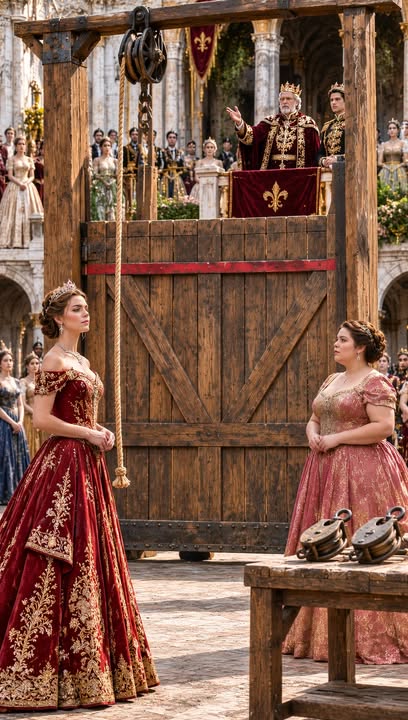
Emma planted her feet firmly against the stone, leaned backward, and began her first powerful pull.
The rope pressed into her palms as the newly threaded pulleys turned above her, their wheels creaking softly beneath the strain.
For one breath, nothing moved.
Then the oak gate gave a low groan.
A murmur passed through the courtyard.
Emma shifted her weight and pulled again, not with a sudden jerk but with steady, deliberate force.
The rope slid through the wheels, and the gate lifted by a finger’s breadth.
Prince Alexander rose from his seat.
Victoria’s arms fell from their folded position.
Emma’s face tightened with effort, but her gaze stayed fixed on the red line painted across the gate’s stone frame.
The supervising royal mechanic watched the pulley system closely, ready to stop her if anything slipped out of place.
“Keep the rope moving evenly,” he called.
Emma adjusted her grip.
The gate rose another inch.
The crowd had become so still that the faint click of each turning wheel seemed to echo beneath the marble arches.
A bead of sweat traced Emma’s temple.
She drew in a slow breath, then let it out as she leaned back once more.
The gate climbed higher.
“Two minutes remain,” announced the supervisor.
A few spectators shifted uneasily.
The gate had moved farther than it had for any of the princesses, but the red line still seemed distant.
Emma glanced briefly at the pulleys, checking how the rope sat against each wheel.
One of them had begun to tremble against its mounting.
“Is that secure?” Alexander asked.
The mechanic moved closer and examined the support.
“It is within the approved mounting point,” he replied, “but she must keep the tension even.”
Emma heard him.
Without letting go, she altered the angle of her pull, easing the rope away from the trembling wheel.
The movement steadied.
Alexander’s expression changed, his seriousness giving way to unmistakable admiration.
Emma pulled again.
The oak gate rose another few inches, its hinges groaning like a ship moving against a stubborn tide.
From somewhere in the crowd came a quiet gasp.
Then another.
Victoria stared at the mechanism, her red gown bright against the pale stone.
The laughter that had followed Emma into the courtyard was gone.
Emma’s hands were reddening where the rope crossed them.
She did not look toward the spectators.
She looked only at the gate.
“Thirty seconds,” the supervisor called.
The red line was close now, but the gate had begun to slow.
Emma’s shoulders trembled.
She planted one foot farther behind her, braced herself, and pulled with every ounce of strength she could summon.
For a moment, the gate seemed to resist her.
Then the pulley wheels turned together, each sharing the weight, and the heavy oak edge rose to meet the mark.
The supervisor stepped forward.
“The gate has reached the red line!”
A hush settled over the courtyard.
It lasted only a heartbeat.
Then the crowd erupted.
People applauded from the marble steps, and several nobles rose to their feet.
The twenty princesses who had tried before her stared in astonishment.
Emma let the rope slip carefully through her hands until the supervisor secured the gate in place.
Only then did she step back.
Her breathing came in quick, uneven bursts.
She looked down at her palms, surprised to see how much they were shaking.
Alexander descended the steps from the royal platform.
“Well done,” he said.
His voice carried to the nearest spectators, but his eyes were on Emma rather than the crowd.
“You understood that the task was not to overpower the gate,” he continued. “You found a way to work with it.”
Emma tried to answer, but her breath caught.
The king rose from his throne, and the applause softened.
“The challenge was clear,” he declared. “Emma has raised the royal gate to the required line, using the materials permitted to every contestant.”
A renewed wave of clapping swept across the courtyard.
The king lifted a hand, and the sound quieted.
“By the terms announced this morning, she has won the right to marry my son.”
Emma’s smile faded.
Not because she was displeased, but because the words had brought her to the edge of a decision she had not expected to face so soon.
She bowed to the king.
“Your Majesty, I am grateful for your honor,” she said carefully. “But I ask for time before any marriage decision is made.”
A surprised murmur traveled through the spectators.
Victoria’s eyebrows rose.
Alexander did not look offended.
He studied Emma for a moment, then inclined his head.
“That is a reasonable request,” he said. “No one should be asked to make such a choice in the middle of a courtyard.”
The king watched his son, then turned to Emma.
“You shall have time,” he said. “The challenge has earned you the right to be heard, not the obligation to decide before you are ready.”
The kindness in his answer loosened something in Emma’s chest.
She bowed again.
“Thank you, Your Majesty.”
The king ordered the gate lowered under the mechanic’s supervision, and the spectators began to drift toward the palace hall, speaking in excited, overlapping voices.
Some praised Emma’s skill.
Others wondered aloud what sort of woman could think so clearly under pressure.
Emma heard only fragments.
Her hands still stung, and the sudden attention felt almost harder to bear than the pull of the rope.
A palace attendant offered her a glass of water.
“Thank you,” Emma said, accepting it with both hands.
She drank slowly while watching the mechanics secure the pulleys.
The first spare wheel had turned smoothly, but the second had made a faint, irregular sound near the end.
Emma could not stop noticing it.
Alexander approached once the king had returned to the palace.
“Would you care to sit somewhere quieter?” he asked. “You have had quite a morning.”
Emma glanced at the crowd, then at the doorway leading into a shaded garden.
“Yes, please.”
He did not offer his arm as though the gesture were expected of her.
Instead, he walked beside her, matching her pace.
The garden was enclosed by low stone walls and scented with rosemary, roses, and damp earth.
A small fountain trickled at its center.
From there, the courtyard’s applause faded into a distant murmur.
Alexander gestured toward a bench beneath a climbing rose.
Emma sat, and he remained standing until she nodded toward the other end.
Only then did he take a seat.
“You could have accepted the king’s offer,” he said. “Many people would have.”
“Many people might have come here for that reason,” Emma replied. “I didn’t.”
He waited, giving her room to continue.
Emma turned the glass between her hands.
“I knew the challenge would draw attention,” she said. “I did not know the king would make marriage the reward.”
“Nor did I,” Alexander admitted. “My father believed a public challenge would reveal something about a person that a ballroom could not.”
“Did it?”
“I think it revealed something about you.”
Emma gave a small, uncertain smile.
“You saw me pull a rope.”
“I saw you notice the trembling wheel before anyone else did.”
She looked toward the courtyard.
“It was vibrating against the mount. If I had kept pulling at the same angle, the rope might have slipped.”
“You learned that somewhere.”
For the first time, Emma’s expression changed in a way Alexander could not quite read.
She set down the glass.
“My father taught me.”
The words were quiet, but they carried a weight she had been holding for years.
“What was his trade?” Alexander asked.
“He worked in palace maintenance,” she said. “He repaired hinges, pumps, carts, and whatever else stopped working at an inconvenient hour.”
A wistful warmth touched her face.
“When I was little, I thought he could fix anything.”
Alexander leaned forward slightly.
“Did he teach you about pulleys?”
“He taught me that a machine is only a promise someone has made with wood and iron. You have to understand where the strain travels before you trust it.”
She glanced down at her reddened hands.
“He used to say that the easiest-looking answer was not always the safest one.”
“That sounds like a lesson that applies to more than machinery.”
“It does.”
A quiet settled between them.
Emma seemed to be weighing whether to say more.
Alexander did not hurry her.
Finally, she drew a folded piece of paper from the small pocket hidden in her gown.
It was worn at the creases and softened along the edges.
“I came to the palace because of this,” she said.
Alexander did not reach for it.
“What is it?”
“A copy of the notice that ended my family’s home.”
She unfolded the paper.
The ink had faded, but the royal seal remained visible at the bottom.
Emma held it on her lap rather than handing it over.
“My father was accused of taking royal funds,” she said. “He was dismissed, and our family had to leave the workers’ cottage where I grew up.”
Alexander’s face grew still.
“I’m sorry,” he said.
The words were simple, without the practiced polish Emma might have expected from a prince.
She gave a short breath that was almost a laugh.
“People usually say that the rules must have been followed.”
“Do you believe your father was innocent?”
“I believe he loved his work. I believe he was careful with what belonged to the palace.” Her thumb traced a crease in the paper. “But I also know that loving someone does not tell you everything they did.”
Alexander considered that answer.
“Why didn’t you come forward sooner?”
“I did not know who would listen. And I had no proof beyond what I remembered and what my father told me.”
She looked up at him.
“I thought that if I could reach the king without being turned away, I might ask him to look again.”
“The challenge gave you a reason to enter the courtyard.”
“It gave me a chance to be heard.”
Alexander’s gaze moved to the folded notice.
“I can ask my father to review the records.”
“I don’t want special treatment because I won the challenge.”
“It would not be special treatment to examine a serious accusation.”
“I’m not asking you to declare my father innocent,” Emma said. “I’m asking for the truth, even if it is more complicated than I hope.”
That answer seemed to reach him more deeply than a plea for comfort would have.
“You understand that the records may not say what you want them to say.”
“Yes.”
“And if they show that your father took the money?”
“Then I will have to learn how to live with that.”
Her voice trembled just once, then steadied.
“But if the record is wrong, someone should know.”
Alexander looked toward the far end of the garden, where sunlight fell across a narrow path.
“My father’s former treasurer kept the accounts during the years your father worked here,” he said. “The man retired long ago, but the ledgers remain in the palace archives.”
“Would you help me find them?”
“Yes.”
The answer came without hesitation.
Emma studied him, searching for the hidden condition behind the promise.
“You don’t have to do this because of the challenge.”
“I know.”
“Or because my story makes you feel sorry for me.”
“I don’t.”
His honest reply surprised her.
“I want to understand what happened,” he said. “And I would rather begin with records than assumptions.”
For the first time since entering the palace, Emma felt the tightness in her chest ease.
She folded the notice and slipped it back into her pocket.
“Thank you, Your Highness.”
“Alexander,” he said. “If you’re willing.”
“Then thank you, Alexander.”
He smiled, and for a moment his royal composure softened into something more approachable.
“You are not at all what the courtyard expected,” he said.
“Neither are you.”
“How so?”
“I thought a prince would have told me what my victory meant before asking what I wanted.”
He gave a quiet laugh.
“Then I’m glad to have disappointed you.”
A sound at the garden entrance drew their attention.
Victoria stood there, no longer surrounded by her friends or the admiring spectators.
Her red gown seemed almost too bright in the garden’s shade.
She held herself with the same practiced poise as before, but the sharp confidence had thinned.
“I hope I’m not interrupting,” she said.
“Not at all,” Alexander replied.
Victoria’s eyes moved to Emma.
“I came to congratulate you,” she said, though the words seemed difficult to arrange. “You did something none of us managed.”
“Thank you,” Emma said.
Victoria hesitated.
Then she added, “I shouldn’t have spoken about your appearance.”
It was not a perfect apology, but it was more than Emma had expected.
“No,” Emma replied. “You shouldn’t.”
Victoria lowered her gaze briefly.
“I know.”
For a moment, the three of them stood in the garden with the awkwardness of people who had discovered that a careless sentence could not simply be taken back.
Then the royal mechanic appeared at the garden entrance.
“Your Highness,” he said to Alexander, “the gate is secured. I thought you should know that the second pulley was slow to turn near the end.”
Emma rose.
“How slow?”
“Only for a moment,” the mechanic replied. “It is likely nothing.”
“Could I see it?”
The mechanic looked to Alexander.
“Of course,” Alexander said.
They returned to the courtyard together.
Most of the spectators had gone, leaving only a few attendants and the palace staff.
The giant gate stood lowered once more.
The mechanic had removed the spare pulleys and placed them on the wooden table.
Emma went straight to the second one.
A thin line of dark grease marked the rim, where the rope had passed over it.
She turned the wheel carefully with one finger.
It rotated, then caught with a faint click.
“That isn’t ordinary wear,” she said.
The mechanic frowned.
“It was checked before the challenge.”
“By whom?” Alexander asked.
The mechanic named two workers, both of whom were still nearby.
They looked troubled, not defensive.
Emma examined the metal beside the wheel’s central pin.
There, almost hidden beneath a smear of oil, was a small notch cut at an angle.
She brushed it clean with the edge of her sleeve.
The mark was familiar.
So familiar that for a heartbeat she could no longer hear the palace around her.
“My father made marks like this,” she whispered.
Alexander stepped closer, but did not touch the pulley.
“What does it mean?”
Emma stared at the angled cut.
“He used it to show that a part had been inspected and fitted by hand.”
The mechanic bent nearer.
“Your father worked on this gate?”
“He helped repair it years ago,” Emma said. “When one of the old wheels cracked.”
She turned the pulley over.
The angled notch was there, just as she remembered.
But beside it, faint under the grease, was another mark—a small, newer line that did not belong to her father’s careful hand.
Emma’s breath caught.
Alexander followed her gaze.
“What is that?”
“I don’t know,” she said. “But it wasn’t there when my father marked a part.”
The mechanic’s face had gone pale.
“This pulley was taken from the palace stores,” he said. “It should not have been near the gate until this morning.”
Emma looked from the strange mark to the lowered oak gate.
Her father’s old inspection cut was unmistakable.
But someone had added a second mark long after he had left the palace.
“Then why,” Alexander asked quietly, “does it carry your father’s mark at all?”
**–END OF PART 2–CLICK “NEXT” AT THE BOTTOM OF THE PAGE TO CONTINUE READING**
* * *
[NEXT: PART 3](https://storyly.idolsgift.com/blog/part-3-the-gate-rose-but-emma-asked-for-time-057)
✓ Lynn R. Adams
Emma planted her feet firmly against the stone, leaned backward, and began her first powerful pull. The rope pressed into her palms as the newly threaded pulleys turned above her, their wheels creaki…