PART 2: The Flame That Wouldn’t Bend 069
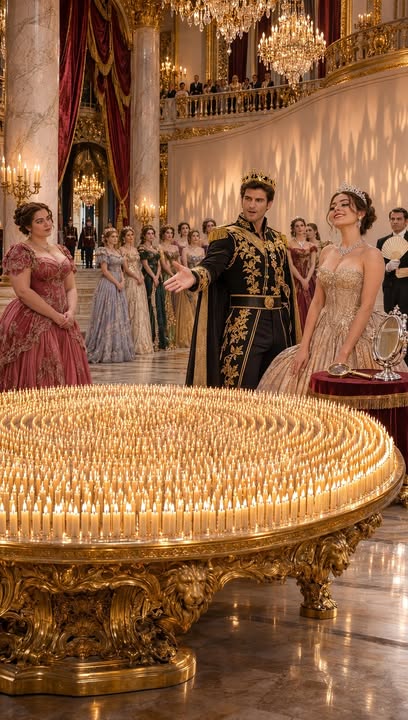
Part 2 – The Flame That Wouldn’t Bend
The fan moved through the air in one slow, careful sweep.
Nearly every flame leaned away from it, their golden tips trembling together as though a single breath had passed over the vast table.
A murmur rippled through the ballroom.
On the ivory wall behind the candles, shadows shivered and stretched, their edges wavering over one another in a restless dance.
Elara lowered the fan.
The air settled, and the flames returned to their upright stillness.
She had not touched a single candle.
The prince watched her with an expression no longer shaped by amusement or doubt.
“Again,” he said quietly.
Elara nodded, and opened the fan for a second sweep, this time moving it from left to right.
Once more, the flames bowed.
Once more, their shadows shifted across the curved wall.
And once more, one flame stayed perfectly upright.
Elara did not point at it at once.
She watched the wall instead, her brown eyes following the overlapping shadows as the last of the moving air faded.
The ballroom grew so silent that the faint crackle of thousands of wicks seemed suddenly loud.
“There,” Elara said.
Her hand rose toward a candle a little beyond the middle ring, its brass holder catching a small glint from the chandelier above.
The prince looked to the royal attendant.
“Place the viewing screen behind that candle.”
The attendant carried the white screen into position.
A dark flame-shadow appeared on it at once.
The champagne-gold noblewoman drew in a breath, already preparing to object, but Elara lifted one hand.
“Please wait,” she said.
She raised the fan again and made a third sweep, gentler than before.
The flames around the indicated candle bent in the moving air, while their shadows slipped across the wall.
The flame at the center of the brass holder remained upright.
Its shadow did not waver.
The attendant shifted the screen a little to either side.
The candle’s shadow appeared, faint but steady, wherever the screen was held.
Elara turned to the prince.
“The candle has a shadow,” she explained, her voice clear enough to carry without becoming a performance.
“It simply does not move when the others do.”
For a long moment, Adrian said nothing.
Then he stepped closer to the table, studying the candle and its holder as though he had never seen either before.
“Correct,” he said at last.
A breath escaped the crowd, and the ballroom broke into scattered whispers.
Elara lowered the fan.
Her fingers had begun to tremble, and she curled them around its carved ivory handle to hide it.
The prince raised his hand, asking the room for quiet.
“Lady Elara has found the candle,” he announced.
“But I will be clear about what this means.”
The crowd stilled again.
“This challenge was intended to test observation, not to decide a bride by itself.”
The noblewoman in champagne gold lowered her jeweled magnifying glass.
Her face remained composed, but the color had risen along her cheeks.
Adrian continued, “No one should be asked to build a life from a single clever answer, least of all in a room full of strangers.”
His gaze moved across the assembled nobles and settled, briefly, on Elara.
“The question of my future belongs to more than a contest.”
There was no triumph in his voice, and no trace of the easy certainty with which he had first presented the challenge.
Elara felt the room’s attention turn toward her again, but it had changed in character.
It was no longer only curiosity, or expectation, or the sharp delight of watching someone be judged.
Now people were waiting to hear what she would do with her answer.
She folded the fan.
“Thank you, Your Highness,” she said.
The words were formal, but something in her expression softened.
Adrian inclined his head.
“And thank you for reminding us what the challenge was meant to reveal.”
A servant stepped forward to take the fan.
Elara handed it over, and only then did she notice that the noblewoman in champagne gold was watching her.
The woman held Elara’s gaze for a moment.
Her lips parted, perhaps to speak, but the gathered courtiers pressed around them, and the moment passed.
Instead, she lowered her eyes to the table.
The ceremony broke apart in a gentle disorder of conversation.
Some guests hurried toward the candles, eager to see the small brass holder for themselves.
Others gathered near the prince, asking what he had meant when he said the challenge could not choose a bride.
Elara slipped away from the center of the room before anyone could ask her to repeat her answer.
She found a quiet passage beyond the ballroom, where the music sounded distant and the air smelled of beeswax and cool stone.
A tall window stood open at the end of the corridor.
The evening breeze brushed her face, carrying the scent of the gardens below.
For the first time since the fan had begun to move, she let herself breathe deeply.
“You look as though you’ve escaped a storm,” said a voice behind her.
Elara turned.
Adrian stood several paces away, no longer surrounded by courtiers.
His crown was still in place, but he had unfastened the top button of his formal coat, and the stern lines of his public expression had eased.
“I’m not sure I’ve escaped it,” Elara said.
“Only found a quieter part of it.”
A brief smile crossed his face.
“That seems fair.”
He stopped at a respectful distance, leaving her space by the window.
For a few moments, neither of them spoke.
The silence between them felt unlike the silence in the ballroom.
There had been crowded silence there, heavy with judgment.
Here, it was simply a pause neither seemed in a hurry to fill.
“I should have made the purpose of the challenge clearer,” Adrian said.
“I let the court believe that finding the candle would decide something it had no right to decide.”
Elara rested her hands against the stone windowsill.
“People heard what they expected to hear.”
“That doesn’t excuse me for allowing it.”
“No,” she said.
“But it matters that you noticed.”
His eyes moved briefly to her hands.
“You’ve been in the palace for years, haven’t you?”
“Since I was seventeen.”
“As a servant?”
“I began in the kitchens.”
She said it without embarrassment, though his question brought the old unease back for a moment.
“Later, I helped in the lamp rooms and on the evening cleaning teams.”
“That explains why you knew where the drafts would travel.”
Elara glanced toward the open window.
“It helped.”
“You seemed certain from the start.”
“I wasn’t certain.”
“You looked certain.”
“That’s different.”
The corner of his mouth lifted.
“I’m beginning to understand that.”
Elara looked toward the ballroom doors, beyond which the courtiers’ voices rose and fell.
“Everyone was looking at the candles as if the answer had to be hidden in one of them,” she said.
“I thought perhaps the answer was in what happened around them.”
“You knew the air would make the flames move?”
“I knew air would make some of them move.”
She paused, considering how to explain without making the discovery sound like a trick.
“When I worked in the lamp rooms, I learned to watch the flame before I tried to fix it.”
“A candle that flickers may be poorly trimmed, or there may be a draft.”
“Sometimes the wick is too long, sometimes the holder is tilted, and sometimes the room is the problem.”
Adrian listened without interrupting.
“My mother used to say that people often blame the nearest thing,” Elara continued.
“They see a flame gutter and blame the candle, when the real cause may be a window left open down the hall.”
“She taught you that?”
“She taught me to notice what people stopped seeing.”
The answer seemed to touch a place in her that she had not meant to show.
Elara looked down at the stone sill.
“My mother worked in the palace too,” she said.
“She died when I was young, but I remember walking with her through the lamp rooms.”
“She could tell where a draft came from by watching a curtain move.”
“Sometimes she’d ask me to stand still and close my eyes, just to feel which way the air was going.”
Adrian’s expression gentled.
“I’m sorry you lost her.”
“Thank you.”
The words were small, but his sympathy did not feel like an obligation.
That mattered more than she expected.
He glanced back toward the ballroom.
“Would you tell me more about her work?”
Elara hesitated.
“She kept the lamps burning.”
“Some nights, she repaired wick trimmers or cleaned the glass.”
“She wasn’t one of the people who stood at the front of a room.”
“No,” Adrian said.
“But she seems to have taught someone who could.”
Elara gave him a look, uncertain whether the remark was meant as praise.
He seemed to read the question in her face.
“I don’t mean that you should have been standing at the front,” he added.
“I mean that the palace has been relying on your judgment without ever asking how you came by it.”
The thought settled between them.
For years, Elara had passed through the same halls as people whose names were announced before they entered a room.
She had learned where the stone steps creaked, which doors caught in damp weather, and how quickly a candle would fail if the wick were trimmed too low.
Those things had been useful, but they had rarely been called knowledge.
Tonight, everyone had watched her use what she knew.
“I’m not sure what I’m meant to do now,” she admitted.
“You don’t have to decide tonight,” Adrian said.
“I was not speaking only of the challenge.”
His gaze held hers, searching but not demanding.
“Then I can’t answer tonight either.”
“I wouldn’t ask you to.”
A quiet warmth came into his voice.
“I’d rather hear an honest uncertainty than a quick answer given because a room is waiting.”
Elara turned back to the window.
Below, the palace gardens lay in dark green shapes, the paths traced in soft lantern light.
The view was beautiful, but it felt strange to stand beside the prince and speak as if they were two people rather than the roles their clothes announced.
“Your Highness,” she said, “why did you make the challenge sound like a betrothal?”
Adrian’s expression changed.
Not with anger, but with the careful stillness of someone choosing what he could say.
“My father wanted the court to see a test that could not be won by family name alone.”
“And you?”
“I wanted the test to be fair.”
“That isn’t the same as wanting it to choose a wife.”
“No,” he said.
“It isn’t.”
He looked down the corridor, where a pair of servants carried a tray toward the ballroom.
“When I was younger, my mother used to set puzzles for us at supper.”
“Small ones, usually.”
“She believed the answer mattered less than the way we reached it.”
Elara listened.
“She would ask us to look at a painting and tell her what was missing, or put a sealed box on the table and ask what we thought it contained.”
“Sometimes there was nothing inside.”
“Sometimes it held a note asking us to listen before we answered.”
The faint smile that had appeared earlier returned, then faded.
“She died when I was sixteen.”
“I’m sorry.”
“Thank you.”
He seemed to understand the weight of the words without asking her to comfort him.
“After she died, my father began arranging those puzzles for court events,” Adrian said.
“I think he wanted to keep something of her alive.”
“But over time, the stories around them changed.”
“A lesson became a tradition, and a tradition became a test.”
Elara watched the light from the corridor lamps shift over his sleeve.
“Did your mother know the candle challenge would be used this way?”
“I don’t know.”
That answer was honest, and it was also a door left slightly open.
Adrian’s voice lowered.
“My father says the challenge was always meant to show what kind of woman could stand beside a future king.”
“And what do you think?”
“I think anyone who can see carefully is worth listening to.”
The words were simple.
Their meaning was not.
Before Elara could reply, footsteps approached from the ballroom.
A palace official in a dark blue coat bowed to Adrian.
“Your Highness, His Majesty asks that you join him in the west salon.”
Adrian’s shoulders tightened almost imperceptibly.
“I’ll come shortly.”
The official bowed again and withdrew.
For a breath, Adrian seemed to consider whether to say more.
Then he looked at Elara.
“I hope we can continue this conversation.”
“If it is a conversation,” she said.
“Not another test?”
“Not another test.”
She inclined her head, and he returned the gesture before turning toward the west salon.
Elara remained by the window until the sound of his footsteps faded.
Then she made her way to the servants’ passage.
The palace was quieter there, its grand rooms giving way to narrow corridors where baskets of clean linen waited beneath the shelves.
The familiar smells of soap, flour, and lamp oil steadied her.
Marta, one of the older attendants, was stacking folded cloths beside a door to the service stair.
“You found the candle,” Marta said.
“I heard the whole hall shouting about it.”
“I found what made it different.”
“That sounds like the same thing to me.”
“It wasn’t.”
Marta’s eyes warmed with approval.
Elara glanced at her.
“Did you know what the challenge was meant to be?”
“Not really.”
“Only that they’d set up a table of candles, and the prince asked the ladies to find one that cast no moving shadow.”
Marta began stacking the cloths again.
“You know how court stories grow,” she said.
“By the time they reach the kitchens, a question has become a prophecy.”
Elara smiled faintly.
“Or a marriage contract.”
Marta gave her a thoughtful look but did not reply.
Elara continued toward the lamp room.
She had promised to check the candles in the lower gallery before the evening ended, and duty felt like a safe place to set her thoughts.
The lamp room was warm, close with the scent of oil and beeswax.
On the worktable, a small brass wick trimmer lay beside a box of replacement candles.
Elara set the tools in order, then paused.
She could still see the unbending flame in her mind.
The brass holder had seemed ordinary when she first pointed to it.
Old, perhaps, and darkened by years of handling, but no different from dozens she had seen in storage.
Yet the flame had not merely been sheltered by the arrangement of the table.
The air had reached it from more than one direction.
Its small glass guard had been almost invisible under the bright lights, a clear curve that caught the draft and turned it aside.
A practical little piece of workmanship.
Nothing about it should have made the court so excited.
And yet, when Adrian had watched the candle, his face had changed.
Elara wondered whether he had recognized the holder.
She was still thinking about it when Marta came into the room.
“His Highness asked for you,” she said.
Elara straightened.
“Now?”
“He said only if you were free.”
The distinction eased something in her.
“I am.”
Marta led her to the east gallery, where Adrian waited beside a table holding two cups of tea.
He had removed his crown, though it rested within reach on the table.
The gesture made him seem younger, and less like the figure who had stood beneath the chandeliers and spoken of choosing a wife.
“I hope you don’t mind,” he said.
“I thought it might be easier to talk here than in the ballroom.”
“It is.”
He poured tea into one cup and offered it to her.
Elara accepted it with both hands.
“I wanted to ask about the holder,” Adrian said.
“The candle you identified.”
“Did anything about it seem unusual to you?”
She considered her answer.
“It had a glass guard around the wick.”
“Very small, and clear enough to disappear against the flame.”
“I could see it when the air moved because the other flames bent and that one didn’t.”
“Was the guard part of the holder?”
“I think so.”
“Did you recognize it?”
“No.”
Adrian looked toward the cup in his hands.
“I thought I might have.”
“You’ve seen it before?”
“Maybe.”
He seemed dissatisfied with the answer, though not with her.
“My father used to say that the old holders in the palace were all made in the royal workshop.”
“If it’s one of those, it could be decades old.”
Elara turned the tea cup slowly between her palms.
“Then the guard may have been there for years.”
“Possibly.”
“Why does that matter?”
“I’m not certain yet.”
He set his cup down.
“I’d like to know who arranged the challenge and why that particular candle was placed among the others.”
“You think someone meant for it to be found?”
“I don’t know.”
His answer was cautious, but his attention had sharpened.
“That is what troubles me.”
Elara glanced toward the ballroom.
The distant conversation continued, and somewhere in the palace a door closed with a soft, echoing sound.
“I didn’t find the candle because someone wanted me to,” she said.
“I found it because I watched.”
“I believe you.”
“Then what are you looking for?”
“An explanation for why the holder was there.”
He paused.
“And whether the challenge was truly arranged the way I was told.”
Elara felt a small chill despite the warmth of the tea.
Adrian seemed to notice.
“I don’t mean that anyone was in danger,” he said.
“Nothing was set to harm anyone.”
“But a test can still tell a story that isn’t true.”
She thought of his mother’s puzzles, and the way a lesson could become something else after the person who taught it was gone.
“You said your father arranged the challenge,” she said.
“He did.”
“Then you think he chose the candle?”
“I think he approved the setup.”
“That’s not quite the same thing.”
“No.”
His expression turned thoughtful.
“You’re careful with the difference.”
“My mother taught me that the nearest answer isn’t always the right one.”
A faint smile appeared on his face.
“Then perhaps I should ask you to help me find the less obvious answer.”
Elara looked at him over the rim of her cup.
“To investigate the candle?”
“To understand how it came to be used.”
“And who decided the challenge should mean what it did.”
The request was not an order.
Still, it reached across a boundary that Elara had spent years learning not to cross.
She was a palace worker, and he was the prince.
One mistake in a room full of powerful people could become a story that followed her long after the candles were forgotten.
“I don’t know enough to promise anything,” she said.
“I wouldn’t ask for a promise.”
“I would ask you to tell me what you notice.”
“That is all.”
Elara looked down at her hands, at the faint red mark left by the fan’s handle.
“I can help with the holder,” she said.
“But I won’t pretend to know the answer before I’ve seen the evidence.”
“I wouldn’t want you to.”
The tea had cooled enough to drink.
Elara lifted the cup, and the warmth settled her.
When she placed it down, her gaze returned to the candle image in her thoughts.
“The holder had a mark on the base,” she said.
Adrian leaned forward.
“What kind of mark?”
“A tiny stamp, on the side facing the table.”
“I couldn’t make out all of it from where I stood.”
“But it looked like a crown over a wheel.”
He was very still.
“Are you certain?”
“Not completely.”
“I saw it when the attendant moved the screen.”
Adrian rose and walked to the gallery window.
For a moment, he said nothing.
Then, in a voice so low it was almost lost beneath the evening air, he asked:
“Did you say a crown over a wheel?”
**–END OF PART 2–CLICK “NEXT” AT THE BOTTOM OF THE PAGE TO CONTINUE READING**
* * *
[NEXT: PART 3](https://storyly.idolsgift.com/blog/part-3-the-flame-that-wouldn-t-bend-069)
✓ Lynn R. Adams
Part 2 – The Flame That Wouldn’t Bend The fan moved through the air in one slow, careful sweep. Nearly every flame leaned away from it, their golden tips trembling together as though a single breath…