PART 2 – The Favor-059
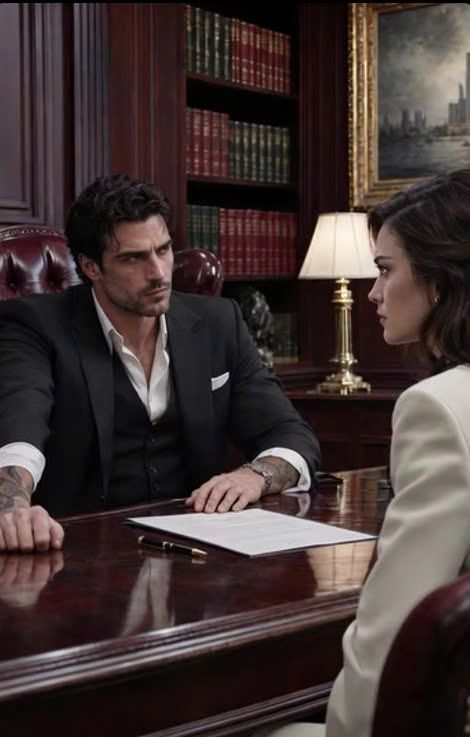
For several seconds, Vincent did not move.
His hand remained against the doorframe, his shoulders rigid beneath his dark coat, while the familiar composure that had carried him through boardrooms, funerals, negotiations, and three years of marriage quietly deserted him.
His gaze stayed on the hand I had pressed unconsciously against my stomach.
Then he looked at me.
“You’re pregnant?”
There was something almost unbearably young in his voice.
I nodded.
“Eight weeks.”
His lips parted, but whatever he meant to say disappeared before it became sound.
I had imagined this moment dozens of times since the second pink line had appeared on the test in the guest bathroom of the house we had shared.
In some versions, Vincent smiled.
In others, he picked me up and spun me around the kitchen as though we were an ordinary married couple who had spent years waiting for exactly this news.
In the darker versions, he looked at me with the same distant expression he had worn while sliding divorce papers across our dining room table.
I had never imagined silence.
Vincent stepped inside only after I moved away from the doorway.
He closed the door carefully behind him.
“You knew when you signed?”
“No.”
I crossed my arms because I suddenly needed something to hold together.
“I found out two days later.”
His face tightened.
“That was the morning you left the house.”
“Yes.”
“And you didn’t tell me.”
“You were leaving me because another woman told you she was carrying your child.”
He lowered his eyes.
There was no accusation in his expression when he looked back at me.
“That isn’t what I meant.”
“I know.”
I walked to the window.
Below us, Chicago glittered against the dark water, the streets reduced to shining lines and moving headlights.
For three years, that city had been Vincent’s territory in ways I had never entirely understood.
People knew his name.
People lowered their voices when they spoke it.
Restaurants found tables when there were none, doors opened before he reached them, and men twice his age waited for him to finish speaking before daring to interrupt.
Yet standing behind me now, he seemed powerless in the face of something weighing less than a grape.
“When were you going to tell me?”
“When I was far enough away that you couldn’t convince me to change my plans.”
His answer came softly.
“You think I would do that?”
I turned.
“I think you would ask.”
Pain crossed his face.
It was gone almost immediately, but I saw it.
“That’s why I’m calling in my favor.”
He understood before I finished.
The deal we had made over the settlement papers came back between us.
One favor.
No questions.
No argument.
“You said when I asked, you owed me.”
“I remember.”
“When I leave tomorrow, don’t follow me.”
His jaw tightened.
“Claire.”
“And don’t ask me to stay.”
He closed his eyes briefly.
That hurt more than anger would have.
When he opened them, his expression was composed again, but his hands were no longer still.
His fingers curled slowly at his sides.
“Does the favor include never seeing my child?”
“No.”
The words left me immediately.
Whatever had happened between us, I would not turn our baby into punishment.
“You’re the father.”
I swallowed.
“You deserve to know your child, and our child deserves the chance to know you.”
His shoulders loosened by an inch.
“But right now, I need distance from you.”
He nodded once.
“How much?”
“I don’t know.”
“Give me something.”
The request was almost a whisper.
I thought about it.
“Thirty days.”
He stared at me.
“No calls unless there is an emergency.”
Another pause.
“No messages because you’re lonely.”
His mouth moved faintly, although it was not quite a smile.
“No flowers?”
“Definitely no flowers.”
“What about medical expenses?”
“No.”
“Claire.”
“I have insurance.”
“I know you have insurance.”
“Then why did you ask?”
His gaze fell again toward my stomach.
“Because I don’t know what I’m allowed to do.”
For the first time that night, my anger softened enough to reveal what had been hiding underneath it.
Grief.
Vincent had once known exactly what he was allowed to do.
He had been allowed to come home after midnight and slip beneath the covers beside me.
He had been allowed to steal coffee from my mug because he insisted mine always tasted better.
He had been allowed to rest his head in my lap on Sunday afternoons while pretending he wasn’t tired.
He had been allowed to touch me without wondering whether the touch was welcome.
Now he stood six feet away from me like a guest waiting to be told whether he could sit down.
“You can respect what I’m asking.”
“I can do that.”
“And when I’m ready, we’ll talk about everything else.”
Vincent nodded.
He reached into the inside pocket of his coat and removed the folded divorce certificate he had supposedly come to return.
He placed it on the little desk near the window.
Neither of us looked at it.
“I am sorry.”
“I know.”
“No.”
His voice steadied.
“I don’t think you do.”
I looked at him.
Vincent took a breath.
“I’m not sorry because Sophia lied.”
His gaze did not leave mine.
“I’m sorry because I believed that wanting something different gave me permission to stop protecting what we already had.”
The ache behind my ribs sharpened.
He continued before I could answer.
“I made the choice.”
“She didn’t make it for me.”
“The pregnancy didn’t make it for me.”
“My grandmother dying didn’t make it for me.”
“I did.”
I had waited through our entire divorce to hear him take responsibility without explanation attached to it.
Hearing it now did not repair anything.
But it mattered.
“I wish you had understood that before signing those papers.”
“So do I.”
A car horn sounded far below us.
Vincent glanced toward the window and then back at me.
“Thirty days.”
I nodded.
He walked to the door.
His hand rested on the handle.
“Claire?”
“Yes?”
His voice was quieter when he asked the question.
“Are you all right?”
It was such a simple thing.
Not whether the baby was all right.
Not whether I had seen a doctor.
Not whether I needed money, protection, a car, a house, or anything else Vincent knew how to provide.
Just me.
“I don’t know yet.”
He accepted that answer.
Then Vincent Moretti, who had rarely left a room before getting what he came for, opened the door and walked away because I had asked him to.
The following afternoon, Madison sat beside me at O’Hare with one ankle hooked behind the other and an enormous coffee balanced on her knee.
She had asked precisely three questions after I told her what happened.
The first was whether Vincent knew.
The second was whether I still wanted to leave.
The third was whether I had eaten breakfast.
That was why she was my best friend.
“You’re staring at your phone.”
“I’m checking the time.”
“You checked it forty seconds ago.”
“I like knowing what time it is.”
“You married a man whose watch probably cost more than my student loans.”
She took a drink.
“You have always known what time it is.”
I turned the screen facedown on my leg.
Vincent had kept his promise.
There were no messages.
I had expected relief.
Instead, some irrational part of me was offended by how good he was at obeying.
Madison noticed my expression.
“You asked him not to contact you.”
“I know.”
“And now you’re bothered because he isn’t contacting you.”
“I didn’t say that.”
“You didn’t have to.”
The gate agent announced boarding for our flight to Boston.
Madison stood and extended her hand.
“Come on.”
I looked through the enormous airport windows toward the gray Chicago sky.
Somewhere beyond the runways, there was a house that had belonged to me until three days ago.
A bedroom where my clothes had once hung beside Vincent’s.
A kitchen where we had eaten breakfast on mornings when neither of us had enough time.
A garden his grandmother had planted because she said every home needed something nobody could hurry.
Then I placed my hand in Madison’s.
“All right.”
Boston did not cure me.
That would have been too easy.
But it gave me somewhere to hurt that did not contain Vincent’s fingerprints.
Madison had found us a furnished apartment in Back Bay, and within two weeks I had accepted a position at the architectural preservation firm where I had worked before my marriage.
My first morning back, I stood beneath the carved stone entrance of a century-old library and remembered something I had almost forgotten.
I was good at my work.
There was satisfaction in measuring cracked cornices and studying old plans.
There was peace in arguing about limestone instead of marriage.
There was even something comforting about carrying a hard hat while secretly carrying a child nobody around me knew existed.
Every evening, I marked another day off the thirty-day calendar I had drawn inside the back cover of my notebook.
Vincent never broke the silence.
On day twelve, I had my first appointment with the obstetrician Madison had found for me.
On the examination table, with the lights lowered and the monitor glowing beside me, I heard my baby’s heartbeat for the first time.
It was astonishingly fast.
A tiny, determined rhythm filled the room.
I covered my mouth.
Madison took my hand.
The technician smiled.
“Everything looks exactly as it should.”
I cried quietly after that.
Not because I was sad.
Not entirely.
I cried because love had arrived before I had prepared a place for it.
I cried because there was suddenly someone in the world whose existence mattered more to me than every argument, every betrayal, every abandoned plan.
And I cried because Vincent should have been there.
That was the truth I hated most.
On day twenty-one, an envelope arrived at the office.
The return address belonged to a law firm in Chicago.
I almost handed it to reception and asked them to send it back.
Then I saw the handwriting beneath the typed address.
PRIVATE CORRESPONDENCE REGARDING THE ESTATE OF ELENA MORETTI.
My breath caught.
Vincent’s grandmother had died six weeks before Sophia returned to Chicago.
Elena Moretti had been the first person in Vincent’s family who made me feel as though I had married more than a surname.
She had taught me how to make gnocchi badly and insulted my technique affectionately every Christmas.
She had telephoned me instead of Vincent when the roses needed pruning because, according to her, “That boy believes money is a substitute for knowing where the scissors are.”
I opened the envelope with trembling hands.
Inside was a letter from Elena’s attorney.
Mrs. Moretti had left several personal items to me.
Most had already been distributed according to instructions written before her death.
One item, however, had been sealed separately.
The attorney explained that Elena had directed him to contact me only if my marriage to Vincent ended.
I read that sentence three times.
Beneath the letter was a smaller cream envelope.
My name was written across the front in Elena’s familiar handwriting.
Claire.
Nothing else.
I sat at my desk long after everyone else had left.
Finally, I broke the seal.
Inside was a brass key and a single folded sheet of paper.
My dearest Claire,
If you are reading this, then something I feared has happened, and Vincent has mistaken running away for choosing a direction.
I laughed once through sudden tears because the sentence sounded exactly like her.
Then I continued reading.
There are things about my grandson that I had hoped he would someday be brave enough to tell you himself.
If he has not, perhaps I was wrong to wait.
The key belongs to a safe-deposit box at First Lake Bank in Chicago.
What is inside belongs to Vincent, but the truth inside it belongs to you as well.
Before you decide what kind of father he may become, I want you to understand why becoming one has frightened him since he was twelve years old.
My hands went cold.
There was one final sentence beneath Elena’s signature.
And Claire, when you open the box, remember this above everything else: Sophia Reynolds did not return to Chicago by accident.
I stared at the words until the letters blurred.
Then I reached for my phone.
For the first time in twenty-one days, I opened Vincent’s name.
**–END OF PART 2–CLICK “NEXT” AT THE BOTTOM OF THE PAGE TO CONTINUE READING**
✓ Lynn R. Adams
For several seconds, Vincent did not move. His hand remained against the doorframe, his shoulders rigid beneath his dark coat, while the familiar composure that had carried him through boardrooms, fu…