PART 2: The Envelope That Waited 027
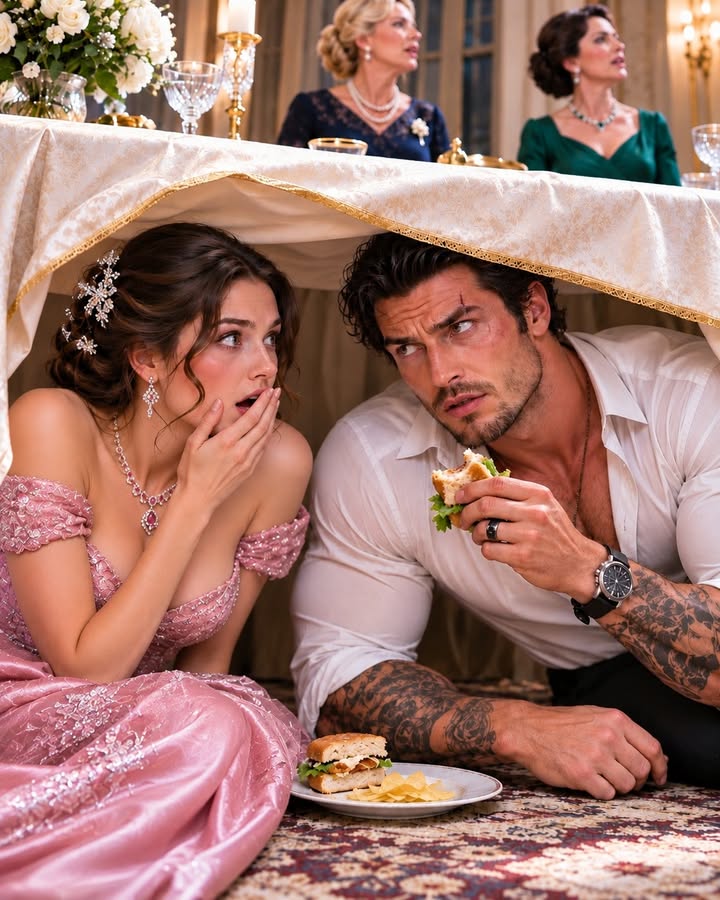
Part 2 – The Envelope That Waited
“Whatever happens next, sweetheart, don’t tell them we met by accident,” Vincent whispered.
His hand closed around mine—not tightly, but with a sudden urgency that made the warmth of his palm feel less like a gesture and more like a warning.
“Because there’s a reason I’ve been looking for you.”
I pulled my hand free.
“Then you can explain that reason before I agree to anything.”
His eyes held mine beneath the tablecloth, steady and unexpectedly tired.
“I will,” he said. “But not while our mothers are listening.”
Above us, the tablecloth stirred as someone came closer.
“Evelyn?” my mother called. “Are you in here?”
I glanced at Vincent, then toward the doorway.
I had spent the evening trying to avoid a conversation with a widower I didn’t want to meet.
Somehow, I had ended up hiding beside a man who seemed to know my name before I knew his.
“Perhaps they’re behind the curtains,” Vincent’s mother said. “Margaret, I think I hear something.”
I gave Vincent a narrow look.
“Your tactical withdrawal is about to fail.”
“Then we should improve the plan.”
He leaned toward the edge of the table and called out, “Mother?”
The tablecloth jumped as the women stopped moving.
“I knew it,” his mother said.
Vincent pushed the fabric aside and crawled out first, then turned to offer me his hand.
I considered refusing it, but the sight of his open palm brought back the ridiculous intimacy of sharing a chicken sandwich in hiding.
I took it.
He helped me to my feet without comment, and for a moment we stood facing our mothers with the ivory tablecloth hanging between us like a curtain after a play neither of us had rehearsed.
My mother, Margaret Hartwell, wore a midnight-blue gown and the expression she usually reserved for seeing a bill she hadn’t expected.
Beside her stood Rosa Marino, elegant in silver and visibly trying not to smile.
“Evelyn,” my mother said, eyeing the hem of my burgundy dress, “why were you underneath the table?”
“I needed a moment.”
“And you found one with Vincent?” Rosa asked.
“I didn’t know who he was,” I said.
Vincent’s mouth twitched.
“That part is true.”
My mother looked from me to him, then down at the sandwich still in his hand.
“You were eating?”
“I was,” he replied. “Evelyn was gracious enough to share.”
“You shared a sandwich?” Rosa said.
“It was an emergency,” I said.
“Of course,” my mother replied, with the careful tone of a woman who had already decided the emergency was romantic.
I felt my face warm.
“Before anyone mistakes this for an introduction arranged by you,” I said, “we should clear up one thing.”
Vincent glanced at me.
I understood then that he was waiting for me to choose.
He could have told them the truth and let the evening become another argument about mothers and their plans.
Instead, he stood beside me, silent and watchful, leaving the decision in my hands.
“We were just talking,” I said. “We met by chance.”
Rosa’s smile faded into something more thoughtful.
“By chance,” she repeated.
“That’s right,” Vincent said. “Evelyn didn’t know who I was.”
“And now she does,” my mother said, her voice brightening in a way I did not trust. “Perhaps this is a happy accident.”
“It’s not an accident,” Vincent said.
My stomach tightened.
He looked at me before adding, “I mean, it’s certainly a coincidence that we found ourselves in the same room.”
It was a clumsy rescue, but I appreciated the attempt.
My mother looked unconvinced.
“Your mother and I have been trying to get the two of you together for months,” she said. “There is no need to pretend fate hasn’t lent a hand.”
“Margaret,” Rosa murmured.
My mother missed the warning in her voice.
“I’m only saying that Evelyn has been refusing every introduction, and Vincent has been doing the same.”
“Maybe we’ve both had our reasons,” I said.
“I’m sure you have,” Rosa replied, and her gentle expression made it difficult to hear judgment in the words.
Vincent folded the remaining half of his sandwich into a napkin.
“Would you both give us a minute?” he asked.
My mother looked surprised.
Rosa looked pleased.
“Of course,” she said.
“Rosa,” my mother began.
“We’ve already interrupted their conversation once.”
It was a delicate way of saying she knew exactly what we had been doing beneath the table.
My mother glanced at me as if searching for an objection.
I gave her none.
The women moved toward the doorway, though my mother paused before leaving.
“I’ll be in the ballroom,” she said. “Evelyn, do try not to disappear again.”
“I’ll do my best.”
She gave Vincent a measured look.
“And you, Vincent, if you are planning to make my daughter uncomfortable, I would prefer to know now.”
“Margaret,” Rosa said softly.
Vincent did not bristle.
“You have my word that I won’t pressure her,” he said.
My mother studied him, apparently trying to fit his calm reply around the frightening name she had just announced.
Then she followed Rosa out.
The door clicked shut behind them.
For a few seconds, neither of us spoke.
I picked up the abandoned sandwich wrapper from the floor.
“So,” I said. “You’ve been looking for me.”
“Yes.”
“Why?”
“I want to tell you the whole story, but I need you to understand that I didn’t know you before tonight.”
“That sounds like a very specific distinction.”
“It is.”
He stood with his hands relaxed at his sides, making a visible effort not to loom over me.
The gesture was subtle, but I noticed it.
Outside the room, distant music drifted through the corridor, softened by the closed door and the thick carpet.
“Tell me what you can,” I said.
“My mother received an envelope from your father years ago.”
The room seemed to grow quieter.
“My father is dead.”
“I know.”
“How did he know your mother?”
“I don’t know all of it yet.”
“That’s not an answer.”
“No,” he admitted. “It isn’t.”
He looked down at the napkin in his hands, then folded it once, carefully, as if he needed something ordinary to do while he chose his words.
“My mother says Daniel Hartwell gave her the envelope before you were old enough to read it. He asked her to keep it until you were ready to make your own choices.”
I stared at him.
“Why would my father give your mother something like that?”
“I don’t know.”
“Did she open it?”
“No.”
“Not once?”
“She says she promised your father she wouldn’t.”
I searched his face for the hint of a practiced lie.
Vincent’s public reputation made it easy to distrust him, and his size made it easy to imagine he had learned to get what he wanted by frightening people.
But he wasn’t trying to force the story into a shape that would please me.
He seemed as unsettled by it as I was.
“What does this have to do with you looking for me?”
“My mother said she wanted to return the envelope once she found out you were here tonight.”
“That doesn’t explain how you knew I was here.”
“She recognized your name on the guest list. She asked me to find you before our mothers turned the evening into another arranged introduction.”
“Your mother sent you to find me?”
“Yes.”
“And you didn’t think that was something you should mention before asking me to keep a secret?”
“You’re right,” he said. “I should have.”
His answer caught me off guard.
I had expected an explanation, perhaps an excuse.
Instead, he had simply agreed with me.
“Why did you tell me not to say we met by accident?”
“Because I hoped we could decide together how to handle our mothers before they decided for us.”
“That’s still not an answer.”
He let out a slow breath.
“I thought they would hear the words ‘we met by chance’ and treat it as permission to arrange the rest. If we said we’d chosen to speak privately, they might give us room.”
“You want us to pretend this meeting was planned?”
“I want us to tell them we chose to talk. We don’t have to say we were under a table.”
I looked at the discarded sandwich wrapper in my hand.
“Your plan is to lie so our mothers will stop arranging dates.”
“My plan is to draw a boundary without turning the evening into a fight.”
“That sounds like a lie with better manners.”
“Yes,” he said. “It does.”
I laughed once, in spite of myself.
“You admit that too?”
“I’m not trying to sell you something.”
“What are you trying to do?”
“Get the envelope to you.”
There was no trace of flirtation in his voice now.
Only sincerity, and something like caution.
I considered him again—the scar across his eyebrow, the dark tattoos, the shoulders that had seemed too broad for the narrow space beneath the table.
I had imagined a dangerous man would speak in commands.
Vincent spoke as if he understood that a request was only meaningful if I could refuse it.
“Where is the envelope?” I asked.
“My mother has it with her.”
“Then why doesn’t she bring it here?”
“She wants you to see that she hasn’t opened it.”
“I would take her word for it.”
“She doesn’t want you to have to.”
The answer unsettled me more than an excuse would have.
“Do you know what’s inside?”
“No.”
“Your mother never told you?”
“She told me the envelope existed this afternoon. She had kept it locked away for years.”
“Why tell you now?”
“Because she recognized your name on the guest list and realized there might not be another chance to return it.”
I glanced at the door.
“Your mother kept a letter from my father for years, and neither of them ever told me?”
“I can’t explain their choices.”
“Can you explain why they made them?”
“No.”
I looked at him sharply.
He met my gaze without flinching.
“I can guess,” he said. “But I won’t pretend a guess is the truth.”
That answer loosened something in my chest.
My father, Daniel, had been dead for six years.
I had spent those years learning how to live with all the questions his death had left behind: the calls I hadn’t returned, the conversations I had kept postponing, the ordinary moments I’d assumed we had more time to share.
He had been private, but not secretive.
At least, I had thought so.
“Did your mother and mine know each other?” I asked.
“I think they did.”
“Think?”
“I’ve seen old photographs of my mother with women I didn’t recognize. She never explained who they were.”
“And my father?”
“I don’t know.”
The ballroom music swelled faintly beyond the walls.
I folded the wrapper and placed it on the table.
“If this envelope is meant for me, I’ll read it in private.”
“Of course.”
“And no more surprises.”
“I’ll try.”
“Not try.”
He nodded once.
“I’ll tell you what I know and what I don’t know. Nothing more, nothing less.”
I studied his face, still uncertain whether that promise meant anything coming from a man who had spent years building an intimidating reputation.
But his gaze did not move away.
“Then we tell our mothers we chose to speak privately,” I said. “That we’re not agreeing to be introduced, and we’re not promising anything.”
“Agreed.”
“And if either of them starts planning our wedding, we leave.”
“Agreed.”
I held out my hand.
He looked at it, then shook it with careful gentleness.
His hand was warm and rough against mine.
“An uneasy agreement,” I said.
“Those are the ones worth keeping.”
We returned to the ballroom together.
My mother and Rosa were standing near a tall arrangement of white roses, both watching the doorway with the same barely concealed curiosity.
“We’ve decided to talk,” I said before either of them could ask.
“Just talk,” Vincent added.
My mother’s expression brightened anyway.
“Of course.”
“Not because you arranged it,” I said.
“Certainly not,” she replied, in a manner that suggested she had already filed the distinction away for later.
Rosa touched my arm.
“Evelyn, I’m sorry this has been so strange.”
“Have you really kept something from my father all these years?”
Her face changed.
The smile disappeared, and the warmth in her eyes deepened into grief.
“Yes,” she said. “I have.”
“Why?”
“Because Daniel asked me to.”
The answer was too simple to satisfy me, but the pain in her voice made it impossible to dismiss.
“Did you know him well?”
“I knew him better than Margaret knew.”
My mother’s head turned toward Rosa.
“Rosa.”
“I’m not telling her what’s inside the envelope,” Rosa said. “That is hers to discover.”
The two women exchanged a look heavy with a history I didn’t understand.
My mother reached for my hand.
“Your father trusted Rosa,” she said. “When he asked her to keep something safe, I believed she was doing what he wanted.”
“But you knew?”
“I knew there was an envelope. I didn’t know what was in it.”
“You never asked?”
“Daniel was very clear that it belonged to you, and that you should receive it when you were ready to choose for yourself.”
The words landed strangely.
Ready to choose for myself.
Not when I was older, not when I turned a particular age, but when I was ready to choose.
I felt my mother’s fingers close around mine, then noticed the sadness behind her attempt at reassurance.
She had spent years trying to choose for me.
Perhaps she had thought she was protecting me from the uncertainty she had once known herself.
It didn’t make the pressure easier to bear, but it gave it a shape I could understand.
“Can we see it?” I asked.
Rosa glanced at Vincent.
He gave a small nod.
“I brought it tonight,” she said. “I didn’t want to leave it at home after I recognized Evelyn’s name.”
She reached into the small evening bag hanging from her wrist and drew out a cream-colored envelope.
The paper was worn at the corners, and the flap had been sealed with dark red wax, now cracked but untouched.
My name was written across the front in my father’s unmistakable handwriting.
Evelyn.
Nothing more.
I couldn’t move.
I had seen that handwriting on birthday cards, grocery lists, and the notes he used to leave beside my coffee when I came home late.
The letters leaned slightly forward, as though even his words had somewhere to be.
My mother inhaled quietly.
Rosa held the envelope out to me.
“I never opened it,” she said. “I wanted you to know that before you decided whether to trust me.”
I accepted it with both hands.
The paper felt impossibly light.
“Did he say anything else?”
“He told me the letter was for you and that I must wait until you were old enough to decide what you wanted from your life.”
“Did he say why you, specifically?”
“He said he trusted me.”
Rosa’s eyes flicked toward my mother.
“And he said there was something important I might have to protect until the time came.”
“What was it?”
“I don’t know.”
“Did you ever ask?”
“I did. He said the less I knew, the safer it would be.”
A chill moved through me, not from fear but from the sudden awareness that my father had carried something carefully hidden, something serious enough to place in another person’s hands.
My mother stepped closer.
“Perhaps we should read it somewhere quiet.”
I looked down at the envelope.
“Not here.”
“Of course,” Rosa said.
Vincent’s gaze met mine.
“You don’t have to read it tonight.”
“I’ve waited long enough without knowing I was waiting.”
He did not argue.
The four of us left the ballroom together, though my mother and Rosa walked several steps ahead, speaking in low voices.
Vincent stayed beside me.
The crowded corridor glowed with chandeliers and reflections, while guests moved through it in evening clothes, unaware that the small, worn envelope in my hands had rearranged the past.
“Were you close to your father?” he asked.
“Yes.”
The word came out too quickly.
I looked down at the envelope.
“I mean, yes, but I was busy. I was always busy. We had a good relationship, but I thought there would be more time to ask him the questions that mattered.”
“Most people think that.”
“Do you?”
“I thought I had more time with my father.”
He didn’t explain further, and I didn’t ask.
His hand brushed mine as we walked, then drew back without trying to hold it.
That restraint made me want to trust him more than any reassurance could have.
We found a quiet sitting room near the hotel’s upper terrace.
Rosa closed the door behind us while my mother drew the curtains.
I sat on the edge of a velvet chair with the envelope in my lap.
The others waited.
“Are you sure?” my mother asked.
“No,” I said. “But I’m ready to know.”
I slid a finger beneath the cracked seal.
The wax gave way with a soft snap.
Inside was a photograph and a folded letter.
The photograph had been taken outdoors, perhaps in a garden, though the background had faded almost completely.
My father stood beside a younger Rosa, both of them smiling at something beyond the frame.
Between them was a woman I recognized immediately, though I had never seen the picture before.
“Mom.”
Margaret leaned close.
She pressed her fingers to her lips.
The woman in the photograph was my mother, much younger, with her dark hair cropped just above her shoulders and a brightness in her eyes I had only glimpsed in old family albums.
“You and Rosa knew each other then?” I asked.
My mother’s expression tightened.
“We did.”
“How long?”
She looked at the photo, and for a moment the years seemed to fall away from her face.
“Long before you were born.”
Rosa sat down beside her.
“Daniel introduced us.”
I looked between them.
“Why did neither of you ever tell me?”
My mother’s eyes shone, but she did not look away.
“Because we thought it was better to keep the past separate from your life.”
“Did Dad ask you to?”
“Not exactly,” Rosa said. “He asked me to protect something, and we decided the safest thing was to say as little as possible.”
“That sounds like a decision you made for me.”
“Yes,” my mother whispered. “It does.”
The admission did not fix anything, but it reached me more honestly than an excuse would have.
I set the photograph aside and unfolded the letter.
The first line was addressed to me.
My dearest Evelyn,
My throat tightened.
I read the next lines silently, letting the familiar rhythm of his handwriting draw me closer to the father I had lost.
He wrote that Rosa had promised to keep the letter safe.
He wrote that she had once been a dear friend to both him and my mother.
He wrote that the day would come when I would be old enough to make a choice that belonged to me alone.
Then he wrote that he trusted Rosa to protect something important until I was ready.
The letter ended there.
No signature.
No explanation.
The final sentence stopped so abruptly that I read it twice, hoping I had missed the rest.
“There’s more,” Vincent said quietly.
I looked up.
“What makes you think that?”
“Because the page ends in the middle of a thought.”
“It could have been torn.”
He leaned forward but did not touch the letter.
The edge was clean, not ragged.
Rosa’s face had gone pale.
“That isn’t how I received it,” she said.
“What do you mean?”
“The envelope was sealed exactly as you found it. There was one photograph and one folded letter.”
My mother looked again at the photograph.
“There was something caught beneath the backing.”
I turned the picture over.
One corner of the paper was lifting where the old adhesive had loosened.
A tiny brass object had slipped beneath the edge, hidden between the photograph and its backing.
I carefully eased it free.
It was an old key, dark with age, no longer than my thumb.
On its round head was a small stamped mark: a circle crossed by two short lines.
Vincent leaned closer.
For the first time since I had met him, his composed expression vanished.
He stared at the key as if it had answered a question he had never dared to ask.
“Where have you seen that symbol?” I whispered.
He looked from the key to the unfinished letter.
“My father kept it in his records,” he said. “I thought it was just a mark from an old property.”
My fingers tightened around the brass.
“Which property?”
Vincent didn’t answer immediately.
His mother looked at him, and I saw recognition—and worry—pass between them.
Then he said, “The old Hartwell place.”
**–END OF PART 2–CLICK “NEXT” AT THE BOTTOM OF THE PAGE TO CONTINUE READING**
* * *
[NEXT: PART 3](https://puretales.idolsgift.com/blog/part-3-the-envelope-that-waited-027)
✓ Lynn R. Adams
Part 2 – The Envelope That Waited “Whatever happens next, sweetheart, don’t tell them we met by accident,” Vincent whispered. His hand closed around mine—not tightly, but with a sudden urgency that …