PART 2: The Envelope Noah Left Behind 046
Part 2 – The Envelope Noah Left Behind
“—using my son to—”
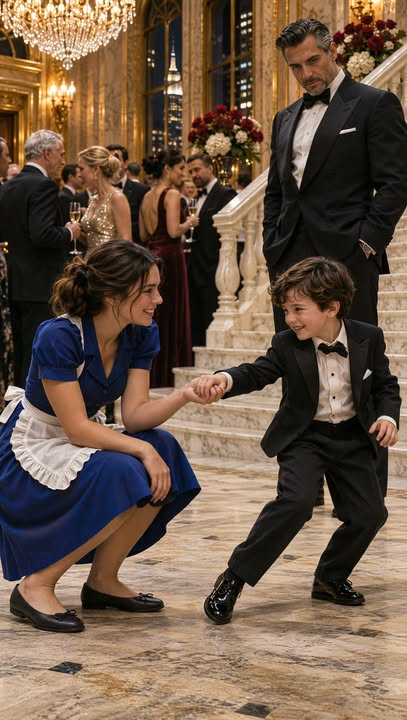
Dominic stopped as the boy’s fingers tightened around mine.
For a moment, the ballroom seemed to hold its breath with us: the musicians silent, the guests turning, and the woman in silver moving toward the doors beneath the watchful eyes of Moretti security.
“Not here,” Dominic said.
His voice had changed.
It was still controlled, but the edge had gone from it, replaced by something closer to fear.
I looked at the boy beside me.
He was watching his father, his small hand wrapped around two of my fingers, as if he had decided that was where he belonged for now.
“Where are we going?” I asked.
“To somewhere quiet.”
“I’m not leaving with you unless I know what you’re planning.”
Dominic’s gaze flicked to his son.
“Neither am I,” he said.
He turned toward the nearest guard.
“Have the car brought around to the side entrance, and tell the orchestra to remain stopped until the guests have cleared the ballroom.”
The guard nodded.
“And no one approaches the boy,” Dominic added, then seemed to hear himself. His eyes came back to me. “Unless he wants them to.”
The correction was small, but I noticed it.
So did his son.
The boy leaned against my apron and made a soft, uncertain sound.
“Would you like to come with us?” I asked him.
His eyes moved to the open ballroom doors, where the bright lights spilled across the floor, then to the dark corridor beyond.
He touched the cuff of my sleeve.
I took that for an answer, but I didn’t move until he did.
Dominic watched us with an expression I couldn’t read.
A second guard appeared at the side entrance, and the woman in silver was nowhere in sight.
“Did she get out?” I asked.
“We’re checking,” Dominic said.
“You told them to close every exit.”
“I did.”
“That doesn’t answer me.”
“No,” he said quietly. “It doesn’t.”
For a man whose name seemed to make everyone around him stand straighter, he looked strangely unsteady when he turned his attention to his son.
The boy tugged once at my sleeve.
“Quiet,” he whispered.
It was the first word I had heard him say.
“All right,” I said. “Quiet.”
Dominic looked toward the corridor.
“There’s a private room upstairs.”
“Is it quiet?”
“It can be.”
“Can he choose where to sit?”
Dominic hesitated.
“Yes.”
“Then we can go.”
We walked slowly, the boy between us, with his hand still in mine.
Dominic’s guards followed several paces behind, not close enough to crowd us, though I could feel their attention like a second set of lights on my back.
At the staircase, the boy stopped.
The carpet beneath our feet was thick and dark, the kind that swallowed sound, but from the ballroom came a sudden burst of conversation as guests began to move.
He covered his ears.
I stopped with him.
Dominic stopped too.
“Should we wait?” he asked.
The boy’s shoulders lifted toward his ears, and he leaned closer to me.
I tapped Noah’s pattern on my knee: two beats, a pause, two more.
The boy watched my hand.
After a moment, he tapped one finger against my sleeve.
I repeated the rhythm, slower this time.
He tapped back.
“Would you like to go up the stairs,” I asked, “or wait here until it’s quieter?”
He looked up toward the landing, then down at the carpet.
After a long pause, he pointed to the stairs.
“All right,” I said. “We’ll take them slowly.”
Dominic said nothing.
But when we reached the landing, he didn’t tell the boy to hurry.
The hotel room was a suite tucked away from the ballroom, with heavy curtains drawn across tall windows and a sitting area arranged in warm shades of cream and brown.
One lamp was on.
The rest of the room was dim.
Dominic asked the guards to wait outside and left the door slightly open.
Then he turned to the boy.
“Leo, do you want the door open or closed?”
Leo looked at the gap.
He pointed to it.
“Open,” Dominic said, then caught himself. “Or would you like it open?”
Leo nodded.
“All right.”
He crossed the room by himself, pausing beside a chair before choosing the rug instead.
Dominic watched him lower himself to the floor.
I sat several feet away, leaving room between us.
Leo drew his knees up and pressed his cheek against them.
The tightness in his small shoulders began to ease.
Dominic remained standing near the window.
“You can sit,” I told him.
“I’m fine.”
“You don’t have to stand guard over us.”
For a second, his face hardened.
Then he glanced at Leo and looked away.
“I know.”
But he didn’t sit.
I wondered how often he had heard that he was fine when what he meant was that he didn’t know what else to do.
A knock sounded from the hall.
Dominic stepped to the door and spoke in a low voice with one of his men.
When he returned, his expression had settled back into its familiar stillness.
“The woman wasn’t found outside,” he said. “My team is reviewing the hotel’s security footage.”
“Do you know who she is?”
“I have a guess.”
“Then tell me.”
“I will, when I’m certain.”
I let out a breath that was almost a laugh.
“You expect me to trust a promise from a man who just told me my brother’s death wasn’t an accident, then stopped before explaining what he meant?”
“I expect you to have questions.”
“Good. Because I have plenty.”
“I can see that.”
He didn’t say it with irritation.
That somehow made me angrier.
I folded my arms.
“My brother’s name is not a tool you can use to make me follow you into a private room.”
“I know.”
“You knew him?”
“Not well.”
“How well?”
“He worked at a garage owned by one of my companies for a few months.”
I looked at him, trying to fit that sentence into the world as I understood it.
“Noah worked for you?”
“Not for me directly. He was a night clerk. He kept the shift log, handled invoices, and checked in vehicles after hours.”
“Where?”
“A service garage in Queens.”
Noah had never mentioned it.
He’d mentioned a dozen jobs over the years, each one a little more temporary than he’d hoped, but not that one.
“How long ago?”
“Three years ago.”
The same year he died.
I lowered my voice.
“Why would he work for one of your companies and never tell me?”
“I don’t know.”
“You know he came to you?”
Dominic’s eyes moved to the floor between us.
“Yes.”
“When?”
“Shortly before he died.”
“What did he say?”
“He didn’t say much.”
“Then why did you say you knew who was using your son?”
His gaze went to Leo.
The boy had lifted his head from his knees.
He was watching us, though his attention seemed to move in and out, like a light changing behind a window.
Dominic softened his voice.
“Leo, would you rather stay here with Emma, or have your driver take you home?”
Leo looked at the door.
“Here,” he said.
“Here, then,” Dominic answered.
No argument.
No order.
Leo rested his cheek on his knees again.
Something about the exchange unsettled me more than the guards outside had.
Dominic had asked, and his son had answered.
It seemed so simple.
It also seemed new.
I moved to the low table and poured a glass of water.
“Would you like some?” I asked Leo.
He glanced at the glass, then shook his head.
“Okay.”
I set it down where he could reach it without making him take it.
Dominic watched.
“You don’t have to interpret every movement for him,” I said.
“I wasn’t.”
“You were waiting to see what I’d do.”
He looked at the water.
“I’m not used to someone else knowing what he might need.”
“That doesn’t mean you have to guess.”
“What do you mean?”
“You can ask.”
A faint crease appeared between his brows.
“I do ask.”
“You asked him where he wanted to go. That was good.”
Something in his expression shifted, not quite pride, not quite relief.
“I spend a lot of time trying to make sure he never gets overwhelmed.”
“And how’s that working?”
His eyes met mine.
The question was plain, but I hadn’t expected the answer to come so quickly.
“Not as well as I thought.”
Leo pressed his fingers together and began to tap them against his knee.
I answered with Noah’s rhythm against the edge of the chair.
Leo paused.
Then he tapped back.
The small sound filled the room more gently than the orchestra ever had.
Dominic looked at his son’s hands.
“How did your brother know that pattern?”
“He made it up when we were kids.”
“Why?”
“Because he hated the grocery store.”
“Why didn’t he just leave?”
I looked at Dominic.
“Because we were kids, and our father needed us to come along.”
“Was it something that helped?”
“It gave Noah a way to tell me he wanted to go without having to say it out loud.”
The rhythm passed between me and Leo once more.
“I used to tap it on his sleeve,” I said. “He’d tap it back if he wanted me to stay. If he wanted me to get him out of somewhere, he’d take my hand.”
Leo reached for my fingers.
He didn’t tug.
He just set his hand over mine.
I felt the old ache rise in me, sharp and immediate.
Dominic saw it.
“Your brother taught you how to listen to him.”
“He taught me that being quiet isn’t the same as having nothing to say.”
For a while, none of us spoke.
Leo’s breathing evened out, and the tension gradually left his shoulders.
I wondered if Dominic knew how many people had probably tried to settle his son by speaking louder, moving faster, or telling him to stop.
I wondered how many times Dominic had done the same.
He sat at last, taking the chair opposite me.
“I thought that if I controlled every room he entered, I could keep anything from hurting him,” he said.
The admission seemed to surprise him as much as it surprised me.
He rubbed a thumb over the seam of his cuff.
“I choose the routes. The people. The timing. I tell the staff what to expect before we arrive. I thought I was protecting him.”
“Sometimes preparing a room helps.”
“I know.”
“But if you choose everything, he doesn’t get to tell you what works.”
“I know that, too.”
His voice was low.
There was no defense in it, and no invitation for me to praise him for seeing what he had missed.
Only the quiet weight of a truth he had finally stopped avoiding.
“I don’t know how to ask without making it feel like another thing he has to get right,” he said.
“Give him time to answer.”
“What if he doesn’t?”
“Then give him more time.”
Dominic looked over at Leo.
The boy was still holding my hand, his eyelids drooping.
“I could have asked him about the door,” Dominic said.
“You did.”
“I usually ask the staff.”
“Tonight, you asked him.”
He leaned back, studying the room.
“I don’t think I’ve ever watched someone wait for his answer.”
“Then you can start now.”
For the first time since I had met him, Dominic’s eyes held something other than authority.
It was not trust.
Not yet.
But it was close enough to make me wary of wanting it.
He reached into the inside pocket of his jacket and removed a small, worn envelope.
It had been folded at one corner and softened with age.
I recognized the name written across it before he turned it toward me.
Noah.
My breath caught.
“Where did you get that?”
“He gave it to me.”
“Before he died?”
“About a week before.”
“And you’ve kept it for three years?”
“Yes.”
I stood so quickly my chair scraped the floor.
Leo flinched at the sound.
I froze.
“Sorry,” I whispered.
He pressed his fingers against the rug, and I tapped the rhythm softly against my knee until he looked back at me.
Only then did I turn to Dominic.
“You had something from my brother this whole time?”
“Yes.”
“You knew who I was tonight.”
“I learned your name when you said it.”
“But you heard it, and you knew.”
“I did.”
“And you said nothing.”
“I didn’t know what Noah meant when he gave me the envelope.”
“That didn’t stop you from keeping it.”
“No.”
“You could have looked for me.”
“I could have.”
“You could have sent it to the address on his employment file.”
“I could have.”
“You could have done a lot of things.”
“I know.”
His agreement offered me nowhere to put my anger.
I wanted him to argue, to explain that he had been protecting something, someone, or even me.
Instead, he sat with the envelope in his hand, his expression stripped of its usual certainty.
“Why didn’t you open it?” I asked.
“I did.”
“What did you find?”
He slid a photograph from the envelope and set it on the table between us.
It showed a woman in profile, standing near a black car beneath the bright, unforgiving lights of a parking garage.
Her hair was pinned up.
A silver cuff circled her wrist.
I recognized the curve of her cheek, the sharp line of her shoulder.
The woman from the ballroom.
Beside her stood a man I didn’t know, though Dominic did.
His jaw tightened.
“Who is he?”
“An associate of mine from years ago.”
“You mean a business associate?”
“Yes.”
“Did Noah know him?”
“I don’t know.”
“Why did Noah bring you this?”
“I don’t know that either.”
I studied the photograph again.
On the back, written in Noah’s careful hand, were four words.
Ask why she came back.
My throat tightened.
“He wrote this?”
“Yes.”
“When?”
“On the envelope. I don’t know if it was written the day he gave it to me.”
“You have had this all this time, and you never found out who she was?”
“I tried.”
“Did you?”
“I had people look into it. I didn’t know her name, and the photograph was old. They couldn’t identify her.”
“Then you gave up.”
“I ran out of leads.”
“You kept it in a drawer?”
“In a locked cabinet.”
I stared at him.
“My brother trusted you with that.”
“I know.”
“He was dead a week later.”
“I know.”
“And you never told me.”
“No.”
His words fell without excuse between us.
I looked down at Noah’s handwriting, and the room seemed to tilt around it.
I had spent three years believing that the last important thing Noah had left me was the space he occupied in our family photographs.
Now there was proof he had been trying to say something to someone.
And Dominic had let the message stay silent.
“You don’t get to decide when I’m ready to know about my own brother,” I said.
“I’m not asking you to forgive me.”
“Good.”
“I’m asking you to look at the photograph.”
“I’ve looked.”
“Then tell me if you recognize her.”
“I don’t.”
The words came out too quickly.
I leaned closer to the picture, looking for anything familiar: a hotel pin, the shape of the car, a reflection in the polished floor.
The back of the envelope held no other writing.
No date.
No explanation.
Only Noah’s question.
Ask why she came back.
“Do you know why she was here tonight?” I asked.
“No.”
“Do you know why she left when she saw Leo?”
“No.”
“Or why she came back at all?”
“No.”
Dominic had answers for almost nothing.
For once, he didn’t pretend otherwise.
Leo shifted on the rug.
His hand slipped from mine, and he touched the edge of the photograph.
Dominic reached to move it away, then stopped.
“Would you like to look?” he asked.
Leo placed two fingers on the corner.
He studied the woman, then tapped the table twice.
I answered with the rhythm against my knee.
He tapped once more.
Dominic watched his son, then turned back to me.
“I’ll show you everything I have.”
“You should have done that three years ago.”
“Yes.”
“If I help you, I’m not going to be managed.”
“I understand.”
“I’m not a witness you can move around to suit your investigation.”
“I understand.”
“And you don’t get to hide things from me because you think it will make the night easier.”
For a moment, he looked as if he wanted to promise more than he could safely promise.
Instead, he said, “I’ll try not to.”
It wasn’t enough.
But it was honest.
Outside the room, a guard knocked softly and spoke through the open door.
“Mr. Moretti, we have a name.”
Dominic stood.
“What is it?”
“Vivian Vale. She worked in the family office several years ago.”
Dominic’s face changed.
Not dramatically.
Only enough for me to see that the name reached somewhere old and uncomfortable.
“Why did she leave?” I asked.
“She resigned.”
“Was that the whole story?”
“I thought it was.”
“Who was the man in the photograph?”
Dominic’s gaze dropped to Noah’s note.
“I don’t know what he has to do with her.”
The guard waited in the hall.
Dominic looked at the photograph, then at his son.
For the first time, he didn’t reach for a decision before asking.
“Leo,” he said gently, “would you like to stay here while I speak with Emma, or come with us?”
Leo looked at me.
I didn’t answer for him.
He tapped two fingers on my sleeve, paused, then tapped them again.
I felt the rhythm under my skin.
“He wants to stay here,” I said.
Dominic nodded.
“Then we stay here.”
The guard gave a brief, uncertain glance toward his employer, but Dominic did not change his mind.
When the door closed again, he lifted Noah’s envelope from the table.
I put my hand over it.
“Not until I’ve read everything inside.”
“There’s nothing else.”
“Then there won’t be a problem.”
He let go.
I turned the photograph over and looked once more at the words Noah had left behind.
Ask why she came back.
Then I looked at Dominic, who had kept the question to himself for three years.
“What did Noah think she had done?” I asked.
“I don’t know.”
“What did he think you had to do with it?”
“I don’t know that, either.”
A new knock sounded at the open door.
This time, the guard did not wait for Dominic to answer.
He stepped inside and held out a clear evidence sleeve, with a narrow strip of paper sealed within it.
“We found this tucked behind the photograph,” he said.
Dominic took the sleeve.
The slip bore a date from the week Noah died and a string of numbers, followed by the name of a service garage.
I recognized the last four digits before I understood why.
They matched the old brass key on my father’s ring, the one we had found among Noah’s things after the funeral.
**–END OF PART 2–CLICK “NEXT” AT THE BOTTOM OF THE PAGE TO CONTINUE READING**
* * *
[NEXT: PART 3](https://echoesofstories.idolsgift.com/blog/part-3-the-envelope-noah-left-behind-046)
✓ Lynn R. Adams
Part 2 – The Envelope Noah Left Behind “—using my son to—” Dominic stopped as the boy’s fingers tightened around mine. For a moment, the ballroom seemed to hold its breath with us: the musicians si…