PART 2: The Door Michael Closed 046
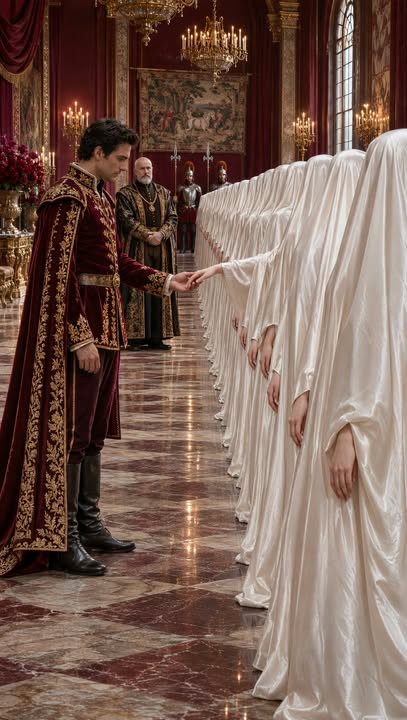
Part 2 – The Door Michael Closed
Rose held my wrist as the glass door settled into its frame behind us.
The courtiers’ voices dulled to a murmur on the other side of the glass, their faces turned toward us like pale flowers following the sun.
Michael stood by the door with one hand still on its brass handle.
For a moment, none of us spoke.
The seed pressed into my palm, its ridged shell warm from my skin.
“Why did you shut the door?” I asked.
“To keep them from hearing what ought not be repeated in a corridor,” Michael said.
Rose released my wrist, though her fingers lingered for the briefest instant before falling to her side.
“That depends on what you mean by ‘ought not,’” she said.
Michael’s eyes moved to her face.
He had known her since she was a child, yet I saw him look at her as if years of silence had changed her into someone he could no longer claim to understand.
“I mean,” he said carefully, “that this is a matter for the three of us.”
“No,” Rose replied. “It became a matter for everyone the day the king took the grove.”
The words fell quietly, without accusation sharpened for effect.
That made them harder to answer.
I closed my fingers over the seed.
“My father told me the trees were diseased.”
“He told the village the same thing,” Rose said. “Then he sent men to cut them down and dig beneath the roots.”
“What did he think was there?”
“I don’t know.”
“You must have some idea.”
“I have questions, not answers.” She glanced toward Michael. “And I want to hear his.”
Michael lowered his hand from the door.
“Your father was the head gardener,” I said. “You were there. What happened after I was told your family had left?”
Rose’s mouth tightened, not with anger so much as the effort of keeping an old hurt from deciding the shape of her voice.
“My father was ordered to dig beneath the oldest trees,” she said. “He refused.”
“Why?”
“He said digging that deep would destroy the roots. He said the trees were healthy, and that if someone wanted the soil examined, there were other ways to do it.”
I remembered a garden path in winter, the gravel hard beneath my shoes, and my father’s voice carrying across the grove.
A gardener’s job is to tend what he is given, he had said.
I had been small enough to think the sentence was about trees.
“What did the king say?” I asked.
“That my father had become difficult,” Rose answered. “That he had taken something from the palace. The next morning, our cottage was locked.”
I looked at Michael.
He had stood beside my father in council chambers for as long as I could remember.
He had taught me how to read a room before I learned to read a map, how to pause before answering, how to tell when courtesy was being used to conceal fear.
“Did you know?” I asked.
“Yes,” he said.
Rose let out a slow breath.
“Did you know my father had refused to dig?”
“Yes.”
“Did you know he was accused of theft?”
Michael looked down at the floor between us.
“Yes.”
The words sounded simple, but they shifted something in the room.
I had thought of Michael as a man who had always been near the truth, even when he did not speak it.
Now I wondered how much of my life had been shaped by truths he had chosen to leave untouched.
“What was he accused of taking?” I asked.
“A set of silver pruning shears,” Michael said.
Rose gave a small, disbelieving laugh.
“My father had his own shears. He sharpened them every Sunday.”
“I know,” Michael said.
“Then why did no one challenge the accusation?”
“I did.”
Her eyes lifted to his.
“What did you say?”
“That the evidence was poor, and that Elias had served the palace faithfully for more than twenty years.”
“That isn’t the same as stopping it.”
“No,” Michael said. “It isn’t.”
He did not defend himself, and perhaps that was why my first impulse to condemn him faltered.
I wanted him to offer some polished explanation I could reject.
Instead, he stood beneath the glass roof with the ordinary burden of his own choices visible in his face.
“Tell us what happened,” I said.
Michael looked toward the door.
Beyond it, the courtiers shifted and murmured, waiting for their prince to reappear with a decision they could repeat in elegant phrases over dinner.
He turned back to us.
“Your father ordered the grove removed,” he said. “Not all at once, though that was what the public notice implied.”
The light through the glass seemed to thin.
“Why?” I asked.
“He said the trees were diseased. But he also ordered the men to dig below the roots.”
Rose’s gaze sharpened.
“You said you didn’t know why.”
“I said I was too young and frightened to learn why,” Michael answered. “That isn’t the same thing as knowing nothing.”
I had never heard him speak of fear.
He had once stood beside my father during a winter flood, calmly organizing food and blankets while half the palace panicked.
He had never told me what that calm cost him.
“How old were you?” I asked.
“Twenty-six.”
“That is not very young.”
“No,” he said. “Not by the measure of years.”
Rose looked away, and I saw the old anger rising in her face, held back by something more complicated.
“Did my father tell you what he believed was beneath the trees?” she asked.
“No.”
“Did he tell you what the king was searching for?”
“No.”
“Then what did you see?”
Michael’s eyes settled on the seed in my hand.
“I saw Elias refuse to continue digging after the first tree was marked for removal.”
“Marked by whom?” I asked.
“Your father’s steward. He carried an order signed by the king.”
Rose’s jaw tightened.
“What did Elias do?”
“He set down his spade and said the tree was not diseased, and that its roots were still living.”
I could almost hear the scrape of iron against earth.
“He was dismissed that same day?” I asked.
“Not at once,” Michael said. “He was given one night to reconsider.”
Rose’s face changed.
My memory supplied an image I had not thought of in years: the cottage windows dark, a single lantern burning behind the orange trees, the pale square of a door newly painted over.
“What happened during that night?” I asked.
“Elias came to me.”
Michael’s voice softened, though not enough to hide the shame beneath it.
“He asked me to help him leave the palace grounds before the guards came at dawn.”
Rose stared at him.
“You helped him escape?”
“I did.”
The words were scarcely louder than the whisper of leaves beyond the glasshouse.
For an instant, the whole room seemed to hold still around them.
“Why didn’t you tell me?” I asked.
“Because your father was king, and I had no proof of what he intended to do. Because I believed that if I told you, you would go to him, and he would know Elias had spoken to me. Because I told myself that silence might keep you both safe.”
“And because?” Rose asked.
Michael’s shoulders sank a fraction.
“Because I was afraid of losing the place I had spent my life trying to make useful.”
No one answered him.
The honesty of it made the confession less like a door opening than a wall revealing where its stones had been missing all along.
“You helped my father flee,” Rose said. “And then you let me believe he had vanished without anyone inside these walls caring enough to ask where he went.”
“I am sorry.”
“I’m sure you are.”
“I have regretted it for years.”
“Regret doesn’t give me back the years I spent wondering whether he was alive.”
“I know.”
She looked at him fully now.
“Do you?”
Michael accepted the question without trying to soften it.
“I know I cannot ask you to forgive me for what I did not have the courage to explain.”
“What did my father tell you?”
“That he would go north first, to a village where an old friend had once worked. He said he would send word when he could.”
“Did he?”
“No.”
“Did you search?”
“I asked discreetly, for a time. I found no trace of him.”
Rose’s hands had curled loosely at her sides.
She was not shaking, but I could see the effort she was making to remain steady.
“Why did you stop?”
“Because the king began asking questions about the night Elias left,” Michael said. “If I continued, I would have risked bringing the search back to him.”
“And you thought that was protection?”
“I did at the time.”
“What do you think now?”
“That I protected the palace first, and called it protection for you.”
Rose looked toward the floor.
I felt the seed shift inside my closed hand.
My father had been dead for seven years.
I had spent those years telling myself that whatever wrongs he had done, I could separate them from the parts of him I loved.
He had taught me to ride, to read the stars over the western wall, to sit beside a sick horse until its breathing steadied.
He had also ordered a grove destroyed and accused a faithful man of theft.
I did not know how to hold both truths without letting one erase the other.
“Why did you keep the seed?” Rose asked.
I opened my hand.
It lay against my palm, small and dark, its seam catching the afternoon light.
“I don’t know yet,” I said.
“You think my father gave it to me?”
“I think it came from one of the trees he saved.”
She studied the seed with an expression I could not read.
“Did he save it before the grove was destroyed?”
“That is what he told me.”
“When?”
“A long time ago.”
Her eyes rose to mine.
“Did he tell you he was alive?”
“No.”
“Did he tell you where he went?”
“No.”
“Then how did you get this?”
The question took me back to the line of veiled women, to the hand with soil beneath its nail and the scar I had recognized before I dared name it.
“He passed it to me,” I said. “I didn’t see his face. I thought it was you.”
“You thought correctly.”
“Then your father is alive?”
“I didn’t say that.”
The answer was gentle, but the distance it created was unmistakable.
I wanted to ask where he was, whether he had suffered, whether he remembered the boy who had watched him teach me to graft a branch.
I wanted to say I had searched.
All of those words crowded my throat at once, and none felt worthy of being the first.
“Rose,” I began.
“Don’t make this into a reunion,” she said. “Not yet.”
I stopped.
She looked at me, not cruelly, but with the steadiness of someone who had learned that hope could be a place people asked you to live while they postponed doing what was right.
“I don’t know why you brought me here,” she said. “You chose me in front of a room full of people who thought this was a game.”
“It wasn’t a game to me.”
“I know you believed that.” She glanced at the seed. “But believing something does not make it true for the person who has to live with the consequences.”
I took that in without answering.
In the past, I might have tried to convince her that my intentions were good.
I had spent years mistaking sincerity for repair.
“What do you want me to do?” I asked.
“I want you to ask the question you were avoiding.”
“About the grove?”
“About the king.”
I turned to Michael.
“Why did my father have the trees taken out, one by one, and why did he make the men dig past the roots?”
Michael’s eyes closed for a moment.
“When he gave the order, I was not in the room,” he said. “Afterward, I asked him why he wanted the ground searched. He told me the roots had spread too far and there might be buried rubbish from the old village.”
“Did you believe him?”
“I believed it was possible.”
“That is not the same answer.”
“No.”
“What did you think he was looking for?”
“I don’t know.”
“Did you ever learn?”
“No.”
Rose’s face remained still, but her eyes had gone distant.
“Then my father might have escaped,” she said, “and the truth might still be buried here.”
“Or destroyed,” Michael replied.
She looked back at him.
“Did you see what they found?”
“I never saw anything removed from the grove.”
“But someone must have found something.”
“I cannot tell you that.”
“Because you don’t know?”
“Because I don’t know,” he said. “And because I will not pretend certainty to make this easier.”
For the first time, Rose’s expression softened, though only a little.
It did not erase her hurt.
It did not give Michael back the years he had withheld.
But it allowed the possibility that his words could be trusted one at a time, if nothing more.
A knock sounded at the glass door.
A courtier’s voice followed, muffled by the pane.
“Your Highness, the guests are waiting.”
I looked through the glass at the assembled people.
They had come to watch me choose a bride, though I had never promised that choosing a hand would settle anything as large as a life.
Some were curious.
Some were already bored.
A few looked worried.
I wondered what they would hear if we opened the door and told them that the grove had been uprooted on a king’s order, that a gardener had been accused of theft, and that the prince’s oldest adviser had helped him escape.
I wondered what would happen if the palace heard the truth before we understood all of it.
Rose followed my gaze.
“You can send them away,” she said.
“I can.”
“Will you?”
I turned back to her.
“I won’t let them decide what this means for us.”
“That isn’t what I asked.”
“No,” I said. “It isn’t.”
She waited.
I knew then that the answer she wanted could not be replaced by a promise to think about it later.
“I’ll send them away,” I said. “And after that, we’ll begin looking for the truth.”
“We?” she asked.
“If you’re willing.”
“I’m willing to look,” she said. “I’m not agreeing to trust you.”
“I understand.”
“Do you?”
“I’m trying to.”
She studied my face as if searching for the boy who once rushed at every problem with a certainty that made her laugh.
Perhaps she found him.
Perhaps she also saw the man who had waited too long to challenge a story because it had been easier to live within it.
“I won’t accept a private apology,” she said. “If my father was blamed, his name must be cleared where people can hear it.”
“I’ll make that right.”
“You can’t promise that before you know what happened.”
She was right.
I looked down at the seed.
“Then I promise I won’t ask you to accept an apology in place of the truth.”
That, at least, was something I could mean without pretending it was enough.
I opened the door.
The courtiers fell quiet as I stepped into the glasshouse aisle.
“My guests,” I said, “you have been invited here under a misunderstanding.”
A few brows lifted.
“I asked you to come because I hoped to meet someone who would speak plainly to me. I have met her. There will be no announcement of a marriage today, and no one will be asked to stay.”
The courtier nearest the door glanced toward Michael, perhaps expecting him to correct me.
Michael gave no sign that he would.
The guests began to leave in a rustle of silk and soft shoes.
The woman with the broken clasp looked at me as she passed.
She did not smile, but she nodded as though I had finally said something worth hearing.
When the glasshouse had emptied, the sunlight seemed louder.
Rose stood beside the table where the gardeners once kept their tools.
Michael remained by the door.
“You should not have had to do that,” Rose said.
“I should not have asked you to come here without knowing what you needed.”
“You could not have known.”
“I could have asked.”
She looked at me, and for a moment I saw the warmth we had once shared, still present beneath all the years of suspicion, but careful now, like a flame sheltered from wind.
“I’m going back to the cottage,” she said.
“You know where it is?”
“I remember the path.”
“May I walk with you?”
“Not today.”
I nodded.
The refusal hurt, but it was honest, and I understood that honesty was the only form of closeness I could ask her for now.
She turned toward the door, then paused.
“Keep the seed safe,” she said.
“I will.”
“Don’t plant it yet.”
I looked up.
“Why?”
“Because we don’t know what it came from.”
Her words seemed to open a space in the room where the past could be examined without being mistaken for a story we already understood.
She left through the glasshouse doors.
Michael watched her go, his hands clasped behind his back in the posture he used before council.
When the doors had closed, I turned to him.
“You helped Elias escape, but you let the accusation stand.”
“Yes.”
“You kept this from me.”
“Yes.”
“Was there anything else?”
He took longer to answer.
“I don’t know.”
That answer unsettled me more than any confession had.
I held up the seed.
“Did Elias give you this?”
“No.”
“Did you know he had saved one of the trees?”
“I suspected he might have kept something. He loved that grove.”
“Why didn’t you tell me?”
“Because I did not know what he had kept, or where he had gone. I thought anything I said would be another guess dressed as hope.”
I looked toward the path Rose had taken.
“Did he ever send word to you?”
“No.”
“Are you certain?”
Michael’s face altered.
It was only a slight change, but I had spent enough years watching him to recognize when he had discovered a door inside himself he did not want to open.
“What is it?” I asked.
“Nothing I can prove.”
“Tell me anyway.”
He studied the glass roof, where sunlight caught in the delicate ironwork.
“After Elias left, I received a message at the old service entrance,” he said. “No name, no seal. It said only that the orange tree nearest the cottage had survived.”
My fingers tightened around the seed.
“When was this?”
“Three days after the grove was cleared.”
“Why didn’t you tell me?”
“Because the message gave no sender, and I feared it was a trap meant to find Elias.”
“Did you keep it?”
“I did.”
“Where?”
“In a locked drawer in my study.”
“Why?”
Michael looked at me with the grave unease of a man who had spent twelve years guarding a scrap of paper without understanding what it might mean.
“Because I could not bring myself to destroy it.”
He turned toward the door.
“Michael,” I said. “You told me Elias asked you to help him escape.”
“He did.”
“Then what is the message that came three days later?”
Michael stopped with his hand on the latch.
“I always thought it was someone repeating an old rumor,” he said. “But now I’m not sure.”
I looked down at the seed in my palm.
Its hard shell seemed suddenly less like a keepsake than a key to a question we had only just begun asking.
“Who sent it?” I said.
Michael opened the door.
“I don’t know,” he replied. “But I kept the paper.”
**–END OF PART 2–CLICK “NEXT” AT THE BOTTOM OF THE PAGE TO CONTINUE READING**
* * *
[NEXT: PART 3](https://echoesofstories.idolsgift.com/blog/part-3-the-door-michael-closed-046)
✓ Lynn R. Adams
Part 2 – The Door Michael Closed Rose held my wrist as the glass door settled into its frame behind us. The courtiers’ voices dulled to a murmur on the other side of the glass, their faces turned to…