PART 2: The Dog Who Remembered 046
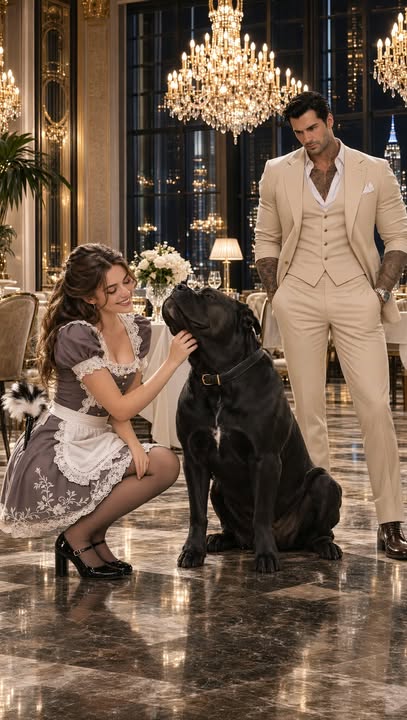
“What did they find?”
My manager glanced toward the window, where the black SUV waited at the curb with its engine running.
“I don’t know,” he said, though his eyes told me he knew more than he was willing to say.
“Then why did you say it makes Mr. Moretti believe his dog already knew me?”
“Those were his words.”
He sounded as if he wished he could take them back.
I looked down at the lavender sleeves of my uniform, at the small tear near one cuff and the faint stain on my apron.
Whatever Dante Moretti had discovered, it couldn’t possibly have anything to do with me.
I was a woman who had grown up in three foster homes before an older couple adopted me when I was six.
I had been told my birth mother was young, frightened, and unable to care for a baby.
There had been no name, no photograph, and no story beyond that.
I had learned not to chase the missing pieces too hard.
They had never changed the fact that I was loved.
“Am I supposed to go with them?” I asked.
My manager rubbed his forehead.
“You’re not supposed to do anything you don’t want to do.”
“That isn’t what I asked.”
He lowered his voice.
“He requested a meeting, not a conversation in the back of a car.”
The distinction was meant to reassure me, but it did not.
I glanced at the restaurant entrance, where a security guard stood with his hands folded in front of him.
“What if I say no?”
“Then you say no.”
The manager’s answer came quickly, almost too quickly, as if he were repeating the sentence to convince himself.
I appreciated him for trying.
I also knew that refusing a man with bodyguards and a name people whispered about was not a decision I could make casually.
“Can you tell him I’ll meet him somewhere public?” I asked.
“I can.”
“And not alone.”
“I can tell him that too.”
“Good.”
My manager gave a small, relieved nod and reached for his phone.
I stayed in his office while he made the call.
He used careful words, never quite saying that I was afraid, and never quite pretending I wasn’t.
After a short exchange, he hung up.
“Mr. Moretti agrees to meet at the restaurant this afternoon,” he said.
“Before opening, in the main dining room.”
“Will the dog be there?”
“He asked if you would allow it.”
That question unsettled me more than the rest.
“Tell him I’m willing to meet Nero.”
My manager repeated my answer into the phone.
A few minutes later, the SUV pulled away.
I went back to work, but the rest of the morning passed in a blur of folded linens, polished silver, and thoughts I couldn’t arrange.
By the time I left, I had decided I would not let anyone turn my past into a puzzle to be solved without my permission.
Whatever Dante Moretti knew, it belonged to me too.
At three in the afternoon, the restaurant felt like a different place.
Sunlight rested in pale bands across the empty tables, and the chandeliers looked less grand without the evening crowd beneath them.
I wore my own clothes instead of my uniform: dark trousers, a soft gray sweater, and the only coat I owned that still fit properly at the shoulders.
The manager had left the front doors unlocked for me.
I walked in, heard the latch click behind me, and immediately wished I had brought a friend.
Then Nero rose from beside the window.
He stood so quietly that for a second I didn’t realize he was there.
His dark coat caught the afternoon light, outlining his broad shoulders and the white flecks near his muzzle.
Dante sat at a table nearby, no longer wearing the ivory suit.
In a charcoal jacket and open-collared shirt, he looked less like a man from a newspaper photograph and more like someone who had not slept.
Two bodyguards stood near the entrance, both keeping a respectful distance.
“Thank you for coming,” Dante said.
“I came because I wanted answers.”
“I expected that.”
He gestured to the chair opposite him, but I remained standing.
“Before we sit, I want to be clear about something.”
“Go ahead.”
“You don’t get to decide what I need, or what my life means, because you found something in a file.”
His expression did not change, but his eyes sharpened with attention.
“I don’t intend to.”
“And if I want to leave, I leave.”
“Yes.”
“No one follows me.”
“No one will.”
I looked toward the guards.
Dante followed my gaze.
“Marco, Luca, wait outside.”
The two men exchanged a glance, then stepped through the front doors without complaint.
Dante sat back, giving me room to choose.
Only then did I take the chair across from him.
Nero had not moved.
He watched me with a solemn, almost searching expression, his ears relaxed but attentive.
“May I?” I asked.
Dante looked at the dog.
“That’s between you and him.”
I crouched beside the chair and held out my hand.
Nero leaned forward, inhaled once, then rested his chin against my palm.
The contact sent a shiver through me, though the dog’s warmth was steady and familiar.
“Hello again,” I whispered.
His eyes softened.
A quiet sound rose from his chest, not quite a whine and not quite a sigh.
Dante watched us without interrupting.
“You said he hasn’t eaten,” I said.
“Not since you left last night.”
“That can’t be because of me.”
“I thought the same thing.”
“Have you tried different food?”
“Three kinds.”
“Treats?”
“He refused those too.”
“Maybe he’s ill.”
“The veterinarian checked him this morning.”
“And?”
“He’s healthy.”
Nero’s head remained in my hand.
I stroked the fur beneath his jaw, trying to make sense of a feeling I could not name.
“Why would he react to me this way?”
“That’s what I’m trying to understand.”
His answer was plain, without the polished confidence I had expected.
I returned to my chair.
Dante folded his hands on the table.
“I had someone look into your background after last night.”
“I didn’t give you permission.”
“No,” he said. “You didn’t.”
The admission caught me off guard.
He did not excuse it or tell me it had been necessary.
He simply let the words sit between us.
“Why did you do it?”
“Because Nero has never approached a stranger.”
“He approached me.”
“Yes.”
“And you thought that meant I must be hiding something?”
“I thought it meant there might be a reason.”
“You could have asked me.”
“I could have.”
I studied his face, trying to decide whether his regret was real or only a useful performance.
He seemed tired, but not impatient.
“I found very little,” he continued. “You were adopted as an infant. Your records are incomplete.”
“I know.”
“Your adoptive parents are named Samuel and Ruth Marshall.”
“They’re my parents.”
“I understand.”
Something in the way he said it made me believe he did.
“Do you?” I asked.
“I’m trying to.”
For the first time since I had entered, I saw a crack in the composure he held so carefully.
It was small, and it disappeared almost at once.
But I had spent years watching people hide their disappointments behind kind words.
I knew the difference between a man who was unmoved and a man who was working hard not to show what moved him.
“What else did you find?” I asked.
“A hospital record with no identifying information about your birth family.”
“That’s all?”
“A note that you were found near the site of a highway accident.”
The words landed with a weight I could feel in my chest.
I had known there had been an accident, or something close to one.
My parents had told me the adoption agency received only a few details from the county office.
A baby had been brought to a nearby hospital after a vehicle left the road.
No adult had claimed her.
The woman who found me was never identified.
That was the story, as far as anyone knew.
“Why does that matter to you?” I asked.
“I don’t know yet.”
“You’ve investigated me, but you don’t know why?”
“I have suspicions.”
“Based on what?”
He looked down at Nero, whose chin now rested against the side of my knee.
“Based on the way my dog behaves around you.”
“That isn’t evidence.”
“No.”
“And on whatever the background check found.”
“It found an accident and a missing name.”
I leaned away from the table.
“So you don’t know anything.”
“Not enough to tell you anything with certainty.”
“Then why bring me here?”
“Because I wanted to ask you what you know.”
It was an honest answer, and that made it harder to dismiss.
I glanced at Nero.
“Does he have a name?”
“Nero.”
“I know that part.”
Dante’s mouth moved almost imperceptibly, as if a smile had occurred to him and he had decided not to let it finish.
“He was named after a rescue dog my mother admired.”
“Your mother trained him?”
“No.”
For a moment, his gaze drifted to the tall windows and the bright city beyond them.
“She died before Nero came to me.”
“I’m sorry.”
“Thank you.”
His words were brief, but something in them carried a history he had no intention of laying out for me.
I understood the instinct.
There were things I had never explained about my own childhood, even to people I trusted.
Dante gave a small nod toward Nero.
“He was trained for search and rescue.”
I looked at the dog again.
“Like finding people?”
“After earthquakes, collapsed buildings, places where someone might be trapped or lost.”
I pictured Nero moving through dust and rubble, guided by commands and the smell of someone who could not call for help.
“That must have taken years.”
“It did.”
“Why did he stop?”
“He injured his shoulder during a training exercise.”
“Was it serious?”
“Serious enough that he couldn’t keep working.”
“But he recovered?”
“Physically, mostly.”
Dante paused before adding, “He had trouble adjusting after he retired.”
The word retired sounded oddly gentle for a dog.
“What kind of trouble?”
“He stopped trusting unfamiliar places and unfamiliar people.”
“Was he always like that?”
“No.”
“Then the injury changed him.”
“Some of it was the injury. Some of it was losing the work he’d been trained to do.”
I looked at Nero with new attention.
His stillness no longer seemed aloof.
It looked like patience practiced for a long time.
“What does he do now?”
“Guard the house, follow me from room to room, and pretend he doesn’t enjoy being spoiled.”
Nero’s ears lifted at Dante’s voice.
“He doesn’t seem to be pretending with me.”
“No,” Dante said. “He doesn’t.”
For a moment, neither of us spoke.
The restaurant held the quiet around us.
Far beyond the windows, traffic moved in bright, unhurried lines.
I could hear Nero breathing beside me.
“Did he ever do this before?” I asked.
“Approach someone like that?”
“Choose someone.”
Dante looked at his dog.
“Once.”
“Who?”
“My mother.”
I waited for him to say more, but he didn’t.
“What does that have to do with me?”
“Nothing I can prove.”
The carefulness of his answer made the silence feel more charged.
I straightened in my chair.
“I’m not a clue, Mr. Moretti.”
“I know.”
“I’m not a missing piece you can put into place.”
“I know that too.”
“Do you?”
He met my eyes.
“I’m not asking you to become anything for me.”
It was the first thing he had said that felt entirely free of strategy.
I looked away before he could see how much I wanted to believe it.
He picked up a slim folder lying beside him.
“I brought copies of the records. You can read them here if you want, or take them with you.”
“I don’t want them yet.”
“All right.”
“You’re not going to insist?”
“No.”
“Or tell me that I owe you an explanation?”
“No.”
I watched him close the folder again.
“Why are you being so careful with me?”
His jaw tightened for an instant.
“Because someone wasn’t careful enough with you before.”
“That sounds like a guess.”
“It is.”
“Then don’t build a story around it.”
“I won’t.”
He said it softly, and I believed he meant to try.
That did not mean I trusted him.
Trust was not a switch that flipped because a powerful man spoke gently.
It was something built slowly, with small choices and no guarantees.
Nero pressed his head more firmly against my knee.
I rested my hand on his neck.
“Can you tell him to eat?”
“I’ve tried.”
“Maybe he needs to see me do it.”
Dante’s eyes lifted to mine.
“If you’re comfortable.”
“I didn’t say I wanted to become his caretaker.”
“I know.”
“I just want to know he’s okay.”
Dante signaled to one of the guards through the window.
A few moments later, a staff member brought a shallow bowl of food and set it on the floor near the table.
Nero glanced at it, then looked back at me.
“Try,” I whispered.
He shifted his weight, but did not approach the bowl.
I placed my hand on the floor beside it, fingers relaxed.
The dog looked at my hand, then at the food.
Finally, he stepped forward and sniffed the bowl.
His ears tilted toward me.
“Good boy,” I murmured.
He ate a few mouthfuls.
Dante went perfectly still.
Nero paused, then ate again.
It was not much, but it was more than he had eaten all day.
I looked up.
Dante’s face held an expression I could not interpret.
Relief, perhaps.
Or something deeper that frightened him more.
“Don’t make this into a miracle,” I said.
“I won’t.”
“He’s just hungry.”
“Maybe.”
“And he happened to trust me.”
Dante’s gaze remained on the dog.
“Maybe.”
Nero finished a small portion, then returned to my side as if he had completed an important task.
I laughed before I could stop myself.
The sound felt strange in the quiet room.
Dante looked at me, and for a second, the guardedness in his face softened.
“Thank you,” he said.
“For feeding your dog?”
“For coming back.”
I considered telling him I had never belonged to him in the first place.
Instead, I said, “I came for answers, remember?”
“I remember.”
“And I still don’t have any.”
“Not yet.”
“Then what happens now?”
“That’s your decision.”
I sat back and let the question settle.
A part of me wanted to leave immediately, to return to my rented room and the life I understood.
Another part wanted to know why Nero had leaned against me as if he recognized the shape of my hand.
“I want to see the records,” I said at last.
“You can.”
“Not here.”
“Where would you prefer?”
“Somewhere I choose.”
“Then tell me where.”
I named a small public library two blocks from the restaurant.
It had a reading room near the front entrance, with wide windows and a staff desk that never seemed to be unattended.
Dante agreed without hesitation.
“I’ll bring the copies tomorrow,” he said.
“Just the copies.”
“Just the copies.”
“And no investigators showing up to watch me read.”
“I’ll make sure they don’t.”
“You can’t promise what you don’t control.”
“I can promise I won’t send them.”
That answer earned him a thin, unwilling smile.
I stood.
Nero rose too, pressing his nose briefly against my hand before I could pull it away.
“Goodbye, Nero.”
He made the same soft sound he had made when I first entered.
Dante walked me to the door, but stopped several paces away.
His guards opened it from outside.
“I appreciate you meeting me,” he said.
“I appreciate you letting me choose where.”
“You should always get to choose.”
I looked at him, uncertain whether the words were meant for me or himself.
Outside, the afternoon air had turned cool.
The city was loud again, full of horns and footsteps and people who had no idea that one strange dog had pulled me toward an unanswered question.
I walked home alone.
No one followed me.
The next morning, I called my parents before work.
I did not tell them everything.
I told them a man had found a copy of my adoption records and that I might learn something more about the accident.
My mother’s silence lasted only a breath.
“Do you want us to come to New York?” she asked.
The offer filled me with warmth and guilt all at once.
“Not yet,” I said. “But I might need you soon.”
“Then we’ll be ready.”
I heard my father in the background asking whether I had eaten breakfast.
I promised I had, though I hadn’t.
When the call ended, I felt steadier.
At noon, I met Dante at the library.
He arrived alone, carrying a sealed folder.
Nero was not with him.
The absence disappointed me before I had time to stop it.
“You left him at home?” I asked.
“He seemed content to sleep.”
“Good.”
Dante placed the folder on the table between us.
“You can take all the time you need.”
“Thank you.”
He sat across from me, leaving the folder unopened.
I broke the seal and removed several pages.
The records were incomplete, just as he had said.
There was a date, the name of a hospital, and a brief description of the circumstances in which I had been found.
The words were plain and official.
Female infant.
Estimated age: three days.
Discovered near the location of a single-vehicle highway accident.
No accompanying adult identified.
The report ended there.
I read it twice.
It did not tell me who had held me before that day, or why no one came looking.
It did not give me a face, a voice, or a name.
It only made the story I had carried since childhood feel less finished.
“Is that all you have?” I asked.
“That is all the public record contains.”
“Did you find the agency file?”
“Not yet.”
“Why not?”
“It was transferred twice, and the last office closed years ago.”
“Who’s looking?”
“An attorney and a records specialist.”
I lowered the papers.
“Did you ask me before starting that search?”
“No.”
“Would you do it again?”
He took a moment before answering.
“Not without asking you first.”
That was not a perfect answer, but it was better than an excuse.
I placed the pages back in the folder.
“I don’t know if I want a search.”
“You don’t have to decide today.”
“I don’t even know what I’d be hoping to find.”
“That makes sense.”
“Would it be a name? A photograph? Proof someone tried to come back?”
“I don’t know.”
“Neither do I.”
We sat quietly while the library hummed around us.
The radiator clicked beneath the window.
A student turned a page at a nearby table.
Dante looked out toward the street, where the afternoon sun had begun to fade behind the buildings.
“I grew up knowing my family’s name meant something before I understood what it meant,” he said.
I glanced at him.
“Did you like that?”
“No.”
“Then why keep carrying it?”
“Because people I loved carried it too.”
There was something in his voice that made me think of his mother again.
I closed the folder.
“I’m not saying yes to your search.”
“I understand.”
“I’m not saying no either.”
“I understand that too.”
“If I decide to look, I want to be involved.”
“You will be.”
“And I want the truth, even if it’s ordinary.”
He nodded.
“Especially if it’s ordinary.”
I studied him across the table.
It was possible he was being honest.
It was possible he was simply better than most people at making honesty sound convincing.
For now, I let the uncertainty remain.
When we left the library, Dante walked beside me only as far as the main entrance.
“Will Nero be all right?” I asked.
“He’s been eating since yesterday.”
“Good.”
“He waits at the door when he hears my car.”
I smiled despite myself.
“Then he’ll be disappointed you came without me.”
“He was disappointed.”
The words made me look up.
Dante’s expression was serious.
“He sat beside the front door for an hour after we left the restaurant,” he said. “He wouldn’t come upstairs until I showed him the bowl you helped him eat from.”
I felt my smile fade.
“Maybe he remembers the food.”
“Maybe.”
“You keep saying that.”
“Because I don’t know.”
The honesty of it settled between us.
I had spent much of my life trying to make peace with not knowing.
I had not expected to find another person standing beside me in the same uncertainty.
Dante’s driver waited at the curb.
Before getting into the car, Dante turned back.
“Would you come see him at my house tomorrow?”
I hesitated.
“Your home?”
“It’s quiet, and Nero is more comfortable there.”
“I don’t want a room full of guards.”
“You won’t have one.”
“I don’t want this to become a visit where you tell me what you think I am.”
“I won’t.”
“And I want to see the original file, if you find it.”
“You can.”
I looked at the dark car, at the city reflected in its windows, then at Dante.
“I’ll think about it.”
“That’s all I’m asking.”
He got into the car.
It pulled away without a horn, leaving me on the pavement with the folder tucked beneath my arm.
That night, I could not stop thinking about the accident report.
I called my parents again, but this time my mother answered on the first ring.
“I’ve been meaning to tell you,” she said, “that when you were little, you used to wake up crying if you smelled smoke.”
The thought startled me.
“I did?”
“Not real smoke. The neighbor’s fireplace would make the whole street smell like it, and you would start shaking.”
My mother’s voice softened with memory.
“It passed as you got older, but for a while, you were frightened of any smell like a fire.”
I sat on the edge of my bed, listening.
“Why didn’t you tell me before?”
“I didn’t want to give your childhood fear a story it might not have had.”
That sounded like my mother.
She never tried to make an unanswered question into a certainty.
“Did the adoption agency ever say anything else?”
“No,” she said. “Only that you’d been brought to the hospital after an accident nearby.”
“Did anyone leave a blanket?”
A pause.
“There was a small piece of blue wool in the box with your papers.”
My heart gave a strange, uneven beat.
“What do you mean?”
“Just a scrap of fabric. The caseworker said it might have come from the clothes you were wrapped in.”
“Do you still have it?”
“I think I kept it with your baby pictures.”
“Could you look?”
“Of course.”
I thanked her and ended the call, but sleep was a long time coming.
The next day, I went to Dante’s house.
I told myself I was going for Nero, and for the chance to see the records in a place where I could leave whenever I wished.
That was true.
It was not the whole truth.
His home stood behind a high stone wall in a quiet neighborhood where bare branches traced the pale winter sky.
The gate opened after Dante’s driver spoke into a small intercom.
Inside, the property was understated, with clean paths, clipped hedges, and a house that looked more warm than grand.
Two security officers stood near the entrance, but neither approached me.
Dante met me at the front door.
“You came,” he said.
“I said I would think about it.”
“And you decided.”
“Don’t make me regret it.”
“I won’t.”
A low thump sounded from somewhere inside.
Nero appeared at the end of the hallway.
He came toward me at a careful walk, then stopped a few feet away.
For the first time, he did not immediately press against my hand.
He studied my face, then lowered his nose to the small bag I carried.
Inside it was the blue wool scrap my mother had found in the box of my baby pictures.
I had not told Dante about it.
Nero sniffed the bag.
His ears lifted.
Then he made a sound I had never heard from him before, a quiet, trembling whine.
Dante’s expression changed.
“What is it?” I asked.
He didn’t answer.
He was staring at the worn blue fabric visible through the open edge of my bag.
For a moment, the whole house seemed to hold its breath.
Nero pressed his nose against the cloth, then turned and looked toward a closed door at the far end of the hallway.
Dante followed his gaze.
“That room belonged to my mother,” he said.
My fingers tightened around the bag strap.
“Why is he looking there?”
Dante’s face had gone pale beneath its careful composure.
“I don’t know,” he said. “But I think we need to see what she left inside.”
**–END OF PART 2–CLICK “NEXT” AT THE BOTTOM OF THE PAGE TO CONTINUE READING**
* * *
[NEXT: PART 3](https://echoesofstories.idolsgift.com/blog/part-3-the-dog-who-remembered-046)
✓ Lynn R. Adams
“What did they find?” My manager glanced toward the window, where the black SUV waited at the curb with its engine running. “I don’t know,” he said, though his eyes told me he knew more than he was …