PART 2: The Dates in Her Journal 052
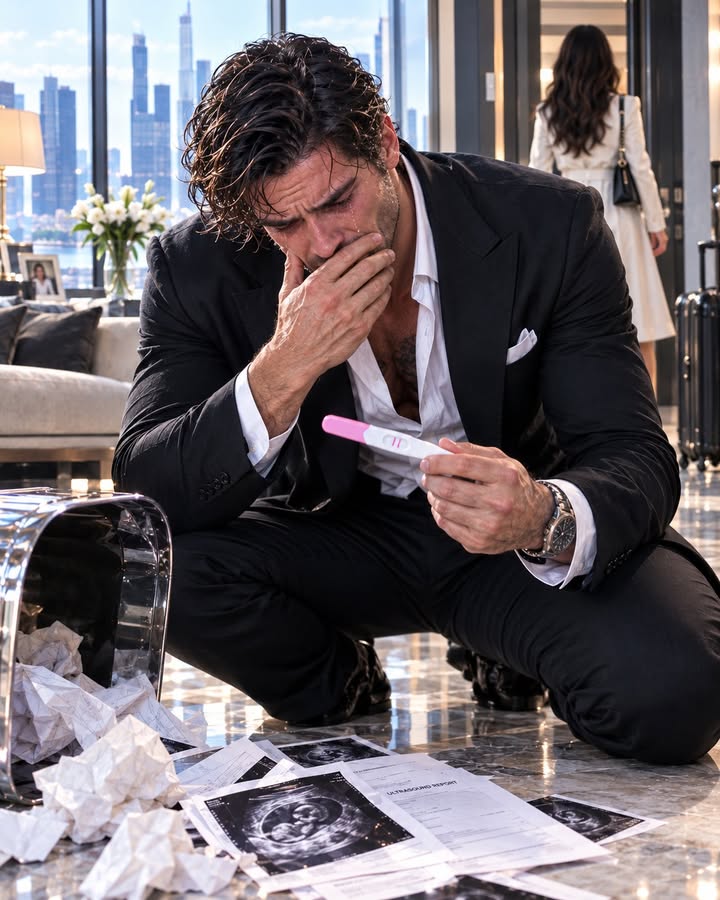
Vincent held the ultrasound report beneath the kitchen light, reading my name as though it might tell him where I had gone.
His hands were still trembling.
The house around him was quiet except for the clock above the stove, each tick marking another second in which he could not undo what he had done.
He called my phone again.
It went straight to voicemail.
He tried the number of the hotel where he thought I might be, then the airline, then the one friend in Chicago he knew I trusted.
No one had seen me.
By dawn, he had called Marco, his adviser, and told him to find me.
“Quietly,” Vincent said, staring at the ultrasound image on the counter.
Marco paused at the other end of the line.
“You want me to bring her home?”
“No.”
The answer came too fast to be mistaken for anything but a decision.
“I want to know she’s safe,” Vincent said, his voice rough. “That’s all.”
He set the report down with care, as if the small black-and-white image could be damaged by the weight of his regret.
Then he noticed the envelope beside it.
Inside were copies of my bank statements and a receipt showing I had withdrawn my personal savings three days earlier.
I had not emptied our accounts.
I had not taken anything that belonged to him.
I had taken only what was mine.
For the first time, Vincent considered that I might not have left to punish him.
The thought unsettled him more than anger would have.
I was already far from Chicago when he reached that conclusion.
Elena’s house stood on a quiet street near the lake, its pale blue shutters softened by years of wind and sun.
She had opened the door before I could knock twice.
For a moment, neither of us spoke.
Then she pulled me into her arms, and I felt the tightness in my chest loosen just enough to let me breathe.
“You’re here,” she whispered.
“I’m sorry I didn’t tell you sooner.”
“You don’t owe me an apology for needing somewhere safe to land.”
She led me inside and took my coat, then set a kettle on the stove without asking what I wanted.
That was one of the reasons I had come to her.
Elena understood that sometimes kindness meant not requiring someone to explain herself before she was ready.
The guest room faced the lake.
Its curtains moved gently in the open window, and the quiet was so complete that I could hear gulls calling somewhere beyond the houses.
For the first time in weeks, no one was waiting for me to be agreeable.
No one was asking me to understand.
I sat on the edge of the bed and placed one hand over my stomach.
The baby was too small for me to feel, but the knowledge of them had changed the shape of every thought.
“Are you all right?” Elena asked from the doorway.
I nodded, then changed my mind.
“I don’t know.”
“That’s honest.”
“I thought finding out I was pregnant would make me happy.”
“It can be frightening and joyful at the same time.”
Her voice held no judgment, only room for the truth.
I looked down at my hand.
“I didn’t want the baby to save my marriage.”
“Did you think Vincent would believe that?”
“I don’t know what he’ll believe.”
Elena sat beside me, leaving a little space between us.
“Then for now, you don’t have to solve what he believes.”
I wanted to believe that.
I wanted to believe I could make choices about my body, my child, and my life without first measuring how Vincent might react.
But two years beside him had taught me to anticipate his needs before my own.
It had made the habit feel like love.
That first evening, Elena brought me soup and toast, and I ate slowly while she told me about the small repairs she had made to the house.
She did not ask whether I would go back.
She did not tell me I should leave him.
She simply filled the quiet with ordinary things until I could sit inside it without feeling trapped.
The next morning, I called my parents.
My mother answered on the second ring.
“Claire?”
“I’m all right, Mom.”
A breath escaped her, unsteady with relief.
“Where are you?”
“With Elena.”
“Are you safe?”
“Yes.”
I heard my father asking something in the background, then my mother covered the phone and answered him.
“Your father wants to know if you’ve eaten.”
I smiled, though my eyes had begun to sting.
“I have.”
“And are you warm?”
“Yes.”
“And is Elena taking good care of you?”
“She is.”
My mother’s voice softened.
“Then that’s enough for today.”
I closed my eyes.
She had always known how to make a day small enough to survive.
“I’m sorry I left you in the middle of everything.”
“Claire, you left because you needed to.”
“I didn’t want to worry you.”
“You’ve been worrying us by pretending nothing was wrong.”
Her words landed gently but firmly.
My mother had spent much of her life protecting everyone around her from discomfort, and she knew the cost of that kind of silence.
“Your father and I are fine,” she continued. “We’re staying with your aunt for a while, just as we planned.”
“Good.”
“And I want you to promise me something.”
“What?”
“Don’t make any decisions about your marriage just because you’re afraid of being alone.”
I pressed the phone closer to my ear.
“I’m not.”
“Then make them because you know what you can live with.”
After the call, I sat by the window and watched the water shift under the morning light.
I had not told my parents about the pregnancy yet.
I wanted to understand what I was choosing before I invited them into the fear and hope tangled together inside me.
At the clinic, Elena came with me.
The waiting room smelled faintly of disinfectant and the paper cups of coffee no one seemed to drink.
A nurse checked my blood pressure and asked the usual questions.
When she asked whether the pregnancy had been planned, I looked down at my hands.
“It was wanted,” I said.
The distinction mattered.
The doctor confirmed what the report had suggested: the pregnancy was early, and everything looked as it should for that stage.
She pointed to a small shape on the screen, explaining what she could see and what was still too soon to know.
The heartbeat was a quick, fluttering sound.
I gripped Elena’s hand.
For a moment, the room disappeared around that sound.
There was no anniversary, no family photograph, no argument about what I had a right to want.
There was only the small life within me, real and quiet and entirely its own.
When the appointment ended, the doctor asked if I had support at home.
“I have Elena,” I answered.
She nodded.
“Good.”
I did not say Vincent’s name.
Not because I had forgotten him, but because I could not yet decide what place he should have in this part of my life.
That afternoon, I told Elena I was ready to explain why I had left.
She sat across from me at the kitchen table while rain gathered in silver lines on the windows.
“I kept a journal,” I began.
“I wrote down the things I couldn’t make myself say out loud.”
Elena waited.
“I wanted a baby for a long time.”
“I know you wanted one.”
“I wanted one with him.”
My voice faltered, and I looked toward the rain.
“For months, I tried to bring it up carefully.”
“What did he say?”
“Not yet.”
The answer was almost too small for what it had done to me.
“He said Noah needed him, or work was complicated, or we should wait until things were calmer.”
“Was it ever calmer?”
“No.”
I folded my hands together.
“I started writing down the dates I asked him to talk about it.”
Elena’s expression changed, but she did not interrupt.
“I thought if I kept the dates, I could prove to myself I wasn’t imagining it.”
“Can I ask what you were trying to prove?”
“That I had tried.”
A silence settled between us.
“I didn’t want to make him feel guilty,” I said. “I didn’t want to pressure him into being a father.”
“You were asking your husband to talk about having a family.”
“I know.”
“But you’re describing it as if you did something wrong.”
I lifted my eyes to hers.
The question was not an accusation.
That made it harder to look away.
“I got used to explaining my needs as though they were inconveniences.”
Elena reached across the table and touched my hand.
“That doesn’t make them inconveniences.”
I had meant to show her the journal eventually.
Instead, I went upstairs and brought it down.
It was a small blue notebook, its cover softened at the edges from being carried in my handbag.
I opened it to the first page.
The earliest entry was more than a year old.
September 12: Asked if we could talk about trying next spring. Vincent said Noah was having a difficult week and we should give him time.
The next entry came three weeks later.
October 4: He promised we would discuss it after the fundraiser.
Then another.
October 22: He said he couldn’t think about a baby while Noah was still adjusting to school.
The pages continued.
Some entries were only a few words.
Some were longer, written after I had gone to bed while Vincent was still out with Sophia and Noah.
Each one recorded a hope postponed until it became easier to stop asking.
Elena read quietly.
When she reached the last page, she closed the notebook without comment.
I felt exposed, though nothing in it was a secret from myself.
“I kept thinking the next time would be different,” I said.
“Sometimes it was,” Elena replied. “He listened for a little while, or told you he understood.”
“Then he went back to doing what he’d always done.”
“And you kept waiting.”
I nodded.
The hardest thing was that I still loved him.
Love had not disappeared when I watched him leave with Sophia and Noah.
It had not disappeared when he brushed off my warning.
It had not disappeared when I saw my mother’s face in the hospital corridor and learned that he had chosen a school celebration instead.
It remained, but it no longer felt like a reason to stay.
“I still love him,” I said.
Elena’s hand stayed over mine.
“But I won’t raise a child in a marriage where I come last.”
The words seemed to settle into the room.
I had rehearsed versions of them in my mind, but the truth sounded different when spoken aloud.
It sounded less like a threat and more like a boundary.
“I didn’t leave because I wanted him to chase me,” I continued. “I left because I finally understood that if I stayed, I would keep making myself smaller to fit beside his other family.”
Elena’s eyes shone.
“You deserve to be chosen without having to compete.”
I looked back at the notebook.
For months, I had used its pages to remember what Vincent had postponed.
Now, for the first time, I saw something else written there.
I had wanted a child before I knew I was carrying one.
I had wanted to be a mother for reasons that belonged to me, not because I believed a baby could fix my marriage.
That knowledge gave me a small, steady comfort.
A few days later, I called my parents again and told them.
My mother cried softly.
My father went quiet for so long I thought the call had dropped.
Then he said, “Are you sure you want this?”
“I’m sure I want the baby.”
“That isn’t what I asked.”
I took a breath.
“I don’t know what will happen with Vincent.”
“Then you don’t have to decide that today.”
My mother took the phone from him.
“We love you, and we’re glad this child is wanted.”
I held the phone close and let her words reach the part of me that had been bracing for disappointment.
After we hung up, I wrote in the blue journal again.
I did not record a date or a conversation.
I wrote that I had told my parents, and that my father had asked the right question.
I wrote that I was afraid.
Then I wrote that fear did not mean I had made the wrong choice.
Back in Chicago, Vincent was still searching for me.
Marco found no trace beyond the fact that I had withdrawn my personal savings and left the city under my own name.
There had been no false passport, no hidden account, no elaborate escape.
I had simply gone somewhere he did not know.
Vincent’s first instinct had been to believe I wanted him to suffer.
The longer he studied the ultrasound, the more that explanation began to fail him.
I had not taken his money.
I had not sent a message through someone else.
I had not demanded an apology.
I had gone.
He called my parents’ house and learned that they were staying with family.
He called again two days later.
My father answered.
“Is Claire with you?”
“No.”
“Do you know where she is?”
“I know she’s safe.”
“Can you tell her I need to speak with her?”
My father’s reply was calm.
“You can tell her yourself when she’s ready to hear from you.”
“Please.”
“I won’t put her in the position of comforting you.”
The line went quiet.
Vincent did not argue.
He lowered the phone and looked at the photograph from the anniversary event, still open on his desk.
Noah’s arms were around his neck.
Sophia was beside him, smiling toward the camera.
The necklace gleamed against the boy’s collar.
For months, Vincent had thought of himself as the person keeping everyone together.
Now the picture seemed to show how easily he had mistaken being needed for doing what was right.
A week after my appointment, I was sitting at Elena’s kitchen table with a cup of ginger tea when my phone lit up with an unfamiliar Chicago number.
I almost ignored it.
Then a message appeared.
It was from Vincent’s mother.
Claire, I owe you an apology.
I read the words twice before continuing.
I gave Noah the family necklace without asking you.
I should have told you, and I should never have let anyone make you feel that it belonged to another child before it belonged to yours.
I’m sorry.
My throat tightened.
A second message followed.
I also heard about your parents.
If they need anything while they recover, I would like to help, but only if you and they are comfortable with it.
I stared at the screen.
I had expected questions from Vincent’s family, perhaps anger, perhaps an attempt to persuade me to come home.
I had not expected an apology.
I set the phone down and told Elena who had written.
“What do you want to do?” she asked.
“I don’t know yet.”
“You don’t have to answer before you know.”
“I know.”
But I kept looking at the message.
The necklace had hurt because it seemed to tell me that Vincent’s family had already chosen another child for the place I had dreamed of filling.
His mother’s apology did not erase that hurt.
Still, it made room for the possibility that she had understood it.
I typed a reply, then erased it.
I tried again and wrote that my parents were being cared for, but I appreciated the offer and would speak with them before accepting any help.
I did not write that I forgave her.
I did not write that I never would.
When I put the phone away, Elena asked whether I wanted to go for a walk.
We took the path beside the lake, moving slowly beneath the bare branches.
The wind carried the smell of water and damp earth.
I had begun to think that silence was all I could expect from Vincent’s world.
Now an apology had arrived from someone I had once believed would never see my side of things.
It was not enough to bring me back.
But it made me wonder what else I had not known.
That evening, Vincent called my phone from his own number.
I watched it ring until the screen went dark.
A moment later, a message appeared.
I know you may not want to speak with me.
I only want to know you’re safe.
I’m sorry I left you and your parents.
I’m sorry I made you believe there would never be room for our child.
I read it once, then again.
The words were not a promise.
They did not ask me to come home.
For that reason, I believed they might be true.
I did not answer.
Instead, I put the phone in a drawer and opened the blue journal.
My thumb brushed across the dates and the small, careful entries.
A page had come loose near the back, folded beneath the cover.
I had not noticed it before.
When I opened it, a photograph slid onto the table.
It showed Noah standing in front of his elementary school, missing one front tooth and holding a paper star.
The picture had been tucked into an old anniversary album I had brought with me, one of the few things I had packed without thinking.
I turned it over.
On the back, in my handwriting, was the date I had found it years ago.
Beneath that, someone had added a line in dark ink:
Vincent Moretti — Father and Emergency Guardian.
The date beside his name was months earlier than the day he had told me helping Sophia was only temporary.
**–END OF PART 2–CLICK “NEXT” AT THE BOTTOM OF THE PAGE TO CONTINUE READING**
* * *
[NEXT: PART 3](https://storyly.idolsgift.com/blog/part-3-the-dates-in-her-journal-052)
✓ Lynn R. Adams
Vincent held the ultrasound report beneath the kitchen light, reading my name as though it might tell him where I had gone. His hands were still trembling. The house around him was quiet except for …