PART 2: The Date on the Paper 047
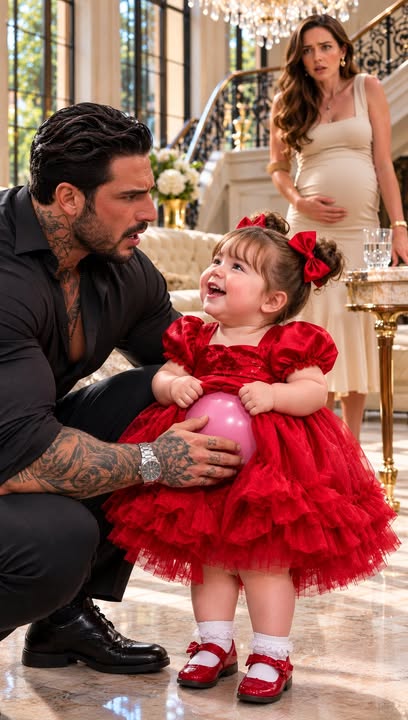
Part 2 – The Date on the Paper
Aurelian stared at the date until the black numbers seemed to blur.
The paper trembled between his fingers, though he tried to hold it steady.
Across the room, Leontine stood with one hand pressed against the banister and the other resting protectively over her stomach.
Maelis looked from one adult to the other, her smile fading as she sensed that her game had become something else.
“Daddy?” she whispered.
Aurelian lowered the paper, careful not to let his voice frighten her.
“It’s all right, sweetheart,” he said, though he was no longer certain it was.
He crouched and gently gathered her into his arms.
“You didn’t do anything wrong.”
Maelis tucked her face against his shoulder, the pink balloon slipping from her hands and rolling across the marble floor.
Leontine flinched at the sound it made as it brushed against the table leg.
“Aurelian,” she said, her voice thin, “please.”
He looked up at her.
The question he had asked remained between them, unanswered, and the quiet of the grand room seemed suddenly too large to contain it.
“Maelis, would you like to take your balloon upstairs?” he asked softly.
The little girl shook her head against his shoulder.
“Stay with Daddy.”
“Of course.”
Aurelian carried her to the sofa and settled her beside him, keeping one arm around her small shoulders.
Leontine remained standing where she was.
For a moment, no one spoke.
Then Maelis reached for his hand and began tracing the lines in his palm with one tiny finger, as if she were trying to soothe him.
Aurelian swallowed.
“Could you give us a little time, sweetheart?” he asked. “I’ll come find you in just a minute.”
Maelis looked toward Leontine.
“Mommy sad?”
Leontine’s lips parted, but the answer did not come.
Aurelian rubbed his daughter’s back.
“Mommy’s having a hard moment,” he said. “You can help by taking your dolls upstairs and choosing a story for us to read later.”
Maelis studied his face.
“Will you come?”
“I promise.”
She climbed off the sofa and picked up her balloon, then paused beside Leontine.
“Mommy, I’m sorry.”
Leontine’s composure broke.
She knelt and opened her arms, and Maelis stepped into them.
“Oh, darling, you have nothing to be sorry for,” she murmured into her daughter’s hair.
Aurelian watched them embrace, the paper still in his hand.
Maelis patted Leontine’s cheek.
“Don’t be sad, Mommy. We can make another baby balloon.”
Leontine closed her eyes.
Aurelian felt the words strike somewhere deeper than the paper had.
When Maelis had gone upstairs, her small footsteps fading into the quiet hallway, Leontine stayed kneeling on the rug.
Aurelian rose slowly.
“Is that document real?” he asked.
“Yes.”
“Is the date real?”
“Yes.”
He glanced down at the sheet again.
It was not a dramatic letter or a warning stamped in red.
It was an ordinary after-visit summary, creased where someone had folded it and softened at the edges from being handled.
The hospital’s name appeared at the top, followed by Leontine’s information and a list of instructions.
At the bottom, the date was three months earlier.
Aurelian’s throat tightened.
“Tell me what happened.”
Leontine stood, using the arm of the sofa for support.
“I lost the baby.”
The words were quiet, almost too quiet to hear.
Aurelian did not move.
For a few seconds, the room seemed to have lost every sound, including the distant hum of the air conditioning.
“You lost the baby,” he repeated.
Leontine nodded.
“I was about twelve weeks along.”
He looked at the hand she had placed over her stomach.
“Then why have you been telling everyone you’re still pregnant?”
“I haven’t told everyone,” she said, then looked away. “I’ve simply let them believe what they wanted to believe.”
“And me?”
Her eyes lifted to his.
“You most of all.”
Aurelian’s jaw tightened, not in anger but in the effort to keep himself from saying something careless.
“How long have you been carrying this alone?”
“Since the hospital.”
“Three months?”
“Almost.”
He set the paper on the coffee table, smoothing it with his palm as if making the creases disappear might change what it said.
“Why didn’t you tell me?”
Leontine lowered herself onto the sofa, leaving a cushion between them.
“I wanted to,” she said. “I tried several times.”
“But you didn’t.”
“No.”
Aurelian looked at the space between them.
It was only a few inches, but it felt like a distance that had been growing for months.
“Was there a reason you kept this?” he asked, lifting the paper again. “Did you want me to find it?”
“No. I didn’t even know Maelis had taken it.”
“How did she get it?”
“It was in my room, inside a folder in the drawer beside my bed.” Leontine pressed her palms together. “I must have left it somewhere she could reach.”
“Why was she in your room?”
“She likes to follow me around. Sometimes she goes looking for her hair clips or the little toys she leaves in there.”
Aurelian glanced toward the staircase.
“She must have found it while she was playing.”
“I think so.”
“And the balloon game?”
Leontine’s shoulders rose with a shallow breath.
“I made it up for her.”
“Why?”
She stared at the pink balloon resting near the coffee table.
“Because I didn’t know how to explain what happened.”
Aurelian sat down in the chair opposite her.
His hands were clasped so tightly that the knuckles had gone pale.
“You told her babies can be pretend.”
“I told her that sometimes she might hear us talk about a baby, and sometimes she might see me sad, and none of that would mean there was a baby she could meet.” Leontine’s voice quivered. “She’s two, Aurelian. I wanted to give her something gentle to hold on to.”
The balloon rolled slightly when the air shifted through the room.
Aurelian watched it, then looked back at his wife.
“So you told her the baby was pretend?”
“I told her the balloon was pretend.”
“But she heard more than that.”
“I know.”
“Did she think the baby inside you was pretend?”
“I don’t know.” Leontine covered her face with both hands for a moment. “I kept trying to find the right words, and every time I thought I had them, I pictured her asking where the baby went.”
Aurelian leaned forward, elbows on his knees.
“She should never have had to carry a secret like this.”
“She didn’t know it was a secret.”
“She said you told her to be quiet because I’d get sad.”
Leontine looked at him through her fingers.
“I never told her that.”
“Then where did she get it?”
“I don’t know. Maybe she heard me tell her not to tell you about the balloon. I only meant that I wanted to explain it to you first.”
“You told her not to tell me?”
“I said, ‘Let’s keep this between us until I can talk to Daddy.’” Leontine’s eyes filled. “I know how that sounds.”
“It sounds like you were teaching her to hide something from me.”
“I wasn’t trying to.”
Aurelian looked down at his hands.
His first instinct had been to ask what else she had hidden, what other pieces of their life had become separate rooms he could not enter.
But beneath that instinct was another, quieter question.
What had he made it feel like to bring bad news to him?
“Did you think I would be angry?” he asked.
“No.”
“Then what?”
Leontine’s mouth trembled.
“I thought you would look at me differently.”
“Differently how?”
“Like I had failed you.”
Aurelian shook his head, but the movement did not make the words disappear.
“I would never think that.”
“You say that now.”
“I would have said it then.”
“Would you?” she asked, not accusingly, but with a tiredness that made the question harder to answer.
He opened his mouth.
Nothing came.
Leontine gave a faint, humorless smile.
“You were so happy when we found out,” she continued. “You started talking about names and the nursery and how Maelis would be the best big sister. You said it was everything you hoped for.”
“It was.”
“And then you started working even more.”
Aurelian looked at her.
“I had deadlines.”
“I know.”
“There were investors flying in. The new division—”
“I know, Aurelian. I’m not saying you did anything wrong by working.”
The quiet in her voice made him feel worse than anger might have.
“I kept telling myself you were busy because you were building the life we wanted,” she said. “And I kept telling myself that if I could make it through the first few months, I would feel less afraid.”
Aurelian’s gaze shifted to the document.
“When did you start bleeding?”
“The morning after you left for New York.”
His mind searched through the calendar.
Three months earlier, he had been at a conference and meetings across the city.
He remembered calling from his hotel room.
He remembered Leontine saying she was tired.
He remembered answering an email while she spoke.
“What did you tell me that night?” he asked.
“I said I wasn’t feeling well.”
“And I told you to rest.”
“You did.”
He closed his eyes.
“I should have asked more.”
“You couldn’t have known.”
“I could have listened.”
Leontine turned toward the window, where the afternoon sunlight had begun to soften into gold.
“I went to the hospital with my sister,” she said. “I called her because I was scared, and I didn’t know whether it was serious. They ran tests. They told me the pregnancy had ended.”
Aurelian felt the words settle into him, one at a time.
“I’m so sorry.”
Leontine nodded, though she kept looking outside.
“At first, I thought I would tell you as soon as I got home. Then I saw the look on your face when you answered my call.”
“What look?”
“You were smiling. You asked if I wanted you to bring home the little book of baby names you’d found.”
He remembered that call.
He had been proud of finding the book, proud of making a plan.
He had heard her silence and mistaken it for emotion.
“I told myself I couldn’t ruin that moment over the phone,” she said. “Then I told myself I’d wait until you came home. Then you came home and had a dinner with the partners, and I thought there would be a better time.”
“There was never a better time.”
“No.”
“And each day made it harder.”
“Yes.”
Aurelian leaned back, pressing his fingers against his brow.
He was hurt.
He could not pretend otherwise.
The silence between them had not been an accident; Leontine had made a choice to keep him outside of something that belonged to both of them.
But beneath his hurt was grief, and beneath the grief was the uneasy recognition that he had been absent at precisely the moment she needed him to notice.
“Did you go through it alone?” he asked.
“My sister stayed with me at the hospital.”
“I mean after.”
Leontine took a breath.
“I went home. I tried to sleep. The next day I started answering messages again.”
“Why?”
“Because the messages kept coming.”
“From whom?”
“Your mother asked how I was feeling. Your office assistant had sent the flowers you ordered. Your cousin wanted to know if we’d chosen a name.”
Aurelian stared at her.
“You didn’t have to answer any of them.”
“I know that now.”
“You could have told me.”
“I could have.”
The admission did not sound like an excuse.
It sounded like a confession she had been carrying too long to dress up.
Aurelian’s eyes moved over the room—the glass walls, the pale stone, the expensive furniture that had seemed so reassuring when they first moved in.
The home they had built was beautiful.
He wondered how many times Leontine had been alone in it while he told himself he was providing for them.
“I kept thinking you were okay because you seemed okay,” he said.
“I was good at seeming okay.”
“I should have known.”
“You were proud of the pregnancy,” Leontine replied. “You kept telling people how well I was doing.”
“Because I believed it.”
“I know.”
She finally turned back toward him.
“I didn’t want to become the person whose only story was that she lost the baby.”
Aurelian’s expression softened.
“You would never have been that to me.”
“But I thought you’d see me as the woman who couldn’t give you the family we wanted.”
His chest tightened.
“Leontine, you are my family.”
Her eyes shone, but she did not look away.
“Before the baby, I had Maelis,” she said. “And I had you. But I knew how much you wanted another child. I knew you wanted us to have that experience together.”
“I wanted a child with you. I didn’t want a promise that nothing painful would happen.”
“I know that now.”
Aurelian rubbed his hands together, searching for a way to make the next words honest.
“I’m hurt you hid it from me,” he said.
Leontine’s shoulders drew inward.
“But I don’t want you to confuse that with blame,” he continued. “I don’t blame you for losing the baby. I don’t blame you for being afraid. I wish you had let me stand beside you, but I know wishing that doesn’t change what you felt.”
Her breath shuddered.
“I was afraid that if I told you, you’d comfort me for a while and then you’d go back to work, and I’d be left with it anyway.”
Aurelian had no immediate answer.
The silence felt like one.
He thought of the countless evenings when he had come home late and asked how she was doing while already looking at the screen in his hand.
He thought of the way he had celebrated the pregnancy as if it were a happy development in their future, rather than something happening inside the body of the woman sitting before him.
“I’m sorry,” he said.
Leontine’s face changed, but she did not reach for him.
“I mean it,” he added. “Not because I think an apology fixes this. I’m sorry I made work feel like the place I chose to be, even when you were home.”
“You weren’t trying to abandon me.”
“I know what I was trying to do. That isn’t the same as what it felt like.”
She looked at him for a long moment.
“I didn’t want to hate you for being happy,” she whispered.
“You don’t have to protect me from your grief.”
“I didn’t know how to let you see it.”
“Then I should have made it easier.”
The room settled into quiet again, but it was no longer empty.
Aurelian stood and moved to the sofa, stopping at a respectful distance.
“May I sit beside you?”
Leontine nodded.
He sat, leaving a small space between them until she shifted closer.
For a moment, neither of them tried to fill the silence.
Then Leontine rested her head against his shoulder.
Aurelian’s arm rose cautiously, and when she did not pull away, he held her.
The embrace was not a solution.
It did not restore the pregnancy or erase the months of secrecy.
But it was the first time in a long while that he felt she had truly let him close enough to understand what had happened.
“I’m sorry I wasn’t there,” he murmured.
“You’re here now.”
“I should have been there then.”
“Yes,” she said.
He accepted the truth without asking her to soften it.
Upstairs, a drawer opened and closed.
Maelis was choosing her dolls, perhaps arranging them in a circle for the story she had asked them to read.
Aurelian looked down at Leontine’s hands.
“Do you want me to tell her what happened?”
“Not yet.”
“All right.”
“She’s too young for all of it. I only wanted her to understand that the baby wasn’t coming.”
“You didn’t do anything wrong by trying to explain it gently.”
“I was trying to protect her.”
“And you were grieving.”
Leontine’s fingers curled around the fabric of his sleeve.
“I didn’t know how to be both.”
“You don’t have to know right now.”
She drew a slow breath.
“I don’t want our family to treat me as if I’m fragile.”
“I won’t ask them to.”
“And I don’t want anyone calling this a tragedy every time they see me.”
“I understand.”
“I just want it to be true.”
Aurelian lowered his cheek to her hair.
“Then we’ll let it be true with us first.”
For a while, they remained together in the quiet living room.
When Leontine finally lifted her head, the tension around her mouth had eased, though her eyes remained tired.
“I should have told you,” she said.
“Yes.”
“I don’t want to pretend I was right.”
“You don’t have to.”
“But I need you to understand I wasn’t trying to deceive you for any reason except fear.”
“I believe you.”
She studied his face as if searching for the part of him that might take the confession back.
Aurelian let her look.
“I don’t know what happens next,” she said.
“Neither do I.”
“That scares me.”
“Then we’ll figure out the next thing. Not every thing. Just the next one.”
Leontine’s hand found his.
Their fingers joined, tentatively at first, then more firmly.
A moment later, Maelis appeared at the top of the staircase, holding a stuffed rabbit by one ear.
“Daddy,” she called, “I picked the story.”
Aurelian eased away from Leontine and stood.
“I’ll be right there.”
Maelis came down two steps, then stopped.
“Mommy coming too?”
Leontine wiped under her eyes.
“Yes, sweetheart.”
Maelis hurried down and climbed onto the sofa between them, placing her rabbit in Leontine’s lap.
“Rabbit wants a story.”
“Then Rabbit is in luck,” Leontine said, managing a small smile.
Aurelian picked up the pink balloon and set it gently on the coffee table.
He did not throw it away.
They read Maelis’s story together, though she interrupted often to ask questions and point to pictures.
As the afternoon faded, the ordinary rhythm of their family returned in small pieces: Maelis leaning against Aurelian’s arm, Leontine smoothing her daughter’s hair, the three of them sharing the same page.
Nothing was repaired all at once.
But for the first time since the hospital, Leontine was no longer the only person who knew.
After Maelis was tucked into bed, Aurelian walked her to the doorway and listened as she whispered goodnight to the rabbit.
When he returned, Leontine was standing near the window.
The medical document lay on the table where he had left it.
“Would you like me to put that somewhere safe?” he asked.
“I’ll take it upstairs.”
“All right.”
She picked up the paper and folded it along its old crease.
Aurelian noticed the hospital instructions on the back, printed in smaller type.
“Did you have follow-up appointments after the hospital?”
Leontine paused.
“Yes.”
“Are you still seeing that doctor?”
“I was.”
The answer held something he could not quite read.
“Were you still going recently?”
“I had an appointment this week.”
Aurelian’s expression changed before he could stop it.
Leontine caught it.
“It was follow-up care,” she said quickly. “Nothing you need to worry about.”
“I’m not trying to—”
“I know.” She drew the paper close to her chest. “I’m just tired, Aurelian.”
“I understand.”
But he did not, not completely.
She had given him the truth, and still there were parts of it she seemed to be guarding.
Perhaps she had every right to.
Perhaps he had not yet earned the rest.
Leontine began toward the stairs, then stopped with one hand on the rail.
“Aurelian?”
“Yes?”
“The doctor who came to the house,” she said, “wasn’t a secret.”
He thought of Maelis’s words, the man who comes when you’re not home.
“I didn’t say it was.”
“No. But I could see you wondering.”
“Who was it?”
“My physician. She came by once because I wasn’t feeling well enough to drive.”
Aurelian nodded.
That explained the visit, but not the appointment she had mentioned, or the careful way she held the paper.
Leontine watched him for a beat.
“I’m not hiding another baby,” she said.
The words landed with a gentleness that somehow made them more unsettling.
“I didn’t ask that.”
“But you wondered.”
Aurelian could not deny it.
Leontine turned toward the stairs again.
“I’m going to bed.”
He let her go, not wanting to turn the small opening she had given him into another interrogation.
At the landing, she glanced back.
“I’m glad you know now,” she said.
“So am I.”
She went into her room and closed the door softly.
Aurelian remained downstairs, alone with the after-visit summary and the small pink balloon.
The document had given him the answer to the question he had asked.
It had also opened questions he had not known to ask.
He picked up the paper and read the lines again, slowly this time, until one detail drew his attention.
Under the visit date, beside a note about continued monitoring, was a reminder for another appointment.
The appointment date was only a few days away.
**–END OF PART 2–CLICK “NEXT” AT THE BOTTOM OF THE PAGE TO CONTINUE READING**
* * *
[NEXT: PART 3](https://echoesofstories.idolsgift.com/blog/part-3-the-date-on-the-paper-047)
✓ Lynn R. Adams
Part 2 – The Date on the Paper Aurelian stared at the date until the black numbers seemed to blur. The paper trembled between his fingers, though he tried to hold it steady. Across the room, Leonti…