PART 2: The Date Inside the Locket 046
Part 2 – The Date Inside the Locket
“That’s my mother.”
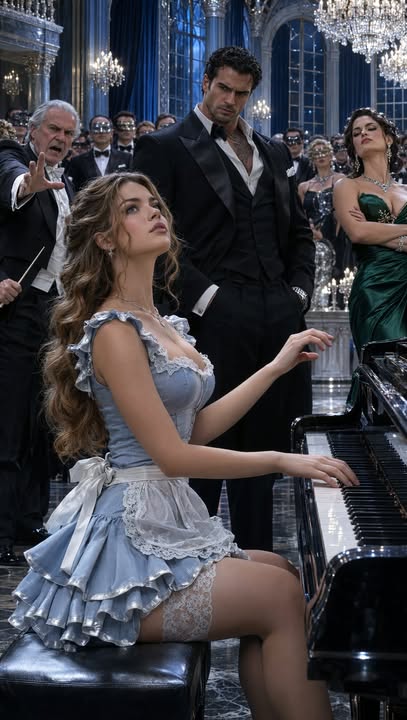
Vincent’s words seemed to empty the opera house of every other sound.
The applause had stopped, the guests had stopped whispering, and even Maestro Falk had gone very still.
I looked down at the silver locket in my hands.
The woman in the photograph had dark, wavy hair and a small, thoughtful smile.
She stood beside my father, Daniel Marlow, one hand resting lightly on the back of a chair.
My father looked younger than I had ever seen him, his shoulders straight and his expression open.
I had spent years searching through the few photographs he left behind, but I had never seen this one.
“May I?” Vincent asked.
His voice was quieter now.
I looked at him before answering.
He had come onto the stage with the calm authority of a man used to being obeyed, but that certainty had fallen away.
What remained was a son staring at a face he had believed lost.
I placed the locket in his palm.
His fingers closed around it with careful precision.
For a moment, neither of us spoke.
Then Maestro Falk stepped forward.
“Enough,” he said, his voice clipped and controlled.
“This is some kind of trick.”
Vincent did not look away from the photograph.
“Is it?”
“The mechanism could have been planted inside the piano.”
“By whom?”
Falk’s gaze flicked briefly toward me.
The movement was small, but I saw it.
So did Vincent.
He lifted his eyes to the conductor.
“You’re finished for tonight, Maestro.”
A ripple of uncertainty passed through the assembled guests.
Falk’s face tightened.
“Vincent, I have known your family for years.”
“And I’m asking you to leave the stage.”
The words were not loud, but they carried through the hall.
Falk looked toward the audience, perhaps expecting someone to intervene.
No one did.
Vivian moved closer to the edge of the stage.
“Perhaps we should give everyone a moment,” she said.
Her tone was composed, but her eyes were fixed on Vincent.
He gave a small nod.
“Everyone except Elena, Vivian, and Maestro Falk may leave.”
Falk’s jaw worked as if he had several replies and could not decide which one was safe to say.
Then he turned away from the piano.
The guests began to drift out, their voices low and restless.
I watched them go, still unable to make sense of what had happened.
The old locket sat in Vincent’s hand, catching the stage lights along its worn silver edge.
When the last of the guests had disappeared through the ballroom doors, Vincent looked at me again.
“You said your father taught you that melody?”
“Yes.”
“Did he ever mention my mother?”
“No.”
My answer came too quickly, and I heard the defensiveness in it.
Vincent seemed to understand.
He did not press me.
Instead, he opened the locket.
Its hinge gave a faint, dry click.
The photograph was faded at the corners, but the faces remained clear.
On the inside of the lid, beneath the woman’s picture, someone had written a date in fine, careful handwriting.
Vincent leaned closer.
The color shifted in his face.
“What is it?” I asked.
He turned the locket so I could see.
The date was written in a format that looked old-fashioned, but the numbers were plain enough.
It matched the night my father died.
I felt the room tilt slightly beneath me.
“That can’t be right.”
“Do you remember the date?” he asked.
“Of course I do.”
My father had died in a fire at the waterfront building where he worked.
I had been nine years old.
My aunt used to tell me that the date would always feel like a door closing, and for years I had hated the sound of it spoken aloud.
Vincent lowered the locket.
“Lucia disappeared when I was a boy,” he said.
“Not long after that, my family was told she had died.”
His voice had gone careful, as if he were choosing each word from a place he had never been allowed to enter.
“They never told me how.”
I looked at the photograph again.
My father stood beside Lucia Moretti, both of them young enough to seem almost like strangers.
“What did they tell you?”
“That there had been an accident.”
He paused.
“Then they stopped talking about it.”
The silence between us grew heavier.
Vivian came to stand beside him, but she did not touch his arm.
She seemed to know that comfort offered too quickly could feel like another kind of pressure.
“I’m sorry,” I said.
Vincent’s expression softened by a fraction.
“So am I.”
Falk had remained near the foot of the stage.
He stared at the locket with open distaste.
“The date proves nothing.”
Vincent turned toward him.
“You recognized it.”
“I recognized the woman.”
“Then tell us who she was.”
Falk’s mouth tightened.
“Lucia Moretti was a private person.”
“She was my mother.”
“And she is gone.”
The reply sounded practiced, as if he had used it many times.
Vincent’s fingers curled around the locket.
“Do you know what happened to her?”
“I know what everyone knows.”
“Which is?”
“That she disappeared.”
“Then you know less than you want me to believe.”
For the first time, Falk looked unsettled.
It passed quickly, but not quickly enough.
He straightened his cuffs.
“You have no reason to involve this woman in an old family matter.”
“I’m already involved,” I said.
The words surprised even me.
Falk turned his eyes on me.
“You have no idea what you’ve found.”
“No,” I answered.
“But I know my father.”
I expected the anger to come back, but what I felt instead was a steady, painful resolve.
If my father had hidden a photograph with the date of his death, I wanted to know why.
If he had left something inside a piano, I wanted to know what he had meant me to find.
Falk gave a thin smile.
“Daniel Marlow was a repairman.”
“He was more than that to me.”
“Sentiment does not make him trustworthy.”
Vincent closed the locket.
“Neither does authority make you right.”
A quiet settled over the room.
Vivian watched Falk, and something unreadable crossed her face before she turned to me.
“Would you like some water?”
I realized my hands were trembling.
“Yes, thank you.”
She stepped down from the stage and returned a moment later with a glass.
She offered it without asking questions.
I accepted it, grateful for the simple kindness.
Vincent glanced at her.
“Thank you.”
Vivian inclined her head, but her gaze stayed on the locket.
“Lucia was elegant,” she said softly.
“Though I never met her.”
“You heard stories?” I asked.
“Only the polished ones.”
She gave a small, rueful smile.
“Families are very good at polishing the parts they want remembered.”
Falk looked away.
It was the first time that evening he seemed to have run out of words.
Vincent slipped the locket into his jacket pocket.
“I want the room cleared completely.”
“It already is,” Vivian said.
“Not the guests.”
He looked at the piano, then at the musicians’ chairs and the stage wings.
“I want to know whether anyone touched the instrument before Elena played.”
The request was measured, not accusatory.
A member of the event staff came in from the side entrance and confirmed that the piano had been brought in that afternoon.
It had been used for rehearsal, but no one had reported opening it.
“Then it was already there,” Vincent said.
“Or someone arranged it earlier,” Falk replied.
He spoke with the confidence of a man reclaiming familiar ground.
“The compartment could have been added during restoration.”
I stared at the piano’s open music rack.
“My father restored instruments,” I said.
“That doesn’t mean he altered them.”
“No,” Falk said.
“But he knew how.”
The implication lay between us, unspoken but unmistakable.
Vincent stepped closer to the piano.
“What did you mean when you called it a forgery?”
Falk hesitated.
“The compartment.”
“Why would anyone hide a photograph in a piano?”
“To create a story.”
He looked toward me.
“A story that makes a dead repairman seem connected to a famous family.”
“Daniel didn’t create this,” I said.
“You cannot know that.”
“He taught me the melody that opened it.”
Falk’s face changed.
Only for an instant, but I saw his eyes sharpen.
“What melody?”
“The last movement you played.”
“That concerto has been performed for decades.”
“Not the version I heard as a child.”
His expression hardened.
“Your memory is not evidence.”
“It’s all I have right now.”
“And yet you expect us to believe it.”
“I don’t expect you to believe anything.”
I met his gaze.
“I expect you to explain why you’re afraid of that compartment.”
Falk went still.
Vivian’s hand tightened around the glass she was holding.
Vincent observed the conductor without speaking.
Falk finally looked away.
“This is becoming pointless.”
“Then help us make it less so,” Vincent said.
“Tell us what you know about Lucia and Daniel.”
“I know they were acquaintances.”
“You said she was private.”
“She was.”
“Were they friends?”
“I don’t know.”
“Were they involved in the concerto?”
Falk’s shoulders lifted in a dismissive shrug.
“Daniel had no role in my music.”
“My father never said he did.”
“Then there is nothing to discuss.”
He turned toward the exit.
Vincent did not stop him.
That, more than anything, seemed to unsettle Falk.
At the doorway, the conductor paused.
“You should be careful about trusting a stranger because she resembles the story you want to believe.”
Vincent’s face gave nothing away.
“I’ll decide whom to trust.”
Falk left.
The door closed behind him with a soft, final sound.
For several seconds, none of us moved.
Then Vincent turned toward the piano.
“Can you show me the notes?”
“I can try.”
I sat down again, though my legs felt unsteady.
The keys were cool beneath my fingertips.
I played the three-note sequence slowly.
A pause followed, then the descending melody my father had taught me.
The notes sounded different without the full concerto around them.
More intimate.
Almost like a voice trying not to be overheard.
Vincent listened without interrupting.
When I finished, he asked, “How long have you known it?”
“As long as I can remember.”
“Did your father ever write it down?”
“Not that I found.”
“Did he call it anything?”
“He never gave it a name.”
I looked down at the keys.
“He only said I should remember it exactly.”
“Why?”
“He didn’t say.”
“And you never asked?”
“I did.”
My throat tightened.
“He always told me I’d understand when I was older.”
The words felt almost childish now.
As if the promise had been made to a little girl who could not know that growing older would not bring her father back.
Vincent sat on the piano bench beside me, leaving a respectful space between us.
“Did he tell you not to play it for strangers?”
“Yes.”
“Why did you play it tonight?”
I considered giving him an easy answer.
Instead, I told him the truth.
“Because I recognized the wrong notes.”
He looked at me.
“Falk’s version?”
“Yes.”
“The melody was nearly the same, but the three notes were different.”
“Then you changed them.”
“I played what my father taught me.”
Vincent glanced toward the opened compartment.
“And the piano answered.”
The phrase settled over us.
The piano had not simply held the locket.
It had responded to the melody.
I ran one finger along the edge of the music rack.
There were fine marks in the wood, nearly invisible unless the light caught them.
Three tiny scratches sat in a row beneath the hinge.
They were so slight I might have mistaken them for wear.
But their spacing was familiar.
I leaned closer.
“Those marks.”
Vincent moved toward me.
“What about them?”
“I’ve seen them before.”
“Where?”
“On my father’s old tuning fork.”
I closed my eyes, trying to recall it.
“It had three little lines near the handle, cut at different angles.”
“Do you still have it?”
“I don’t know.”
The answer frustrated me.
My father’s tools had been divided among relatives after his death, and many had vanished over the years.
“I might have something else,” I added.
“What?”
“His notebooks.”
“You kept them?”
“Some of them.”
I had never thought of them as anything more than reminders of the work he loved.
Vincent’s voice softened.
“Would you be willing to look?”
I studied his face.
His mother’s photograph was in his pocket.
My father’s secret melody was still beneath my hands.
There was no reason to trust Vincent simply because he had recognized the woman in the picture.
Yet there was something in the way he had asked, something that left the choice with me.
“I’ll look,” I said.
“Thank you.”
He did not reach for my hand or make the moment larger than it was.
That restraint made his gratitude feel sincere.
Vivian came closer.
“We should make sure the locket is safe.”
Vincent touched the inside of his jacket.
“It is.”
“I meant safe from being lost, not from being stolen.”
“I know.”
She regarded him for a moment.
“You always say that when you’re worried.”
“I’m not worried.”
“You’re holding your shoulders as if you expect the room to change shape.”
Vincent looked down, as if only then noticing the tension in his body.
A faint smile crossed Vivian’s face.
“You’re allowed to be shaken.”
He did not answer.
I watched them, wondering how a woman could stand so close to someone and still seem to be measuring the distance between them.
Vivian had played her part beautifully earlier, laughing at my challenge as though she had no reason to take it seriously.
Now she seemed neither triumphant nor jealous.
She seemed concerned.
“Would you like me to arrange for a car?” she asked me.
“I can take the train.”
“It’s late.”
“I’ve managed before.”
Vincent looked toward the side doors.
“Then I’ll have someone drive you.”
“I don’t need an escort.”
“I didn’t say you did.”
The answer was calm, almost apologetic.
“I’m offering a ride.”
I hesitated.
The thought of returning alone to my small apartment with the date still turning over in my mind felt unbearable.
“All right,” I said.
Vivian watched me, then nodded as if she understood why I had accepted.
We left the stage together.
The opera house seemed altered without its guests.
The gilded balconies and faded red curtains held a quiet that made every footstep sound important.
At the rear entrance, Vincent stopped beside a dark sedan.
“I’ll have my driver take you home.”
“I can give him the address.”
“Thank you.”
For a moment, we stood facing one another.
I wanted to ask him whether he remembered his mother’s voice, whether he had kept any of her things, whether he had spent years believing she was dead because no one had trusted him with the truth.
Instead, I said, “I’m sorry about your mother.”
He lowered his eyes.
“People have been sorry for years.”
“Did it help?”
“Not particularly.”
The honesty of the answer made me smile despite myself.
“Then I won’t pretend it does.”
He looked at me again.
“No,” he said.
“You don’t have to.”
The car door opened.
Before I got in, he added, “Elena, I’d like you to help me find out what she knew.”
I looked back at the opera house.
The piano was still visible through the open doorway, its polished black surface reflecting the empty room.
“I want to know what my father knew,” I said.
“Then we start there.”
We exchanged no promises.
There was too much we did not know for promises.
But for the first time since my father died, his silence felt less like a wall and more like a door I might be able to open.
At home, I went straight to the narrow cupboard where I kept the few things of his that had survived the years.
The notebooks were tied together with blue thread, their covers soft from handling.
I carried them to the kitchen table and untied the knot.
Most pages were filled with measurements, repair notes, and careful sketches of piano mechanisms.
I turned through them slowly, searching for anything about the opera house.
The first notebook held nothing.
The second contained a list of clients and dates.
The third had a page marked with a small musical staff.
My father’s handwriting leaned slightly to the right.
I knew the melody immediately.
Three notes, then a descending line.
Beside it, he had written a sentence I had never noticed before.
The last movement is a map.
I read it again.
Then, beneath the words, I found a date.
The same date engraved inside the locket.
My phone rang.
Vincent’s name appeared on the screen.
I answered.
“Elena,” he said, “I found something else in the locket.”
My grip tightened around the notebook.
“What?”
“A second inscription, hidden under the photograph.”
I looked at my father’s writing.
“What does it say?”
There was a pause long enough to make me think he had changed his mind.
Then Vincent read the words aloud.
“Ask Falk what happened beneath the opera house.”
I stared at the sentence in my father’s notebook.
The last movement is a map.
And in my ear, Vincent repeated the name of the man who had just insisted there was nothing left to discuss.
**–END OF PART 2–CLICK “NEXT” AT THE BOTTOM OF THE PAGE TO CONTINUE READING**
* * *
[NEXT: PART 3](https://echoesofstories.idolsgift.com/blog/part-3-the-date-inside-the-locket-046)
✓ Lynn R. Adams
Part 2 – The Date Inside the Locket “That’s my mother.” Vincent’s words seemed to empty the opera house of every other sound. The applause had stopped, the guests had stopped whispering, and even M…