PART 2: The Dance That Remembered 070
Part 2 – The Dance That Remembered
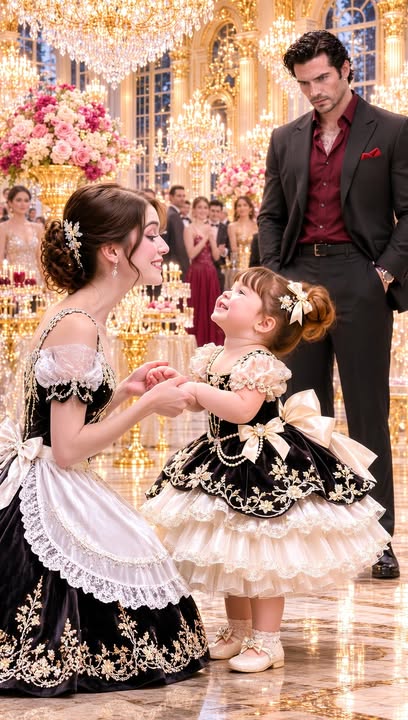
I froze, my hand still holding his daughter’s.
The orchestra played on, but the music seemed to recede beneath the weight of the man’s stare.
Sofia’s fingers tightened around mine.
“Dad?” she asked, her laughter fading into worry.
Vincent Moretti blinked, as if her voice had pulled him back from somewhere far away.
He looked at the guests watching us, then at the bodyguards standing nearby.
“Give us a moment,” he said.
He didn’t raise his voice, yet the people around him immediately found other things to look at.
My supervisor appeared at the edge of the dance floor, her expression caught between alarm and confusion.
“Emily,” she called softly, “perhaps you should come with me.”
Vincent’s gaze moved to her.
“She’ll speak with me first.”
The words were quiet and controlled, but something in them made my supervisor stop where she was.
My stomach tightened.
I had broken the rule I’d been given, and now I was standing in the middle of a ballroom beside the most powerful man in the room.
Sofia looked from her father to me.
“She was only helping me,” she said.
“I know,” Vincent replied.
Then, turning to me, he added, “Would you come with us, please?”
It was phrased as a request.
The two bodyguards behind him made it difficult to hear it that way.
Sofia’s hand slipped from mine.
“I’ll come too.”
“You can stay here,” Vincent told her.
“No.”
There was no sharpness in her voice, only a quiet firmness that surprised me.
“I don’t want you to frighten her.”
For a second, Vincent seemed to have no answer.
Then his expression softened at the edges.
“You’re right,” he said. “You can come.”
The three of us left the dance floor together.
As we crossed the ballroom, the guests pretended not to watch.
I could feel their attention following us anyway, curious and bright as the chandelier light overhead.
My supervisor hurried after us.
“Mr. Moretti,” she said, managing a professional smile, “Emily is on my staff. Is there a problem?”
“No,” Vincent replied. “I need to ask her about something.”
His tone held no threat, but he offered no explanation either.
My supervisor glanced at me.
“Are you all right?”
“I think so,” I answered, though I was no longer certain.
“Then I’ll be just outside the terrace doors,” she said. “If you need anything.”
I nodded gratefully.
Vincent led us into a smaller room off the ballroom, where the music became a soft murmur behind closed doors.
A tall window overlooked the city, its glass reflecting the warm glow of the room’s lamps.
There was a long table, several chairs, and a bowl of untouched white roses.
Vincent asked one of his bodyguards to wait outside.
The man gave a brief nod and closed the door behind him.
Sofia stayed beside me.
Vincent did not sit.
For a moment, he simply watched me, as though he were trying to decide whether I was the answer to a question he had carried for years.
“Where did you learn that dance?” he asked.
His voice was quieter now.
“I’m not sure what you mean.”
“The turn,” he said. “The hand above your head, then the circle of the wrist.”
I looked down at my own hand.
“It was just something my mother taught me.”
“When?”
“When I was little.”
“Where?”
“At home, mostly.”
He waited.
I could tell he wanted more than that, but I had no more to give him.
“My mother used to hum while she showed me,” I said. “It felt like a lullaby. She’d count the steps under her breath, and I’d copy her in the kitchen or the living room.”
“What was her name?” Vincent asked.
“Margaret.”
Sofia’s eyes moved toward me.
“Your mother taught you that exact movement?”
“Yes.”
“Did she tell you where she learned it?”
I searched through my memories, hoping one of them might suddenly become clear.
“No. Not that I remember.”
Vincent turned toward the window.
The reflection of his face looked older than the man standing in the room.
“Only one person ever danced it for me,” he said.
Sofia’s expression changed.
“Mom,” she whispered.
Vincent gave a small nod.
“Your mother created it when Sofia was very young.”
The words settled between us.
I glanced at Sofia.
She seemed as startled as I was, but there was something else in her face too—recognition that had not yet become a memory.
“I don’t remember it,” she said.
“You were little,” Vincent replied. “Elena would hum while she danced with you in her arms.”
He stopped, as if the rest of the sentence had become difficult to say aloud.
The name Elena made the mystery feel suddenly more real.
“Was she the woman you meant?” I asked.
“Yes.”
He turned back to me.
“My wife.”
I swallowed.
“I’m sorry.”
“You didn’t know.”
“No, but—”
“I know what you mean,” he said, with a tired gentleness that hadn’t been there before. “It’s been years.”
Sofia came closer to him.
She didn’t touch his arm, but she stood near enough that he seemed to notice her warmth.
“Why did you say no one else knew the dance?” she asked.
“Because I believed that was true.”
“But Emily’s mother knew it.”
“Apparently.”
His gaze returned to me.
“Did your mother ever mention Elena?”
I shook my head.
“Not by that name.”
“Did she know your father?”
“I don’t know.”
“Did she have friends in New York?”
“Of course,” I said, then paused. “But she didn’t talk much about the years before I was born.”
The answer seemed to stir something in him.
“Why not?”
“She died when I was young,” I said. “I remember pieces. Not enough to ask her everything I wish I could ask now.”
A silence followed, gentler than the one in the ballroom but heavier.
Sofia’s face softened.
“I’m sorry about your mother.”
“Thank you.”
“What was she like?”
The question caught me off guard.
Most people asked about the work I did, or whether I had always lived in the city.
They rarely asked me what I remembered about the person I had lost.
“She was kind,” I said. “Patient. She used to turn ordinary things into games.”
“What kind of games?” Sofia asked.
“If I was upset, she’d tell me to dance with the rain, or make up a story about the moon following us home.”
Sofia’s lips parted.
Vincent noticed.
“What is it?” he asked her.
“I don’t know,” she said. “That sounds familiar.”
“From when you were little?”
“Maybe.”
Her gaze had drifted to the roses on the table.
“I remember being held,” she said slowly. “Someone was humming. I thought it was Mom, but I was too young to be sure.”
Vincent didn’t interrupt.
“Maybe you’re remembering Elena,” I said.
“Maybe.” Sofia looked at me. “Do you know what your mother called the dance?”
The answer rose from somewhere so deep in my memory that for a moment I almost mistook it for a dream.
“The moon turn.”
Sofia looked at her father.
Vincent’s face went still.
“What did you say?” he asked.
“My mother called that movement the moon turn.”
He took one slow step toward the table.
“Elena called it that too.”
“I didn’t know.”
“I understand.”
But he sounded as if understanding were precisely what he didn’t have.
Sofia came to stand at my side.
“I told you she wasn’t doing it to upset anyone,” she said to Vincent.
“I never thought she was.”
“You looked like you did.”
“I was surprised.”
“You looked frightened.”
Vincent glanced at his daughter.
There was no anger in her eyes, only the discomfort of seeing a familiar sadness appear on his face.
“I’m sorry,” he said.
The apology seemed to take something from him.
Sofia gave a small nod and looked down at her hands.
Vincent drew out a chair, but he didn’t sit.
“Did your mother teach you any other parts of the dance?” he asked.
“Some steps,” I replied. “But I don’t know whether they belonged to the same routine. We never had music. She would hum and clap softly to keep the rhythm.”
“Can you show me?”
I hesitated.
“Here?”
“If you’re comfortable.”
Sofia watched me with hopeful eyes.
I glanced toward the closed door.
“I don’t want to cause trouble for my supervisor.”
“I’ll speak to her,” Vincent said. “You won’t be in trouble.”
I wanted to believe him, though I wasn’t sure a promise from Vincent Moretti could feel like an ordinary promise.
Sofia touched my wrist.
“Only if you want to.”
That settled it.
I stood and moved the chair aside.
The room was small, but there was enough space between the table and the window.
I began with the first steps I remembered.
One, two, three.
A gentle step to the left.
A pause.
A turn that followed the curve of the melody in my mind.
I lifted one hand and made the circular gesture.
When I finished, I opened my eyes.
Vincent had not moved.
Sofia was staring at my raised hand.
“That’s it,” she whispered. “That’s what I remember.”
“You remember the dance?”
“Not exactly.” She pressed her fingertips to her temple, searching. “I remember the feeling of being carried. And the humming.”
Vincent looked away.
I lowered my hand.
“I’m sorry if this brought up something painful.”
“It brought up something I thought was gone,” he said.
He walked to the window and rested one palm against the frame.
“For a long time, Elena’s life before me was a closed door,” he continued. “She never liked to talk about it.”
“Did you ask her?” I asked.
“I did. She told me there were people she cared about, but that she wanted to leave certain years behind.”
His reflection seemed to look out at the city, though his eyes were lowered.
“I thought I understood.”
“Maybe she had a reason,” Sofia said.
“Maybe.”
He didn’t sound offended by her suggestion.
Sofia moved closer to me.
“Would you teach me the rest?”
I blinked.
“The rest?”
“Whatever your mother taught you.”
“I don’t remember all of it.”
“That’s all right,” she said. “We can start with what you do remember.”
I looked at Vincent.
He was still facing the window, but I saw his shoulders ease a little.
“If you’d like,” I said.
“I would.”
The wish in Sofia’s voice was plain, and that made it hard to refuse.
“Then we’ll try.”
“Not tonight,” Vincent said.
Sofia looked at him.
“Why not?”
“Because you’ve been standing in uncomfortable shoes for hours, and Emily is working.”
“I can still dance.”
“You can barely walk.”
“I can do both.”
“Perhaps tomorrow,” I offered, hoping to smooth the exchange.
Sofia seemed to consider it.
“Tomorrow?”
“If my supervisor can spare me.”
“I’ll ask her,” Vincent said.
He spoke with the same certainty he had used on the dance floor, but this time it sounded less like an order and more like an intention.
Sofia smiled.
It was a small smile, but it brought back the joy I had seen when she first learned to follow the rhythm.
Vincent finally sat.
He folded his hands on the table and looked at me with care rather than suspicion.
“My wife never taught that dance to anyone else,” he said.
“I believe you.”
“Then I need to understand how your mother learned it.”
“So do I.”
“Did she leave anything behind? Letters, journals, photographs?”
The question struck a tender place.
“I have a few boxes,” I said. “I haven’t looked through all of them in years.”
“Would you be willing to?”
I wasn’t sure.
The boxes were in the small apartment I had shared with my mother, stored in the closet beneath a shelf of winter coats.
Opening them meant touching the parts of her life I had preserved by refusing to disturb them.
“I could look,” I said.
“You don’t have to do it for me.”
“I know.”
It was the first thing he had said that made me feel he understood what the question cost.
Sofia leaned her elbows on the table.
“Do you think our mothers knew each other?”
“I don’t know,” I said.
Vincent’s eyes met mine.
“Neither do I.”
That answer was honest, but it left the room full of new questions.
A knock sounded at the door.
Vincent’s bodyguard stepped inside and quietly said that my supervisor was waiting.
“I should go,” I said.
“Yes,” Vincent replied. “And I will make sure you’re paid for the time you spent helping Sofia.”
“You don’t have to do that.”
“She asked for your help. You gave it. That deserves respect.”
I nodded, unsure how to answer.
Sofia stood and came around the table.
“Thank you for dancing with me.”
“Thank you for letting me.”
“You made me forget everyone was watching.”
“That’s a lovely thing to say.”
She squeezed my hand, then let go.
Vincent walked us to the door.
Just before we stepped into the corridor, he spoke again.
“Emily.”
I turned.
“If you find anything that connects your mother to Elena, please tell me.”
“I’ll tell you what I find.”
He seemed to accept the distinction.
“Thank you.”
The ballroom was still bright and crowded when we returned, but the moment had passed.
The orchestra had shifted to a faster tune.
Guests swayed beneath the chandeliers, their laughter rising over the music.
My supervisor waited near the terrace doors.
She looked relieved when she saw me.
“Are you all right?”
“Yes,” I said.
“Did he—”
“He asked about the dance.”
She lowered her voice.
“And?”
“I don’t really know.”
That was the truth.
Vincent spoke briefly with my supervisor, assuring her that I had done nothing wrong.
Then Sofia stayed by her father’s side as he rejoined the guests.
Before I returned to the serving station, she glanced back at me.
Her smile was no longer the wide, delighted smile she had worn on the dance floor.
It was quieter, but it seemed to hold a promise.
I spent the rest of the evening carrying trays and trying not to replay every word.
Each time I heard the orchestra, I found myself remembering my mother’s humming.
One, two, three.
The moon turn.
By the time I reached home, the city had gone dark and still.
My apartment felt smaller than usual.
I took off my shoes, put my work uniform over the back of a chair, and stood in the doorway of the closet.
The boxes were still where I had left them.
One of them held old tax papers and school drawings.
Another held my mother’s scarves, folded in tissue.
The third was marked with her handwriting, the letters rounded and careful.
Photographs.
I had opened that box only once since her funeral.
I carried it to the kitchen table.
The lid lifted with a soft scrape.
Inside lay stacks of photographs, most of them arranged in envelopes by year.
I recognized my mother at different ages, her hair longer in some pictures, shorter in others.
There were snapshots of family gatherings, street fairs, and quiet afternoons in the park.
I found one of myself as a child, holding a wooden spoon while my mother laughed beside me.
For a while, I forgot why I had opened the box.
Then I remembered the name Vincent had spoken.
Elena.
I checked the backs of the photographs, hoping to find a caption or a date that might lead somewhere.
Most were blank.
Near the bottom, I found an envelope with no writing on it.
It was sealed, though the flap had come loose over time.
Inside was a narrow strip of pale blue ribbon.
A small paper note had been folded around it.
My mother’s handwriting filled just two lines.
For Emily, when she’s old enough to ask about the moon turn.
I read it twice.
Then a third time.
The note didn’t explain the dance, or who had taught it to her, or why she had kept the words hidden.
But it told me she had known that one day I might ask.
The room seemed to grow quiet around me.
I turned the paper over.
On the blank side, in faded ink, was a name I had never seen among my mother’s belongings before.
Elena.
**–END OF PART 2–CLICK “NEXT” AT THE BOTTOM OF THE PAGE TO CONTINUE READING**
* * *
[NEXT: PART 3](https://storyly.idolsgift.com/blog/part-3-the-dance-that-remembered-070)
✓ Lynn R. Adams
Part 2 – The Dance That Remembered I froze, my hand still holding his daughter’s. The orchestra played on, but the music seemed to recede beneath the weight of the man’s stare. Sofia’s fingers tigh…