PART 2: The Cufflink in Bethany’s Hand 027
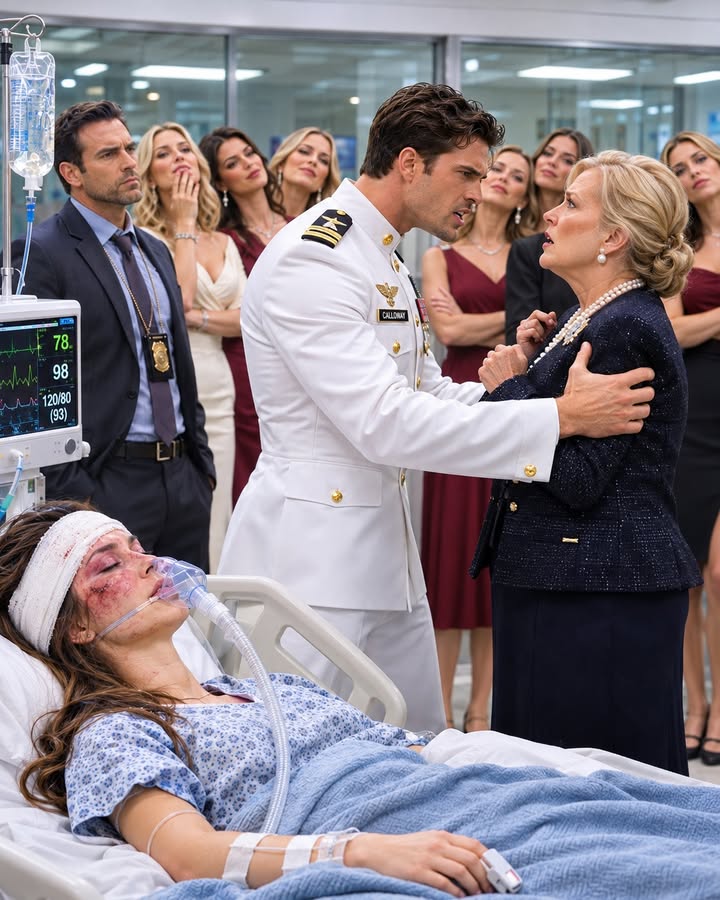
Bethany’s trembling hand hovered between us, and for a moment the whole hallway seemed to hold its breath.
Constance caught her daughter’s wrist, not roughly, but with the practiced certainty of someone accustomed to being obeyed.
“Bethany is exhausted,” she said. “This is neither the time nor the place.”
Bethany flinched at the touch.
That small movement told me more than any accusation could have.
“Let go of her,” I said, keeping my voice low.
Constance’s eyes narrowed, but before she could answer, Detective Granger stepped between us.
“Mrs. Voss, I need to speak with everyone who was present at the house,” he said. “Separately.”
“You already have my statement,” Constance replied.
“I have a preliminary account,” Granger said. “It isn’t the same thing.”
For a second, I thought she might refuse in front of all of us.
Then she released Bethany and smoothed the cuff of her charcoal sleeve, restoring the composure that had slipped.
“Of course,” she said. “We have nothing to hide.”
Her daughters shifted behind her.
Vivian looked irritated, Renata unreadable, Gwen distracted by her phone, and Delia and Monica seemed suddenly interested in the corridor tiles.
Bethany lowered her hand.
“Can I talk to him?” she asked.
Constance looked at me as if I were an inconvenience she had not yet decided how to remove.
“You may speak to Detective Granger,” she said. “Not alone with Wesley.”
“I’m not a child,” Bethany whispered.
“No,” Constance replied. “You’re my daughter.”
The words sounded less like affection than a door being closed.
Granger glanced toward the ICU entrance, where Dr. Pike had appeared with a nurse.
“We can use the family consultation room,” he said. “Mrs. Voss, you can wait here.”
Constance’s expression cooled.
“If Bethany has anything relevant to say, I should hear it.”
“Then you can hear her statement after I take it,” Granger said.
The detective’s tone was professional, almost gentle, but I saw the strain at the corner of his eyes.
He knew how much of this county answered to the Voss name.
He was choosing, quietly, to do his job anyway.
Bethany looked at me once before following him.
I stayed behind.
Every instinct urged me to go after her, to demand the whole truth, to find someone who could tell me how Adeline had gone from our home to an ICU bed while I was halfway across the world.
But Bethany had looked frightened, and fear did not become courage simply because I needed answers.
So I turned back toward the glass.
Adeline lay motionless beneath the pale hospital light, her chest rising and falling with the help of the ventilator.
A nurse adjusted a line near her arm, then checked the monitor.
I pressed my palm against the glass.
“I’m here,” I murmured. “I’m not going anywhere.”
Behind me, Vivian gave a quiet, impatient sigh.
“You can’t fix this by staring at her,” she said.
I didn’t turn around.
“I’m not trying to fix her.”
“Then what are you doing?”
“Staying.”
The silence that followed was more honest than anything she had said.
Dr. Pike came out a few minutes later and asked me to step aside.
He explained that Adeline’s condition remained critical but stable, that the next day would be important, and that the hospital was monitoring her closely for changes in her brain swelling.
I listened, asked what I could do, and tried to absorb every detail.
When he finished, he studied me with the steady look of someone who had delivered too much difficult news.
“You should eat something and rest when you can,” he said.
“I’m all right.”
“That isn’t what I asked.”
I almost told him that rest was impossible while the woman I loved lay unconscious a few yards away.
Instead, I thanked him.
A nurse brought me a paper cup of coffee that had gone lukewarm before I remembered to drink it.
I held it in both hands and watched the family through the corridor window.
Constance sat with perfect posture, her hands folded over a leather handbag.
Vivian stood near her, speaking into her phone in a voice too low to make out.
The others had drifted apart, no longer laughing.
Bethany was still in the consultation room with Granger.
I wondered what she knew.
I wondered what she was afraid to say.
And beneath those questions, another one kept returning: why had Adeline’s family arrived before the ambulance?
The consultation room door opened at last.
Granger stepped out first, his face difficult to read.
Bethany followed, her eyes red but dry.
She looked toward Constance, then toward me.
“Could we talk somewhere quieter?” she asked.
Constance rose immediately.
“No.”
“Mother,” Bethany said, and something steadier entered her voice. “Please.”
The word seemed to surprise her as much as it did the rest of us.
Granger looked to me.
“I’ll stay close,” he said. “But Bethany can speak with you privately if she wants.”
Constance’s gaze moved from the detective to her youngest daughter.
“Do you understand what you’re doing?”
Bethany swallowed.
“I think I’m beginning to.”
For a heartbeat, Constance said nothing.
Then she sat again, her face composed, though her fingers had tightened around the strap of her handbag.
Bethany and I walked to the small family room at the end of the corridor.
The room had a round table, two chairs, and a window overlooking the hospital’s service entrance.
Someone had left a box of tissues beside a vase of artificial flowers.
Bethany stood by the window rather than sitting.
I didn’t ask her to start.
I had learned in the Army that silence could be more useful than pressure.
She folded her arms around herself.
“I was at your house that night,” she said.
My breath caught, but I kept my voice even.
“Why?”
“I didn’t go there to hurt Adeline.”
“I didn’t think you did.”
Her eyes lifted to mine, uncertain.
“I was visiting her,” she continued. “She had called me a few days earlier. She sounded worried, but she wouldn’t say why over the phone.”
“Did she tell you what was wrong?”
“No. She said she needed to talk in person, and that I shouldn’t tell Mother.”
Bethany looked down at her hands.
“I almost didn’t go.”
“What changed your mind?”
“She was my sister.”
The words came out with such quiet simplicity that I felt their weight.
Bethany had spent much of her life surrounded by the Voss family’s wealth and certainty, but at that moment she looked like someone who had been trying to decide whether she was allowed to love her sister.
“I arrived after dark,” she said. “Adeline let me in through the kitchen. We talked for a while.”
“About what?”
“She asked me whether I still had the old photographs from Father’s study.”
I frowned.
“Photographs?”
“From when we were children. There were pictures of us at the airfield, before everything changed. She said she wanted to see them.”
The detail sounded ordinary, almost painfully so.
“Did she seem afraid?”
Bethany took a long moment to answer.
“She seemed tired. More than tired, maybe. She kept checking the front windows, and she asked whether I had seen anyone follow me.”
My jaw tightened.
“Did you?”
“No. I told her I hadn’t.”
She closed her eyes briefly.
“I wish I had asked more questions.”
“Bethany, you can’t make yourself responsible for what happened.”
“But I was there.”
“Being there doesn’t make you responsible.”
She looked away, as if she couldn’t accept comfort from someone who had just learned she had been in the house.
“Adeline went upstairs to get something,” she said. “I waited in the kitchen. Then I heard a car outside.”
“Did you see who got out?”
“No. I looked through the curtain, but the lights were off.”
Her voice grew thinner.
“I heard the front door open a few minutes later. I thought it was Adeline coming back downstairs, but then I heard someone say, ‘Get the ledger.’”
A chill moved through me.
“Who said it?”
“I don’t know. A man, I think. The voice was low.”
“Did you hear Adeline?”
“No.”
Bethany pressed her palm against her own sternum, as if steadying her breath.
“Then I heard Mother.”
I stared at her.
“What did she say?”
“She asked whether they had checked the study. I heard another voice say the ledger wasn’t there, and then Mother said, ‘Find it before anyone else does.’”
The hospital’s air system hummed above us.
For several seconds, neither of us spoke.
“Was your mother inside the house?” I asked.
“I think so. I didn’t see her, but I recognized her voice.”
“Who else?”
“Vivian.”
Bethany’s eyes filled again, and this time she did not look away.
“I saw her through the doorway,” she said. “She was standing beside a man I’d never met. He wore a dark jacket and had a radio clipped to his belt.”
“Security?”
“I don’t know. He looked like the private guards Mother sometimes hires for company events.”
“Did you see them go into the study?”
Bethany nodded.
“Vivian went first. The man followed her.”
“Was Adeline with them?”
“I didn’t see her.”
“Did you hear anything?”
“A door shut. Then a crash.”
She stopped and swallowed.
“I ran.”
The answer was so immediate, so ashamed, that I wanted to reach for her and knew I shouldn’t assume she wanted me to.
“You were scared,” I said.
“I should have helped her.”
“You were alone, and you didn’t know how many people were in the house.”
“I could have called the police.”
“You might have. But you’re telling me now, and that matters.”
Bethany wiped one cheek with the back of her hand.
“I didn’t come forward earlier because Mother was waiting outside the house when I got home.”
I leaned closer, careful not to crowd her.
“She knew you were there?”
“I don’t know. She asked why I had been out. Then she said the family needed to stay united and that anything I said could ruin Adeline’s chance of getting better.”
“That doesn’t make sense.”
“I know.”
“Did she threaten you?”
“Not exactly.” Bethany looked toward the closed door. “She doesn’t have to threaten me. She knows what I’m afraid of.”
“What is that?”
“That if I oppose her, she’ll decide I’m disloyal too.”
Her face held no melodrama, only the exhaustion of someone who had been taught to anticipate consequences before choosing anything for herself.
“What would happen if you were disloyal?” I asked.
“She would cut me off, I suppose. She would tell everyone I’m unstable, or selfish, or confused. She has a way of making people believe that a person is the problem before they ever ask what happened.”
I thought of Adeline’s words from years before, when she had told me that leaving her family had felt like stepping into open air without knowing whether there would be ground beneath her.
I had understood the sentence then.
Now I understood the cost of it.
“Why are you telling me?” I asked.
“Because Adeline is still in there.” Bethany glanced toward the ICU. “And I keep thinking that if she wakes up, she deserves to know someone tried to help.”
I searched her face.
“Did you see who attacked her?”
“No.”
“Did you see anyone leave?”
“I was already outside by then.”
“Then I won’t ask you to claim more than you know.”
Her shoulders eased by a fraction.
“I heard the front door close after I left,” she said. “I didn’t know if they were still inside. I just kept walking until I reached the road.”
“You didn’t call anyone?”
“No.”
“Bethany.”
“I know.” Her voice broke. “I know what that sounds like.”
“It sounds like you were afraid.”
“I’m afraid now.”
“I understand.”
She studied me as if waiting for the promise most people would make in a moment like this.
That they would protect her.
That they would make her mother pay.
That everything would be all right.
I could not offer a promise I had no way to keep.
So I told her the truth.
“I can’t control what your mother does or what the police decide,” I said. “But I can stay with you while we tell Detective Granger exactly what you remember.”
Bethany drew a shaky breath.
“Will you be angry if I don’t know everything?”
“No.”
“Will you be angry if I change my mind?”
“I’ll ask you to be honest about why. I won’t punish you for being frightened.”
She seemed to take that in slowly.
Then she reached into the pocket of her cardigan.
“I didn’t leave the house with nothing,” she said.
She opened her hand.
A silver cufflink rested in her palm, darkened near the edge by a dried brown stain.
My eyes fixed on it.
“Where did you find that?”
“In the hallway outside the study.”
“You took it?”
“I didn’t know what else to do. I picked it up after I ran back inside, just for a few seconds.”
“You went back in?”
“I realized I’d left my coat near the kitchen door. I was afraid someone would see it and know I’d been there.”
She curled her fingers around the cufflink.
“I saw this on the floor. There was a little blood on it.”
“Did you touch anything else?”
“No.”
“Why keep it?”
“I thought it might matter.”
She looked embarrassed by the answer, but I could see the choice beneath it: she had carried evidence for weeks while fear told her to hide it.
I didn’t reach for the cufflink.
“Detective Granger needs to take it,” I said. “He’ll have to document exactly where you found it and when you picked it up.”
“I know.”
“Are you ready to give it to him?”
Bethany looked through the narrow window in the door.
Constance sat beyond it, her gaze fixed on the corridor as if she could feel every word being spoken.
Bethany’s fingers tightened around the silver.
“Not if you make me do it,” she said.
“I won’t.”
“But if Adeline were here, she’d tell me to.”
“She might,” I said. “Or she might ask what you need to feel safe enough to do it.”
A small, surprised smile touched Bethany’s mouth and vanished.
“She used to do that when we were children,” she said. “When Mother wanted one of us to apologize, Adeline would ask what had actually happened first.”
I thought of my wife as a girl, standing between her sisters and the certainty of their mother.
The image hurt in a way I hadn’t expected.
“Then we’ll do it the way she would have wanted,” I said. “We’ll tell the truth, carefully.”
Bethany nodded.
I opened the door, and Granger was waiting nearby.
He had kept his distance as promised, though his attention sharpened when he saw the cufflink.
“What do you have there?” he asked.
Bethany held it out.
“I found it in the hallway outside the study the night Adeline was attacked,” she said. “I heard Constance say someone needed to get the ledger. I saw Vivian enter the study with a man who appeared to be security.”
Granger’s face changed, but only slightly.
“Did you see the man’s face?”
“No.”
“Did you see him touch your sister?”
“No.”
“Can you describe the cufflink?”
“It’s silver. There’s a mark on the front, but I don’t know what it means.”
Granger took out a small evidence envelope.
“Thank you for telling me. I’ll document your account and the chain of custody as accurately as I can.”
Bethany let the cufflink go.
Her hand stayed open for a moment after it was gone.
Granger made a note, then asked permission to take a formal statement.
Bethany agreed.
Constance rose as they began to move toward the consultation room again.
“What is that?” she asked.
“A piece of evidence,” Granger said.
“From where?”
“That’s part of my investigation.”
“Detective, you know this family is cooperating.”
“I hope that remains true.”
For the first time since I had met him, Granger sounded less like a man placating the powerful and more like a man drawing a line he might not be able to hold.
Constance looked toward Bethany.
“Come with me.”
Bethany didn’t move.
“Not yet.”
“Bethany.”
“I’m giving a statement.”
The words were quiet, but they stood their ground.
Constance’s face remained composed, though a pulse beat beneath the skin at her temple.
“Very well,” she said. “I’ll be right here.”
She returned to her chair.
The others watched Bethany follow Granger away.
Vivian’s expression had gone still.
I wondered whether she had heard every word.
I wondered whether she had been expecting Bethany to stay silent.
A nurse came out of the ICU and said Dr. Pike wanted to speak with me.
I looked at Bethany.
“Go,” she said. “I’ll finish.”
“You sure?”
“No,” she admitted. “But I’m going anyway.”
I followed the nurse into a small office beside the unit.
Dr. Pike stood with a chart in his hands.
“Adeline’s vital signs are holding,” he said. “There’s no significant change in the swelling, which is encouraging, though we need to continue monitoring her.”
“Can I sit with her?”
“For a few minutes, yes. We’re limiting stimulation, but she may still hear familiar voices.”
I returned to Adeline’s bedside.
The room was quieter than the corridor, the machines keeping their measured rhythm.
I drew a chair close and sat, taking care not to touch the lines or bandages.
“Bethany told the detective what she saw,” I said.
Adeline’s face did not move.
“She was frightened, but she did it anyway.”
I laid my hand near hers, close enough that she could find it if she woke, not so close that I disturbed her.
“I know you’ve spent years trying to make peace with that family. I know you were the one who kept hoping your sisters could become what you needed them to be.”
The ventilator breathed for her.
“I don’t know what happened in that house yet,” I continued. “I don’t know what the ledger is, or why they wanted it. But I’ll listen when you can tell me.”
My voice wavered on the last words.
I lowered my head, resting my forehead against the edge of the mattress.
“I won’t decide your story for you.”
For a long time, I stayed there.
The evening light faded beyond the narrow window, turning the room’s reflection into a ghostly overlay of my own tired face.
When I returned to the corridor, Bethany had finished her statement.
Granger was speaking with her in a low voice, explaining that the cufflink would be sent for examination.
Constance stood a little farther away, her attention fixed on the evidence envelope in the detective’s hand.
“Can you tell what the mark is?” I asked.
“Not yet,” Granger replied. “It’s too small to identify without a closer look.”
“Will it be entered into evidence?”
“I’m doing that now.”
Constance gave him a thin smile.
“Surely a cufflink proves very little.”
“It may prove nothing,” Granger said. “But we don’t know that yet.”
Bethany moved closer to me.
“I’m going to stay,” she said.
“You don’t have to.”
“I know.”
She glanced at the ICU doors.
“I want to.”
I nodded, and for the first time that day, I saw her make a choice without looking toward her mother for permission.
Not a grand declaration.
Just one chair pulled close to the wall, one quiet refusal to leave.
The hallway settled into the uneasy stillness of night.
The Voss sisters drifted away one by one, though Vivian lingered long enough to give Bethany a look I couldn’t interpret.
Constance remained seated, perfectly still, as if the hospital had become another room she could command through patience alone.
Granger returned from the nurses’ station carrying a clear evidence sleeve.
He had placed the cufflink inside it, along with a folded card bearing his notes.
“I’ve recorded the source and the time it was surrendered,” he said. “The lab will examine the stain and the engraving.”
Bethany watched the sleeve.
“I’m sorry I kept it this long.”
“You brought it forward when you were ready,” Granger said. “That’s what matters now.”
He turned the sleeve slightly beneath the corridor lights.
The mark on the front came into focus: a small crest above two narrow initials.
Granger’s brows drew together.
“Do you recognize it?” I asked.
“I don’t,” he said, though his tone suggested the symbol meant something to him.
He took out his phone, enlarged a photograph, and stared at the image for several seconds.
Then his eyes lifted to mine.
“This cufflink may not belong to anyone in the Voss family,” he said.
Bethany’s face drained of color.
“Then whose is it?” I asked.
Granger looked down at the crest again.
“Colonel Aaron Vale,” he said. “A retired officer who consults for Voss Aeronautics.”
For the first time since I had arrived, the mystery in front of me shifted shape.
The cufflink had come from our hallway.
The man attached to it had served in a world I knew.
And somewhere in that world, he had a reason to be standing inside my wife’s house the night she was attacked.
**–END OF PART 2–CLICK “NEXT” AT THE BOTTOM OF THE PAGE TO CONTINUE READING**
* * *
[NEXT: PART 3](https://puretales.idolsgift.com/blog/part-3-the-cufflink-in-bethany-s-hand-027)
✓ Lynn R. Adams
Bethany’s trembling hand hovered between us, and for a moment the whole hallway seemed to hold its breath. Constance caught her daughter’s wrist, not roughly, but with the practiced certainty of some…