PART 2: The Crown That Would Not Touch Her 041
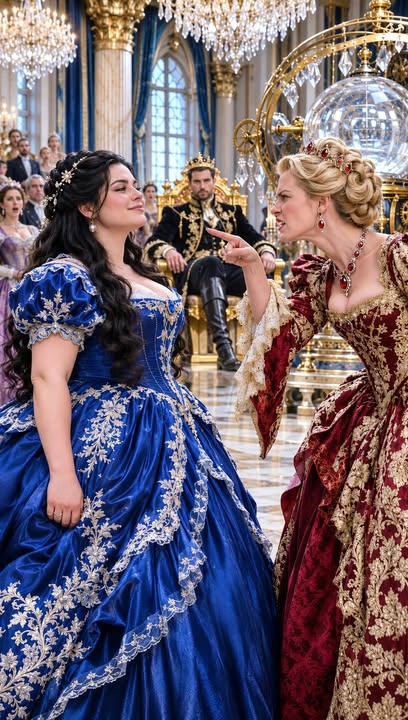
The golden throne continued its descent, and King Adrian’s crown drifted toward me as if the air itself had decided where it belonged.
I could not breathe.
The courtiers had gone silent, their faces turned upward beneath the glittering crystals, while the royal sorcerer remained on his knees beside the machine.
I looked at the crown, then at the king, whose lowered head seemed to make the whole ballroom tilt.
“Your Majesty, please stand,” I said.
Adrian lifted his eyes, but did not rise.
“The prophecy commands me to surrender my crown.”
“Then perhaps the prophecy can wait until someone explains what it means.”
A ripple of dismay moved through the court.
The Duchess of Ravenshire, who had been smiling moments earlier, now watched me with a wary frown.
The crown hovered only a hand’s breadth above my hair.
I raised my palm.
“Stop.”
The word was not loud, yet it struck the room with the force of a bell.
The crown halted.
A shiver passed through the golden throne, and every crystal hanging above us went perfectly still.
For a long moment, no one moved.
Then the crown began to turn slowly in the air, its points glimmering like small suns, before drifting backward toward Adrian.
He caught it with both hands.
The king stared at the crown as if it had become something unfamiliar.
I stared at my palm.
The sun-shaped mark had faded to a faint warmth beneath my skin, but the sensation lingered, like the memory of holding a heated cup.
The sorcerer rose cautiously.
“The machine obeyed her.”
“Does it often obey people who are not its master?” Adrian asked.
“Not in any record I have read, Your Majesty.”
“Then perhaps the records are incomplete.”
Adrian set the crown on a nearby cushion rather than placing it on his head.
He did not look at me as though I had stolen something from him.
Instead, he studied the golden throne with the troubled patience of a man standing before a door he had never expected to open.
“What happens now?” I asked.
The sorcerer glanced at the floating seat.
“That depends on what the machine intends.”
“That is not an answer.”
“No, my lady,” he said softly. “It is the only honest one I have.”
The throne descended until its carved feet touched the ballroom floor.
At once, the roar of the hidden gears quieted.
The crystal sphere closed with a delicate chime, and the golden light faded from the marble, leaving only the ordinary brilliance of chandeliers and candlelight.
A few courtiers began to whisper.
Adrian turned toward them.
“The evening is over,” he said, his voice carrying easily across the room. “Lady Isabella will be escorted to the eastern apartments. No one is to question her or approach her without her consent.”
The Duchess of Ravenshire’s eyebrows rose.
“Your Majesty, surely the court must be allowed to understand what has occurred.”
“The court has seen enough to understand that we do not yet know what has occurred.”
His gaze settled on the duchess, not in anger but with a calmness that made her look away first.
“I will speak with Lady Isabella tomorrow, after she has rested.”
I had spent years learning to recognize the difference between kindness offered sincerely and kindness shaped to make a person easier to manage.
Adrian’s words held no promise that he would solve everything for me.
They held something more unusual: the assurance that I would not be treated as a spectacle while he tried.
The sorcerer approached the crystal machine and began examining its base.
When he noticed me watching, he bowed.
“My lady, may I ask you to keep your hand uncovered until we learn whether the mark changes?”
“No,” Adrian said before I could answer.
The sorcerer paused.
“Not unless she wishes to.”
The small correction settled into the room more deeply than the command to end the evening.
I pulled the sleeve of my gown over my palm.
“I would rather not be examined tonight.”
“Then you will not be,” Adrian replied.
The golden throne stood between us, elegant and strange, as though it had been waiting patiently for someone to notice that it was more than a seat.
I followed the attendants through the ballroom doors.
Behind me, I heard the duchess murmur, “A pause is not an answer.”
“No,” Adrian said. “But it is not permission to force one.”
The door closed before I could hear what she said next.
The eastern apartments had been prepared for visiting relatives of the court, though I doubted anyone had expected their guest to arrive under a floating crown.
A fire burned in the sitting room, and a tray of tea had been laid out beside a plate of untouched sugared plums.
The attendant who helped me remove my gloves kept glancing at the mark on my palm.
When she apologized, I understood that she had noticed herself doing it.
“You needn’t apologize,” I told her. “Everyone seems to be looking.”
“Not everyone looks kindly, my lady.”
“Kindness is harder to notice when one is frightened.”
She regarded me with a little more warmth after that.
When the room was finally quiet, I sat beside the window and opened my hand to the moonlight.
The mark was no longer bright, but it had not disappeared.
A fine gold line curved around my palm, forming a small sun with one ray longer than the others.
I touched it with my other hand.
It did not hurt.
Still, I remembered my father’s hand wrapped around mine when I was a child, guiding my fingers over the complicated shapes he used to sketch in the margins of old books.
He had taught me that a symbol was not a decoration.
It was a promise someone had tried to make visible.
Back then, I had not understood why he became quiet whenever the palace was mentioned.
I had not understood why my mother stopped speaking when his name appeared in the newspapers after his disgrace.
And I had not understood why, years after his death, people still looked at me as if his alleged crime had been stitched into my skin.
I had spent my life being measured against a story I had never been allowed to read.
Now a machine beneath the palace had chosen me, and I feared that it might be another version of the same story: a judgment delivered before I could speak.
I slept badly.
By morning, the court had found its voice again.
I heard it in the corridor, in the careful pauses of the servants, and in the way the guards lowered their eyes when I passed.
Some called me the king’s chosen bride.
Others whispered that the machine had found its rightful ruler.
A woman in the palace kitchens told me, with sincere relief, that perhaps the old magic would finally bring prosperity.
None of them asked what I wanted.
When the attendant announced that King Adrian was waiting in the glass conservatory, I considered refusing.
Then I remembered that refusing out of fear was still allowing fear to make my choices.
The conservatory was filled with citrus trees and pale roses.
Morning sun fell through the glass roof in long golden bands, warming the tiled floor and turning the leaves almost translucent.
Adrian stood beside a small table with a book open before him.
He had removed his crown and wore a dark green coat without ceremonial embroidery.
For the first time, he looked less like the distant figure on a throne and more like a man who had been awake as long as I had.
“Lady Isabella,” he said. “Thank you for coming.”
“You asked me to come.”
“I did. I still wished to give you the chance to decline.”
I sat opposite him.
“Do you have an answer for me?”
“I have several questions, and no answers I would trust.”
“That is at least honest.”
“I thought so.”
He closed the book and rested his hands on the cover.
“The throne is not a prize,” he said. “It is a bond between the crown, the machine, and the people it protects.”
“Then why did the prophecy say you had to surrender your crown?”
“I don’t know.”
His reply was immediate and unguarded.
“If the machine can protect the kingdom, it can also endanger it. Whoever commands it has a responsibility, not a right to take whatever they desire.”
“Yet everyone in that ballroom assumed I should sit in the throne.”
“Many people hear the word ‘chosen’ and mistake it for permission.”
His eyes held mine, and I saw no mockery there.
“What does the machine do?”
“According to the histories, it steadies the old wards around the capital and gathers power from the sunlight. In times of crisis, it can direct that power toward protection.”
“And in times of peace?”
“Apparently, it waits.”
“Does it have a habit of choosing people at royal parties?”
“No.”
The faintest trace of amusement touched his mouth.
“I would have been warned if it did.”
“Then how can you know whether it chose me or merely reacted to something?”
“I can’t know yet.”
He turned the book so I could see its pages.
The ink had faded in places, and the drawings showed the crystal sphere, the hidden gears, and the golden throne.
The machine was described in ornate language, but the sentence nearest the bottom of the page was plain.
The ruler shall be bound by service, not blood alone.
I read the words twice.
“Not blood alone,” I said.
“The royal histories say that line refers to the king’s duty.”
“Perhaps it means something else.”
“Perhaps.”
“You don’t sound troubled by that.”
“I am troubled by many things,” Adrian said. “I have found that pretending otherwise rarely makes them easier.”
I looked out through the glass roof.
Beyond the conservatory, the palace gardens were bright with late spring flowers.
“You inherited your crown.”
“Yes.”
“Did you want it?”
He took a moment before answering.
“I wanted to be good at the work. I did not want to become the work.”
There was no bitterness in his voice, only a weariness that felt familiar.
“My father died when I was young,” he continued. “After that, everyone spoke to me as though I were already a king. They asked what I would do for the realm before they asked what I hoped for myself.”
“And what did you hope for?”
“Once, I wanted to be a mapmaker.”
I glanced at the book between us.
“You still could be.”
“Not while the kingdom needs a king.”
“Does it need one who never gets to choose anything?”
He looked down at his hands.
“That is a question I have not yet learned to answer.”
The admission softened something in me, though I was careful not to mistake understanding for trust.
I knew what it was to be defined by a family story.
I did not know what it was to be king.
“And you?” he asked. “What would you choose if no one had already decided what you were?”
The question caught me off guard.
I had rehearsed many answers to accusations.
I had not rehearsed an answer to that.
“I would choose a life in which my father’s name belonged to the truth,” I said at last. “Whatever the truth is.”
Adrian did not rush to assure me that my father had been innocent.
Perhaps he understood that comfort built on guesses could become another kind of burden.
“I can help you investigate the machine,” he said. “If you want that.”
“And if I don’t?”
“Then I will keep it secured and leave you in peace.”
“You would allow me to walk away from a prophecy?”
“I would rather have a person tell me what she wants than have a prophecy tell me what she must be.”
For the first time since entering the palace, my shoulders loosened.
It was not trust.
It was room enough to consider trust.
“Then I want to know what happened last night,” I said. “Not what the court wishes had happened.”
“That seems fair.”
“Start with the sorcerer. He looked frightened.”
“He has spent much of his life studying the machine, and he has never seen it wake.”
“Is he always so certain about what he knows?”
“Only when he is certain.”
“Then perhaps he has learned to hide what he doesn’t.”
Adrian watched me for a moment.
“That is a careful observation.”
“I have had practice listening to what people leave unsaid.”
He accepted this without asking me to explain.
The sorcerer joined us shortly afterward, carrying a leather case and a bundle of copied pages.
He was a narrow-shouldered man with silver threaded through his dark hair, and his spectacles kept slipping down his nose.
“I have compared last night’s markings with the oldest surviving account,” he said. “The machine’s response appears to have been authentic.”
“What does that mean?” I asked.
“It means it was not an illusion or a fault in the crystals.”
“Could it have been a mistake?”
“The machine has never behaved this way before.”
“That does not answer whether it can be mistaken.”
The sorcerer’s gaze shifted to Adrian, who made no move to rescue him.
“I cannot rule it out,” he admitted.
“Good,” I said. “I would rather begin with uncertainty than be handed another certainty I have not earned.”
He bowed his head.
“As you wish, my lady.”
We returned to the ballroom that afternoon.
Most of the guests had been dismissed, though servants were still collecting glasses and folding the embroidered banners that had decorated the walls.
The crystal sphere sat silent at the center of the floor.
The golden throne had vanished beneath the marble, leaving no trace of its descent.
The sorcerer knelt beside a narrow inscription cut into the machine’s base.
“Someone tried to restore these letters,” he said. “The work is old, and part of the surface has cracked.”
Adrian crouched beside him.
“What does it say?”
“We can read only fragments.”
The sorcerer brushed dust from the stone.
“‘The hand that serves…’ Then the rest is damaged.”
I stared at the words.
“The hand that serves,” I repeated.
My palm warmed beneath my sleeve.
I drew in a breath and uncovered it.
The sun-shaped mark brightened, so gently at first I wondered whether the light was only reflecting from the ballroom windows.
Then it glowed gold.
The sorcerer looked up sharply.
“Lady Isabella, hold your hand near the inscription.”
I hesitated.
Adrian stood, leaving space between us and the machine.
“You may stop whenever you wish.”
I reached toward the cracked stone.
As my palm came within a few inches of it, the gold lines of the mark sharpened, and a faint light ran beneath the inscription.
The ancient letters filled themselves in for the briefest moment.
The hand that serves, not the hand that rules.
A deep note hummed through the floor.
Then it faded.
The sorcerer went pale.
“That phrase does not appear in the royal histories.”
“Why not?” Adrian asked.
“I cannot say.”
“You can say whether you have seen it before.”
The sorcerer lowered his eyes.
“I have seen a similar fragment in a restricted collection, Your Majesty.”
“What collection?”
“The sealed archive beneath the western library.”
Adrian’s expression tightened.
“Why was it sealed?”
“Some records were removed from the public histories because they were considered incomplete, or dangerous when misunderstood.”
“Did you read them?”
The sorcerer was quiet for a moment.
“I was ordered to catalogue them, not interpret them.”
“That is not what I asked.”
“No, Your Majesty. I did not read them.”
I watched his face.
He seemed ashamed, but not surprised by his own answer.
Adrian’s voice remained controlled.
“Then we will open the archive.”
The sorcerer nodded.
“I will prepare the key.”
The light on my palm faded, leaving the mark as it had been before.
Yet the words remained with me.
Not the hand that rules.
The machine had not chosen the most beautiful woman in the room, nor the oldest royal blood, nor the person who had reached for the throne.
It had answered when I stopped a crown from being placed on my head.
I looked at Adrian.
He was watching the inscription rather than me, as if he knew better than to turn my uncertainty into another declaration.
“Tomorrow,” I said, “we read what has been hidden.”
“Yes,” he replied. “Together, if you still wish it.”
“I do.”
The sorcerer gathered his pages and case, his expression drawn with the weight of the sealed archive.
As he turned toward the corridor, a loose sheet slipped from the bundle and fluttered to the floor.
I picked it up before he could.
The page held a faded drawing of a small sun-shaped relic, its rays uneven and one longer than the others.
The mark on my palm gave a sudden, bright pulse.
At the bottom of the page, in a hand much older than the sorcerer’s, were the words:
The relic was last recorded in the palace archives under the custody of Lord Elias Vale.
**–END OF PART 2–CLICK “NEXT” AT THE BOTTOM OF THE PAGE TO CONTINUE READING**
* * *
[NEXT: PART 3](https://echoesofstories.idolsgift.com/blog/part-3-the-crown-that-would-not-touch-her-041)
✓ Lynn R. Adams
The golden throne continued its descent, and King Adrian’s crown drifted toward me as if the air itself had decided where it belonged. I could not breathe. The courtiers had gone silent, their faces…