PART 2: The Count Beneath the Music 046
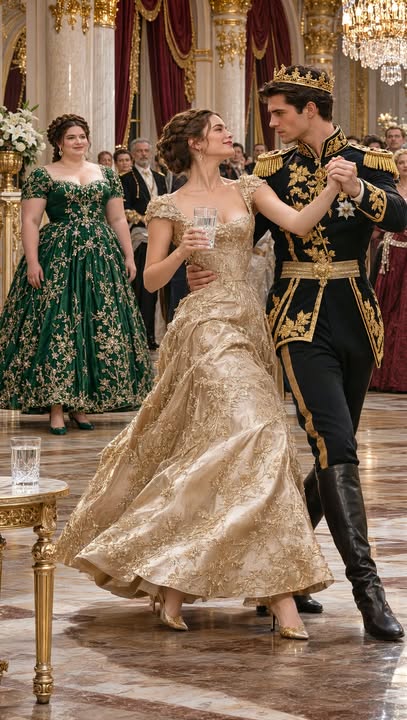
The conductor’s bow descended, and the orchestra swept us back into motion.
The prince did not give me time to settle.
He led us into a brisk traveling turn, then changed direction so suddenly that the water climbed the side of my glass.
I felt the tremor in my wrist.
I did not tighten it into a fist.
Instead, I let the movement travel through my shoulder and along my arm, keeping the glass level as his hand guided my back.
His steps were exact, but they were no longer merely elegant.
He was asking me to listen with my whole body.
The next sequence crossed the floor in a tight diagonal, followed by a pivot sharp enough to send my skirt whispering around my ankles.
I matched him, watching his shoulder, his center of balance, the small pressure of his fingers against my hand.
The water shivered.
It stayed in the glass.
“You’re making this harder,” I murmured.
“Would you prefer I make it easy?”
“No.”
The answer came out before I had time to polish it.
His eyes flicked to mine, and for the first time that evening, something like approval warmed his expression.
He drew me into another turn.
This one was faster, but not careless.
A partner who watched only his feet would have missed the change in his frame.
A partner who watched only his face might have mistaken the slight lift of his brow for a warning.
I felt the lead in his hand and moved with it.
The glass remained steady.
We reached the center of the ballroom, where the chandeliers laid a bright path across the marble.
The prince guided me through a sequence that seemed designed to pull my attention in three directions at once: a change of pace, a close turn, then a sudden pause.
I stopped with him.
A thin ripple crossed the water and vanished.
His fingers remained at my back for a beat longer than the pause required.
Then the music carried us onward.
His breathing had deepened.
So had mine.
Neither of us had given way.
At last the conductor brought the orchestra to a close.
The final note lingered beneath the high ceiling.
I lowered my arm carefully and looked into my glass.
The water was still there.
Not a drop had escaped.
The prince glanced at it, then at me.
“You read the lead,” he said.
“I listened.”
“Most people assume a lead is an instruction.”
“Most people miss the difference between being led and being dragged.”
His face changed, though only slightly.
A thoughtful stillness settled over him.
He took the glass from my hand and set it on a passing tray.
“Thank you,” he said.
The words were meant for the room, but his gaze remained on mine.
A court official stepped forward with a list of names and began announcing the contestants who would advance.
I heard my own name, followed by a polite murmur of applause.
The woman in champagne gold stood among the remaining guests, her hands clasped before her.
She did not look pleased.
She did not look angry, either.
Her expression was harder to read now that the prince had stopped dancing.
The announcement continued, and I found myself wishing there were somewhere to put my hands.
I had expected to compete.
I had not expected the strange quiet that followed a challenge, when the room seemed to be deciding what my success meant.
The prince offered his arm.
“Would you walk with me?”
It was not an order.
That made it harder to refuse.
I accepted his arm, and we crossed toward the open terrace doors while the orchestra resumed with a softer piece for the guests.
Cool night air brushed my face.
The terrace overlooked the palace gardens, where lanterns glowed among clipped hedges and pale winter roses.
For a moment, neither of us spoke.
Behind us, the ballroom continued its measured conversation.
“You could have made me spill,” I said at last.
“Yes.”
“Yet you didn’t.”
“I wanted to know whether you could respond when the pattern changed.”
“And if I couldn’t?”
“Then we would have learned that.”
I turned toward him.
“Is that how you approach everyone?”
“No.”
The answer was immediate.
He leaned lightly against the stone balustrade, keeping a respectful distance between us.
“I was told you were testing our balance,” I said.
“I was testing more than that.”
His candor unsettled me more than a polished excuse would have.
“What, exactly?”
He looked past the garden toward the dark line of trees beyond the palace grounds.
“The court expects me to choose a bride with political advantages in mind.”
I had known the selection was about marriage.
I had not expected him to say it as plainly as if he were discussing the weather.
“Family connections, influence, alliances,” he continued.
“Everyone has a careful list of what a suitable match might secure.”
“And you want to know whether someone can dance.”
“I want to know whether someone can meet me as an equal.”
The quiet in his voice made the words feel less like a confession than a truth he had carried for a long time.
I folded my hands in front of me.
“A dance can show you how someone moves under pressure.”
“Perhaps.”
“It can’t tell you whether she wants the life you’re offering.”
“No,” he said.
“Nor whether she wants you.”
His gaze returned to mine.
“That, too.”
There was no flattery in his expression, which I appreciated.
I had spent enough of my life watching people decide what my shape meant before they learned my name.
“You should know I didn’t come here to be rescued,” I said.
“I didn’t think you had.”
“Or displayed.”
“I didn’t think that, either.”
“I came to compete.”
“Then you did.”
His answer was simple, but it loosened something in my chest.
Most people would have tried to soften my words, turning them into an invitation to reassure me.
He did not.
“What would an equal look like to you?” I asked.
He considered the question rather than reaching for an easy response.
“Someone who can disagree with me without trying to win a favor.”
“That sounds useful in a wife.”
“It sounds useful in any person I trust.”
The last word rested between us.
Trust was too large a thing to claim after one dance.
Still, I liked that he had not called it affection.
“I wouldn’t want a marriage where my opinions were praised only when they matched yours,” I said.
“Nor would I.”
“Would the court agree?”
His mouth shifted in something that was not quite a smile.
“The court agrees with me when it suits the court.”
That earned a laugh from me, brief and unguarded.
For a moment, his face opened in response.
The prince seemed younger when he smiled, and less like the figure from the formal portraits that lined the palace corridors.
Then the ballroom door opened behind us.
A footman stepped onto the terrace and bowed.
“Your Highness, Lady Celeste is asking whether she may speak with you.”
The woman in gold.
I glanced at him.
“You should go.”
“I will.”
He paused, as if he wanted to say something else.
“Your name,” he said.
I gave it to him.
He repeated it once, carefully, without adding a title or looking toward the officials who had arranged the contest.
“I’ll remember.”
Before I could decide whether that mattered, he returned inside.
I stayed on the terrace for several breaths, letting the cold air cool the warmth in my cheeks.
When I reentered the ballroom, Lady Celeste was beside one of the tall windows.
Up close, the gold of her gown was softer than it had looked beneath the chandeliers, and a fine tremor had appeared in the hand she held against her skirt.
She noticed me looking and straightened.
“Your dance was beautiful,” she said.
The words sounded as if they had cost her something.
“Thank you.”
“I should apologize for what I said about your gown.”
I had not expected that.
She glanced toward the ballroom floor, where attendants were clearing the glasses.
“I thought I was being clever,” she said.
“I was being unkind.”
“Why did you say it?”
The question was sharper than I intended.
Her eyes lowered.
“My mother told me that if I wanted to be taken seriously, I had to make certain I was the one being noticed.”
She drew a quiet breath.
“She has spent most of my life telling me what a match with the prince could secure for our family.”
There was no triumph in her voice.
Only weariness.
“I’m sorry,” I said.
She looked up again, perhaps surprised that I had answered gently.
“I haven’t decided what I think of you yet,” I added.
A faint, rueful smile touched her face.
“That seems fair.”
“I don’t like being treated as if I’m a joke.”
“I understand.”
“Do you?”
Her gaze held mine.
“I think I do.”
For a moment, neither of us spoke.
Around us, the remaining contestants were being led toward a side chamber, where the next part of the selection would be explained.
Lady Celeste glanced toward them.
“I hope you advance,” she said.
It was not yet friendship.
But it was not the same as the sharp smile she had given me earlier.
“Thank you,” I replied.
A court secretary called for the contestants to gather.
I joined the others beneath a row of painted arches.
The prince stood at the far end of the room, speaking quietly with the elderly man who had been seated beside the judges’ table throughout the challenge.
The man was small and silver-haired, with a cane resting against his chair and a neatly folded handkerchief tucked into his breast pocket.
I had noticed him before because he watched the dancing differently from the rest of the court.
He did not look at the gowns.
He watched the feet.
When the prince leaned close to speak to him, the old man’s eyes sharpened with concern.
“Did you find the contestants’ old practice records?” the prince asked.
The question was low, but the room had gone quiet enough for me to hear it.
The tutor’s hand closed around the top of his cane.
“Not yet, Your Highness.”
“They should be in the archive box from the old program.”
“That box has not been opened in years.”
“Then perhaps it is time.”
The tutor’s gaze moved briefly across the room.
When it passed over me, it stopped.
Only for a heartbeat.
Then he looked back at the prince.
“Those records may not be what you need tonight,” he said.
The prince’s expression did not change, but something in his shoulders grew still.
“What do you mean?”
The tutor glanced toward the assembled contestants.
“Your Highness, the next round is ready to begin.”
He said it with such practiced ease that several officials turned toward the doors at once.
The prince held his gaze a moment longer.
Then he inclined his head.
The old man rose with care, one hand braced on his cane.
As he passed me, the faint scent of paper and cedar clung to his coat.
He did not speak.
Yet I was left with the feeling that I had not simply overheard a question.
I had heard the edge of an answer someone had spent years trying not to give.
The next round was not a dance.
A secretary led us into a smaller salon, where a long table had been set with cards bearing the names of charitable institutions.
The prince followed with the tutor, whose steps were slow but steady.
“Each of you will choose a cause,” the secretary announced, “and explain how you would use the palace’s support to strengthen it.”
The room shifted with quiet uncertainty.
I looked over the cards.
Hospitals. Orphanages. Veterans’ homes.
Then I found one near the end: the Royal Dance Schools Fund.
My fingers paused above it.
The tutor noticed.
“An interesting choice,” he said.
“Why?”
His eyes rested on the card, then moved to me.
“Because it has been dormant for some time.”
The prince was listening now.
“How long?” I asked.
The tutor’s hand tightened on his cane.
“Long enough that it will need more than a generous announcement.”
I picked up the card.
“Then I’d want to know why it stopped.”
A few contestants exchanged glances.
The prince did not.
“Would you restore it?” he asked.
“I’d visit the schools first.”
“And if the palace preferred a grand public launch?”
“I’d ask what the schools needed before deciding what would look impressive.”
The secretary’s pen hovered over his paper.
The prince’s expression had gone thoughtful again.
“Practical,” he said.
“Necessary.”
The tutor looked down at the card in my hand.
For an instant, his face seemed older than it had before.
Then the secretary called for the next contestant, and the moment passed.
We spoke in turn about education, housing, medical care, and the uses of royal patronage.
I listened as much as I answered.
Some candidates offered polished plans that sounded prepared for applause.
Others spoke from genuine experience.
Lady Celeste chose a hospital fund and described the work her family already supported.
She did not look at me while she spoke, but she did not use the moment to compete with me, either.
When the formal round ended, the court announced that the final selection would be made the following morning.
I had advanced.
So had Lady Celeste and three others.
A footman offered to escort me to the guest apartments.
Before I could follow, the prince came over.
“Your answer about the schools was sensible.”
“I meant it.”
“I assumed you did.”
He glanced toward the tutor, who was speaking with a secretary beside the table.
“Would you consider helping with a public event?” he asked.
“What sort of event?”
“A charity ball. The palace has been planning one for the spring.”
“Planning,” I repeated.
His mouth curved slightly.
“It has not yet been organized.”
“Then what would you want me to do?”
“Help decide what it should be.”
I considered him.
“Would I actually be allowed to disagree?”
“I would hope you would.”
“And if I said the palace was making the event about itself?”
“Then I would ask you to show me how to make it about the people it is meant to serve.”
That was a better answer than I expected.
Not a perfect one.
But a real one.
“I’ll think about it,” I said.
“Good.”
He did not press me.
Instead, he turned toward the tutor.
The old man had finished with the secretary and was gathering a small stack of papers.
One sheet slipped loose and drifted to the floor.
I bent to retrieve it before he could reach for it.
The paper was old, its edges softened with age.
A series of penciled marks ran across it in compact lines.
At the bottom, someone had written a count:
One, two, three—hold—five, six, turn.
The tutor took the page from my hand a little too quickly.
“An old rehearsal note,” he said.
The prince had gone still.
I recognized the count.
Not because I had seen the paper before.
Because I had felt it in the dance: the sudden pause, the shift of weight, the turn that had demanded I answer before I could think.
“Was that part of the challenge?” I asked.
“No,” the tutor said.
The prince’s gaze remained on the page.
“Where did this come from?”
The tutor folded it once, hiding the marks.
“An old performance.”
“What performance?”
The room around us continued to murmur, but the tutor’s face closed.
“One that was never completed.”
He placed the paper inside his coat.
Then, with a courteous nod, he left the salon.
The prince watched him go.
I looked at the closed door, hearing the count again beneath the music.
One, two, three—hold—five, six, turn.
“Your Highness,” I said, “why was the performance never completed?”
For a moment, I thought he might answer.
Instead, his eyes met mine.
“I don’t know,” he said.
Then he looked toward the door the tutor had taken.
“But I think he does.”
**–END OF PART 2–CLICK “NEXT” AT THE BOTTOM OF THE PAGE TO CONTINUE READING**
* * *
[NEXT: PART 3](https://echoesofstories.idolsgift.com/blog/part-3-the-count-beneath-the-music-046)
✓ Lynn R. Adams
The conductor’s bow descended, and the orchestra swept us back into motion. The prince did not give me time to settle. He led us into a brisk traveling turn, then changed direction so suddenly that …