PART 2: The Cord Beneath the Bandage 008
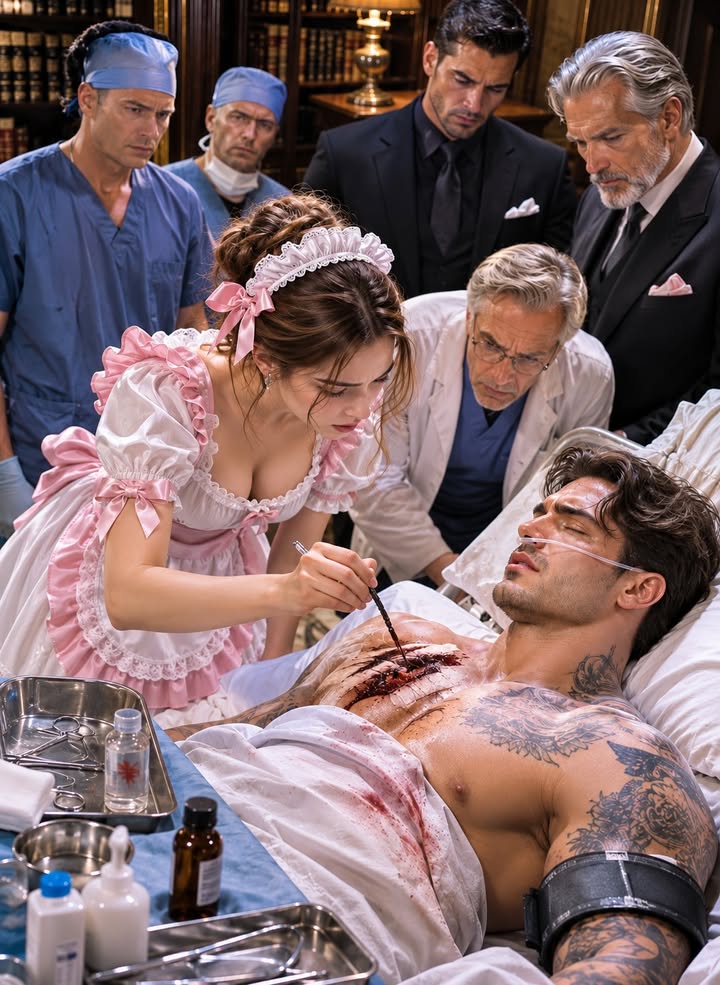
Part 2 – The Cord Beneath the Bandage
Dr. Pierce took one slow step toward me, but Daniel moved between us before he could speak.
“Wait,” Daniel said, his voice low and controlled.
The guards shifted, their attention moving from me to him, but Daniel kept his eyes on the wound.
“Let her explain what she saw.”
Dr. Pierce’s jaw tightened.
“We have a patient whose blood pressure is collapsing, not a seminar about sewing materials.”
“Then give her thirty seconds,” Daniel replied. “If she’s wrong, we continue.”
Victor’s gaze flicked from Daniel to me.
“She’s a maid,” he said, though there was less certainty in his voice now.
“I know what I am,” I managed to answer.
My fingers had gone numb around the yellow trash bag, and I set it down carefully before they could shake it open.
Dr. Pierce glanced at the monitors, then at the exposed shoulder.
“Thirty seconds,” he said. “And you do not touch him.”
I nodded.
The room seemed to narrow until all I could see was the dark material caught between swollen edges of tissue.
I had never seen anything like it inside a person, but I knew the pattern.
“Could you turn the surgical light a little?” I asked.
A nurse adjusted it, and the harsh beam moved across the wound.
The cord’s strands showed clearly now, twisted in a repeating diagonal that made small diamond shapes along its length.
“It’s braided line,” I said. “Not medical suture.”
Dr. Pierce gave a humorless breath.
“Many kinds of suture are braided.”
“This is thicker than any surgical thread I’ve ever seen, and the fibers aren’t even. Look at the way the outer strands lift.”
Daniel leaned toward the bed, careful not to cross the sterile field.
“Could it be something used to close the wound after the shooting?”
“I don’t know,” I said. “But it doesn’t look like something that belongs in an operating room.”
Dr. Pierce’s expression remained skeptical, but he did not dismiss me again.
He turned to the surgeon standing nearest him.
“Magnification.”
A nurse brought a surgical loupe, and Dr. Pierce bent over the wound.
For a long moment, no one spoke.
Then he eased back.
“She may be right about the material.”
The words changed the room more than any shout could have.
The surgeon reached for a pair of forceps.
“Don’t pull,” I said, then caught myself. “Please. If it’s caught in the tissue, you could tear more than you mean to.”
Dr. Pierce looked at me sharply.
“That is exactly why you’re not directing the procedure.”
“I’m not trying to,” I said. “I just know what my mother taught me about that kind of cord.”
The mention of my mother seemed to soften something in Daniel’s face.
He turned to the others.
“Can we pause the amputation decision long enough to collect a sample?”
Dr. Pierce studied the monitors again.
“His pressure is unstable, and the infection is spreading. We cannot afford to waste time.”
“I’m asking for a brief pause, not a delay without a plan,” Daniel said. “We need to know what’s in the wound before we remove an arm.”
Victor stepped closer to the bed.
“Adrian’s surgeon said there was no alternative.”
“Dr. Pierce is here now,” Daniel replied. “He can make that call after seeing what we’re seeing.”
The room filled with small sounds: the steady electronic pulse of the monitor, the rustle of gowns, a tray being shifted across a table.
Dr. Pierce glanced toward the surgeon who had treated Adrian after the shooting.
“Dr. Sloane, do you remember using anything other than standard closure material?”
Dr. Sloane’s expression stiffened.
“Of course not.”
“Then the sample should settle the question,” Dr. Pierce said.
He looked toward the nurse.
“Sterile collection kit. We’ll remove only what can be taken safely, preserve it, and send it for analysis.”
Nobody moved for a beat.
Then the room began to work again.
The doctors cleared a small area around Adrian’s shoulder, and Dr. Pierce carefully examined the exposed cord under the loupe.
He eased one short segment free without disturbing the surrounding tissue.
The material came away with a faint, dry scrape.
I smelled the sharp bitterness again.
It was faint beneath the antiseptic, but unmistakable.
Dr. Pierce placed the sample in a clear specimen container and sealed it.
“Label it with the time and location,” he instructed. “We need a lab to identify the fibers and test the residue.”
“Can the residue be causing the infection?” Daniel asked.
“Not necessarily,” Dr. Pierce said. “It may be an irritant, a contaminant, or neither. We don’t know yet.”
He looked at the cord through the clear container.
“What we do know is that it doesn’t belong in this wound.”
The answer was not enough to reassure me, but it was more than anyone had been willing to admit a few minutes earlier.
Dr. Pierce turned back to the team.
“Stabilize him, broaden the infection workup, and take cultures from the wound. No amputation until we have a clearer picture, unless his condition leaves us no choice.”
Victor let out a slow breath.
“You’re postponing the surgery?”
“Postponing the decision,” Dr. Pierce corrected. “If Adrian becomes unstable, we may have to act quickly. But removing his arm before understanding what we found could cost him a limb without treating the cause.”
Daniel shut his eyes for the briefest moment.
When he opened them, he looked at Adrian rather than at any of us.
“Thank you,” he said.
Dr. Pierce nodded, already turning back to the monitors.
The room returned to motion, but it no longer felt as if everyone was moving toward one irreversible act.
They adjusted Adrian’s medication and began preparing him for another round of tests.
A nurse replaced the dressing, leaving the sample container on a separate tray where it could not be confused with anything else.
I stepped back to the wall, my legs unsteady beneath me.
The yellow trash bag lay where I had set it down.
The job I’d been assigned still waited, ordinary and ridiculous beside the bed where a man’s life had nearly been decided by a single missing detail.
Daniel came to stand beside me.
“You recognized the braid immediately,” he said.
“My mother taught me.”
“You’re sure it’s the same kind?”
“I’m sure it’s the same construction. I can’t tell you what it was coated with or where it came from.”
“That distinction matters,” he said.
He spoke quietly, not as if he were questioning me but as if he wanted the room to understand the limits of what I knew.
That made me trust him a little.
Dr. Pierce overheard and walked over, stripping off his gloves.
“Mara, I owe you an apology,” he said.
The admission seemed to surprise him as much as it surprised me.
“I should have listened before dismissing you.”
I glanced toward the specimen container.
“Will the test tell you if it caused the infection?”
“It may tell us what the material is and whether the coating is harmful,” he replied. “It cannot answer every question. The infection could have entered through the original wound, through a later procedure, or from another source.”
“So you don’t know yet.”
“No,” he said. “We don’t.”
His honesty settled more gently than reassurance would have.
“Could the material have been there from the beginning?” I asked.
Dr. Sloane, the original surgeon, was removing his gloves nearby.
“The wound was cleaned and closed with medical sutures,” he said. “There was nothing like this in it.”
His tone was firm, but his eyes had gone to the sample container.
“You’re certain?” Daniel asked.
“I am certain I used sterile surgical material.”
“Could a fragment have been introduced afterward?”
Dr. Sloane’s mouth tightened.
“I can’t explain how it got there.”
That answer left the silence between them heavier than before.
Victor folded his arms.
“This is not proof that anyone did anything deliberately,” he said. “A fragment could have been caught in a dressing or carried in by accident.”
“It could have,” Dr. Pierce agreed. “We won’t know until we test it and review the sequence of care.”
For the first time, Victor seemed relieved to hear a doctor say there was still uncertainty.
I looked again at Adrian.
His face was pale beneath the surgical lights, and his right hand rested open on the blanket.
I had seen him across the mansion before, always surrounded by people who seemed to anticipate his needs before he spoke.
He had never spoken to me for more than a sentence at a time.
I knew he paid our wages on time and insisted the kitchen staff receive the same holiday bonus as the household managers.
I also knew no one in the house talked about him as a person.
They talked about what he controlled, who he trusted, what he might order.
Now he was unconscious, and the doctors were deciding which parts of his future could still be saved.
The monitors continued their steady rhythm, but the numbers did not improve as quickly as I wanted.
A nurse lowered her voice as she spoke to Dr. Pierce about Adrian’s fever.
The team continued treatment without rushing to the amputation table.
Daniel stayed near the bed, reading each change in the monitor as if he could hold Adrian steady by paying attention.
Victor remained at the foot of the bed.
He had promised Adrian’s father he would protect him.
The promise sounded sincere.
That was what made the uncertainty harder to bear.
After the last sample had been collected, Dr. Pierce turned to me.
“You said your mother worked with marine material?”
“She repaired canvas and straps. Mostly for boatyards and cargo companies.”
“Could you identify the cord more specifically if you saw it outside the wound?”
“Maybe. I’d need to see the full length and know what I was looking at.”
“Would you be willing to do that if we find another piece?”
I looked at Daniel, then at the sealed specimen.
“If it helps you figure out what happened, yes.”
“Only if you’re comfortable,” Daniel said.
The way he said it surprised me.
In the mansion, people generally told me what they needed and expected me to do it.
Nobody had asked whether I was comfortable.
“I am,” I said.
Dr. Pierce nodded.
“We’ll call if the lab needs your help.”
He returned to the other doctors, and I bent to pick up the trash bag.
Daniel stopped me.
“You don’t need to clean that up now.”
“It’s my job.”
“Not in here. Not tonight.”
“I don’t want to get in anyone’s way.”
“You already helped,” he said. “Let someone else take the bag.”
For a moment I did not know what to do with my hands.
Then one of the nurses took it from me and carried it through the side door.
I watched it disappear.
It felt strange to stand in the library without being useful.
I had spent nine months learning the mansion’s rhythms: which rooms needed sweeping before dawn, which doors were left unlocked for the kitchen staff, which visitors expected not to be noticed.
I had learned that being invisible could protect me.
Tonight, visibility had frightened me more than invisibility ever had.
Victor approached after Dr. Pierce had moved away.
“You said your mother taught you to recognize this cord,” he said.
“Yes.”
“How long did she work with it?”
“Most of her life.”
“Did she ever bring it home?”
“Not usually. The work materials belonged to the companies she repaired things for.”
Victor nodded, though his gaze lingered on me.
“My sister—Adrian’s mother—used to talk about how difficult industrial repairs were. She said people who knew those materials could recognize a defect before anyone else.”
I had never heard Victor mention Adrian’s mother before.
“Your mother must have been very good at her work,” he added.
“She was.”
My answer came out harder than I intended.
His expression changed.
“I’m sorry,” he said. “I didn’t mean to pry.”
The apology was unexpected.
I lowered my eyes.
“She’s been gone for two years.”
“I know,” Daniel said from beside the bed.
I turned toward him.
He looked as if he wished he had not spoken, but he did not take the words back.
“What do you mean, you know?”
Daniel stepped away from Adrian’s bedside and lowered his voice.
“I knew she was ill. Adrian knew, too.”
My chest tightened.
“How?”
“Your mother’s medical bills came through a local clinic connected to a charity fund. Adrian asked me to make sure she received help without putting his name on it.”
I stared at him, waiting for the rest.
“He paid for her treatment?” I asked.
“Some of it,” Daniel said. “More than once.”
The room seemed to tilt slightly beneath my feet.
“No,” I said, though I had no reason to doubt him. “Someone from the clinic must have—”
“Your mother never knew who covered the remaining balance. That was the point.”
I remembered the hospital billing office calling to tell us that an anonymous donor had made a payment.
I remembered my mother’s relief, followed by her suspicion that it was a mistake.
She had sat at our kitchen table with the letter in both hands, trying to decide whether hope was safe.
I had assumed it was a small community grant.
I had never imagined Adrian Vale.
“Why didn’t he tell me?” I asked.
“He didn’t want gratitude to become a debt,” Daniel said. “He said you should never feel you owed him because he helped your mother.”
The words landed with an ache I could not name.
For months I had cleaned Adrian’s home and walked past the doors to his private rooms without understanding that he had once reached into our small apartment’s hardest days.
I felt gratitude, certainly.
But beneath it was anger at the secrecy, grief for the time my mother had spent wondering who had helped us, and something like shame for having judged him without knowing.
“Did he tell you not to mention it?” I asked.
“Yes.”
“And you kept it from me.”
“I did.”
His answer held no defense.
“Why tell me now?”
“Because you deserve to know the truth before someone else turns your connection to this family into a reason to distrust you.”
I searched his face.
“Are you saying someone might accuse me?”
“I’m saying people are frightened, and frightened people look for a simple explanation.”
His gaze moved toward the sealed container.
“You recognized the material before anyone else did. That makes you useful, but it may also make some people suspicious.”
The thought had already begun to form in my mind.
I was the only person in the room who had known what the cord was.
I was the maid who had handled the bandages.
I had stood close enough to Adrian’s wound to notice the thread.
To anyone who wanted an easy answer, those facts could be rearranged until they sounded like evidence.
“I didn’t put it there,” I said.
“I know.”
“You can’t know that.”
“I know what I’ve seen from you,” Daniel replied. “And I know that Adrian would have wanted me to listen.”
The monitor chimed softly behind us.
Dr. Pierce leaned over it, then called for a medication adjustment.
The motion pulled all of us back to the moment.
“Can he survive without the amputation?” I asked.
“Dr. Pierce has to answer that,” Daniel said. “Right now, he’s being stabilized. The infection has not been solved, but they have more information than they had an hour ago.”
More information was a small thing.
It was also the first thing that had moved the night away from certainty.
Victor stepped closer, his voice quiet.
“You helped keep him from losing his arm without a clear diagnosis.”
“I only pointed out what I saw.”
“Sometimes that’s what help looks like,” he said.
I could not tell whether he meant it as kindness or reassurance, and I did not ask.
The doctors transferred Adrian to a private recovery room connected to the library.
They did not move him far, and they kept the medical equipment running as they went.
Dr. Pierce said the next few hours would be critical.
He promised to contact a laboratory with the specimen as soon as possible.
Daniel followed the team out, then returned to the library to speak with the security staff.
Before he left, he asked me to wait in the small sitting room next door.
I sat beneath a framed painting of a harbor at dusk, listening to the house settle around the quiet urgency.
Beyond the door, the low murmur of doctors continued.
My phone vibrated in my pocket.
A message from my landlord lit the screen: Please call me in the morning about the balance.
I turned the phone facedown.
For one brief moment, I let myself think of my mother at our kitchen table, the anonymous payment letter between her hands.
She had smiled that night, even though she was tired.
“Somebody remembered us,” she had said.
I had thought she meant the clinic.
Perhaps she had been right in a way neither of us understood.
The door opened, and Daniel came back in.
“Dr. Pierce wants to review the timeline with anyone who was near the room when Adrian’s dressings were changed,” he said. “You can leave if you’d rather not be part of it.”
“I’ll stay.”
“Thank you.”
He pulled a chair across from me, keeping a respectful distance.
“Do you remember seeing anything unusual before tonight?”
I closed my eyes and tried to revisit the past twelve days.
“I cleaned the hallway outside the recovery room twice. I never went in while they were treating him.”
“Did you handle the dressings?”
“Only the used ones after the nurses removed them. I was told not to touch anything else.”
“Did you ever notice that smell before?”
I thought of the first evening the doctors had come to the mansion.
A sharp, bitter odor had drifted from the library into the hall, but antiseptic had been used everywhere.
“Maybe,” I said. “I can’t be certain.”
“That’s all right.”
He took out a small notebook and wrote down what I could remember.
There was nothing dramatic in the questions.
No accusation, no raised voice, no attempt to make my uncertainty sound like guilt.
That quiet care made it easier to speak honestly.
When we were done, Daniel closed the notebook.
“Thank you for telling us what you know, and for saying when you don’t know.”
I looked at him.
“Does Adrian treat you that way?”
Daniel’s expression softened.
“He tries.”
“What does that mean?”
“It means he can be difficult. He’s used to making decisions alone, and he doesn’t always understand how much his silence weighs on other people.”
“Yet he helped my mother without telling me.”
“He thought keeping it secret would protect your independence.”
I looked down at my hands.
“Maybe he should have let her decide what to do with the help.”
“Maybe,” Daniel said.
He did not rush to defend Adrian.
For that, I trusted him more.
A moment later, Dr. Pierce entered, his tired eyes settling on us.
“He’s more stable,” he said. “Not safe, but stable enough for now.”
I let out a breath I had been holding too long.
“The sample is going to the lab,” Dr. Pierce continued. “We won’t have a complete answer tonight, and we still have to understand how the material got there.”
Daniel stood.
“Who had access to the wound supplies?”
“That’s part of the review,” Dr. Pierce said. “We’ll speak to the medical staff and check the records.”
Victor appeared in the doorway.
“Adrian’s first surgeon was selected by Adrian himself,” he said. “He’s treated this family for years. I see no reason to cast suspicion on him.”
Dr. Pierce did not answer immediately.
“Trust and evidence are not opposites,” he said at last. “If the material was introduced during care, we have to find out when and how.”
Victor’s face tightened, but he nodded.
“I only want us to be careful.”
“So do I,” Daniel replied.
The room fell quiet again, though not with the same helpless stillness as before.
The amputation had been postponed, the sample was on its way to a lab, and Adrian was still fighting.
Nothing had been solved.
But now the mystery had a shape.
Dr. Pierce glanced toward the recovery room.
“I’ll update you when we know more.”
After he left, I stood by the door, uncertain whether I should return to my work or remain close in case they needed me.
Daniel answered the question without making me ask it.
“Go home and try to rest. We can reach you if the lab needs your help.”
“I don’t know if I’ll sleep.”
“You don’t have to sleep to rest.”
I almost smiled.
The advice sounded like something my mother might have said.
As I turned to leave, a nurse hurried into the library carrying a small tray.
“Dr. Pierce,” she called. “We found this in the outer dressing.”
He returned from the corridor.
“What is it?”
The nurse lifted a clear evidence sleeve.
Inside lay a short, frayed piece of dark cord, no longer than my little finger.
Its cut end was clean, its braided pattern unmistakable.
I leaned closer, and the bitter odor rose from it again.
Dr. Pierce’s expression changed.
“Where exactly did you find this?”
“Caught in the lining of the medical supply case,” the nurse said. “The case came with the materials from the first procedure.”
Victor’s face had gone pale.
He stared at the small piece of cord as though he recognized it.
Then his eyes met mine.
“That case came from the warehouse,” he said.
**–END OF PART 2–CLICK “NEXT” AT THE BOTTOM OF THE PAGE TO CONTINUE READING**
* * *
[NEXT: PART 3](https://puretales.idolsgift.com/blog/part-3-the-cord-beneath-the-bandage-008)
✓ Lynn R. Adams
Part 2 – The Cord Beneath the Bandage Dr. Pierce took one slow step toward me, but Daniel moved between us before he could speak. “Wait,” Daniel said, his voice low and controlled. The guards shift…