PART 2: The Child on the Stairs 029
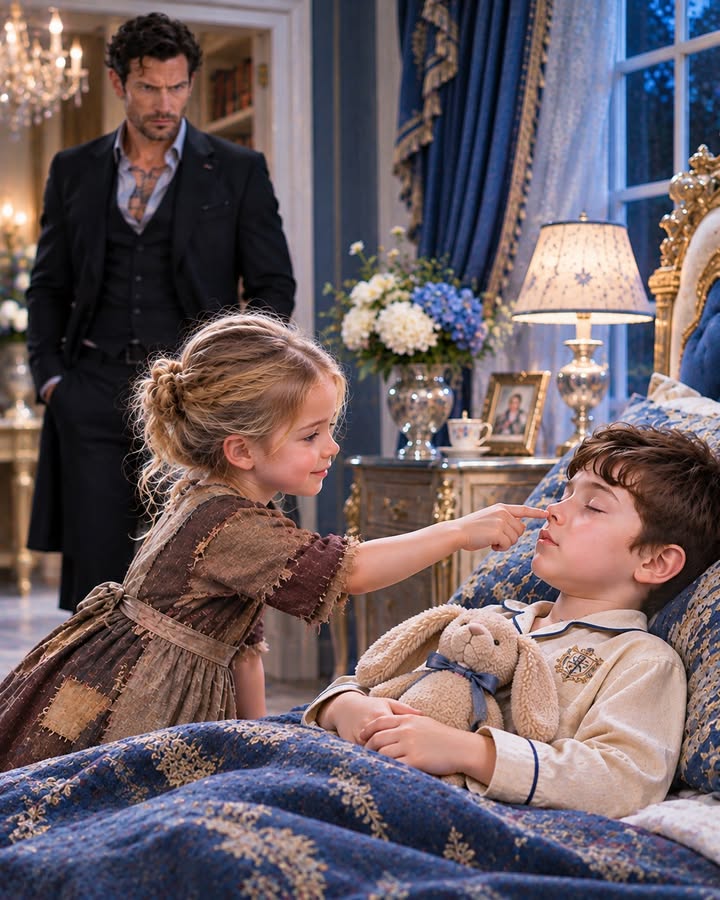
Part 2 – The Child on the Stairs
The footsteps stopped behind me, so softly I almost mistook them for the house settling.
Then Captain’s glassy black eyes caught a small reflection in the doorway.
I turned.
A little girl stood on the landing, one hand gripping the banister and the other clutching a picture book against her chest.
She wore a yellow cardigan that was too large for her and had a smudge of dust across one cheek.
For a moment, none of us spoke.
The guards were supposed to keep the third floor empty of everyone except family, doctors, and the nurses assigned to Lucas.
The girl looked at me as if she understood that she had broken a rule, but not why the rule mattered.
“Who are you?” I asked.
My voice came out harder than I meant it to.
She glanced toward Lucas, then back at me.
“Maya,” she whispered.
I knew the name.
Elena, our longtime housekeeper, had a daughter who sometimes waited for her after school in the staff quarters, though I had never met her properly.
“Where is your mother?”
“Downstairs,” Maya said. “She’s working.”
“And how did you get up here?”
Her fingers tightened around the book.
“I came to see Lucas.”
Behind me, the monitor continued its steady, patient beeping.
Lucas had heard her.
His head shifted on the pillow, and his eyes opened with the careful effort of someone who had learned not to waste strength.
“Maya,” he said.
It was the first time that evening I had heard him speak without prompting.
The name had warmth in it.
That warmth unsettled me more than his silence had.
I looked from my son to the girl.
“How long have you been coming here?”
Maya lowered her eyes.
“I’m sorry.”
“That isn’t an answer.”
She swallowed, then said, “A few weeks.”
The words landed with more force than they should have.
A few weeks.
My house was surrounded by cameras, guards, and locked doors, yet a child had been slipping through it unnoticed to visit my son.
I should have been angry.
Instead, I looked at Lucas and saw that his face had changed.
Not much.
Just enough to make him look less like a patient and more like a six-year-old who had been waiting for someone.
“Do you want her to stay?” I asked him.
Lucas looked at me as if the question itself were a surprise.
Then he nodded.
It was a small movement, but he gave it all the certainty he could manage.
Maya took one step into the room.
I moved aside.
She walked to the chair beside his bed and placed the book on her lap.
The cover showed a bright blue sea and a small boat with a red sail.
“I brought the one with the lighthouse,” she said.
Lucas’s fingers shifted against the blanket.
“You already read it,” I said.
“I know,” Maya answered. “He likes it.”
The casual certainty in her voice made me feel like a stranger in my own son’s room.
I sat back down, though I could not remember deciding to.
Maya opened the book and began to read.
She did not use a practiced storyteller’s voice.
She stumbled over a word, went back to fix it, and paused to study the pictures.
But Lucas watched her with quiet attention.
When the little boat found its way home by following the lighthouse beam, Lucas’s mouth softened into something almost like a smile.
I had spent years learning how to negotiate with men who carried knives and how to silence rooms full of people with a glance.
I had never learned how to make my son smile.
Maya turned the last page.
“Do you want me to read it again?” she asked.
Lucas shook his head.
“Maybe tomorrow,” she said.
He looked toward the notebook under his hand.
Maya noticed.
“Did you write something?”
Lucas hesitated.
I saw his fingers curl protectively around the little book.
“It’s private,” he said.
“Okay,” Maya replied at once.
No coaxing.
No demand to see.
She simply closed the picture book and rested it on her knees.
Something in Lucas eased.
I understood then that he had not been hiding the notebook because he was ashamed of his handwriting.
He was hiding it because it belonged to him.
The thought shamed me.
For months, every part of his life had been examined by doctors, measured by machines, and discussed in front of him as if he were not in the room.
Even his fear had become a symptom to manage.
I had let it happen because I believed that money and expertise could protect him.
“Your mother knows you’re here?” I asked Maya.
“Sometimes.”
“Sometimes?”
She looked at Lucas, as if asking whether he wanted her to explain.
He gave the smallest nod.
“Mom knows I go to the laundry corridor,” Maya said. “She doesn’t know I come all the way upstairs.”
“Why the laundry corridor?”
“It’s quiet there,” she said. “And the doors are usually open when the carts come through.”
I glanced toward the hallway.
The laundry corridor ran behind the east wing, a narrow passage used by staff to move linens and supplies without crossing the formal rooms.
It was an old part of the house, with a service stair hidden behind a paneled door.
I had walked past that door hundreds of times.
Apparently, Maya had found it more useful than I had.
“Who lets you through?”
“No one,” she said. “I wait until the laundry cart goes by, then I follow it.”
“That’s not safe.”
“I know,” she murmured.
Her cheeks reddened.
For a moment I saw Elena in her face, the same careful expression she wore when she was trying not to take up too much space.
I stood.
Maya’s shoulders tensed.
Lucas’s hand slid beneath the blanket.
I noticed both reactions, and the sight made me stop.
“I’m not sending you away,” I said.
Maya watched me warily.
“I only want to understand.”
She nodded, but did not seem convinced.
I could not blame her.
The door opened behind us, and Elena hurried in, still wearing her cleaning apron.
Her eyes moved from me to Maya, then to Lucas.
“I’m sorry, Mr. Duca,” she said. “I didn’t know she’d come up here.”
Maya started to speak, but Elena lifted a hand gently.
“Your mother is responsible for you,” I said, though I heard the unfairness in my own voice.
Elena’s face tightened.
“Yes, sir.”
Maya climbed down from the chair.
“I’ll go.”
Lucas looked at her.
The monitor kept beeping, but his face had gone still again.
I watched the change happen and felt something inside me give way.
“Not yet,” I said.
Elena blinked.
“Mr. Duca?”
“Let her finish her visit.”
Maya glanced at her mother.
Elena looked uncertain, then at Lucas, whose attention had fixed on the book.
“Only a little longer,” she said.
Maya sat again.
Elena stayed near the door, her hands folded over her apron.
I could see she was trying to judge what kind of man I would be in this moment.
I had never thought of myself as a man who needed to be judged by a housekeeper.
Perhaps that was another thing I had misunderstood.
“Why didn’t you tell me she was visiting?” I asked Elena.
“I didn’t know she was,” she said. “Not until tonight.”
Her voice was quiet, but there was no evasion in it.
I believed her.
The realization made me look again at the security camera above the hall.
It had a blind spot near the old service door.
I had ordered the system installed after Isabella died.
I had never checked whether it watched the places that mattered.
Lucas coughed, a dry little sound.
Elena stepped forward at once, but Maya was already reaching for the water glass.
She held it while Lucas drank through the straw, patient and steady.
When he finished, she set the glass down exactly where it had been.
“You know how to do that?” I asked.
“I’ve seen the nurses,” she said. “I don’t do anything unless Lucas asks.”
It was a simple answer.
It told me more about care than half the consultations I had paid for.
Maya returned the book to her lap.
Lucas stared at the cover.
“Do you want to hear about the lighthouse again?” she asked.
He shook his head, then seemed to reconsider.
“Not the whole thing.”
“Just the part with the storm?”
He nodded.
She found the page and began to read.
I listened, though my thoughts kept returning to the notebook beneath Lucas’s hand.
When Maya reached the storm, she paused.
“What does the boat do?” she asked.
“It keeps going,” Lucas said.
“And what does the lighthouse do?”
“It stays.”
Maya glanced at him.
“Then the boat knows where to go.”
Lucas looked away.
The words stayed in the room after the story moved on.
When Maya finished, Elena told her it was time to leave.
This time Lucas did not protest.
Maya closed the book and leaned toward him.
“I’ll bring another one tomorrow,” she said.
“Maybe,” Lucas whispered.
“I’ll bring two, so you can choose.”
A faint smile touched his face.
Maya stood and walked to the doorway.
Before she left, she looked at me.
“Can I come back?”
The answer should have been no.
Not because I wanted to punish her, but because every door in my home had rules, and every rule had been made to keep danger out.
But my son had been alone in a room full of people for too long.
“You can come back,” I said. “With your mother’s permission, and by the front hall.”
Maya nodded.
“I can do that.”
Elena led her toward the stairs.
At the threshold, Maya turned back once.
Lucas lifted two fingers from the blanket.
She lifted her hand in return.
When the door shut, the room seemed to empty all at once.
I expected Lucas to close his eyes.
Instead, he reached for the notebook.
“Can I read what you wrote?” I asked.
His hand tightened over it.
“Why?”
The question had no defiance in it.
Only caution.
“Because I want to understand.”
He studied me.
“Will you be mad?”
“No.”
“Will you call the doctor?”
I paused.
“I don’t know yet.”
His expression changed, and I realized that my answer had frightened him more than a lie would have.
I reached for the chair and moved it closer to the bed.
“I won’t do anything without listening to you first,” I said.
Lucas kept his hand on the notebook for several long seconds.
Then he let go.
I opened to the page he had been writing on.
Today my tummy hurt less.
Below it, in uneven green letters, he had added another line.
I don’t know when I will get well.
“I’m sorry,” I said.
Lucas frowned.
“For what?”
“For not asking you how you feel.”
“You ask the doctors.”
“I know.”
“They ask me too.”
“But they ask because they need to write it down.”
He looked at the notebook.
“I write it down because I want to remember.”
I turned the page carefully.
There were small notes scattered through the notebook, some only a few words long.
My head hurt after breakfast.
My hands shook today.
I felt better when Maya came.
The last sentence made my throat close.
“Does your stomach hurt every day?” I asked.
“Not every day.”
“Do you know when it starts?”
Lucas glanced toward the shelves, where the medicine bottles stood in neat rows.
“Sometimes after I eat.”
I waited.
He looked at me and corrected himself.
“Sometimes after medicine.”
The words landed between us.
I felt the old instinct rise at once: summon the doctors, demand an explanation, find the person who had failed my son and make sure it never happened again.
But Lucas was watching me.
He seemed to be waiting to see whether I would hear him or turn his words into another medical report.
“Which medicine?” I asked.
“I don’t know.”
“Can you show me?”
His eyes moved to the bottles.
“I’m not supposed to touch them.”
“You won’t,” I said. “We can look together.”
He hesitated.
Then he pointed to a small amber bottle beside the lamp.
“That one makes my tummy hurt.”
I read the label.
The name was unfamiliar, though I recognized the dosage and the prescribing clinic.
I had never studied the bottles closely.
I had trusted the people who placed them there.
“Did you tell Dr. Voss?”
Lucas pulled the blanket up to his chest.
“He said it was probably the food.”
“And the other doctors?”
“They say it’s my sickness.”
His voice was small, but the words carried the weight of a child who had learned not to repeat himself.
“Why didn’t you tell me?”
Lucas looked down at the notebook.
“I did.”
“When?”
“Before.”
I searched my memory and found only rushed conversations in which I had asked if he had taken his medicine, if he had eaten, if he needed anything.
He had said yes or no.
I had accepted the answers and returned to the calls waiting on my phone.
“I’m sorry,” I said again.
Lucas rubbed the edge of the page with his thumb.
“I thought maybe you didn’t hear.”
I had heard him.
I had simply been listening for information I could act on, not for the child trying to tell me how it felt to live in his body.
I closed the notebook and placed it back in his hands.
“Thank you for telling me now.”
“Are you going to stop the medicine?”
“I’m not going to change anything without a doctor who can explain what’s safe.”
He looked worried.
“But I will make sure someone listens to you.”
He considered that.
Then he nodded once.
For the first time since I had entered the room, I stayed without checking the time.
I stayed while the nurse adjusted the monitor.
I stayed while Lucas asked for water.
I stayed through a silence that no one tried to fill.
Later, Elena returned to say Maya was waiting downstairs.
She had brought a second book, she explained, and had left it with the maid near the front hall.
I thanked her.
The words sounded unfamiliar in my mouth, and Elena seemed startled by them.
She said good night and went back to her work.
I remained beside Lucas until his eyelids grew heavy.
Before he fell asleep, he reached for Captain.
I helped position the bear beneath his arm.
“Will Maya come tomorrow?” he murmured.
“If your mother agrees.”
“And if you say yes?”
“I’ll say yes.”
Lucas seemed satisfied.
He curled toward the bear, the notebook tucked safely beneath his pillow.
The machine kept its rhythm beside him.
For once, I did not hear it as a countdown.
I heard a small, steady sound that meant he was still here.
The next morning, I called Dr. Voss before leaving my study.
He was our family physician, trusted by three generations of Ducas and familiar with every specialist who had come through the estate.
He answered on the second ring.
“Lorenzo,” he said. “How is Lucas today?”
“I want to review his medications.”
There was a brief silence.
“Of course,” Voss replied. “Has something changed?”
“Lucas says one of them makes his stomach hurt.”
“That can happen with several of his prescriptions,” he said smoothly. “It may be a side effect, but we should be careful not to draw conclusions from one observation.”
“I’m not drawing a conclusion.”
“Good. I’ll come by this afternoon and go over everything with you.”
His response was reasonable.
So was the caution in it.
Still, I looked through the glass wall of my study toward the corridor where Lucas’s room waited.
“I’d like a written list of every medication and every recent adjustment,” I said.
“Certainly.”
“And I want the dose times included.”
“Of course.”
When I ended the call, I kept my hand on the phone.
I was not ready to accuse anyone.
I was not ready to trust my instincts either.
At noon, Maya came through the front hall with her mother.
She carried two books, just as promised.
Lucas chose the one about a small fox who had lost his way in the snow.
I listened from the chair beside the window while Maya read.
At one point, Lucas interrupted to say the fox should follow the stars.
Maya said stars were too far away to help.
Lucas said they had helped sailors for a long time.
Maya thought about it and conceded that he might be right.
Their argument was gentle, and for a few minutes the room belonged to them.
I watched my son lean toward the page.
His cheeks were still pale.
The tubes and wires remained.
Nothing about his illness had changed.
Yet he was no longer alone inside it.
When Maya left, Lucas asked me to keep the book on the bedside table.
I placed it beside Captain and the notebook.
Then I looked again at the amber bottle.
The label caught the afternoon light.
For the first time, I noticed that its paper was brighter than the labels on the other bottles, and its edge sat unevenly against the glass.
Lucas followed my gaze.
“That one,” he whispered.
I reached for the bottle, but did not open it.
“What about it?”
“It didn’t look like that before.”
His eyes shifted toward the hall.
“Before when?”
“Before the new doctor came.”
The words were barely audible.
I set the bottle back on the shelf with care.
And for the first time, I wondered not only whether the medicine was making my son sick, but who had changed the label.
**–END OF PART 2–CLICK “NEXT” AT THE BOTTOM OF THE PAGE TO CONTINUE READING**
* * *
[NEXT: PART 3](https://puretales.idolsgift.com/blog/part-3-the-child-on-the-stairs-029)
✓ Lynn R. Adams
Part 2 – The Child on the Stairs The footsteps stopped behind me, so softly I almost mistook them for the house settling. Then Captain’s glassy black eyes caught a small reflection in the doorway. …