PART 2: The Chamber’s True Purpose 041
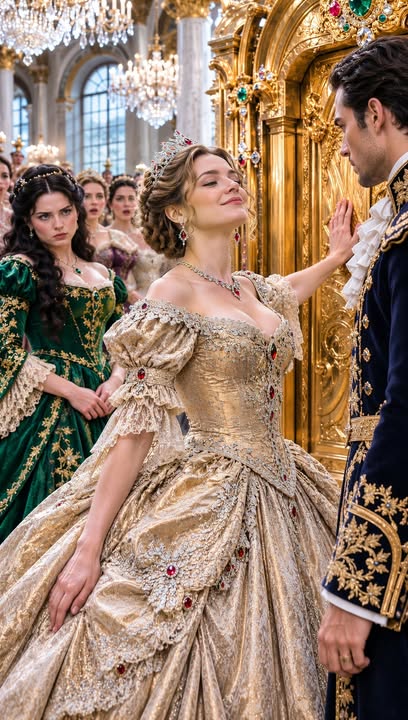
“Your Highness, if Lady Clara enters that chamber, the truth we have concealed for twenty years may finally be revealed!”
The chancellor’s words seemed to still the entire ballroom.
Even the musicians had stopped, their bows suspended above the strings.
I lowered my hand from the inscription, though I had not yet touched it.
Prince Adrian’s expression had changed from doubt to something more guarded.
“What truth?” he asked.
Lord Edric glanced at the watching courtiers, then at the chamber, its golden surface reflecting the chandeliers in a hundred wavering lights.
“Not here, Your Highness.”
Lady Victoria had paused at the ballroom doors, her face no longer flushed with triumph or anger, but pale with curiosity.
The other guests had fallen quiet, and I felt their attention gathering around me like an invisible cloak.
Adrian turned to the assembled court.
“The testing is over for tonight,” he announced.
A murmur rose at once.
“Your Highness,” Lady Victoria began, “surely you don’t intend to let this—”
“I intend to hear the chancellor,” Adrian said, his voice calm but unmistakably firm.
He did not look toward me as he spoke, and I wondered whether that was kindness or simply a way to keep the court from noticing how closely he was watching me.
Two guards approached the chamber.
“Seal it,” Adrian instructed. “No one is to enter, touch, or examine it until I have spoken with Lord Edric.”
The chancellor bowed, visibly relieved, though the lines at the corners of his mouth remained drawn tight.
As the guards moved into position, I felt an odd disappointment stir beneath my fear.
I had wanted to understand the inscription, to know why those words had appeared in a manuscript I had studied in my father’s library.
Now the chamber was being closed against me before I could learn anything.
“Lady Clara,” Adrian said.
His voice held a note of uncertainty I had not heard before.
“Would you accompany us?”
The invitation surprised me enough that I nearly looked behind myself to see whether he meant someone else.
“If I am permitted to ask questions,” I replied.
A faint, unexpected smile touched his mouth.
“I would be disappointed if you did not.”
We left the ballroom by a narrow passage behind the musicians’ gallery.
The court’s whispers followed us only as far as the heavy doors, where they faded into the muffled warmth of the celebration we had left behind.
Lord Edric led the way, one hand resting on the carved head of his cane.
Adrian walked beside him, while I followed a few steps behind, acutely aware of the distance between my worn slippers and their polished shoes.
The passage opened into a small council room lined with dark oak panels and high windows.
Rain traced fine silver lines down the glass.
A fire burned low in the hearth, offering more light than warmth.
Lord Edric waited until the door had been closed.
Then he looked at me.
“I owe you an apology, Lady Clara.”
“For stopping me?”
“For making your presence appear dangerous before I explained why.”
The apology was so direct that I did not know what to do with it.
“I was not certain I wanted to enter,” I said. “But I would have preferred to make that choice for myself.”
“As you should have.”
The chancellor folded his hands over the head of his cane.
Prince Adrian remained standing near the window, his shoulders held stiffly beneath his uniform.
“You said the chamber could reveal a secret hidden for twenty years,” he said. “Tell us what it is.”
Edric’s gaze lowered to the fire.
“The chamber was never built to judge beauty.”
I stared at him.
“Then why has every young woman at court been asked to stand before it?”
“That was a mistake,” he said quietly. “An old misunderstanding that became a tradition because too many people found it convenient.”
The prince’s brows drew together.
“Convenient for whom?”
“For those who hoped a strange device could answer a question no one wished to ask honestly.”
The fire shifted, and a small flurry of sparks rose through the grate.
Edric continued.
“The chamber was made during the reign of King Alistair, when the kingdom was still young and its succession uncertain. It was designed to recognize the bearer of an ancient royal vow.”
“What vow?” Adrian asked.
“That is the part I cannot yet explain.”
The chancellor’s answer unsettled me more than an outright refusal would have.
“You know enough to fear the chamber,” I said, “but not enough to tell us what it recognizes.”
“I know that its purpose has been misunderstood,” Edric replied. “And I know that some people at court would use the truth for their own advantage.”
“Some people,” Adrian repeated. “Or you?”
Edric looked up sharply, but there was no anger in his face.
“Perhaps I have been too cautious, Your Highness.”
“That is not an answer.”
“No.” Edric’s voice softened. “It is not.”
For a moment, the three of us listened to the rain.
I had spent years among old books and half-lost histories, learning that the most important sentences were often the ones people had scratched out or left unfinished.
I could feel one of those silences forming in the room.
“Why did you tell the court I must not enter?” I asked.
The chancellor’s eyes settled on me.
“Because the chamber may respond to you.”
My fingers curled around the edge of my sleeve.
“Why?”
“I don’t know.”
“You just said you knew what it was made to recognize.”
“I know what it was made to recognize,” he said. “I do not know why it might recognize you.”
Adrian took one step away from the window.
“You said the truth had been concealed for twenty years.”
“I did.”
“Is Lady Clara part of that truth?”
Edric did not answer.
His silence reached me more sharply than any accusation could have.
I looked down at my emerald gown, suddenly conscious of the fine stitches at its cuffs, which my mother had once mended by candlelight.
My father had given the dress to me for this evening, saying that an old garment lovingly kept was worth more than a new one bought for show.
I had come to court expecting laughter.
I had not expected to become the subject of a secret.
“If you believe I have some connection to this matter, you should tell me plainly,” I said.
The chancellor’s face tightened with regret.
“I wish I could.”
“Do you wish you could, or are you choosing not to?”
The question brought a flicker of something like shame to his eyes.
“Both,” he admitted.
Adrian turned from the window.
“Lord Edric, if this concerns the royal family, then I have the right to know.”
“You do,” Edric replied. “But the right to know does not always make the knowledge harmless.”
“I am not asking you to decide what I can bear.”
“No, Your Highness. You are asking me to decide what the kingdom can bear.”
The two men regarded one another across the small room.
I sensed that their disagreement had been building for years, long before I had stepped beneath the chandeliers.
Adrian’s face carried the familiar composure of a prince trained to listen without revealing what he thought.
But beneath it, I saw weariness.
“You have spent three years asking the chamber to choose a wife for you,” I said, before I could stop myself.
Adrian looked at me.
The words had sounded bolder in my mind.
“I have not asked it to choose a wife,” he said. “The court has.”
“And you allowed them to.”
His jaw tightened, though his eyes stayed on mine.
“Yes.”
The honesty of the admission caught me off guard.
“I told myself it would simplify matters,” he continued. “A test would spare me from hurting someone by declining her.”
“Would it?”
“No.”
His answer was so quiet that I almost missed it.
Edric eased himself into a chair beside the fire.
“Your Highness has been raised to consider every private choice in terms of public consequence.”
“And you have been raised to remind me of those consequences,” Adrian said.
“I have.”
“Yet you withhold the one thing I need to understand.”
“I am trying to prevent the past from becoming a weapon in the present.”
“And if silence makes it one?”
The chancellor had no answer.
I found myself studying Adrian more carefully.
The court’s handsome prince, with his gold embroidery and straight-backed bearing, looked less like a man eager to command than someone who had long ago learned to keep his wishes folded away.
I understood that feeling more than I wanted to.
“Everyone here seems to believe I came to be judged,” I said.
Adrian’s expression shifted.
“I did not think you would.”
“You looked at me as though you expected me to fail.”
“I did.”
His candor stung, but his eyes did not look away.
“I thought the chamber was a contest,” he continued. “I had never seen anyone question it before.”
“Then perhaps you and I have both been listening to the wrong people.”
For an instant, the strain left his face.
“You may be right.”
The agreement was small, but it felt more sincere than any courtly compliment.
Edric rose slowly from his chair.
“Your Highness, I recommend that Lady Clara return home.”
“Why?”
“Because the court will ask questions, and I cannot protect her from every rumor.”
“I don’t need protection from questions,” I said. “I need answers.”
“And if the answers put you in danger?”
“Then I would rather know what I am facing.”
My voice trembled on the last word, betraying more fear than I had intended.
Adrian heard it.
He did not offer reassurance that everything would be well, as people often did when they had no idea what to do.
Instead, he said, “You should not have to stand alone while the court decides what your presence means.”
The simplicity of it touched something tender in me.
“Are you asking me to remain?” I asked.
“If you are willing,” he said. “As a scholar. We have manuscripts that have not been properly examined in years. The palace library needs someone with your knowledge.”
“I have read a great many books,” I said, “but I have never been employed by a prince.”
“Then neither of us will know whether it is a good idea until we try.”
Lord Edric watched us with a troubled expression.
“Your Highness, I caution you against drawing Lady Clara further into this.”
“And I caution you against assuming that you alone know what is best for her.”
The chancellor lowered his gaze.
I realized then that Adrian was not defending me because he believed I belonged to him, or because he thought my presence would solve some royal problem.
He was simply refusing to let the others decide my future without asking me.
“I will stay,” I said. “At least long enough to understand the chamber and the inscription.”
Adrian inclined his head.
“Then I’ll arrange access to the library tomorrow morning.”
Edric made no further objection, though his worry followed us when we left the council room.
A palace attendant led me to a guest chamber overlooking the eastern gardens.
It was smaller than the rooms reserved for titled guests, but its blue curtains were clean, and a vase of white asters sat on the table.
Someone had thought to make the room welcoming.
That kindness moved me more than the gilded mirror above the fireplace.
I had barely removed my gloves when a gentle knock sounded at the door.
Adrian stood outside, now without his ceremonial sash.
Without the gold across his chest, he seemed younger, though the seriousness in his eyes remained.
“I hope I am not intruding,” he said.
“You are the prince,” I replied. “I suspect the palace has given you permission to intrude anywhere.”
He let out a quiet laugh.
“That may be true. But I would rather not make use of it.”
I stepped aside.
He did not enter at once.
“I wanted to ask whether you were truly comfortable staying here.”
“I would not have agreed if I were not.”
“You have already been made the center of a conversation you did not ask to join.”
“So have you,” I said. “Only you were dressed for it.”
His brows rose, and I felt my cheeks warm.
“I’m sorry,” I added. “That sounded sharper than I intended.”
“It sounded honest.”
He came inside and remained near the door, as if uncertain whether the room belonged to him.
For a moment, neither of us spoke.
The quiet felt strange after the ballroom, where every pause had been crowded with judgment.
“What does it feel like?” I asked.
“What?”
“To be expected to marry according to the wishes of everyone except yourself.”
Adrian glanced toward the darkened garden.
“It feels like being handed a map with every road already marked, then told that the destination was your own choice.”
I understood too well.
“People have always been eager to tell me what I should become,” I said. “A smaller daughter, a quieter one, a grateful one. They speak as though the body is an apology I ought to make.”
“You owe no one an apology for existing.”
His words were plain, without flattery.
I felt my throat tighten.
“I know that,” I said. “Most days.”
“Knowing is not always enough.”
“No,” I agreed. “But it is a beginning.”
He looked at me then, and something in his expression gentled.
“I am sorry for how I looked at you in the ballroom.”
“You did not say anything unkind.”
“I expected the chamber to dismiss you before you had a chance to speak. That is unkind enough.”
I studied him, searching for the courtly excuse that might follow.
It never came.
“I accept your apology,” I said.
“Thank you.”
He turned to leave, but paused with his hand on the latch.
“Lady Clara, I cannot promise that Lord Edric will answer every question tomorrow.”
“I would be surprised if he did.”
“But I can promise I will keep asking.”
“That is more than most people would offer.”
For a second, his guarded expression slipped, revealing the tired young man beneath the prince.
“Then we shall have to see whether most people have been offering enough.”
After he left, I stood by the window for a long while.
The rain had passed, and moonlight lay across the gardens in pale strips.
I thought of the chamber’s inscription and the chancellor’s fear.
I thought, too, of the prince’s admission that he had let others decide what counted as his choice.
Perhaps he and I were not so different after all.
The next morning, an elderly librarian named Mistress Vale met me at the entrance to the palace library.
She had a silver braid coiled at the nape of her neck and a pair of reading glasses perched low on her nose.
“His Highness tells me you have a fondness for difficult manuscripts,” she said.
“I do, though I cannot claim they return the affection.”
“That is often why they survive,” she replied.
She led me through a room of bright new books into a shadowed passage that ended at a narrow iron door.
Beyond it lay the older collection.
Dust softened the shelves, and the air held the dry, comforting scent of paper and cedar.
Sunlight entered through high windows in narrow beams, turning every drifting particle into a tiny star.
I felt my shoulders relax.
For the first time since entering the palace, I was somewhere that did not seem to be measuring me.
Mistress Vale showed me the catalogues, then left me to explore.
I searched the histories of King Alistair’s reign, hoping to find some record of the royal vow Edric had mentioned.
Most of the books concerned wars, treaties, and the rebuilding of the capital.
A thin volume bound in faded green leather caught my attention.
Its title had almost worn away, but the words *Studies of the Crown Chamber* remained visible.
I carried it to a table beneath the window.
The book contained several drawings of the golden device, each more detailed than the last.
There was the carved arch, the jeweled entrance, and a pattern of small symbols encircling the inscription.
My breath caught.
The same symbols appeared in a sketch in my father’s library.
I turned the page carefully.
At the foot of a faded drawing, someone had written a note in a cramped, slanting hand:
*The crown’s true light is awakened not by splendor, but by the hand that remembers what the powerful forget.*
I read the sentence twice.
Then a third time.
Before I could copy it, footsteps sounded in the passage.
Lord Edric entered, his face drawn with concern.
“Lady Clara, I had hoped you would not find that volume so quickly.”
“Why?”
He looked at the book, then at me.
“Because its author was not supposed to leave a copy.”
“Who was the author?”
He hesitated.
“An inventor named Maeron, who served the royal family during the chamber’s construction.”
“And what did he mean by the crown’s true light?”
“I don’t know.”
The answer came too quickly.
I closed the book.
“You said that yesterday about the vow. Now you say it again about this.”
“I knew Maeron,” Edric said. “He was a gifted man, but he wrote in riddles even when plain words would have served him better.”
“Did he write anything about why the chamber might respond to me?”
“No.”
“Did anyone?”
The chancellor’s expression changed, and I saw the weight of the secret settle over him once more.
“Not in any record I have read.”
“That is not the same as saying no.”
“No,” he admitted. “It is not.”
A soft step sounded behind us.
Adrian had entered the library without either of us noticing.
“What have you found?” he asked.
I showed him the drawing and the note.
He read the words in silence, his gaze lingering on the phrase *what the powerful forget*.
“What do you think it means?” he asked.
“I think it asks the people who wear a crown to remember the people who do not.”
Adrian considered that.
“And what does that have to do with the chamber recognizing someone?”
“I don’t know yet.”
I closed the book again, but the symbols on the page seemed to remain before my eyes.
“May I see the original chamber?” I asked.
Edric looked troubled.
“Your Highness ordered it sealed.”
“I ordered that no one examine it without permission,” Adrian replied. “I am giving permission.”
The chancellor’s mouth tightened.
“Then I must advise against it.”
“I have heard your advice,” Adrian said. “I am asking you to come with us.”
That, at least, seemed to surprise Edric.
For a moment he studied Adrian, then gave a weary nod.
We returned to the ballroom by the same passage we had taken the night before.
The celebration had been cleared away, leaving the chamber alone beneath the chandeliers.
In daylight, it looked less like a magical wonder and more like an extraordinary piece of craft, assembled by hands that had understood both mathematics and beauty.
The guards stood aside at Adrian’s signal.
I approached slowly, the old green book tucked beneath one arm.
“I don’t know if touching it is wise,” I said.
“Then don’t,” Adrian replied. “No answer is worth forcing.”
His willingness to leave the choice with me eased some of the tightness in my chest.
I set the book on a nearby table and leaned toward the inscription.
The tiny letters seemed almost familiar now.
*Only the worthy shall awaken the crown.*
I traced the air above them with one finger, careful not to make contact.
The symbols encircling the arch were not decorative.
They formed a sequence, like a line of written music or a mathematical proof.
“Those marks repeat in Maeron’s drawing,” I murmured.
The chancellor stepped closer, but stopped at a respectful distance.
“Do you know what they say?” Adrian asked.
“Not yet.”
I read the inscription again, then glanced at the sketch in the open book.
One symbol had been drawn differently in the manuscript, its central line bent in the opposite direction.
“Could it be a reflection?” I wondered. “Or a mistake?”
I reached toward the page, intending to compare the mark more closely.
The chamber gave a faint pulse of green light.
Not a flash, but a soft glow that traveled once around the carved arch and faded.
Adrian drew a slow breath.
Edric gripped his cane.
I snatched my hand back, though I had touched only the page.
For a few heartbeats, none of us spoke.
Then the chamber’s lowest jewel shone again, steady and green.
And beneath it, a hidden line of inscription began to emerge.
**–END OF PART 2–CLICK “NEXT” AT THE BOTTOM OF THE PAGE TO CONTINUE READING**
* * *
[NEXT: PART 3](https://echoesofstories.idolsgift.com/blog/part-3-the-chamber-s-true-purpose-041)
✓ Lynn R. Adams
“Your Highness, if Lady Clara enters that chamber, the truth we have concealed for twenty years may finally be revealed!” The chancellor’s words seemed to still the entire ballroom. Even the musicia…