PART 2: The Card He Begged Me to Hide 008
Part 2 – The Card He Begged Me to Hide
“What do you mean?” I asked.
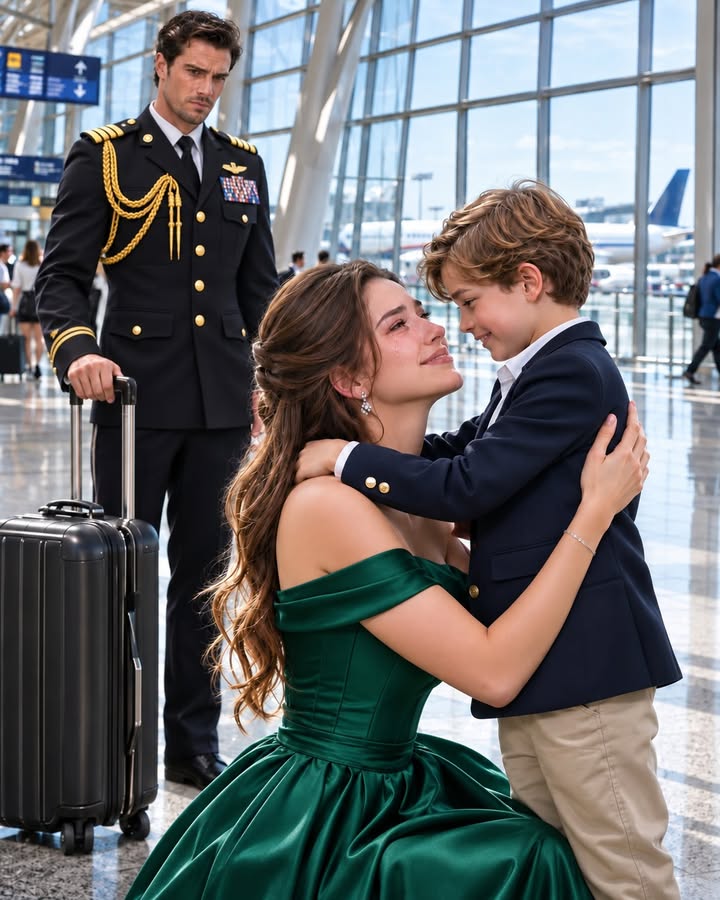
Owen’s eyes flicked toward Grant, who stood a few feet away with his phone in one hand and his boarding pass in the other.
“Mom,” he whispered, pressing something flat into my palm. “Please trust me.”
I felt the edge of a card beneath his fingers.
Before I could look down, Grant called his name.
“Owen, we need to go.”
My son held on to me for one more second, his cheek against my coat.
Then he let go.
I watched him walk toward his father, each step taking him closer to the security line and farther from the life we had shared.
Grant glanced back once.
His expression held no anger, only impatience, as if the goodbye had lasted longer than he had expected.
I curled my fingers around the card and slipped it into my coat pocket.
For a few minutes, I stayed where I was, staring at the place they had disappeared.
The airport moved around me in its usual, indifferent rhythm: rolling suitcases, gate announcements, a child asking for a snack.
I could hear none of it clearly.
My phone vibrated.
The message was from Owen.
Whatever happens, don’t let Dad get the card.
I read it once.
Then again.
I looked toward the security checkpoint, but Grant and Owen were already gone.
The card seemed to grow heavier in my pocket, though it was only a thin piece of black plastic.
I had no idea what it was.
I only knew that my son had looked frightened when he gave it to me.
I walked to the nearest quiet corner and called his number.
The call went straight to voicemail.
I didn’t leave a message.
I didn’t want to give Grant a reason to check Owen’s phone, or to make my son feel that he had done something wrong.
Instead, I took a photograph of the text and sent it to my attorney, Melissa Grant—no relation to my ex-husband, a coincidence she had joked about during our first meeting.
Then I wrote, Owen just gave me a bank card and sent this. What should I do?
Her reply came a few minutes later.
Do not use it, transfer anything, or confront Grant about it at the airport. Keep it safe. I’ll call you as soon as I can.
I read those lines until they stopped looking like words and started looking like instructions from another world.
The card had no name printed on it.
Only a small silver mark in one corner and a set of numbers along the bottom.
I had seen cards like it before, the kind issued for private accounts or business clients, but I had no reason to think it belonged to Owen.
I called Melissa.
She answered on the second ring.
“Rachel, tell me exactly what happened.”
I described the hug, the card, and the text.
“Did Grant see him hand it to you?” she asked.
“I don’t think so.”
“Did Owen say what it was?”
“No. Just that I should trust him.”
Melissa was silent for a moment.
“Don’t call the bank from the airport,” she said. “And don’t call Grant yet. We need to make sure this is handled properly, especially with the travel order in place.”
“I’m not trying to take anything from anyone.”
“I know,” she said gently. “But you’re upset, and this could be important. For now, keep the message and the card somewhere secure. I’ll review the custody order and call you back.”
“Can I contact Owen?”
“You can send a calm, ordinary message. Nothing that asks him to explain or put anything in writing. The order allows reasonable contact, correct?”
“Yes. We have a video call scheduled tomorrow.”
“Then let that call be the first chance. Keep it light, and let him know you love him. If he chooses to tell you more, listen. Don’t press him.”
I wanted to ask what she thought the card meant.
I wanted her to tell me that it was a mistake, or an ordinary account card, or a piece of plastic Owen had found in a drawer.
Instead, I thanked her and hung up.
In the parking garage, I sat in my car without starting the engine.
The card lay in my palm.
I turned it over, searching for a bank logo, a name, anything that might tell me why my child had placed it there with such urgency.
The silver mark was no logo I recognized.
There was a telephone number on the back, along with the familiar words, “For account assistance.”
I put it back in my wallet and drove home.
The townhouse felt too quiet when I opened the door.
Owen’s sneakers still sat beside the entryway, one turned on its side.
A half-finished drawing rested on the kitchen table, a spaceship with bright blue windows and a yellow sun drawn in the corner.
He had left his colored pencils scattered beside it.
I picked up the drawing and tried to imagine him making it in Grant’s house, surrounded by rooms I had never been invited into.
Then I imagined him on an airplane, looking out at clouds and trying not to cry where his father could see.
My phone buzzed again.
Owen had sent a second message.
I’m okay. Please don’t be mad.
The words loosened something in my chest, then tightened it again.
I sat down at the kitchen table and wrote back carefully.
I love you. I’m not mad. I’m here whenever you’re ready to talk.
I did not mention the card.
I didn’t mention the warning.
I waited for the typing dots to appear, but they never did.
That night I moved the card from my wallet to the small lockbox in my bedroom.
It was the same box where I kept Owen’s birth certificate and the papers from our divorce.
I locked it, tested the latch twice, and placed the key on the top shelf of my closet.
It felt absurd to treat a bank card like evidence.
It also felt impossible to do anything else.
I slept badly.
At some point before dawn, I dreamed Owen was standing on the far side of the airport glass, holding his backpack and trying to tell me something I couldn’t hear.
When I woke, I found myself with one hand stretched toward the empty side of the bed.
The next morning, Melissa called while I was at work.
“I’ve looked at the order,” she said. “The travel is permitted, and the video calls are scheduled. You should follow the order exactly. Keep a record of every call and every message.”
“I will.”
“About the card, I’ve made a few inquiries through the proper channels. I haven’t provided the number to anyone. I’m not going to speculate yet, but I do think you should find out what institution issued it.”
“Can I call them?”
“You can ask only what you’re entitled to know as the person holding the card. Don’t present yourself as an account owner, and don’t authorize any transaction.”
I glanced at the clock.
It was nearly lunchtime.
“I can call on my break.”
“Before you do, write down the date and time Owen gave it to you, and save the message. If the bank confirms anything, take notes. Don’t agree to move or access funds.”
“I understand.”
I knew what my voice sounded like to her: steady, reasonable, under control.
I wasn’t.
I spent the next two hours typing the same email twice and forgetting what I had just read.
At lunch, I sat in my car and called the number on the back of the card.
A recorded voice welcomed me to a private banking service.
I was transferred twice before a representative named Helen answered.
“Thank you for calling,” she said. “How may I help you today?”
“I have a card that may belong to my son,” I said. “He gave it to me, but I don’t know why. I’m not trying to use it. I only want to understand what it is.”
“I can help with limited information,” Helen said. “For privacy, I’ll need to verify the card number and ask a few questions.”
I read the number, then gave her my name and explained that I wasn’t the account holder.
There was a pause while she checked the system.
“I’m sorry,” she said. “I can confirm that this card is associated with a trust account. I can’t disclose the full account details to you.”
My hand tightened around the steering wheel.
“Is it Owen’s account?”
“I can’t confirm the beneficiary’s identity without additional authorization,” Helen replied. “But the card is linked to a trust established for a minor.”
I stopped breathing for a moment.
“Can you tell me what the card allows someone to do?”
“It depends on the account terms. Some cards are connected to restricted administrative access, while others are intended for limited disbursements. This account is flagged as restricted. No transfer or withdrawal can be completed by the card alone.”
“That’s good,” I said, though I wasn’t sure why I was saying it.
“Are you the trustee?”
“No.”
“Then please do not attempt to use the card or provide its details to anyone who asks you to do so. If you believe it was given to you by mistake, we can guide you through returning it to the authorized trustee.”
“Who is the trustee?”
“I can’t disclose that information.”
I looked at the black card on my passenger seat.
“Is there a balance?”
Helen hesitated.
“I can’t provide a precise figure without authorization. I can tell you that the account is substantial and has been established for the child’s future.”
I swallowed.
“Could you give me an approximate range?”
“I’m not sure I should.”
“I’m not asking for access. I’m trying to understand why my eight-year-old son would give it to me before leaving the country.”
The line went quiet.
When Helen spoke again, her voice had softened.
“Ma’am, I understand. I still can’t share confidential details, but I can tell you this account is not an ordinary savings account. Please speak to your attorney before taking any action.”
“I will.”
“And please keep the card secure.”
“I have.”
After the call, I sat in the car for a long time.
I had gone into it thinking I might learn that the card was a prepaid travel card, or an old business card Owen had found somewhere.
Instead, I had learned it was tied to a restricted trust established for a child.
I called Melissa and gave her the details.
She listened without interrupting.
“Did the representative give you an amount?” she asked.
“No exact figure. She called it substantial.”
“Good. Don’t call again unless we agree on what you need to ask.”
I stared through the windshield at a row of parked cars.
“Melissa, why would Owen have it?”
“That’s what we need to find out,” she said. “But carefully. He’s eight, Rachel. Whatever he knows, he may not understand all of it.”
“I know.”
“And don’t assume that because he gave it to you, he wants you to use it. His message said the opposite.”
I looked down at the card.
The words on my screen came back to me.
Whatever happens, don’t let Dad get the card.
“Could Grant be trying to take money from it?” I asked.
“I don’t know,” Melissa said. “And neither do you. Don’t turn uncertainty into an accusation. We need documents, and we need to respect the court’s order.”
I understood what she meant.
I also understood that my mind had already begun filling the empty spaces with the worst possibilities.
Grant had always known how to make a room feel like it belonged to him.
His confidence wasn’t loud.
It was in the way he expected people to listen, in the way he spoke as if the conclusion had been reached before anyone else entered the conversation.
The same habit had been present during the custody hearing.
It was present in the photographs of his estate and in the polished plan his attorneys had presented.
It was there in his certainty that Owen would have more with him.
I had told myself that Grant’s advantage was simply money.
Now I wondered whether there was something else he had been trying to manage.
That evening, I read through the court papers again.
I reviewed the travel provisions, the video-call schedule, and the instructions about communication between parents.
I found no mention of a trust.
I found no mention of a bank card.
I found only the judge’s decision that Owen should travel with his father for the approved period, and my promise to follow the order.
When I reached the section about Owen’s stated preference, I had to close the folder.
I could still hear his small voice in the judge’s chambers.
Mom can’t give me the future I need.
I had spent the week believing those words meant that our life together was too small.
The card did not change what he had said.
But it changed the shape of the question.
Why had my son given it to me?
Why had he asked me not to be mad?
And why, if he believed his father was the future he wanted, had he been so afraid of Grant getting it?
The next afternoon, I prepared for the scheduled video call.
I made tea, though it had gone cold by the time the call connected.
I sat at the kitchen table where Owen had left his spaceship drawing and tried not to stare at the lockbox key on the counter.
Grant’s face appeared first.
He was sitting in a bright room with a pale wall behind him.
Owen leaned into view beside him, wearing a gray sweatshirt I didn’t recognize.
“Hi, Mom,” he said.
“Hi, sweetheart,” I answered. “I’m happy to see you.”
Grant gave a polite nod.
“We’ve had a long travel day,” he said. “Owen’s tired, so we’ll keep this brief.”
“Of course,” I said. “How was the flight?”
Owen shrugged.
“It was okay.”
“Did you see any clouds?”
“Lots.”
“What kind?”
He thought about it.
“Big ones.”
I smiled, and for a moment his face brightened.
Then he glanced at his father.
The expression faded.
I wanted to ask whether he was safe, whether he was sleeping well, whether he remembered the promise he had asked me to keep.
Instead, I told him his spaceship drawing was still on the kitchen table.
“You left the pencils out,” I said. “I’m keeping them there for when you come home.”
Owen’s eyes lifted to mine.
“Okay,” he said.
Grant shifted in his chair.
“He’s adjusting,” he said. “It’s a lot to take in.”
“I understand.”
The call was supposed to last fifteen minutes.
It ended after seven.
When the screen went dark, I stayed at the table, listening to the silence return.
Then my phone chimed.
A new message from Owen appeared.
I read it once, my heart beating faster with every word.
Can you keep the card somewhere Dad won’t find it? He thinks it’s just an old card.
I looked toward the lockbox key.
Then I read the message again.
My son had not given me the card by accident.
And Grant, it seemed, did not yet know what Owen had placed in my hands.
**–END OF PART 2–CLICK “NEXT” AT THE BOTTOM OF THE PAGE TO CONTINUE READING**
* * *
[NEXT: PART 3](https://puretales.idolsgift.com/blog/part-3-the-card-he-begged-me-to-hide-008)
✓ Lynn R. Adams
Part 2 – The Card He Begged Me to Hide “What do you mean?” I asked. Owen’s eyes flicked toward Grant, who stood a few feet away with his phone in one hand and his boarding pass in the other. “Mom,”…