PART 2: The Card at the Window 055
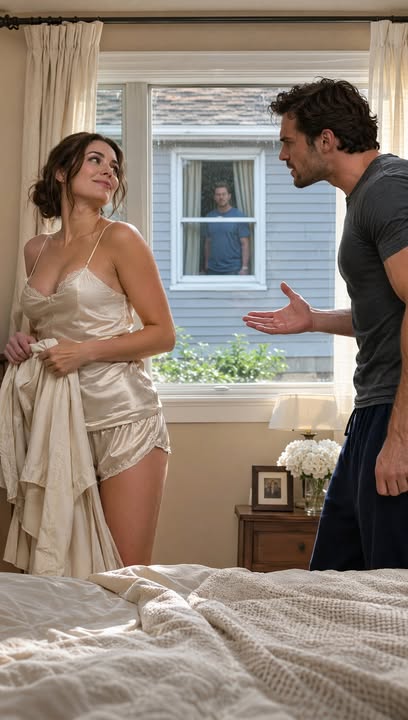
He was holding up a card.
My first thought was that it was a note meant for my wife, and the certainty of that thought made my stomach tighten.
The card was small, pale against the light spilling from his room, and he held it with both hands as if he wanted to make sure I could read it.
I leaned closer to the glass.
The handwriting was too distant to make out.
Behind me, the bedroom door creaked.
“Don’t move,” my wife whispered.
I turned.
She stood just inside the room, fully dressed in the same blouse and dark trousers she had worn home from work.
Her face had lost the amused ease I had seen the night before.
For a moment, neither of us spoke.
Then she lifted one finger to her lips and glanced toward the window.
The neighbor was still there, holding the card.
“What is this?” I whispered.
“Not here,” she said.
She crossed the room and closed the curtains with a careful, deliberate pull.
The fabric met in the middle, shutting out the bright square of his window.
I watched her hands linger on the curtains.
“Come outside with me,” she said.
I looked from her to the window, then back to her face.
“You want to go talk to him?”
“I want to explain something before you decide what you think you saw.”
Her voice was quiet, but there was a strain beneath it that I had never heard before.
The words from the previous night returned to me: *I look good. Let him watch.*
I wanted to ask whether she had been playing some game with him, whether the card was part of it, whether she had known all along that he was trying to communicate.
Instead, I asked, “Why didn’t you tell me?”
She lowered her eyes.
“Because I wasn’t sure what he wanted, and I thought I could find out without making it your problem.”
“That sounds like something you say when you already know it’s a problem.”
“I know.”
The simple answer left me with nowhere to put my anger.
She picked up her cardigan from the chair and slipped it on, though she didn’t look cold.
Then she reached for my hand.
I let her take it, but I didn’t squeeze back.
We walked out through the kitchen and down the front steps, keeping our voices low as if the whole neighborhood might be listening.
The evening air had turned cool, and the streetlights were beginning to glow along the quiet road.
For a few seconds, we stood at the end of our walkway, facing the house next door.
Its upstairs window was empty now.
The card was gone.
“Do you know him?” I asked.
“His name is Martin,” she said. “We’ve spoken a few times.”
The answer felt like a door opening onto a room I had never known was there.
“How many times?”
“Three, maybe four.”
“And you didn’t mention it?”
“I was going to.”
“When?”
She looked down the street, where a car rolled past without slowing.
“I don’t know,” she admitted. “I kept thinking I should wait until I understood why he was talking to me.”
I stared at her.
“What did he say?”
“He asked if my mother’s name was Elaine.”
I knew her mother’s name, of course.
Elaine had died before I met my wife, but her photographs still stood on the bookshelf in our living room, arranged among wedding pictures and old holiday snapshots.
“What does he know about your mother?”
“That’s what I was trying to find out.”
She folded her arms across her chest.
It was a small gesture, almost protective, and it unsettled me more than the card had.
“When did this start?” I asked.
“About two weeks ago.”
“Two weeks?”
She nodded.
“He was outside one afternoon when I was bringing in the mail.”
“And he just asked you about your mother?”
“Not exactly.”
She paused, searching for words.
“He asked whether I grew up in Cedar Falls.”
The name meant nothing to me, but I could tell from her expression that it meant something to her.
“That’s where my mother grew up,” she said.
“I thought you grew up here.”
“I did. She lived there before she met my father.”
“Why would Martin know that?”
“I asked him the same thing.”
“And?”
“He said he thought he recognized me from a photograph.”
I let out a short breath.
“A photograph of you?”
“No. Of my mother.”
She looked toward his house, though the curtains upstairs were now drawn.
“He said he had seen her picture in a box that belonged to his sister.”
Something in the way she said *his sister* made the conversation feel suddenly older and heavier.
“His sister knew your mother?”
“He believes they did.”
“Believes?”
“He said the picture was old, and he didn’t know who the other woman was until he saw me.”
I rubbed my palms together, trying to steady the restless energy gathering in me.
“So he recognized you from a picture, then started standing at his window?”
“He didn’t tell me that he was standing at his window.”
“But he was.”
“I know.”
“And you left our curtains open.”
She flinched, and I regretted the sharpness of my voice almost immediately.
“I wasn’t trying to encourage him,” she said.
“Then why?”
“I wanted to see if he would try to speak to me again.”
“That’s not the same as wanting him to watch you change.”
“I didn’t think he could see much from that far away.”
“You saw him.”
“Yes,” she said. “I saw him.”
The admission came without defense, and that made it harder to stay angry.
She looked toward the darkened upstairs window again.
“I should have closed the curtains. I know that now.”
“Do you?”
“I do.”
Her eyes met mine.
“I wasn’t trying to make you feel foolish, or jealous, or shut out. I was trying to handle something strange before it became real.”
“It was already real to me.”
She nodded, and for a moment she looked less like the confident woman who had shrugged off my concern and more like the girl I had first met, carrying too many questions and refusing to ask for help.
“I’m sorry,” she said.
I wanted those words to fix what had been building between us, but they couldn’t undo the silence that had come before them.
“Why didn’t you trust me enough to tell me?”
“I did trust you.”
“Then why keep it from me?”
She looked away.
“Because I knew how it would sound.”
“How would it sound?”
“Like I was being watched by the neighbor, and somehow I was curious about him.”
The words landed harder than I expected.
“Were you?”
“No.”
She answered so quickly that I believed her, though the relief did not erase the hurt.
“I was curious about what he knew about my mother,” she continued. “That’s all.”
“You could have said that.”
“I know.”
For several seconds, we stood side by side beneath the porch light.
The distance between our houses seemed smaller than it had from the bedroom window, and the quiet street around us seemed suddenly full of things we had failed to say.
“Did he ever ask you to meet him?” I asked.
“No.”
“Did he ever give you anything?”
“No.”
“Then what was on the card?”
“I don’t know.”
“You said you’d spoken to him three or four times.”
“I did.”
“And now he’s holding up a card in his window.”
“I know how it looks.”
“How does it look?”
She let out a tired breath.
“Like I’ve been keeping something from you.”
“You have.”
She didn’t argue.
That answer stayed between us as we started down the sidewalk toward his house.
We didn’t go all the way to his front door.
My wife stopped near the narrow strip of lawn separating our homes and looked up at the upstairs window.
The curtains had closed over it.
“Martin?” she called, not loudly.
There was no answer.
She glanced at me.
I had expected to feel more certain now that the two of us were together, but the sight of the empty window left me with a fresh unease.
“Maybe we should go home,” I said.
“Maybe.”
She still didn’t move.
Then the porch light at Martin’s house flicked on.
A moment later, the front door opened.
Martin stepped onto his porch.
He was older than I had guessed from a distance, perhaps in his late sixties, with neatly combed gray hair and a cardigan buttoned over a checked shirt.
He looked first at my wife, then at me.
“I’m sorry,” he said.
His voice carried softly across the lawn.
“I didn’t mean to frighten either of you.”
“Then why were you standing there holding up a card?” I asked.
My wife touched my sleeve, but I wasn’t trying to threaten him.
I needed him to understand that the years of watching had not been harmless just because he had a reason.
Martin’s hands rested on the porch rail.
“I was trying to get her attention without coming over again,” he said.
“Why?”
“Because I thought she might recognize the writing.”
My wife’s brow furrowed.
“The writing?”
He nodded.
“I found something in my sister’s things. I thought your mother might have written it.”
The quiet around us seemed to sharpen.
“You have a note from my mother?” my wife asked.
“I don’t know if it’s from her. It was with a photograph.”
“What photograph?”
“A picture of two young women.”
He looked at her with an expression I couldn’t read.
“One of them was my sister, Claire. The other looked a great deal like your mother.”
My wife took one step closer to the edge of our lawn.
“What was my mother’s name?”
“Elaine.”
She went still.
I reached for her hand, and this time she held on to mine.
“How do you know her?” she asked.
“I don’t know her,” Martin said. “Not personally.”
His reply sounded careful, but not evasive.
“My sister knew her. I think they were close.”
“How close?”
“I can’t say yet.”
The answer struck me as both honest and frustrating.
“Why didn’t you just come over and tell us that?” I asked.
“I tried to speak with her when I saw her outside,” Martin said. “She seemed startled, and I realized I might be making her uncomfortable.”
“You were making me uncomfortable too,” I said.
He lowered his gaze.
“I understand.”
“Do you?”
“I do now.”
My wife gave my hand a small, uncertain squeeze.
Martin turned toward her again.
“I’m sorry for standing at the window and staring. I thought I was giving you a chance to notice me, but I see how it looked from your side.”
“From our side,” I said.
“Yes,” he replied. “From both your sides.”
The apology was plain and without excuses, but it didn’t change the fact that I had seen him there more than once, standing beneath the light while my wife moved around our bedroom.
I didn’t know what he had seen.
I didn’t want to know.
“I have the photograph,” Martin continued. “And the card has one sentence from a note beside it. I thought if your wife saw it, she might know whether it was her mother’s handwriting.”
My wife glanced at the upstairs window behind him.
“Couldn’t you have brought it to the door?”
“I could have.”
“Then why the card?”
He paused.
“I was afraid she wouldn’t answer.”
There it was, the simple explanation beneath the odd behavior.
It didn’t make the way he had acted acceptable, but it made it more human than the story I had been imagining in the dark.
My wife studied his face.
“Can you show it to us tomorrow?” she asked.
I turned toward her.
“Tomorrow?”
“In daylight,” she added, as if she understood the question in my expression. “And with the front curtains open. We’ll sit in the living room.”
Martin nodded immediately.
“Of course.”
“And no more signals from the window,” I said.
“Agreed.”
“If you need to talk to us, knock on the front door.”
“I will.”
“Not the bedroom window.”
“I understand.”
The exchange might have sounded severe, but the boundary steadied me.
Martin accepted it without complaint.
“I’m sorry again,” he said. “I should have been more thoughtful.”
My wife looked at me, and I saw that she was waiting to see whether I would leave the decision with her.
“Tomorrow,” she said. “We’ll see the photograph.”
“Thank you,” Martin replied.
He went back inside.
My wife and I walked home in silence.
The streetlights had fully brightened now, laying soft gold circles over the pavement.
At our front door, I stopped before reaching for the key.
“Did you really think you were sparing me?” I asked.
She leaned her shoulder against the doorframe.
“I thought I could get an answer first, then tell you something clear instead of dragging you into a question I couldn’t explain.”
“You could have told me it was a question.”
“I know.”
She looked down at her hands.
“I kept thinking that if it turned out to be nothing, I wouldn’t have worried you for no reason.”
“And if it turned out to be something?”
“Then I would tell you.”
“You made that choice for both of us.”
“I did.”
Her voice faltered.
“I’m sorry.”
I searched her face for the easy smile she had worn the night before, the one that had made me feel like the only person in our house who understood what was happening.
It was gone.
“I was hurt,” I said. “Not because I think you wanted him watching you. Because you let me believe I was being ridiculous while you knew he had been trying to talk to you.”
“I didn’t understand the window thing as part of it until today.”
“Did you know he was watching you when you were changing?”
She took a moment before answering.
“I knew he was there. I didn’t know what he could see.”
“That isn’t quite the same.”
“No,” she said. “It isn’t.”
She didn’t offer another defense, and I was grateful.
We went inside and left the curtains closed.
For the rest of the evening, the small card remained in my mind, though I had not seen a single word on it.
I wondered what sentence could connect a stranger, a dead woman, and the uneasy silence that had settled between my wife and me.
Later, as we prepared for bed, my wife sat on the edge of the mattress with her hands folded in her lap.
“I should tell you why my mother never talked much about Cedar Falls,” she said.
I stopped beside the dresser.
“Did she tell you something?”
“Not exactly. She would mention it sometimes, but whenever I asked, she changed the subject.”
“Why?”
“She said it was a small town, and people remembered things for too long.”
The phrase sounded almost rehearsed.
“She never said anything about a friend named Claire?”
My wife shook her head.
“No.”
“Did she have old friends whose names you didn’t know?”
“Probably. I was young when she left that town, and she didn’t keep many photographs out.”
She looked toward the closed curtains.
“There was one box of pictures she wouldn’t let me open when I was a child.”
“Do you remember what was in it?”
“Only that she kept it on the high shelf in her closet.”
“Do you still have it?”
“I don’t know. After she died, I went through her things, but there were boxes I couldn’t bring myself to open.”
Her fingers twisted together.
“I thought I’d have time to go through them later. Then later started to feel like a way of pretending I wasn’t ready.”
I sat down beside her.
She leaned into my shoulder, and I placed my arm around her.
For a while, neither of us spoke.
“I should have told you about Martin,” she said.
“Yes.”
“And I shouldn’t have brushed off what you saw.”
“No.”
She lifted her face and looked at me.
“Are you angry?”
“I’m hurt. I’m worried. And I’m trying not to turn those feelings into a story before we know the truth.”
She nodded slowly.
“That’s fair.”
“I don’t want another secret between us.”
“Neither do I.”
Her hand found mine.
“I didn’t know there was a secret until he showed me the photograph.”
It was the closest thing to a promise she could offer, and I believed she meant it.
The next morning, she made coffee while I stood by the bedroom window, watching the curtains hang closed in the pale daylight.
Martin’s house was quiet.
I found myself thinking about the photograph and the unknown woman beside her mother.
I thought about the way my wife had said *Cedar Falls*, as if she had grown up with a question about that town she had never managed to ask.
Then I thought about the card.
A minute later, the doorbell rang.
We both looked toward the hallway.
My wife set down the coffee pot.
“I’ll get it,” she said.
I followed her to the front door, close enough that our shoulders nearly touched.
Martin stood on the porch, holding a small envelope.
He did not step forward until my wife invited him in.
When we had settled in the living room, he placed the envelope on the coffee table but kept one hand resting gently over it.
“I want to show you the photograph,” he said. “But before I do, there’s something I need to explain.”
My wife leaned forward.
“What?”
Martin looked at her, and his expression changed from apology to something more fragile.
“My sister Claire kept your mother’s picture in the drawer beside her bed for most of her life,” he said. “I only found it after she died.”
He took his hand off the envelope.
“And tucked behind it was a note with your name on it.”
**–END OF PART 2–CLICK “NEXT” AT THE BOTTOM OF THE PAGE TO CONTINUE READING**
* * *
[NEXT: PART 3](https://storyly.idolsgift.com/blog/part-3-the-card-at-the-window-055)
✓ Lynn R. Adams
He was holding up a card. My first thought was that it was a note meant for my wife, and the certainty of that thought made my stomach tighten. The card was small, pale against the light spilling fr…