Part 2: The Breakfast That Brought a Family’s Forgotten Promise Back to Life 039
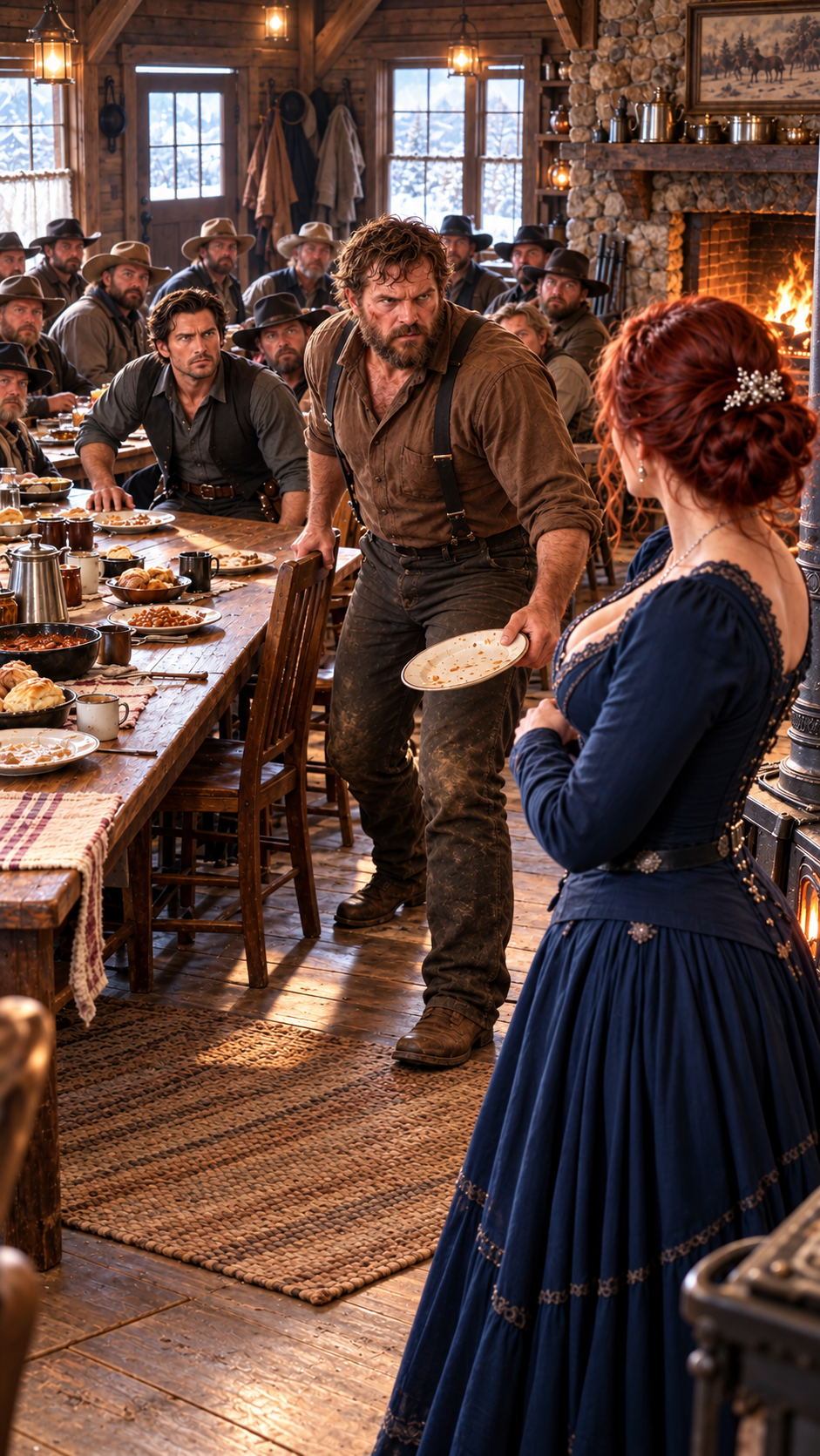
Coulter Grady had barely taken a step from his chair when the enormous cowboy standing before Edith lowered his empty plate and cleared his throat.
“Would you mind terribly,” the man said, his rough voice suddenly uncertain, “if I had another helping of that bread pudding?”
For one suspended heartbeat, nobody moved.
Then a spoon clattered against a plate somewhere near the end of the table.
A laugh escaped one of the younger cowboys, but it was not the mocking laughter that had followed Edith across the ranch yard an hour earlier.
It was laughter born entirely from relief.
The big man turned his scarred face toward the table.
“You laugh, Benny Cole, and I’ll remind everybody how you asked for thirds before your first plate was cold.”
Benny immediately became interested in his coffee.
Edith looked at the cowboy before her and felt the last tightness leave her shoulders.
“You marched across this room like you were preparing to challenge me to a duel over breakfast.”
The man glanced down at his plate.
“I was trying to think how to ask politely.”
“That took considerable concentration, apparently.”
A few men chuckled.
Even Coulter’s mouth shifted at one corner.
The cowboy scratched the dark beard along his jaw.
“My name’s Elias Mercer, ma’am, though everybody here calls me Eli.”
“I know who you are.”
Eli blinked.
“You do?”
“You were the one who said my dress wouldn’t fry bacon.”
A low chorus of amusement rolled through the room.
Eli looked as though he would have preferred being kicked by a horse.
“I suppose I said something along those lines.”
“You did.”
“Then I suppose I owe you an apology.”
“You suppose?”
Eli straightened.
“I owe you an apology.”
Edith let him suffer another second before taking his plate.
“Apology accepted.”
She spooned a generous portion of bread pudding onto it.
Eli watched the warm molasses sauce sink into the soft bread.
His expression changed.
Something quieter entered it.
“My mother used to make something like this.”
Edith’s hand paused.
“She did?”
“Every first snow.”
Nobody laughed now.
Eli looked toward the nearest window, where pale morning light covered the yard and the mountains beyond it in a silver haze.
“She died when I was seventeen.”
The confession seemed to surprise him as much as everyone else.
He rubbed his thumb along the edge of the plate.
“I haven’t thought about that kitchen in years.”
Edith set the spoon down.
“Maybe you were supposed to remember it today.”
Eli lifted his gaze toward her.
For the first time since she had arrived at Grady Ranch, Edith did not see a cowboy judging her appearance, her dress, her confidence, or her ability to handle an iron skillet.
She saw a tired man remembering home.
“Thank you,” he said.
This time there was no teasing in his voice.
“You’re welcome.”
Eli carried his plate back to the table.
A strange transformation followed.
Men who had entered the bunkhouse prepared to test the new cook began offering their names.
Benny Cole asked whether there were any biscuits left.
Tobias Reed wanted to know what Edith had put in the beans.
Young Jamie Foster admitted that he had never tasted gravy that did not come from a tin.
Someone asked whether she could bake apple pie.
Someone else demanded to know whether she knew anything about chicken dumplings.
Within several minutes, twenty ranch hands who had greeted Edith like an entertainment had become twenty hungry men discussing food with the seriousness of bankers negotiating loans.
Coulter remained standing near the head of the table.
Edith noticed him watching her.
Not staring.
Watching.
There was a difference, and she had spent enough years being looked at to recognize it.
“You going to eat, Mr. Grady?”
“I was considering whether there would be anything left.”
“There will be if you stop considering.”
That earned another ripple of laughter.
Coulter sat down.
Edith filled his plate herself.
He tasted the gravy first.
His expression revealed almost nothing.
Edith folded her arms.
“Well?”
He took another bite.
“You’re hired.”
The table erupted again.
Edith raised an eyebrow.
“I thought I was hired yesterday.”
“That was before I knew whether you could cook.”
“You rode through a snowstorm to my cabin because you had heard I could cook.”
“I believe in verifying information personally.”
“And now?”
Coulter looked down at the biscuit in his hand.
“Now I believe the person who told me underestimated you.”
The simple statement reached Edith more deeply than she expected.
She looked away before he could notice.
Breakfast eventually ended because even cowboys had chores that could not be postponed indefinitely.
Chairs scraped back.
Plates were stacked.
Boots crossed the wooden floor.
One by one, the men disappeared outside into the bright cold morning.
Eli was the last ranch hand to leave.
He stopped beside Edith.
“If you ever need wood carried in, ma’am, you tell me.”
“I have two perfectly good arms.”
“I noticed.”
“Then why would I need yours?”
Eli’s mouth twitched.
“Because mine are bigger.”
Edith laughed.
“Get to work, Mr. Mercer.”
“Yes, ma’am.”
He reached the doorway before turning back.
“And Miss Mayburn?”
“Yes?”
“I meant what I said.”
“So did I.”
He nodded once and left.
The room became quiet.
Coulter remained at the table.
Edith gathered plates, conscious of his presence.
“You don’t have to supervise me.”
“I’m not supervising.”
“You’re sitting in an empty dining room watching me wash dishes.”
“When you say it that way, it sounds questionable.”
“It looks questionable too.”
Coulter rose and carried several plates toward the washbasin.
Edith stared at him.
“What are you doing?”
“Helping.”
“You own eleven thousand acres, three barns, two bunkhouses, a cattle herd larger than Powder Creek’s population, and enough horses to start your own cavalry.”
Coulter set the plates beside her.
“You’ve been here two hours and already know too much about me.”
“I listen.”
“That may be dangerous.”
“For you or me?”
He met her eyes.
For one moment, neither of them answered.
Then Coulter glanced toward the stove.
“You’ll need better supplies.”
Edith followed his gaze.
“That depends.”
“On what?”
“Whether you want meals that keep men alive or meals that make them glad they are.”
Coulter considered that.
“What’s the difference in cost?”
“Less than you think.”
“And the difference in work?”
“More than you think.”
He almost smiled.
“Make a list.”
Edith dried her hands.
“I’ll need apples when you can find them, cinnamon, dried peaches, cornmeal, real butter when possible, more flour, proper coffee, and herbs.”
“Herbs?”
“Yes.”
“This is Wyoming.”
“Plants grow in Wyoming.”
“Mostly things cattle eat.”
“Then your cattle have been dining better than your cowboys.”
That smile appeared properly this time.
It changed his entire face.
Edith found herself abruptly annoyed that he did not do it more often.
Coulter walked toward the door.
“Put anything reasonable on the list.”
“And who decides what is reasonable?”
“I do.”
“Then we may have our first disagreement.”
“I suspect it won’t be our last.”
He pulled open the door.
Cold air rushed into the room.
“Miss Mayburn?”
“Yes?”
“Welcome to Grady Ranch.”
The door closed behind him.
Edith remained beside the washbasin for several seconds.
Welcome.
It was an ordinary word.
She had heard it hundreds of times.
Yet somewhere between Coulter’s quiet voice and Eli Mercer’s empty plate, it had begun to feel like something she had not realized she wanted.
She turned toward the kitchen before she could examine that feeling too closely.
There was too much work to do.
By noon, Edith had reorganized half the pantry.
By two, she had discovered three sacks of flour that should have been used months earlier.
By three, she had decided the spice shelf was an insult to civilization.
By four, she had found the first strange thing.
It was beneath a warped floorboard behind the flour bin.
Edith had moved the bin because she suspected mice.
Instead she found a small folded piece of paper wedged beneath the loose plank.
At first she assumed it was an old receipt.
The paper was yellowed and brittle along the edges.
Several lines had been written in pencil.
Most were numbers.
Flour deliveries.
Coffee.
Salt pork.
Lamp oil.
The final entry was different.
NOVEMBER 3.
SOUTH STOREHOUSE.
ASK C.G. ABOUT THE MAYBURN ACCOUNT.
Edith stopped breathing for a moment.
She read the words again.
Mayburn.
Her own surname looked strangely foreign written by someone else’s hand.
There was no reason for it to be there.
She had never worked at Grady Ranch.
Until yesterday, she had never spoken to Coulter Grady.
Her mother had never mentioned the place.
Her father certainly had not.
Edith crouched beside the flour bin while the afternoon light slowly shifted across the kitchen floor.
At the bottom of the page were two initials.
J.P.
Jonah Pike.
The missing cook.
Coulter had said his cook disappeared.
Edith had imagined a restless man deciding that ranch life no longer suited him.
Suddenly that explanation seemed incomplete.
She folded the paper carefully and slipped it into her apron pocket.
Dinner approached.
Questions would have to wait.
Twenty men still expected food.
That evening Edith served beef stew thick with onions and potatoes, skillet cornbread brushed with butter, and stewed apples sweetened with molasses.
The cowboys ate more slowly than they had at breakfast.
Not because they liked the food less.
Because they had already learned that Edith sometimes sat with them after everyone received a plate.
She listened to stories.
She learned that Benny Cole sang badly whenever he repaired fences.
She learned that Jamie Foster sent half his wages to two younger sisters in Nebraska.
She learned that Tobias Reed had been saving for three years to buy forty acres of his own.
She learned that Eli Mercer, feared by almost every newcomer to the ranch, secretly carved tiny wooden horses during winter evenings.
People became different when they believed someone was listening.
Edith had always known that.
What she had not expected was how quickly the ranch hands would begin listening to her.
When she described the little cabin where she had lived alone since her mother’s death, nobody interrupted.
When she mentioned that her father had died when she was young, Eli quietly pushed the apple bowl toward her.
When she admitted that she had once dreamed of opening a boardinghouse where travelers could eat at one long table, Jamie immediately said Powder Creek needed exactly such a place.
The suggestion caused something delicate to stir inside her.
She dismissed it.
Dreams were easy around warm tables.
Morning made them expensive.
After dinner, Coulter entered while Edith was wiping the final table.
“The men like you.”
“They like stew.”
“No.”
Coulter removed his gloves.
“They like you.”
Edith continued wiping.
“You’ve known me for one day.”
“I’ve known them for twelve years.”
She stopped.
That answer was inconveniently difficult to dismiss.
Coulter crossed to the stove.
“There’s coffee?”
“There’s always coffee.”
“Good.”
Edith poured him a cup.
He leaned against the counter while she cleaned.
She waited until he had taken several drinks.
Then she removed the folded paper from her apron.
“I found something.”
Coulter accepted it.
His eyes moved across the writing.
The moment he reached the final lines, his expression changed.
Only slightly.
But Edith saw it.
“You recognize this.”
“I recognize Jonah’s handwriting.”
“What Mayburn account?”
Coulter looked at the paper again.
“I don’t know.”
“Coulter.”
It was the first time she had used his given name.
They both noticed.
He lifted his gaze.
“I’m telling you the truth.”
“Was my family connected to this ranch?”
“Not that I know.”
“My father?”
Coulter shook his head.
“I was twenty when my father died, and I took over the ranch afterward.”
“How long ago?”
“Twelve years.”
“My father died fourteen years ago.”
Silence settled between them.
Coulter unfolded the paper completely.
“Jonah disappeared three nights ago.”
“You said your cook disappeared.”
“He packed some clothes, took his horse, and left.”
“Without saying anything?”
“He left a note.”
“What did it say?”
Coulter hesitated.
Edith immediately noticed.
“What did it say?”
Coulter walked to a cabinet near the dining-room door.
From the top drawer he removed a small piece of paper.
He handed it to her.
Edith read the message.
COULTER,
THERE IS SOMETHING WRONG IN THE OLD ACCOUNTS.
I NEED TO KNOW BEFORE I SPEAK.
DON’T FOLLOW ME.
JONAH.
Edith looked toward him.
“You thought this was worth mentioning when you hired his replacement?”
“I thought Jonah had found an accounting mistake.”
“And now?”
Coulter glanced toward the folded page in her other hand.
“Now I think he found your name.”
Outside, wind brushed snow against the bunkhouse windows.
Edith looked down at the two papers.
Something from the past had been waiting beneath that kitchen floor.
Something carrying her family name.
“Where are the old accounts?”
Coulter did not answer immediately.
“In the ranch office.”
“I want to see them.”
“It’s late.”
“I didn’t ask what time it was.”
Coulter studied her for several seconds.
Then he reached for his coat.
“All right.”
The ranch office occupied a small room attached to the main house.
Edith had not entered the Grady home before.
It was warmer than she expected, with books lining one wall and an old landscape painting hanging above the fireplace.
Nothing looked extravagant.
Everything looked used.
Coulter lit an oil lamp in the office.
Ledgers filled two shelves.
“Most of these belonged to my father.”
Edith ran one finger along the worn leather spines.
“What year?”
“Fourteen years ago would be 1872.”
She found the volume.
Coulter set it on the desk.
Dust rose when Edith opened it.
Pages of careful handwriting followed.
Cattle purchases.
Feed.
Timber.
Wages.
Repairs.
Then, halfway through November, a name appeared.
SILAS MAYBURN.
Edith’s father.
She sat down without intending to.
Coulter leaned closer.
Beside Silas Mayburn’s name was a payment notation.
Twenty-eight dollars.
Below it appeared another entry.
Mayburn advance toward south property agreement.
Edith touched the faded ink.
“My father never told me he worked here.”
Coulter turned several pages.
Another entry appeared.
Silas Mayburn.
Then another.
Then Eleanor Mayburn.
Edith’s mother.
Her chest tightened.
“My mother too?”
Coulter frowned.
“I don’t understand.”
Neither did Edith.
She turned another page.
A folded envelope slipped from between the sheets and landed on the desk.
Both of them froze.
Unlike the ledger, the envelope was not coated heavily with dust.
Someone had handled it more recently.
Jonah.
Edith picked it up.
Her name had been written across the front.
MISS EDITH MAYBURN.
Her fingers began to tremble.
Coulter saw.
“You don’t have to open it tonight.”
“Yes, I do.”
She turned the envelope over.
The seal had never been broken.
Beneath her name were four smaller words.
To be delivered someday.
Edith stared at the handwriting.
She knew it.
She had seen it on recipe cards tucked inside an old wooden box in her cabin.
She had seen it on birthday notes.
She had seen it on the last letter her mother had written before illness weakened her hands.
“This is my mother’s writing.”
Coulter said nothing.
Edith opened the envelope.
Inside was a single sheet of paper.
She unfolded it carefully.
The first line made every sound in the room disappear.
My dearest Edith, if you are reading this at Grady Ranch, then the secret your father and I carried away from this place has finally found you.
**–END OF PART 2–CLICK “NEXT” AT THE BOTTOM OF THE PAGE TO CONTINUE READING**
✓ Lynn R. Adams
Coulter Grady had barely taken a step from his chair when the enormous cowboy standing before Edith lowered his empty plate and cleared his throat. “Would you mind terribly,” the man said, his rough …