PART 2: The Bracelet He Remembered 008
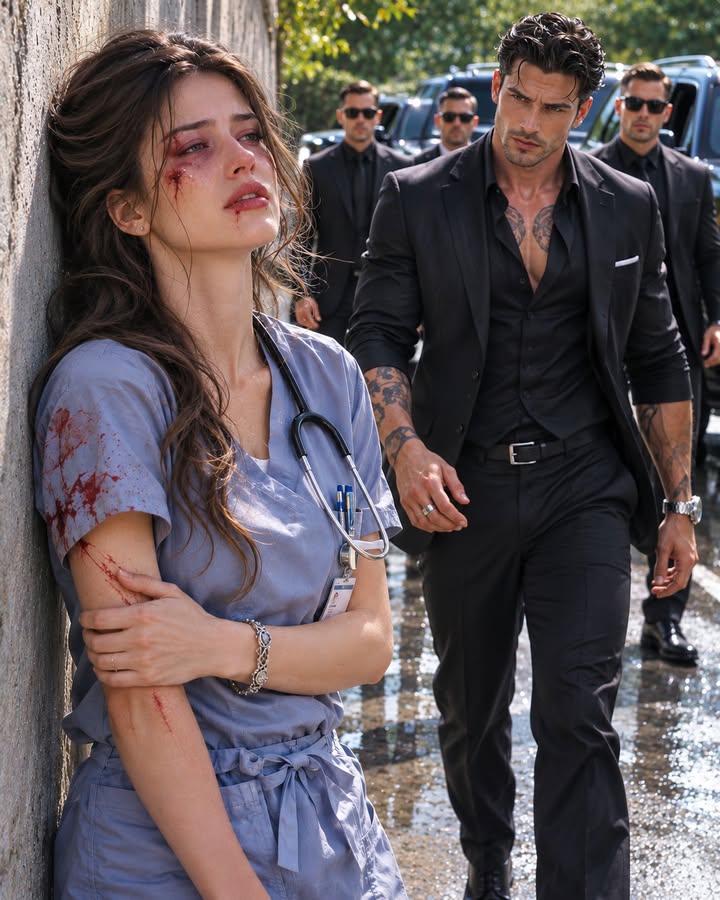
“Rose Whitmore,” I managed to say.
Vincent’s face went still.
For one suspended moment, he seemed to forget the rain, the men behind him, even the road beneath our feet.
Then he looked over his shoulder.
“Call an ambulance,” he said. “And tell the driver to take the next exit. We’re going to St. Agnes.”
One of the men reached for his phone.
I tried to push myself upright, but pain flared through my ribs and I gasped.
Vincent moved closer without touching me.
“Don’t try to stand,” he said. “Help is coming.”
“I know what an ambulance is,” I answered, sharper than I meant to.
“I’m sure you do.”
His calmness unsettled me more than anger would have.
A man who commanded a convoy of black SUVs and armed guards had no business sounding so gentle.
I searched his face for the reason he knew my name, but his expression had closed again.
“Why did you ask about my grandmother?” I said.
“Not here.”
“That isn’t an answer.”
“No,” he conceded. “It isn’t.”
The rain ran down his temple and disappeared beneath the collar of his coat.
Behind him, a second man spoke quietly into a phone, giving the dispatcher our location and describing my injuries.
Vincent glanced at my wrist.
The bracelet had slid toward my hand, its silver links dulled by rain and road grit.
“May I see it?” he asked.
“No.”
He stopped immediately.
The restraint in that small motion caught me off guard.
I had expected him to take what he wanted.
Instead, he lowered his hand and waited.
“My grandmother gave it to me,” I said. “It’s all I have of hers.”
“I understand.”
“Do you?”
“I think I do.”
The words sounded as if they belonged to a much older conversation, one he had been avoiding for years.
The ambulance arrived several minutes later, its flashing lights turning the wet pavement red, then blue, then red again.
The paramedics approached with a stretcher.
I tried to answer their questions clearly, though my thoughts kept drifting toward Vincent and the look that had crossed his face when I said Rose’s name.
“Any loss of consciousness?” one asked.
“I don’t think so.”
“Do you know what day it is?”
“Thursday.”
“Good,” he said. “We’re going to get you checked out.”
Vincent stepped aside as they prepared to lift me.
I watched him through the open doors of the ambulance.
“Are you coming?” I asked before I could reconsider.
He paused.
“If you want me to.”
“I don’t know what I want.”
“That’s fair.”
He climbed in after the paramedic, leaving his men to follow in the SUVs.
The ambulance doors closed.
As the vehicle pulled away, I gripped the stretcher rail and tried to keep my breathing steady.
The paramedic checked my blood pressure while Vincent sat opposite me, his broad shoulders nearly filling the narrow space.
“You should give them your full medical history,” I said, mostly because silence had become unbearable.
“I’m healthy.”
“That’s not what I asked.”
One corner of his mouth shifted, almost a smile.
“You sound like a nurse.”
“I am a nurse.”
“I know.”
I turned my head toward him.
“How?”
His eyes met mine, then moved to the small name badge still clipped crookedly to my blouse.
The answer was ordinary, and I felt foolish for letting fear turn everything into a mystery.
At the hospital, they took me through the emergency entrance and into a curtained bay.
A doctor examined my ribs and wrist while a nurse cleaned the cut on my lip.
I answered questions, described the attack, and tried not to look at the empty space where my bag should have been.
The doctors confirmed that my wrist was sprained and that I had bruised ribs, but nothing appeared broken.
They wanted to monitor me for a while because I had struck my head.
When the doctor left, I found Vincent standing near the curtain.
He had removed his wet coat.
Without it, he looked less like the figure I had recognized from newspaper photographs and more like a tired man who had not slept enough.
That impression vanished when his security detail appeared in the corridor.
I sat up carefully.
“Are you going to have the police called?”
“The hospital already contacted them,” he said. “They’re on their way.”
“Good.”
“I’ll make sure the staff knows you need privacy.”
“I don’t need you to make sure of anything.”
He accepted that without protest.
“Then I’ll stay out of the way.”
“Why are you doing this?”
“Because you were hurt.”
“That’s not the whole reason.”
“No,” he said. “It isn’t.”
There it was again, the truth held just beyond reach.
I studied his face.
“Is this about my bracelet?”
“Partly.”
“My grandmother?”
“Yes.”
The simplicity of his answer made my throat tighten.
“Did you know her?”
“I did.”
“How?”
He glanced toward the curtain, where a nurse was speaking to someone at the station.
“I’ll explain when you’re not in the middle of an examination and surrounded by strangers.”
“You keep deciding when I’m allowed to know things.”
His gaze returned to mine.
“You’re right,” he said. “I’m sorry.”
I had expected an argument, perhaps a polished excuse.
His apology left me with nowhere to direct my anger.
A police officer arrived soon afterward and took my statement.
She asked about the men, the car, the stolen bag, and the records I had been carrying.
I told her what I could remember, though the attack had blurred the details.
When she asked what the records contained, I hesitated.
Vincent stood near the far wall, listening without appearing to listen.
“They’re documents connected to my hospital,” I said. “I work at St. Agnes.”
The officer looked up from her notebook.
“What kind of documents?”
“Copies of old patient records, incident reports, and internal notes. I’ve been comparing them with public records.”
“For what purpose?”
“I believe some deaths were recorded inaccurately. In a few cases, the records don’t match the timelines in the reports.”
The officer’s expression grew more serious.
“Do you believe the attackers knew what was in your bag?”
“I don’t know. They didn’t ask about it, but they took the bag and smashed my phone.”
“Have you reported your concerns to the hospital?”
“I tried to raise them through the proper channels.”
“And?”
“The answers didn’t fit the documents.”
I did not tell her how many times I had been redirected, or how often someone had said the files were incomplete.
I did not tell her I had begun to fear that the records had been altered intentionally.
Those details had taken fourteen months to gather, and now they were gone.
The officer finished writing and promised to follow up.
After she left, Vincent stepped closer, stopping at a respectful distance from my bed.
“You were collecting evidence of suspicious deaths,” he said.
“I was reviewing records that raised questions.”
“That’s a careful distinction.”
“It matters.”
“I understand.”
“Do you?”
His expression did not change, but something in his eyes softened.
“I understand that people deserve the truth about what happened to them.”
For a moment, I forgot who he was.
Then I remembered the armed men outside the room and the stories I had heard about his influence.
“Your understanding doesn’t make you a safe person to involve.”
“I didn’t ask you to involve me.”
“You came with four SUVs.”
“I was traveling with my security detail.”
“That’s not exactly reassuring.”
“No,” he said. “I suppose it isn’t.”
A nurse entered to check my wrist and brought me a cup of water.
When she left, Vincent looked again at the bracelet.
“Rose gave that to you before she died?” he asked.
“Yes.”
“Did she ever tell you where it came from?”
“She said a friend had given it to her, and that she wanted me to have it one day.”
“Did she mention the friend’s name?”
“No.”
“Did she tell you anything about the hospital fire?”
My hand tightened around the cup.
“What fire?”
Vincent looked as if he regretted the question before I had finished asking it.
“A fire at St. Agnes, many years ago.”
“I’ve worked there for three years. I know there was a fire in the old east wing, but I don’t know much about it.”
“It happened decades ago.”
“Why would my grandmother know about it?”
He lowered his eyes.
“Because she was there.”
The room seemed to tilt, though I knew it was only the medication and the blow to my head.
“My grandmother was at the hospital during a fire?”
“She worked there for a time,” he said. “And she helped someone I loved.”
“Who?”
“My younger sister.”
He said it quietly, without ornament or explanation.
The words changed the shape of the room.
I looked again at the bracelet.
“Your sister wore one like this?”
“She wore this one.”
My fingers moved instinctively over the silver links.
“No,” I whispered. “My grandmother said it was a gift from a friend.”
“She didn’t lie to you. It was a gift from her friend.”
“Your sister.”
“Yes.”
I stared at him, trying to reconcile the feared man in front of me with a sister who had once worn a small silver bracelet.
“What was her name?”
“Sofia.”
The name settled between us, carrying a grief so old it seemed to have become part of his posture.
“How did she die?”
Vincent looked toward the window.
“The fire.”
“You said my grandmother helped her.”
“She did.”
“Then why did she give the bracelet to Rose?”
“I don’t know everything Rose told her. I only know Sofia wanted Rose to keep it.”
“Why?”
His jaw tightened.
“She was young. She may have wanted it safe.”
“That doesn’t sound like the whole answer.”
“No,” he said. “It doesn’t.”
I set the water down before my hand could shake enough to spill it.
“Did my grandmother know you?”
“She knew me as a boy.”
“And she helped you after your sister died?”
His eyes returned to mine.
“Yes.”
The admission seemed to cost him more than the others.
I thought of Rose in her small apartment, always folding dish towels into perfect squares, always making tea before difficult conversations.
I thought of the bracelet she had fastened around my wrist when I was old enough to wear it without losing it.
She had told me it was a reminder that I was loved, even when she could no longer be beside me.
She had never said that the silver belonged to another girl.
“Why didn’t she tell me?” I asked.
“I can’t answer that for her.”
“But you knew the bracelet. You saw it, and you knew.”
“I recognized the pattern.”
“Then you knew who I was.”
“I didn’t know who you were until you told me her name.”
“You knew she was Rose Whitmore.”
“I knew a Rose who helped my family. I didn’t know she had a granddaughter named Evelyn.”
“And you recognized the bracelet before I said anything.”
“Yes.”
I looked at him carefully.
“Were you following me?”
“No.”
“Did someone tell you about me?”
“No.”
“Then why were you on that road?”
“My driver took a detour because of the storm. We saw you.”
His answer was plain, but I could not yet decide whether it was the whole truth.
The doctor returned to discuss discharge instructions.
I was to rest, avoid lifting anything heavy, and return if my symptoms worsened.
The hospital could arrange a ride, but the officer had advised me not to go back to my apartment alone until they had more information about the attack.
Vincent offered a room at a secure hotel.
I refused.
He offered to arrange a hospital-approved shelter.
I refused that too.
“I’ll go to my friend’s apartment,” I said. “She’s a few blocks away.”
“Do you have a way to contact her?”
“My phone is gone.”
“I can ask the nurse to call from the desk.”
“I can make the call myself.”
“All right.”
That mattered more than I expected: he did not argue.
The nurse found my friend’s number in the emergency contact information on my chart and placed the call.
When she answered, I heard relief and fear rise together in her voice.
She said she was on her way.
While we waited, Vincent remained near the door, giving me space.
“What did Rose tell you about the fire?” I asked.
“Not much.”
“That sounds unlikely.”
“She told me Sofia had been moved from the hospital before the official report said she was. She said the people responsible for the fire were trying to control what became known.”
My pulse quickened.
“Who was responsible?”
“I didn’t know then.”
“And now?”
“I have suspicions.”
“That isn’t the same as proof.”
“No.”
For the first time, I felt a thread of recognition between us.
We had both spent years living beside unanswered questions, each trying to distinguish what we feared from what the evidence could prove.
“Did you ever find out how Sofia died?”
“She died from her injuries later.”
“Did you get to see her?”
Vincent’s expression changed, a small fracture in the composure he had maintained.
“Yes.”
“I’m sorry.”
He looked down at his hands.
“So am I.”
No more than that.
No story of his grief, no attempt to make me comfort him.
Yet the silence held more than any explanation could have.
My friend arrived a few minutes later, breathless and damp from the rain.
She stopped when she saw Vincent.
“Evelyn, are you all right?”
“I will be.”
She crossed the room and squeezed my uninjured hand.
“Are you sure you want to leave?”
“I don’t want to stay here longer than I have to.”
The nurse helped me gather the few things the hospital had given me.
Vincent’s security detail had arranged for an officer to accompany us to the entrance, but he did not offer to send a car until I asked.
“I don’t want your men following us,” I said.
“They won’t.”
“Promise me.”
“I promise.”
He said it without hesitation, then turned to his driver and gave a brief instruction.
My friend helped me into her car.
Before I climbed in, Vincent held out a small paper bag containing my discharge papers and the bracelet, which the staff had removed while examining my wrist.
I took the bag.
“Thank you for getting me medical care,” I said.
“You don’t owe me thanks.”
“I wasn’t saying I owed you anything.”
A faint, weary smile touched his face.
“I know.”
I hesitated, then asked the question that had followed me since the roadside.
“Why did you really want to know my grandmother’s name?”
He looked at the bracelet in my hand.
“Because I had not heard Rose’s name in years,” he said. “And because I thought everyone who knew what happened to Sofia was gone.”
My friend opened the car door, but I did not move.
“What happened to Sofia?”
Vincent’s gaze lifted to mine.
“I’m still trying to understand that.”
“Then why do you think my grandmother could help?”
“Because she was the last person I knew who could tell me what Sofia wanted.”
The rain had softened to a mist, gathering in the streetlights like pale smoke.
I slipped the bracelet back onto my wrist.
For the first time, it felt heavier than silver.
“I can’t promise to help you,” I said.
“I’m not asking you to.”
“I also can’t give you anything from the records. They’re gone.”
“I know.”
“You seem very sure of that.”
“The men who attacked you took your bag.”
“That doesn’t mean they knew what was in it.”
“No,” he said. “It doesn’t.”
My friend touched my shoulder, reminding me that the night was cold and I was hurt.
I stepped toward the car.
“Evelyn,” Vincent said.
I turned.
“If you find anything connected to that fire, don’t bring it to me before you make a copy and tell someone you trust.”
The unexpected caution stopped me.
“You’re telling me not to trust you?”
“I’m telling you not to let anyone become the only person who has the truth.”
For a man whose power seemed to rest on making other people depend on him, the advice sounded almost like a confession.
I watched him as my friend helped me into the car.
As we pulled away, he stayed beneath the hospital awning, his face turned toward the rain.
The next morning, I woke on my friend’s couch with my wrist wrapped and my ribs aching.
My head throbbed, but the doctor’s instructions had been clear, so I stayed still and let the room settle around me.
The bracelet lay on the table beside a glass of water.
I had not taken it off in years.
Now I could not stop thinking about the girl named Sofia who had once worn it.
My friend brought me coffee and asked whether I wanted her to call the police again.
“Not yet,” I said. “I want to think.”
“About Vincent Romano?”
“About my grandmother.”
I called Rose’s old neighbor, Mrs. Alvarez, who had known her for decades and still kept a box of photographs Rose had left with her.
Mrs. Alvarez listened while I explained what had happened.
She did not sound surprised when I mentioned the bracelet.
“Oh, Evelyn,” she said softly. “I wondered when you’d ask about that.”
My fingers tightened around the phone.
“You knew?”
“I knew it belonged to Rose’s friend. I never knew the girl’s name.”
“Did Rose ever tell you about a fire at St. Agnes?”
There was a pause.
Then Mrs. Alvarez said, “She told me she had kept a promise for a long time.”
“What promise?”
“She never explained. Only that one day, if the right person came looking, she hoped the truth would be kinder than silence.”
I looked at the bracelet on the table.
“Who was supposed to come looking?”
“I don’t know.”
The call ended a moment later, leaving me with more questions than answers.
That afternoon, I went through the notes I had kept at home, trying to remember what the stolen records had contained.
Most of my working files had been in the bag.
I had made copies of a few pages and hidden them separately, but I could not remember whether those pages were enough to establish anything.
One name, however, remained clear in my mind.
My father’s.
He had worked at St. Agnes before I was born.
He had died when I was young, and my mother had always said he was a quiet man who kept to himself.
I had found his name in a payroll ledger among the records I had been studying.
At the time, I had assumed it was a coincidence.
Now, with Vincent’s account of Sofia and Rose’s promise, the name began to feel less like a coincidence and more like a door I had never thought to open.
My friend noticed my expression.
“What is it?”
I stared down at the blank page where I had begun writing everything I remembered.
“My father worked at St. Agnes,” I said. “I don’t know what he did there.”
“Do you think Vincent knows?”
“I don’t know.”
“Will you ask him?”
I touched the bracelet, remembering Vincent’s warning not to let anyone become the only person who had the truth.
“I will,” I said. “But not until I know what I’m asking.”
My phone, borrowed from my friend, rang before I could write another line.
The caller’s number was unfamiliar.
I answered.
“Evelyn?” Vincent said.
My breath caught.
“How did you get this number?”
“Your emergency contact gave it to the officer, and the officer passed along my message.”
“That sounds like a complicated way to say you asked for it.”
“I did.”
“What do you want?”
“I remembered something Rose told me after the fire.”
I gripped the phone.
“What?”
“She said Sofia had been taken out of the hospital before the official report placed her there.”
“That doesn’t make sense.”
“No,” Vincent said. “But it may explain why the records you were gathering matter.”
I looked at the bracelet, its silver catching the afternoon light.
Then Vincent spoke again, his voice careful and unsteady.
“Evelyn, I think your father’s name was in the hospital records because he was there the night Sofia disappeared.”
**–END OF PART 2–CLICK “NEXT” AT THE BOTTOM OF THE PAGE TO CONTINUE READING**
* * *
[NEXT: PART 3](https://puretales.idolsgift.com/blog/part-3-the-bracelet-he-remembered-008)
✓ Lynn R. Adams
“Rose Whitmore,” I managed to say. Vincent’s face went still. For one suspended moment, he seemed to forget the rain, the men behind him, even the road beneath our feet. Then he looked over his sho…