PART 2: “The Ballroom Had Been Locked for Three Years—Until Two Children Accidentally Uncovered the Secret a Mother Left Behind” 066
Richard did not move.
For several seconds, he remained beside me in the doorway, his shoulders stiff beneath his charcoal sweater, one hand resting against the frame as though he needed the wood to steady him.
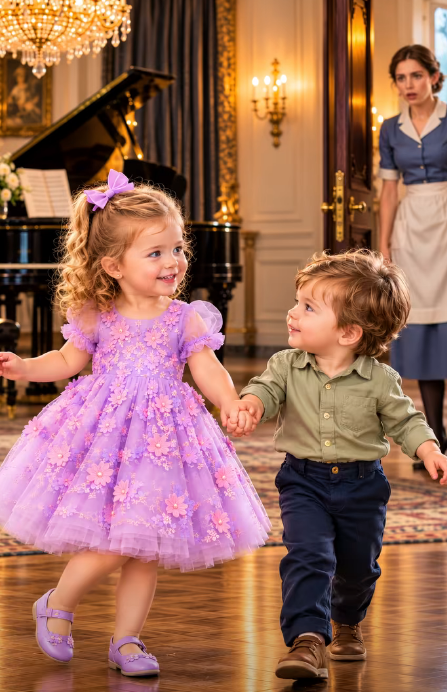
Across the ballroom, Noah had forgotten we existed.
“Again,” he said.
It was only one word.
Yet Richard drew in a sharp breath.
I looked at him.
In the five months I had worked at the Caldwell estate, I had heard Noah speak occasionally. He could say _milk_, _no_, _more_, and several versions of Emma’s name. But his words usually came quietly, as though he had learned that silence was the natural language of the house.
This was different.
“Again!” he repeated, laughing.
Emma nodded with great seriousness.
“You have to watch.”
She placed one bare foot forward.
“Step.”
Noah copied her.
“Step.”
He copied that too.
“Turn!”
They spun in opposite directions, lost each other’s hands, and collapsed onto the rug in a heap of laughter.
A sound escaped Richard.
Not quite a laugh.
Not quite a sob.
I turned toward him, but he was already walking into the ballroom.
For one awful second, I thought the anger I had expected had finally arrived. Instead, Richard crossed the room slowly and crouched beside his son.
Noah looked up at him.
Richard’s expression changed.
It was such a small shift that anyone who did not know him might have missed it. The tightness around his mouth disappeared. His eyes softened.
“What are you doing in here, little man?” he asked.
Noah pointed at Emma.
“Dance.”
“I can see that.”
“Emma dance.”
“Yes.”
Emma sat cross-legged on the carpet, completely unconcerned by the fact that she had violated the strictest rule in the house.
“I’m teaching him,” she explained.
Richard looked at her.
“So I gathered.”
“He falls down a lot.”
“Emma,” I whispered.
“What?”
“You’re not helping.”
Richard surprised me by smiling.
It lasted only a second, but it changed the room.
Then his gaze traveled toward the piano.
Everything inside the ballroom had remained almost exactly as Amelia had left it. The black grand piano stood near the tall windows. A silver-framed photograph rested on top of it, showing a young woman laughing toward someone beyond the camera.
Amelia.
I had never met her, but I had seen photographs throughout the estate.
Richard rarely spoke about her.
Now, surrounded by the things she had touched, he looked less like my employer and more like a man who had accidentally opened a door into another life.
He stood.
“How did you get in?”
Emma looked toward Noah.
“Noah had the key.”
Richard frowned.
“What key?”
“The shiny one.”
Noah seemed to understand that he was suddenly important. He reached into the pocket of his tiny navy trousers.
Nothing.
Then his other pocket.
His face became worried.
Emma crawled toward him.
“You put it in the book.”
“What book?” I asked.
“The dancing book.”
Richard and I exchanged a look.
There was no dancing book that I knew of.
Emma took Noah’s hand.
“Come on.”
They hurried from the ballroom.
“Emma,” I called.
She turned.
“You do not run on the stairs.”
“We know.”
They disappeared into the corridor at a speed that suggested knowing a rule and obeying it were entirely separate concepts.
I pressed my fingers to my forehead.
“I’m very sorry.”
Richard remained near the piano.
“Stop apologizing.”
I blinked.
He looked toward the open doorway.
“I mean it, Claire.”
“But the room—”
“I know what the rule was.”
_Was._
The word caught my attention.
Richard seemed to hear it too.
Neither of us mentioned it.
A minute later, two pairs of small footsteps returned.
Emma carried a thin blue book nearly as large as her chest.
Noah followed behind.
Emma held it out.
“This.”
Richard took it.
The change in his face was immediate.
His fingers tightened around the faded blue cover.
“Where did you find this?”
Noah pointed vaguely upstairs.
“My room.”
Richard looked at me.
I shook my head. I had never seen it.
He sat on the piano bench.
“Show me.”
Noah climbed beside him.
Emma squeezed onto the remaining space.
Richard opened the book.
The first page contained a watercolor drawing of two feet.
One red.
One blue.
Beneath them were handwritten words.
Richard touched the page.
I watched his thumb hover over the writing without quite making contact.
“Is that Amelia’s?” I asked.
He nodded.
His voice came quietly.
“Yes.”
The children did not notice the significance.
Emma flipped the page.
“Here.”
Another drawing showed a child taking three steps toward a door.
The following page showed a little brass key.
Another showed the outline of the Caldwell estate, though drawn almost like a child’s picture.
Richard turned faster.
“What is this?”
“I told you,” Emma said. “The dancing book.”
“Where exactly was it?”
Noah slid down from the bench.
“Box.”
“What box?”
He pointed upstairs again.
Richard stood.
We followed the children to the nursery.
Noah went directly to a window seat where several wooden toys had been stored in woven baskets.
He removed a train, two stuffed animals, and a wooden puzzle.
Then he lifted a small cedar box from the back.
I had dusted that window seat more than once.
I had never seen the box.
Richard crouched beside it.
“Where did you get this?”
Noah looked confused by the question.
“Here.”
Richard opened it.
The box was empty except for a strip of pale ribbon.
He picked it up.
There was embroidery along one edge.
A.
C.
Amelia Caldwell.
Richard closed his eyes.
I felt like an intruder.
“Richard,” I said gently, “we can leave.”
“No.”
His answer came quickly.
When he looked at me again, there was something almost frightened in his face.
“Stay.”
So I did.
Emma leaned against my knee.
Richard returned to the book.
Page after page contained simple drawings.
Feet.
Hands.
Stars.
A piano.
A window.
A crescent moon.
It looked like something designed for a child who could not yet read.
At last Richard said, “She made this for him.”
“For Noah?”
He nodded.
“Amelia loved drawing. Badly.”
I looked at one particularly uneven horse.
“I wasn’t going to say anything.”
The corner of his mouth lifted.
“She would have.”
Noah pointed at another page.
“Key.”
The illustration showed a blue book with a brass key tucked inside its pages.
Emma grabbed the real book.
“See?”
She flipped backward.
Between two thick pages was a narrow slit where something had clearly been hidden.
“That’s where Noah got it,” she said.
Richard stared at the empty space.
“And you knew it opened the ballroom?”
Emma shook her head.
“We tried doors.”
My heart sank.
“How many?”
She considered this.
“A lot.”
Richard covered his mouth, possibly to conceal another smile.
Eventually Emma said, “Then this one worked.”
I knelt in front of her.
“Sweetheart, when a door is locked, we don’t try to find a key.”
“Why?”
“Because locked doors usually mean somebody doesn’t want us going inside.”
She thought about that.
Then she glanced toward Richard.
“Did you not want Noah inside?”
The room went still.
Children could locate the one question adults spent years avoiding.
Richard looked at his son.
Noah had returned to the picture book.
“No,” Richard said.
Emma waited.
Richard corrected himself.
“I mean… I didn’t know if I wanted anyone inside.”
“Why?”
“Emma,” I warned.
Richard raised a hand.
“It’s all right.”
He sat on the floor.
The estate had staff who arranged his meetings, prepared his meals, cared for his grounds, and maintained rooms large enough to swallow my old apartment whole.
Yet I had never seen Richard Caldwell sitting on the nursery carpet.
“It was Noah’s mother’s room,” he told Emma.
“Where is she?”
I held my breath.
Richard answered simply.
“She died when Noah was born.”
Emma looked at Noah.
Then at Richard.
“So he doesn’t know her?”
“Not the way you know your mother.”
Emma absorbed this.
“Was she nice?”
Richard’s eyes became bright.
“Yes.”
“Did she dance?”
“All the time.”
Emma looked delighted.
“That’s why Noah has the book.”
Richard gave a faint nod.
“I think so.”
She seemed satisfied.
Adults saw tragedy.
Emma saw an explanation.
She returned to the blue book.
Richard remained still, watching the children turn pages his wife had prepared almost three years earlier.
After several minutes he whispered, “I never knew this existed.”
I sat beside him.
“You couldn’t know everything she left behind.”
“I should have.”
There it was.
Not anger.
Guilt.
I had heard grief spoken about as sadness, but Richard’s seemed to have hardened into responsibility. If something connected to Amelia had been lost, he blamed himself for failing to preserve it.
“You were raising a newborn,” I said.
“And burying his mother.”
“Yes.”
He looked at me.
The words sounded cruel when spoken aloud, but they were only true.
“You survived what happened,” I continued. “That doesn’t mean you catalogued every box in the house.”
His gaze returned to Noah.
“I locked that room four days after the funeral.”
I said nothing.
“I thought I was protecting it.”
“From what?”
Richard gave a tired smile.
“Time, maybe.”
From the window seat, Emma suddenly gasped.
“Another one!”
She had reached the final pages.
Most had stuck together with age.
Emma carefully separated two.
A folded sheet slid onto the floor.
Richard picked it up.
The paper was cream-colored and covered in Amelia’s handwriting.
At the top was a small drawing of a star.
Beneath it were four words.
Richard read them aloud.
“Find the place winter blooms.”
I frowned.
“What does that mean?”
His expression changed.
“I don’t know.”
But Emma pointed at the drawing.
“That flower.”
In the corner, Amelia had drawn a tiny white blossom.
Richard stared.
Then he stood so quickly the children looked up.
“What is it?” I asked.
He walked toward the window.
“My wife had a winter garden.”
I had worked at the estate for five months.
I knew the greenhouse.
The rose garden.
The kitchen garden.
The orchard beyond the stone wall.
I had never heard anyone mention a winter garden.
“Where?”
Richard looked toward the western edge of the property.
“It was closed after she died.”
He glanced down at the note again.
“Apparently the ballroom wasn’t the only door Amelia expected someone to open.”
That afternoon, Richard did something no one on the Caldwell staff had seen him do in nearly three years.
He left the west ballroom unlocked.
And just before dinner, while helping Emma put away the picture book, I noticed words on the inside back cover that none of us had seen before.
The ink had faded almost completely.
I tilted the book toward the lamp.
There, written in Amelia Caldwell’s unmistakable hand, was a sentence addressed to a child who had been only a hope when she wrote it.
_For Noah—when you are big enough to find the key, follow the music all the way home._
I stared at it.
Because beneath that sentence was another line.
A name.
**Evelyn knows the rest.**
**–END OF PART 2–CLICK “NEXT” AT THE BOTTOM OF THE PAGE TO CONTINUE READING**
✓ Lynn R. Adams
Richard did not move. For several seconds, he remained beside me in the doorway, his shoulders stiff beneath his charcoal sweater, one hand resting against the frame as though he needed the wood to s…