PART 2: The Bags Beside the Door15 026
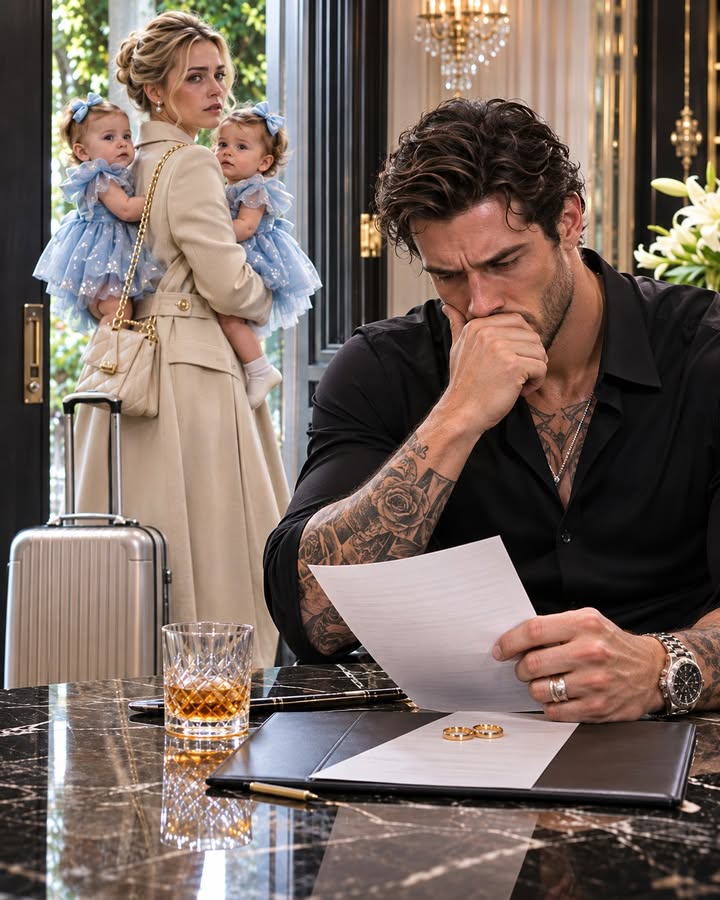
Garrett’s hand stayed on the doorknob.
The house was so quiet that the small click of the latch sounded louder than it should have.
He glanced toward the living room, where he expected to find the girls’ play mat, a jumble of bottles, and the familiar signs of a day that had gone on too long.
Instead, the floor was clear.
The bottles were washed and lined neatly on a towel beside the sink.
A folded blanket lay over the arm of the sofa, and the twins slept side by side in a travel crib near the window, their tiny chests rising and falling beneath a pale yellow sheet.
Garrett stared at them for a moment, then looked past the crib.
Three packed bags sat beside the front door.
His fishing duffel still hung from his shoulder.
“What’s going on?” he asked.
I stood in the hallway, one hand resting lightly against the wall.
I had spent the last hour imagining this moment, but now that he was there, the words I had practiced seemed to have scattered.
“They’re asleep,” I said.
“I can see that.”
He looked at the bags again.
“Are you going somewhere?”
“Yes.”
His expression tightened, though he tried to keep his voice casual.
“Your mom’s?”
“No.”
The pause between us widened.
He set his duffel down by the door, as if he were already preparing to stay.
“Where, then?”
“My sister’s.”
He looked toward the travel crib again.
“You’re taking the girls to your sister’s?”
“For a while.”
His eyes returned to me.
The question he wanted to ask was there before he said it.
“Because I went fishing?”
I could have answered yes.
It would have been true, but not the whole truth.
“Because I can’t keep doing this the way we’ve been doing it.”
He opened his mouth, then closed it.
For the first time since he’d walked in, he seemed to notice the details around him rather than just the fact that I had made a decision.
The diaper bag stood by the packed luggage, its side pocket zipped shut.
The girls’ spare clothes had been folded into clear pouches.
A small paper list was tucked beneath one handle, with the names of their pediatrician, their usual feeding times, and the number for the pharmacy written in my handwriting.
It was not an angry departure.
It was a careful one.
“Are you leaving me?” he asked.
“I’m taking the girls somewhere I can get help.”
“Your sister’s?”
“Yes.”
“For how long?”
“I don’t know yet.”
He looked wounded by the uncertainty, but I didn’t take it back.
His gaze moved over my face, searching for a familiar sign that I might soften if he asked the right question.
“I thought we’d talk about the trip when I got back,” he said.
I let out a quiet breath.
“You didn’t tell me you were leaving.”
“I said I needed a break.”
“You told me you were going fishing for four days.”
“I thought you’d be okay.”
I looked at him.
He seemed to hear how small that sounded only after he had said it.
His shoulders lowered.
“I didn’t mean it like that.”
“I know you probably didn’t.”
The answer surprised him.
He had come prepared, I thought, for anger or tears.
Perhaps he had expected the argument to resume exactly where he left it, as if those four days had been a pause rather than a dividing line.
But I had used those days to make a different kind of choice.
I looked toward the sleeping girls.
“They were okay,” I said. “I took care of them.”
“I know you did.”
“And I was not okay.”
He rubbed his thumb along the strap of his duffel.
“I’m sorry about what I said.”
It was the first apology he had offered.
It came quietly, without the edge of an argument around it.
But the words did not undo the feeling of standing in our bedroom while he packed to leave, one baby crying in my arms and the other crying behind me.
“I heard you,” I said.
He looked down.
For a few seconds, neither of us spoke.
Then one of the girls made a soft sound in her sleep, a tiny breathy murmur that settled back into silence.
Garrett turned toward the crib.
“Can I pick them up?”
I glanced at the clock.
“They’ll probably wake soon.”
“Can I?”
I hesitated.
Not because I thought he would hurt them.
Because I didn’t know what it would mean to say yes.
“You can sit with them,” I said. “Let them sleep for now.”
He nodded, accepting the boundary even though disappointment crossed his face.
He crouched beside the crib, careful not to bump it.
One of the girls had a hand curled near her cheek.
Garrett watched her as if he were trying to learn her by looking.
“How big they’ve gotten,” he murmured.
“They’ve grown a lot in four days.”
He glanced over his shoulder at me.
“That wasn’t what I meant.”
I didn’t answer.
He turned back toward the babies.
“I missed them.”
“You chose to leave.”
His shoulders stiffened.
Then, slowly, he let them drop again.
“I know.”
The fact that he didn’t argue unsettled me more than an excuse might have.
He had always been better at explaining his intentions than looking at their effect.
I wondered if the four days away had been long enough for something to change in him, or if he was simply tired from the drive and surprised to find his home no longer waiting in exactly the same shape.
“My sister is expecting us,” I said. “She’s cleared out the guest room.”
“When did you arrange that?”
“On the second day.”
He stood up.
“You decided this on the second day?”
“I started thinking about it then.”
“What happened on the first?”
I looked at him.
“The girls cried a lot. I was tired.”
He blinked as though there should be more.
There was more, but I was not sure I could make him understand it in the doorway.
The first night, I had sat on the nursery floor after both girls finally fell asleep, my back against the crib and my phone glowing in my hand.
I had looked through our messages for some sign that I had asked him for help more often than I remembered.
I had found one request from a Tuesday morning, another from the week before, and a third that I had sent after a night when one twin had been awake for hours.
There were messages from him, too, but most were practical.
Did you order the formula?
Can you pick up more wipes?
I’ll be home around seven.
Nothing that said he understood what the days felt like.
Nothing that said he saw how alone I was becoming.
The next morning, I called my sister.
“Did you tell her I was leaving?” Garrett asked.
“No.”
“Did you tell anyone else?”
“My sister.”
He looked at the bags again.
“What did you tell her?”
“That I needed help.”
He drew a breath.
“Help with the girls?”
“With making a plan.”
That answer seemed to unsettle him.
“What kind of plan?”
“A safe, practical one.”
His eyes narrowed slightly, not in anger but in confusion.
“Practical for what?”
“For staying somewhere else for a while.”
He stared at me.
“You planned to leave before I got home.”
“Yes.”
The words landed between us with a firmness I had not managed in the days before.
I had imagined he might be furious.
Instead, his expression shifted toward something more fragile.
“You didn’t think we could talk first?”
“I thought about it.”
“You could have called me.”
“I could have.”
“Why didn’t you?”
“Because when I asked you to help, you told me I wanted to be a mother, so I should act like one.”
He looked away.
The silence that followed was not the silence of a slammed door or a conversation ending.
It was the silence of a sentence that could not be made harmless by explaining it.
“I shouldn’t have said that,” he said at last.
“No.”
“I was frustrated.”
“I know.”
“I thought the trip would help me come back with a clearer head.”
“I believe you.”
He looked at me, searching again.
“But that doesn’t mean it was okay.”
“No,” he said. “It doesn’t.”
The simple agreement left me with nowhere to put the anger I had been holding.
I had expected to defend my decision.
I had prepared to list every late night, every bottle, every time I had asked him to take one baby so I could shower.
Instead, I found myself standing beside packed bags, listening to my husband say he was sorry, while feeling too tired to know whether I wanted to be comforted by it.
Garrett lowered himself onto the edge of the sofa.
The cushion sank beneath him.
“Can I come with you?” he asked.
“Not tonight.”
“Can I visit?”
“Yes, but we’ll agree on a time first.”
He nodded slowly.
“And the counselor?”
I hadn’t told him yet.
The counselor’s name and office number were written on the back of a card in my wallet.
I had made the appointment that morning, after speaking with my sister and after the girls had settled for their nap.
“I’ve arranged a consultation with a family counselor,” I said.
His eyebrows lifted.
“You have?”
“Yes.”
“For us?”
“For the family.”
He leaned forward, elbows on his knees.
“I didn’t know you thought things were that bad.”
I felt the words in my chest before I answered.
“I’ve been telling you I’m exhausted.”
“I thought you meant tired.”
“I did mean tired.”
“I didn’t realize you were considering leaving.”
“I didn’t realize I would either.”
He rubbed his palms over his face.
For a moment, he looked older than he had when he arrived, the four days of fishing suddenly seeming less like a break and more like a place he had gone to avoid the house he had helped create.
“Did your sister tell you to do this?” he asked.
“No.”
“Did she say I was a bad husband?”
“No.”
“Then what did she say?”
I thought of the call.
My sister had listened while I spoke in fragments, the way people speak when they have been holding too much in for too long.
She had not called Garrett names.
She had not told me to punish him.
She had asked whether I felt safe, whether I had somewhere to go, whether the girls had everything they needed.
Then she had said, “You don’t have to decide the rest of your life tonight. You just need to make sure you don’t have to carry the next few days alone.”
“She asked what I needed,” I said.
Garrett looked toward the window.
“And you said?”
“I said I needed a few days where I wasn’t the only adult responsible.”
He nodded, but his gaze stayed distant.
A quiet rustle came from the travel crib.
One of the twins stirred, lifted her head, then settled again against the mattress.
Garrett rose instinctively.
He took a step toward her, then stopped and looked back at me.
“Do you want me to—”
“Let her sleep,” I said.
He stayed where he was.
I noticed the restraint.
It was small, but it mattered that he had asked.
I also noticed that I was already noticing small things, measuring them for signs of whether he had changed.
That felt unfair to both of us.
It also felt necessary.
He sat down again.
“Have you told your parents?”
“No.”
“Your friends?”
“No.”
“Anyone else?”
“Just my sister.”
He glanced at the packed bags.
“It feels like you’ve made all these decisions without me.”
“I made the decisions I needed to make while you were gone.”
“I wasn’t gone on purpose to hurt you.”
“I know.”
He drew in a breath as if he were about to say something else, but the words did not come.
I walked to the kitchen and picked up a folded sheet of paper from the counter.
It was a simple schedule I had put together for the next few days.
The girls’ feeding times were approximate, not because babies followed a schedule perfectly, but because writing the details down helped me feel less scattered.
There were notes about which bottle each preferred, when they usually napped, and the lullaby that sometimes settled them.
I set the sheet on the coffee table.
“Here,” I said. “This is what they’ve been doing.”
Garrett looked at it but didn’t pick it up right away.
“You made a schedule?”
“I made notes.”
“Why?”
“Because it helps.”
He read the page.
His finger paused beside one line.
“Sometimes they wake at the same time?”
“Most nights.”
“What do you do?”
“Feed one while holding the other, if I can. Sometimes I put one in the bassinet and rock it with my foot while I feed the other.”
He looked at the notes for a long time.
I had never written any of it down for him before.
Not because I thought he couldn’t read it, but because I had assumed that living in the same house would be enough for him to understand.
It had not been.
He folded the page carefully and placed it back on the table.
“I didn’t know you were doing all of that.”
“I’ve done it every day.”
“I mean—”
“I know what you mean.”
He looked up at me, and I saw something in his face that might have been shame.
I could not tell whether he was beginning to understand, or simply beginning to see the distance between us.
The girls woke a few minutes later.
The first began to fuss, and the second followed with a startled cry.
Garrett stood quickly.
I reached the crib first, then paused.
“Do you want to take this one?” I asked.
He looked surprised by the offer.
“Are you sure?”
“I’m asking if you want to.”
He nodded and lifted the first baby with a little more care than confidence.
She squirmed against his chest, her face crumpling as she started to cry.
Garrett bounced her gently.
“Hey, sweetheart,” he whispered. “It’s okay.”
The baby cried harder.
He looked at me.
“What do I do?”
“Keep holding her. Try walking a little.”
He started to pace the living room.
His steps were careful at first, then steadier.
I picked up the other twin, who had gone quiet as soon as I gathered her against me.
Garrett watched me over the baby’s head.
“You always make it look easy.”
“It isn’t.”
He shifted the baby in his arms.
“Could you show me how you hold her when she’s upset?”
I stepped closer and adjusted his hand beneath her neck.
The baby’s crying softened for a breath, then rose again.
He tried to copy the sway I used, a small movement from the hips instead of a bounce.
The girl rested her cheek against his shoulder.
Garrett’s face changed.
His expression did not become joyful exactly.
It became tender, with an ache beneath it.
“There,” I said quietly.
“I’ve missed this.”
“You’ve missed them.”
He glanced at me.
“And you?”
The question caught me unprepared.
I looked down at the baby in my arms.
“I missed having a partner.”
He absorbed that without answering.
My sister, Lena, arrived twenty minutes later.
She had promised to come by for the bags and to drive us to her house, though I had not asked her to enter the conversation.
She knocked once and let herself in when I called out.
Her eyes moved first to the babies, then to Garrett, and finally to the bags by the door.
She did not make a show of surprise.
“Hi,” she said.
“Hi,” Garrett replied.
Lena set her keys on the table.
“I brought the car around.”
“Thanks,” I said.
She looked at the twins.
“They both just woke?”
“Yeah.”
“I can take one while you finish getting ready.”
Garrett’s arms tightened slightly around the baby.
“I can help.”
Lena’s expression stayed kind.
“I know,” she said. “But she and I have a routine, and we’re leaving soon.”
The words were gentle, but there was no invitation for him to argue.
He glanced at me.
I gave him a small nod.
He handed the baby over carefully.
Lena settled her against her shoulder with the ease of long practice.
“Thank you,” he said.
She nodded.
When I went to fetch the last bag from the bedroom, I found Garrett in the hallway, looking at the open closet.
He had never seen the room packed like that.
“I didn’t know you were planning to go,” he said.
“I told you I was.”
“I mean before today.”
“I didn’t know before the second day.”
He looked down at the floor.
“I keep thinking I should have noticed.”
I paused at the bedroom door.
“I wish you had.”
“I know.”
“I wasn’t hiding it.”
His eyes lifted to mine.
“I don’t know why I didn’t see how bad it was.”
I could have told him why.
He came home tired.
I came home tired too, except I rarely left the house without taking the girls.
He had learned to think of my exhaustion as ordinary because it happened every day.
He had learned that if I continued doing everything, the system must be working.
But I didn’t know how to explain that in a way that would make him feel the weight without turning me into his teacher.
So I carried the bag past him and set it by the door.
Garrett picked up his duffel.
“Are you coming back tonight?” he asked.
“No.”
“Tomorrow?”
“I don’t know yet.”
He looked toward the twins.
“Can I call?”
“Yes. We’ll talk about a time.”
He nodded, holding on to the answer as if it were a fragile thing.
I zipped the diaper bag.
Lena buckled one twin into the carrier while I secured the other in her car seat.
Garrett stood close enough to watch, but not so close that he crowded me.
When I finished, I turned toward him.
“I’ll send you the counselor’s details.”
“Thank you.”
“I want you to come with me, if you’re willing.”
“I am.”
“I’m not promising that the appointment fixes anything.”
“I understand.”
“And I’m not promising when we come home.”
His eyes flickered at that.
“I understand,” he repeated, though I wasn’t sure he did.
Lena carried the first bag outside.
I took the second.
Garrett reached for it, then stopped himself.
“Do you want help?”
The question was so ordinary that it almost hurt.
I looked at him.
“Not with the bags.”
He let his hand fall.
At the door, I turned back once.
Garrett stood in the quiet living room, looking at the empty place where the travel crib had been.
The house was no longer arranged around the assumption that I would simply manage.
For a moment, I thought he might call my name.
He didn’t.
Lena loaded the last bag into the car, and I settled into the back seat between the girls.
As we drove away, I watched the house grow smaller through the window.
I felt relief first.
Then sadness.
Then guilt for feeling relief.
Lena drove without asking me to explain myself.
A few blocks later, she reached across the console and rested her hand over mine.
“You don’t have to decide everything today,” she said.
“I know.”
“Just let us help you with today.”
I swallowed.
“I called you because I couldn’t trust my own judgment anymore.”
She squeezed my fingers.
“You were exhausted. That doesn’t make your judgment wrong.”
“I kept wondering if I was making it sound worse than it was.”
“You weren’t.”
“I wrote things down because I thought maybe I was forgetting.”
Lena glanced at me in the mirror.
“You wrote things down?”
I nodded.
“In my phone. Dates. How many nights I got up. What I asked him to do. What he said.”
“Why didn’t you tell me?”
“I didn’t want it to feel like I was collecting evidence against him.”
“You were trying to remember what happened.”
“That’s what I told myself.”
She was quiet for a moment.
“Can I ask you something?”
“Sure.”
“Do you still want him to understand?”
The question reached somewhere I had tried not to touch.
“Yes,” I said.
Then, after a breath, “I just don’t know if wanting him to understand is enough anymore.”
Lena nodded, her eyes on the road.
At her house, she had made up the guest room with clean sheets and a small lamp.
The girls settled into the portable crib she had borrowed from a neighbor, and I stood beside them while evening light softened against the curtains.
For the first time in months, another adult was in the next room, awake and listening.
The knowledge loosened something in me.
When my phone buzzed, I expected a message from Garrett asking when he could visit.
Instead, the screen showed a number I didn’t recognize.
I answered carefully.
“Hello?”
“Is this Nora?” a woman asked.
“Yes.”
“My name is Elise. I’m the counselor you spoke with this morning.”
I glanced toward the doorway, where Lena was folding a blanket.
“Yes,” I said. “Is everything all right?”
“Of course. I’m calling to confirm that you’d like to keep the consultation appointment for next week.”
“I do.”
“Good. I also wanted to let you know that I received a call from someone asking whether there would be room for both of you.”
My fingers tightened around the phone.
“Garrett called?”
There was a short pause.
“I can’t discuss another person’s call without their permission,” Elise said. “But I can tell you that the person asked about attending with you.”
I looked through the open doorway at my sleeping daughters.
For the first time since Garrett had left, I wondered whether he had begun to understand that coming home was not the same as coming back.
**–END OF PART 2–CLICK “NEXT” AT THE BOTTOM OF THE PAGE TO CONTINUE READING**
* * *
[NEXT: PART 3](https://puretales.idolsgift.com/blog/part-3-the-bags-beside-the-door15-026)
✓ Lynn R. Adams
Garrett’s hand stayed on the doorknob. The house was so quiet that the small click of the latch sounded louder than it should have. He glanced toward the living room, where he expected to find the g…