PART 2: The Accounts I Had Never Counted 029
Part 2 – The Accounts I Had Never Counted
For a long while, I stood beside the tree with Daniel’s message glowing on my phone, while the cinnamon scent from the cookies drifted through the quiet room.
The presents beneath the branches looked suddenly different, less like welcome gifts than promises I had made to someone who had not promised to come.
I set the phone down and turned off the oven.
Then I sat at the kitchen table, where my husband and I had once spread bills between us and planned each month down to the last dollar.
I had not thought about those evenings in years.
Back then, we had been young enough to believe that if we worked hard and worried carefully, we could keep every bad thing from reaching our child.
We had managed some of it.
We had not managed to teach him that love and money were different things.
I opened the small drawer where I kept my household papers and found the notebook I used to track expenses.
The handwriting was mine, careful and slanted, with dates and amounts tucked into neat rows.
I had started it after my husband died, partly to keep myself organized and partly because the house felt too quiet without someone to discuss the numbers with.
The list of payments I had made for Daniel over the last year filled more of the page than I expected.
Some were small, like a utility bill he had forgotten or a repair on his car.
Others were larger, and each had a note beside it in my own hand: help with the month, bridge until closing, just this once.
I stared at those words.
I had written them as if naming a payment made it temporary.
The money had left my account all the same.
I did not decide, in that moment, that Daniel was selfish or that I had been foolish.
What I felt was something quieter and harder to bear: the sense that I had stopped asking questions because asking might have meant hearing an answer I did not want.
The next morning, I made coffee and called the bank.
My voice sounded steady as I asked the representative to remove Daniel as an authorized user from the emergency credit card in my name.
I was careful to explain that I was not canceling the card itself.
I only wanted to end his access to it.
The representative confirmed the change and asked whether I wanted the account closed.
“No,” I said.
“I’ll keep it for myself.”
After that, I called the phone company and removed Daniel’s line from the family plan I had kept in my name since he was young.
He had his own phone, of course, but the monthly bill still came to me, and I had continued paying it without ever deciding to continue.
I asked the company to transfer the number and service into his name rather than disconnect it.
It took longer than I expected, with questions and confirmation codes, but the woman on the phone was patient.
When she asked why I was making the change, I found myself looking at the tree through the kitchen doorway.
“It’s time for him to handle his own account,” I said.
The final account was a small household account I had set up years earlier.
It held money for groceries and errands when Daniel was between jobs, and I had let him use the card for things we both needed.
Over time, the boundaries had blurred.
He would pick up light bulbs or a bag of salt for the steps, and sometimes he would also pay for something I had not asked him to buy.
I had never checked every receipt.
I had trusted that we understood the arrangement in the same way.
Now I asked the bank to remove his card and leave the account open under my name alone.
When the calls were finished, I sat with the notebook open in front of me and waited for relief to arrive.
It did not.
The house was still quiet, and the message was still there on my phone.
I had not punished Daniel.
I had not taken anything that belonged to him.
Yet the thought of him discovering the changes made my chest tighten as if I had done something cruel.
I remembered him at ten years old, standing on a chair to help his father hang the Christmas lights, his tongue caught between his teeth as he concentrated on untangling a knot.
He had insisted on carrying the biggest box of ornaments, though it was almost as wide as he was.
He had been a tender child, eager to help, quick to laugh.
When had I started measuring his visits by what he needed?
Or had I been doing it for years without admitting it?
I folded the notebook shut and went to the front window.
Outside, the day was pale and cold, and the bare branches scratched softly against the sky.
I could see the small wreath on the door and the path Daniel had once raced up with snow on his boots.
I had imagined him coming through that door for Christmas.
I had not imagined the first thing he might ask about would be money.
For the rest of the day, I kept busy.
I wrapped the gifts I had already bought, though I did not know whether I would send them.
I put the snickerdoodles in a tin and carried them to the library the next morning, where the other volunteers were setting out a display of winter books.
One of them asked whether Daniel was coming home for the holiday.
I told her he was spending Christmas with Claire’s parents.
She smiled and said it was good that they were making time for both families.
I smiled back, because explaining the rest would have taken more honesty than I had ready.
That afternoon, I went into town to buy stamps and stopped at the small office of the attorney who had helped my neighbor settle her husband’s estate.
I had called his receptionist months earlier, after realizing I had no idea what would happen to my savings or the house if something happened to me.
The appointment had not been about Daniel.
At least, that was what I had told myself.
I had wanted to understand my accounts, make a will, and put my papers in order.
The lawyer had listened while I described the house, my pension, and the savings account my husband and I had built slowly over decades.
He had not told me what to do with any of it.
He had simply asked questions I had never asked myself.
What did I want to keep available for my own needs?
Were there people who had access to accounts they did not own?
Did I understand every transfer I had made?
I had answered as best I could, then gone home with a folder of forms and a list of things to review.
I had left the folder on the shelf in my bedroom and thought about it only when I dusted around it.
Now, standing outside his office, I remembered the questions more clearly.
I had not gone back because I was angry.
I went because I wanted the facts to stop hiding behind my good intentions.
The receptionist found an opening the following week and booked me for a short follow-up.
On the way home, I picked up a loaf of bread and a small jar of orange marmalade, then drove back to the house.
Daniel’s message remained unanswered.
I thought about replying with a question, but every version I drafted sounded like a plea.
Are you sure you can’t come?
Did something happen?
Could you stop by before you leave?
I deleted them all.
I did not want him to come because I had asked him to reconsider.
I wanted him to come because he wanted to see me.
That evening, I made soup for one and ate it at the kitchen table.
The gifts under the tree waited in their paper and ribbon.
When I finished, I carried the attorney’s folder from my bedroom to the table.
Inside were my notes, a few printed account summaries, and the business card of the lawyer.
On one page, I had written down the payments I remembered making to Daniel.
The list stopped several months ago.
I wondered what else I had forgotten.
I also wondered what Daniel believed I had agreed to.
The questions followed me to bed.
In the morning, I woke before sunrise, as I often did, and put coffee on.
I was still holding the mug with both hands when the doorbell rang.
I knew it was Daniel before I reached the hall.
He had a particular way of pressing the bell twice, with a small pause between, as if he expected me to recognize him from the rhythm.
I opened the door.
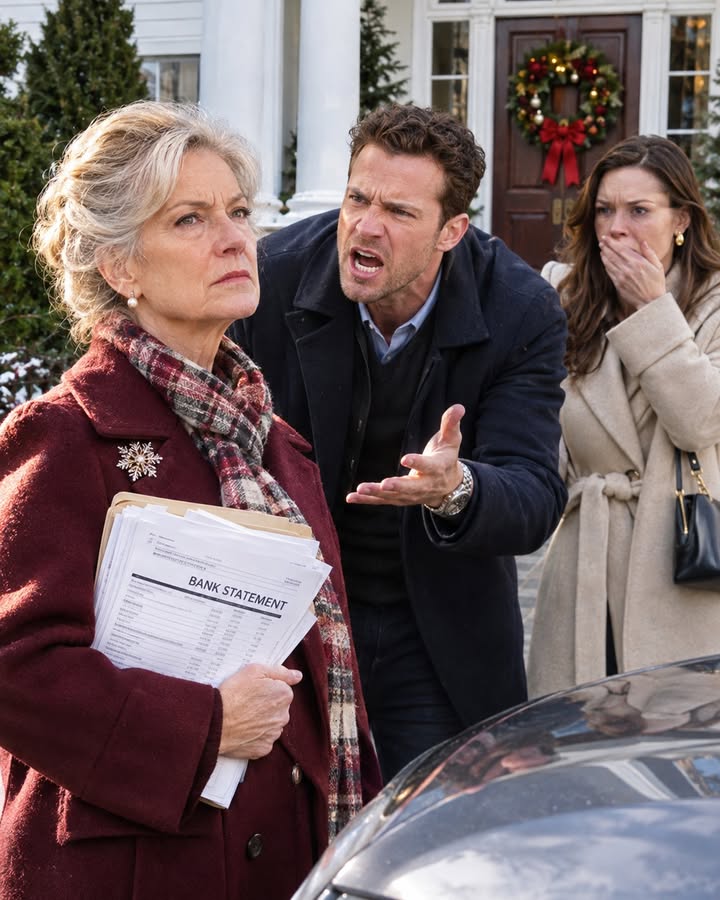
He stood on the porch in his dark coat, hair damp from the cold air, his face pale with anger and something else I could not name.
“Mom,” he said, without greeting me.
“Did you cancel my card?”
The question landed between us.
I stepped aside, and he came in.
“I removed you as an authorized user,” I said.
“The card is still open.”
He took off his gloves but kept his coat on.
“I tried to pay for something this morning, and it was declined.”
“I’m sorry it surprised you.”
“Surprised me?” His voice rose, then he lowered it again as if remembering where he was.
“I thought we had an arrangement.”
“We had several arrangements,” I said.
“I’m trying to understand what each one was.”
He looked at me, as though he expected me to explain myself and had not prepared for a question in return.
“You could have called me first.”
“I could have.”
“And you didn’t.”
“No.”
The simple answer seemed to unsettle him more than an argument would have.
He glanced toward the kitchen, where the notebook and attorney’s folder sat on the table.
“What’s all that?”
“My records.”
“Since when do you need records?”
“Since I realized I couldn’t tell you exactly what I had given you, or what you thought I had agreed to.”
His expression tightened.
“Mom, I’ve always intended to pay you back.”
I felt the words settle into the room.
He had said them before, in one form or another, but this time I heard how much I needed to know what they meant.
“Then we should write it down,” I said.
He looked at me sharply.
“Write what down?”
“What you borrowed, what you consider a gift, and what you intend to repay.”
For a moment, he seemed more hurt than angry.
“I thought you trusted me.”
“I did.”
He looked away.
The silence that followed was not empty.
It was full of all the times I had said yes without asking for details, and all the times he had accepted without offering them.
“I’m not trying to make you feel small,” I said.
“I’m trying to see clearly.”
His shoulders dropped a little, though his face remained guarded.
“I have to go,” he said.
“Claire’s waiting.”
He walked toward the door, then paused with one hand on the knob.
“Are you really doing this because we’re going to her parents’ house?”
I could have said yes.
Part of me was hurt, and the timing had made the hurt impossible to ignore.
But the truth was larger than one holiday.
“No,” I said.
“I’m doing it because I can’t keep pretending I understand an arrangement I’ve never properly understood.”
He nodded once, without looking at me, and left.
I stood at the door until his car disappeared beyond the bend.
There was no satisfaction in watching him go.
Only grief, familiar and sharp, for the closeness I had believed we still had.
I returned to the kitchen and opened the folder.
The pages were neat, the accounts listed in a way that made them look more manageable than they felt.
At the back, I found the notes from my conversation with the lawyer.
One line had been underlined in my own hand: Ask about transfer from savings—house deposit?
I stared at it, trying to remember why I had written those words.
Then I found the statement I had tucked beneath the folder, with a large transfer recorded several months earlier.
The description read: HOUSE DEPOSIT—DANIEL.
I remembered sending the money.
I remembered Daniel telling me it was a short-term loan, only until a deal went through.
But the notation beside the transfer was in my handwriting, and I had written the word gift.
**–END OF PART 2–CLICK “NEXT” AT THE BOTTOM OF THE PAGE TO CONTINUE READING**
* * *
[NEXT: PART 3](https://puretales.idolsgift.com/blog/part-3-the-accounts-i-had-never-counted-029)
✓ Lynn R. Adams
Part 2 – The Accounts I Had Never Counted For a long while, I stood beside the tree with Daniel’s message glowing on my phone, while the cinnamon scent from the cookies drifted through the quiet room…