On the day a demolition crew shattered the bridge he had built with his own hands, seventy-year-old Daniel Mercer
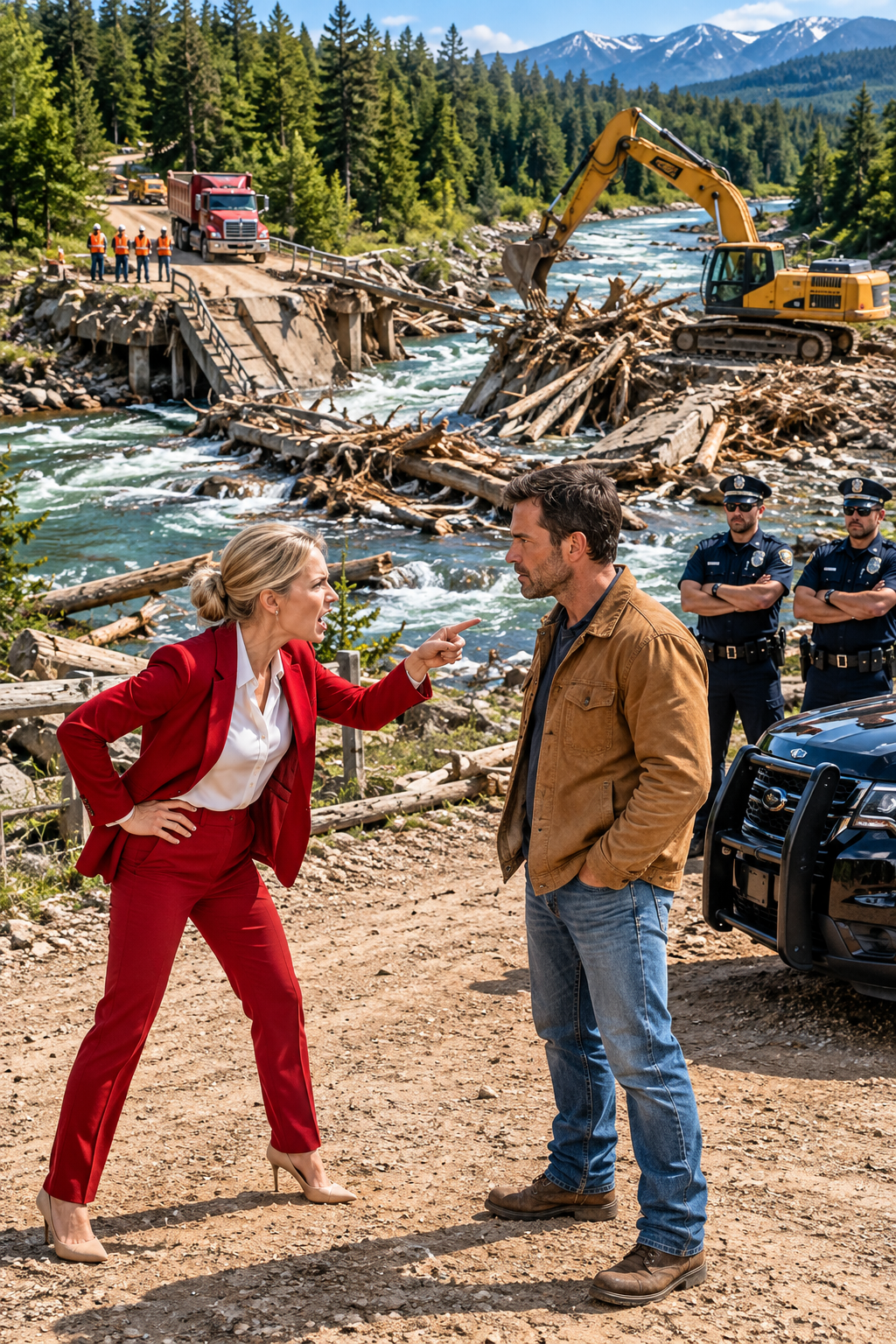
Part 2: A neighbor’s folder turned a private grievance into a fight
That evening, I sat at my kitchen table with the lights off, watching the creek through the window and thinking about what was missing from Karen’s paperwork. There was no permit number, no court reference, and no recorded vote authorizing the physical destruction of anything on my land. The orange notice cited a bylaw about unapproved structures, but it did not show that the HOA had the right to enter my property with a demolition crew. I had spent years choosing quiet over conflict, attending meetings, paying dues, and changing a porch light because the bulb was supposedly the wrong shade of white. The bridge had been the first time Karen’s authority reached beyond nuisance and into something I could not pretend was harmless.
At seven that night, Mrs. Chen knocked on my door with a casserole dish in both hands and worry written plainly across her face. She lived two houses down, was in her seventies, and had received fourteen violation notices in fourteen months for matters as small as the angle of a porch light. “She’s done this to six families,” she told me, lowering her voice though we were alone on the porch. “You’re the first person who didn’t apologize right away.” Before she left, she set her neatly sorted folder of notices on my kitchen counter, offering it in case the paperwork helped.
I retrieved the fireproof box from the hall closet and found the deed my family had held since 1987. The legal description included the road, its full boundary, and every parcel of land that connected it to the public highway. The county had assessed taxes on the property to my family for thirty-one consecutive years, without a break or a change in owner. That night, I called Martin Hale, the property attorney who had handled my deeds and easements for nineteen years. He listened carefully, then told me that administrative fines did not give an HOA the power to demolish private property without a court order or proper permit.
Three days after the demolition, I drove to the HOA office, which Karen had set up in the empty half of her two-car garage. Her folding table, ring light, padded chair, and framed charter made the place look like a tiny courtroom built for one judge. I gave her a formal request for the demolition permit, the board vote, and any legal document authorizing the work. She opened a tabbed binder to Section Twelve and insisted the HOA’s broad enforcement powers covered the bridge. When I asked again whether that section allowed her to destroy a structure without a permit or court order, she shut the binder and placed a pre-drafted lien notice beside my request.
That was when I understood how far ahead she had prepared. The lien form already carried my address, and the invoice appeared ready for filing before I had even asked what authority she claimed. I took both papers without arguing and asked whether she had ever checked the county records for the road the HOA called its own. “It’s community property,” she said, with the impatience of someone repeating a fact she had never needed to prove. I thanked her, went home, and wrote a certified letter requesting the full board records and the recorded instrument establishing HOA ownership of the road. Four days later, she answered with a new claim: the entire parcel was under community jurisdiction because residents had used it for more than twenty years.
Part 3: The deed exposed a plan bigger than my bridge
The county recorder’s office was a low brick building where the public records lived in cabinets and databases, waiting for someone to ask the right question. I took my deed number to the clerk and requested the original subdivision plat, the survey filed when the homes were built. Twelve minutes later, she placed the large sheet before me, and I found the road immediately, drawn through the neighborhood with my family’s name printed beside its boundaries. There was no recorded easement, no transfer of ownership, and no right-of-way document showing that the HOA had ever acquired legal control. The road was not merely absent from Karen’s records; it had never left my family’s.
I also ordered the HOA’s incorporation charter and its attached schedule of common property. The list named the pool, clubhouse, playground, decorative ponds, and walking paths, each described in precise legal language. The road did not appear anywhere, not even as a note or an addendum. As I drove home with certified copies on the passenger seat, I kept thinking about Karen’s certainty and how little of it rested on actual documents. Her claim was not supported by the public record, but she was already using it to pressure people who had no idea what the record said.
Mrs. Chen came back that evening with Patricia, a neighbor from the east side of the loop. Patricia told me Karen had once described the road as a “revenue opportunity,” proposing monthly assessments for residents once the HOA claimed control of it. Over the next two days, four more neighbors came to my door, each carrying a different story about fines, liens, or delayed home sales. A retired veteran had a lien filed over a mailbox painted two shades away from the approved gray. A young couple had paid twelve hundred dollars after Karen disputed a stone path installed by the previous owner, even though the fee never appeared in meeting minutes.
A family with a daughter who used a wheelchair had been fined eight hundred dollars for a front-door ramp after twice submitting approval requests and receiving no answer. Their daughter still needed the ramp, but they had begun to fear that every effort to make their home accessible would invite more trouble. None of these neighbors came looking for a hero; most just wanted someone to confirm that what had happened to them was not normal. Their stories changed the meaning of the broken bridge, turning it from a personal loss into a pattern that had been allowed to grow unchecked. I wrote down every date, gathered every document, and asked Martin to put the road’s ownership plainly on the record.
His response to Karen’s jurisdiction claim was one page long and free of threats. It cited my deed, the recorded plat, and the absence of any easement or title transfer, then stated that the road remained private property. A certified copy went to the HOA office, and another was added to my file beside the tax records and the demolition invoice. That same week, Karen’s attorney filed a civil suit claiming a prescriptive easement based on the community’s long use of the road. Martin explained that the HOA might argue that years of open, continuous use had created a legal right, but thirty-one years of taxes paid by me weakened that claim from the start.
Part 4: The lawsuit tried to freeze the road while neighbors took sides
The lawsuit did not need to be strong to make life harder. While it remained open, Martin advised me not to block the road or make any unilateral changes that could be portrayed as retaliation. Karen knew the case could take months, and she used that time to frame herself as the defender of everyone’s access to home. Three days after filing, she sent a glossy newsletter to every mailbox, claiming that one homeowner was trying to take the shared road away from the community. She did not mention that I had made no public claim before her attorney sued, or that her own charter excluded the road.
That week, my mortgage company paused a refinancing application because the suit had placed a title alert on the parcel. Patricia told me Karen had phoned to say that people associated with my “side” might find their compliance reviews becoming more thorough. Two days later, the young couple received a violation notice about the angle of their downspouts, which had been installed before they bought the house. I added each event to the file, recording the date and keeping copies of every letter. Martin filed a motion to dismiss, attaching the deed, the subdivision plat, the HOA charter, and the thirty-one years of tax assessments.
Then the annual meeting agenda arrived in everyone’s inbox. Item Four promised a “final community vote” on road access and community property, a phrase that sounded official enough to reassure people who had never seen the records. I knew Karen planned to use the suit and newsletter to make the vote feel urgent, then present the result as proof that the road belonged to the HOA. I could have challenged her before the meeting, but Martin and I agreed that a public claim would draw the most attention to the documents she had refused to examine. I sealed certified copies of the deed, plat, charter, and tax record in a manila envelope and put it in my folder.
The community center was packed when I arrived, with more than sixty residents filling folding chairs and the room smelling of coffee and floor cleaner. Karen had projected an aerial photo of the subdivision, the road traced in blue and labeled “HOA Community Road—Established 2003.” She spoke for ten minutes about the neighborhood’s history and the danger of losing access, calling my bridge an unapproved hazard the association had responsibly removed. The applause began with her inner circle, then spread unevenly through the room as people followed the sound without knowing what they were endorsing. I watched Mrs. Chen, the veteran, and the young couple sit still, their faces fixed on the screen.
Mrs. Chen raised her hand and asked which recorded HOA document listed the road as common property. Karen answered that years of use formed the legal basis, but Mrs. Chen repeated her request for the specific recorded document. The veteran followed by asking who had paid the road taxes, and said the assessor’s office had told him they were billed to a private owner for more than thirty years. Karen called the tax records irrelevant and quickly moved toward the vote. I stood, walked to the front, and placed my sealed envelope on the table, telling the board that its contents directly affected the legal validity of any resolution.
Part 5: Karen called the vote with the evidence still sealed
For a moment, the whole room seemed to wait with me. The board member who had looked at his shoes during the demolition said quietly that perhaps they should open the envelope before voting. Karen held his gaze, picked up the envelope, and set it aside without breaking the seal. Then she called for the vote, and the motion passed thirty-one to twenty-eight. Her supporters shook hands while someone took a photograph of the board, and Karen smiled as if the close result had settled the matter for good.
The envelope remained on the table as residents collected their coats and emptied their coffee cups. I watched it sit there, unopened and slightly crooked, while the room slowly drained of the people who had just voted on property they did not own. Twenty-eight neighbors had voted no, the closest opposition I could remember during Karen’s years in office. She had won a community vote, but the deed could not be changed by applause or a show of hands. The case would be decided by records, and the records were already waiting in court.
Nine weeks after the suit was filed, Martin and I entered a wood-paneled courtroom for the motion-to-dismiss hearing. Karen sat beside her lawyer, Garrett, who had brought a box of tabbed documents and appeared prepared to make the strongest argument he could. He described more than twenty years of community use, the association’s maintenance work, and the residents’ dependence on the road. His presentation was composed and competent, but it depended on the idea that I had abandoned control of the land. The judge listened without expression, making occasional notes beneath the fluorescent lights.
Martin stood and placed the deed on the bench, followed by the 2003 plat showing the road’s boundary and my family’s ownership. He explained that no easement or transfer had ever been filed and that the HOA’s own founding documents did not list the road as common property. The judge read the deed, reviewed the plat, and asked Garrett whether his client had conducted a title search before filing suit. Garrett said they had relied on the community’s established history of use. The judge put on her glasses and asked how the HOA could prove abandonment when the defendant held a deed and had continued to pay taxes.
Martin added the county assessor’s history, showing thirty-one consecutive years of tax bills paid by me. Then he placed the HOA’s incorporation schedule beside it, with the road conspicuously absent from the list of community property. The judge reviewed both documents, turned a page, and announced that the motion to dismiss was granted with prejudice. Karen’s claim could not be refiled in that form, and the community vote had no power to change ownership. For the first time since the demolition, I saw Karen look not at me, but down at the table.
Part 6: The judge sent the demolition beyond the HOA dispute
The judge was not finished when she dismissed the case. She picked up the orange notice, pointed out that it contained no demolition permit or court authorization, and then reviewed the transcript of my recording. The HOA representative had claimed authority over property the court had just confirmed was private. A bylaw dispute, the judge said, did not authorize the physical destruction of a structure on land outside the HOA’s jurisdiction. She ordered her clerk to forward the relevant documents to the district attorney’s office for review.
Karen’s lawyer leaned close and spoke into her ear, but whatever he said could not restore the calm she had worn through every previous meeting. Her face had gone pale, and her hands were clasped too tightly on the table. I gathered my copy of the deed, thanked Martin, and walked into the hallway without turning back. Outside, people were moving through the courthouse as if nothing had happened, carrying folders and coffee beneath a row of framed county officials. Yet the truth had finally been stated where Karen could not edit it: the road was mine, and her demolition had not been authorized.
The calls began before evening. The board member who had urged Karen to open the envelope called an emergency session, and Mrs. Chen phoned to say the neighborhood felt different already. The veteran told me his mortgage servicer had seen the court docket and removed the litigation flag from his property. The young couple sent a simple text: Thank you. None of them sounded triumphant; they sounded as if they were learning what it felt like to breathe without first checking whether someone might punish them for it.
Twelve days later, the judge’s written ruling arrived, forty-three pages documenting the procedural record and legal conclusions. It confirmed the HOA had never held jurisdiction over my road or bridge, and that the community vote carried no force to transfer private property. The district attorney’s office opened a formal criminal investigation and requested copies of the notice, recording, invoice, and contractor records. Martin sent the full file the following morning. Karen was later charged personally with criminal destruction of private property, and she hired a criminal defense attorney separate from Garrett.
The civil case over the demolition resolved six weeks after the dismissal. A court order made Karen personally responsible for the cost of rebuilding the bridge and my legal fees, totaling twenty-eight thousand dollars. The four-thousand-two-hundred-dollar invoice she had placed on my truck was returned with statutory interest, while the five-hundred-dollar fine was voided. Every notice and lien associated with my property during her tenure was ordered removed from the record. My refinancing application, frozen by the lawsuit, was approved within ten days of the clean title confirmation.
Part 7: A neighborhood that had learned to stay quiet spoke up
The HOA called an emergency board meeting three weeks after the hearing, and Karen was voted off the board that evening. Three of her closest allies submitted resignations before the week was out, leaving the remaining members to explain how the association had come to act without checking its own records. At a follow-up meeting, homeowners elected a new board that included Mrs. Chen and the retired veteran whose mailbox had once triggered a lien. Their first formal action was not a new fine schedule or a stricter design rule. It was a written apology to me, signed by all nine members, retracting the enforcement actions and entered into the permanent HOA record.
The changes around the neighborhood came gradually, one small act at a time. People who had once hurried past each other began waving from their driveways, and neighbors stopped by without whispering about who might see them. Mrs. Chen brought back the bird feeder that had been called noncompliant, hanging it where she wanted and filling it with seed for the cardinals. The veteran visited one afternoon with a six-pack, and we sat on the porch for nearly an hour without discussing the lawsuit or Karen. Some of the people who had stood beside her at meetings grew quiet and kept their distance, but no one asked the neighborhood to pretend the past had not happened.
I hired a licensed contractor to rebuild the bridge in early spring. Martin recommended a structural engineer, and the county issued the proper permit before the crew set the deeper footings and laid the new span. The new bridge was wider than the old one, built to withstand years of flooding and winter ice. When the work was finished, I bought a cedar plank, routed the letters myself, and mounted it on the railing. It read: “Built 1987. Rebuilt 2024.”
I also filed a recorded notice with the county clarifying that the road remained private property and that residents could use it with my permission. The notice stated that future HOA enforcement on my parcel required lawful authority, not a board member’s interpretation of a bylaw. Martin made sure it was entered into the public record where anyone conducting a proper title search would find it. The road remained open, and people continued driving to their homes as they always had. The difference was that the arrangement no longer depended on everyone pretending the HOA owned something it did not.
Six weeks after the ruling, Karen came to my door on a Saturday morning carrying an envelope. She had parked at the curb, just off the asphalt, and walked up the path with the careful posture of someone newly aware of where private property began. The envelope contained her court-ordered payment, and she held it out without quite meeting my eyes. I accepted it, thanked her, and held the door open long enough for the transaction to be complete. She walked back down the road, got into her car, and drove away without saying another word.
Part 8: The rebuilt bridge became a reminder of what neighbors could protect
By late spring, the new bridge had lost the raw brightness of fresh lumber, though it still caught the morning sun before the trees did. I drank coffee on the porch and watched the water move beneath it, remembering the old span without wishing the story had gone differently. The old bridge had been built with my hands; the new one had been built with permits, drawings, and a lesson I should have learned sooner. Property lines matter, but so does the courage to speak when someone tries to erase them. A deed can establish ownership, but it cannot make a frightened neighbor believe they are safe enough to stand up.
The new board held monthly meetings that were shorter and less theatrical than Karen’s had been. They began publishing minutes, explaining decisions, and giving residents a clear process for appealing a violation. Notices that had been issued without board approval were reviewed and removed where appropriate. The association also created a small access committee to communicate with me about road maintenance, since residents still needed to use the road and I had no interest in punishing families for the developer’s old mistake. We signed a simple written agreement that allowed continued access while preserving the actual ownership record.
Mrs. Chen was the first to use the new appeal process. She submitted a request to keep her bird feeder and received a written approval within a week, though no one had any real reason to think she needed one. She laughed when she showed me the letter, a sound I had not heard from her during the months she brought her folders of violations. The veteran asked the board to review every lien placed during Karen’s tenure, and several families found their records cleared. The young couple sold their house the following year without a title delay, and they sent me a postcard from their new home with a photograph of their daughter using the ramp.
I was asked to attend a community meeting the following winter, not to give a speech about the lawsuit but to explain what the old plat showed. I brought copies of the deed, survey, and tax history, then set them on the front table. People asked practical questions about road repairs, insurance, access, and how an easement could have been recorded properly. I answered what I could and let Martin handle the legal details. When the meeting ended, the board voted to hire a title professional to review every common area and correct the association’s records.
The investigation into Karen moved more slowly than the HOA reforms, as criminal cases often do. She eventually pleaded to a reduced property-damage charge under an agreement that included restitution, probation, and a public acknowledgment that she had ordered the demolition without the required legal authority. I did not attend the hearing, and I did not ask anyone to celebrate the sentence. The bridge was rebuilt, the road’s status was on record, and the people who had been harmed were beginning to recover their confidence. Justice did not return the summer afternoons I had spent building the first bridge, but it did stop the damage from spreading.
Part 9: The road stayed open, and the neighborhood learned to speak
A year after the demolition, the HOA held its annual meeting in the same community center where Karen had once called the vote. The chairs were still stackable, the coffee still came from the same urn, and the cleaning solution still lingered in the air. This time, the board placed the road agreement and the title review on the agenda before anyone arrived. Mrs. Chen sat in the front row with her bird feeder approval letter tucked into her folder, while the veteran sat beside her. When the chair opened the floor, residents spoke about sidewalk repairs, playground upkeep, and the little problems that make a neighborhood feel like a shared home.
I sat near the back as I had at the previous meeting, but I was no longer hiding behind a folder or waiting for someone else to ask the difficult question. The road remained open, the homes remained connected, and the HOA had no need to invent authority it had never possessed. There was no grand apology speech and no photograph of a victorious board. There was simply a vote to maintain transparent records and a promise that no structure on private land would be removed without lawful process. It was less dramatic than Karen’s old meetings, and that was precisely why it felt like progress.
In the months that followed, people still disagreed about paint colors, parking, and how late children could play basketball. The difference was that a disagreement no longer arrived wrapped in a threat of liens and legal fees. The board posted its rules, answered messages, and admitted when it had made a mistake. Neighbors began contacting one another before calling the HOA, and many disputes ended with a conversation over a fence. The community was not perfect, but it had stopped confusing obedience with peace.
I kept the orange notice in a drawer with the old bridge plans, not because I wanted to relive the day it came down but because I wanted to remember how quickly a person can mistake confidence for authority. Karen had believed her title and laminated card made her untouchable. She had expected me to argue, then pay, then disappear into the same silence that had kept everyone else manageable. Instead, I had read the deed, asked for the records, and listened when my neighbors told me what had happened to them. That was the beginning of the end of her control.
Some mornings, when the creek ran high and the new bridge trembled faintly beneath a passing truck, I thought about my father and the open farmland that had once surrounded the property. He had agreed to let the first residents use the road because he thought a handshake was enough when people meant well. He had not imagined that years later an HOA would confuse courtesy with ownership, or that I would need a courtroom to protect a bridge I had built decades before. I could not change that history, but I could make the terms clear for the people who came after me.
The cedar plank remains on the railing, weathering slowly beneath the branches. On one side is the creek; on the other is the road that carries families home. Most days, I see nothing remarkable in either view, only water, trees, tires, and the ordinary rhythm of people living their lives. But when I look at the bridge, I remember that the most powerful thing I did was refuse to accept a false bill for someone else’s wrongdoing. The bridge stands because the truth finally stood with it, and the road stays open because the neighbors learned that speaking together is stronger than staying quiet alone.
✓ Lynn R. Adams
Part 2: A neighbor’s folder turned a private grievance into a fight That evening, I sat at my kitchen table with the lights off, watching the creek through the window and thinking about what was miss…