On my wedding morning, my fiancé gave my limousine to his childhood friend,
Part 2: A group chat showed me where I stood
I stared at the message until the words blurred. Ethan remembered that Vanessa had fought with someone in Toronto and knew she hated sharing attention. He had planned every detail to protect her mood and her image; he had simply forgotten that it was my wedding day. The light ahead turned red, and Frank looked at me in the rearview mirror. I glanced at the empty road where the limousine had disappeared, felt something inside me finally snap, and told him to turn around. “Take me back to the hotel,” I said, “but not for the wedding; I need my luggage.”
My phone erupted with notifications from Ethan’s private group chat with his childhood friends. Vanessa had added me months earlier, saying we would all be family soon, but the group had been almost silent until that morning. She posted more than a dozen photographs of herself beside Ethan in the limousine, with a caption about proving she could be happy without a certain man. In the last picture, she cupped Ethan’s face in both hands while he smiled with a tenderness I had not seen directed at me in months. During our engagement shoot, he had called a similar pose forced and said he hated staged photographs.
The replies came quickly. Mark, Ethan’s closest childhood friend, wrote that he had always thought Ethan and Vanessa belonged together. Luke, Ethan’s cousin, called me the rebound Ethan found after Vanessa left the country. Someone else said they would have skipped my wedding if they had known Vanessa would look more like the bride. Every one of them had been polite to my face. Mark once thanked me for helping Ethan recover after Vanessa moved away, and Luke had held my hand after I drove through a storm to deliver his missing bidding documents.
I had arrived at Luke’s office with a swollen knee and blood on my stockings after my car skidded against a barrier. He promised he would remember my kindness for the rest of his life. Apparently, the only thing these people remembered was that I would always rank below Vanessa. Ethan finally appeared in the chat, but he did not defend me or tell anyone to stop. He wrote one sentence: “Don’t talk about Clare today. Just tell Vanessa how beautiful she looks.” My fingers had gone cold, but I typed back, asking whether they were all comfortable insulting me behind my back and who exactly was the bride.
Mark replied, “Damn, wrong group,” and Ethan called immediately. There was no apology or explanation. He told me to return to the chat and apologize, and when I asked to whom, he said not everyone had to like me. “They’ve known Vanessa and me for more than twenty years,” he explained. “You came later.” When I asked whether that gave them permission to humiliate me on my wedding day, he sighed and said Vanessa was crying because she felt guilty that I had seen the messages. Her tears, he said, were the emergency; my dignity could wait.
Part 3: His choices brought back the day I lost our baby
“Ethan, we’re done,” I said quietly. “The wedding is canceled. I will not sign or consent to any paperwork that makes us legally married.” He did not answer at first; I heard tissues rustling and Vanessa crying nearby. He covered the phone and told her I was being sensitive and would not actually leave. He even reminded her not to ruin her makeup because the hotel photographer still needed her arrival footage. When he came back to me, he warned me not to end a ten-year relationship on our wedding day over something I would regret.
“We’ve been together ten years, Clare,” he said with a faint, amused edge. “Do you really think you can walk away?” I ended the call. Frank glanced at me in the mirror and asked whether Ethan had always treated me like that. I wanted to say no, but old memories came back before I could answer. During college, a blizzard trapped us on campus while I had a fever of nearly 104 degrees. Ethan carried me for miles through the snow, wrapped his coat around me, and ended up hospitalized with frostbite.
I had been barely conscious on his back when I whispered, “Don’t leave me.” He answered, “Never,” and I believed him for years. Two years before the wedding, I lost our baby after waking with severe pain and bleeding. I called Ethan repeatedly, but when he finally answered, Vanessa’s laughter came through the phone. She and their friends were at an amusement park, and they had agreed not to take work or family calls that day. Ethan said he would call me back, then the connection ended before anyone could help.
My roommate, whom I had known for less than a month, found me unconscious and rushed me to the hospital. She signed the emergency forms because no one else was there. The doctor later told me that arriving even half an hour sooner might have changed the outcome. Ethan did not appear until late that night, after my parents had driven in from another state. My father ordered him out and told me that if I stayed with a man who abandoned me in an emergency, I should not come home again. I left Ethan then, but eighteen months later, I returned.
For those eighteen months, Ethan seemed transformed. He cut off contact with Vanessa, attended couples counseling, accompanied me to medical appointments, and added me to his company’s product decision committee. One winter night, he stood outside my parents’ house in the snow until hypothermia sent him to the emergency room. I believed that pain had made him understand what he might lose. Then Vanessa returned to Boston six months before the wedding, and the rides, late-night calls, and weekend gatherings began again. I had mistaken eighteen months without temptation for permanent change.
Part 4: I left the hotel and went home to my parents
At the Hawthorne, I avoided the ballroom and went straight to the bridal suite. I removed my gown, washed off my makeup, and packed my identification, laptop, notebooks, and a few necessary clothes. Vanessa’s public videos kept appearing on my phone, each one clearly aimed at someone in Toronto. She stepped out of my limousine and told the camera that some people missed their chance and regretted it forever. Ethan had described her behavior as emotional venting after a fight with a friend, but why was my wedding the stage for it?
The wedding coordinator had been told Vanessa would film a short mock entrance before the real ceremony. The videos showed something very different: she stayed after walking down the aisle, stopped in front of Ethan, and asked him to read vows for the camera. The officiant assumed it was a rehearsal and made light comments about commitment. Then came decorative rings, a first dance, and a family toast. Ethan’s mother even placed the Cole family’s heirloom pearl necklace around Vanessa’s neck. When I confronted Ethan, he said my parents had not even bothered to come and that Vanessa had helped fill the room.
My cousin Lily sent me a video from my parents’ house. They had refused to attend, but they had spent the day at my aunt’s home waiting for news. My mother’s eyes were swollen from crying, and she blamed my father for the harsh words he had spoken two years earlier. My father sat quietly before taking out a check and handing it to Lily. “This is for Clare to start over,” he said. “It doesn’t matter whether she gets married. Just make sure she never stays anywhere because she thinks she has nowhere else to go.”
I stared at the gray in my father’s hair and finally broke down. The people who feared seeing me humiliated were the people I had shut out of the wedding. The man who humiliated me expected me to enter through a side door and thank him for letting me participate. I texted my father, “Dad, can I come home?” His answer arrived almost instantly: “The door was never locked.” I was closing my suitcase when Ethan called again, saying Vanessa had damaged part of the cake display and backdrop, and the hotel could move our ceremony to a smaller room at nine.
I let my voice sound calm, and Ethan seemed relieved. He said he was glad I had settled down, then promised that once the legal paperwork was finished, he would make everything up to me. I did not tell him that I had already notified the officiant and clerk that the marriage would not proceed. I removed my engagement ring, placed it beside the unsigned paperwork, and took my suitcase downstairs. Frank was still waiting. When I gave him my parents’ address, a six-hour drive away, he opened the trunk without asking a single question.
Part 5: The wedding ended without its bride
I did not watch the hotel’s livestream during the drive. I learned what happened afterward from the coordinator’s report, videos my bridesmaid Rachel sent, and screenshots Noah gave to my attorney. Noah had been Ethan’s college roommate and the only person in the group chat who had not insulted me. At nine that evening, the lights came on in the smaller ceremony room, and the officiant waited twenty minutes for the bride. Ethan was not worried at first; he assumed I was hiding somewhere in the hotel and wanted him to persuade me to stop being difficult.
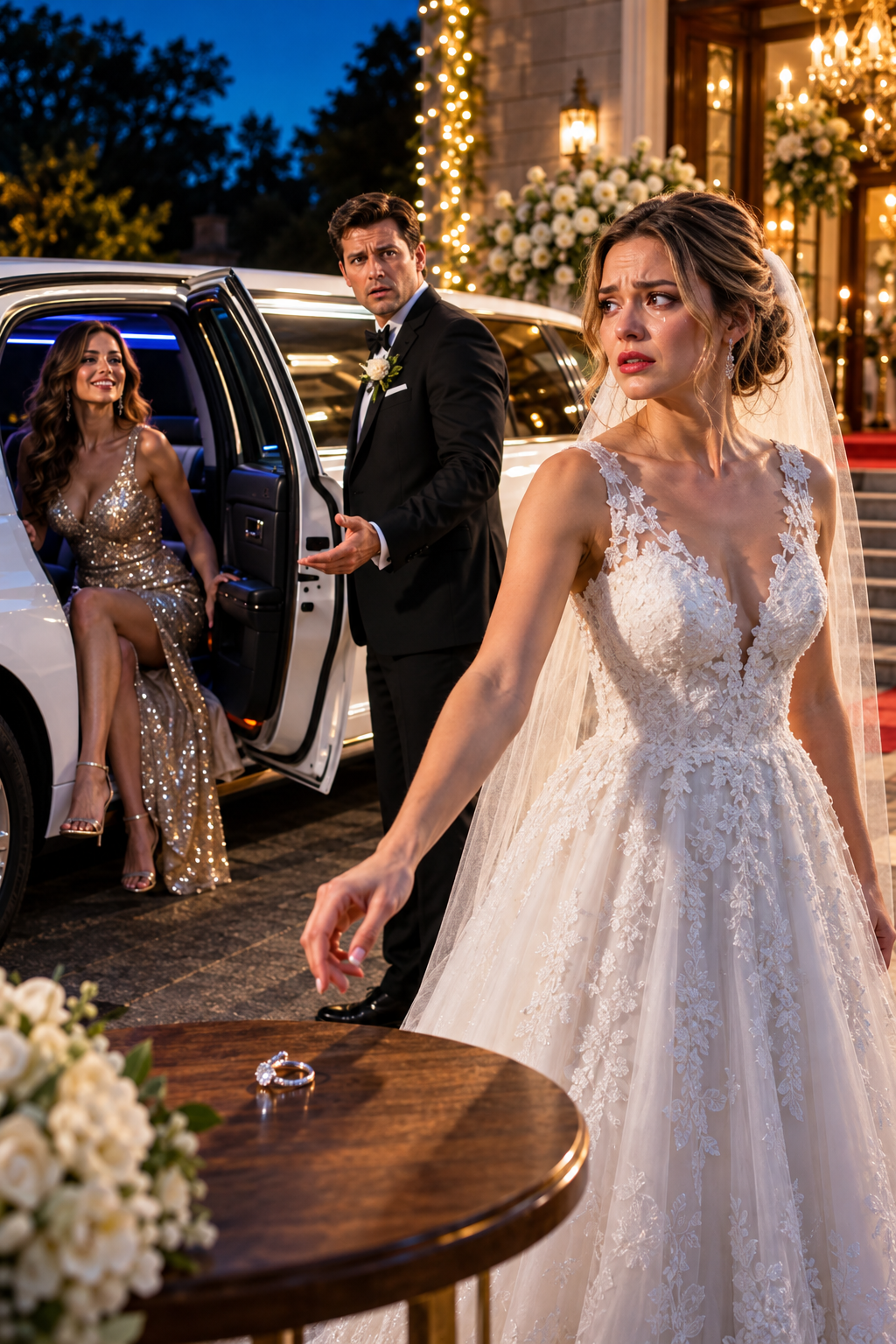
Then the guest-services manager handed him a clear property bag. Inside were my engagement ring, the unsigned paperwork, and a note telling the hotel the ceremony was canceled and no wedding activity should proceed in my name. Around the same time, a stranger uploaded a video filmed outside our apartment building. It showed Ethan blocking me from the limousine, helping Vanessa inside, then leaving me in my wedding gown to climb into an ordinary ride share. The caption asked why the bride was calling a car while another woman rode away in the bridal limo.
Vanessa had posted every part of her bridal-limo experience publicly because she wanted someone in Toronto to see it. People placed her videos beside the stranger’s footage, and the full picture became impossible to misunderstand. Rachel confirmed that Vanessa had worn my reception dress, accepted the family pearls, read vows, danced the first dance, and destroyed the wedding cake. Noah sent the group-chat screenshots to my attorney so they could be preserved. The comments about me being Ethan’s rebound spread alongside the videos. People saw that the woman who had planned the wedding was not the one being treated like a bride.
Guests began leaving the Hawthorne early. Ethan’s mother demanded that Vanessa delete her posts, while Vanessa cried and insisted she had only wanted to experience a wedding. According to Noah, she then suggested she could stand in for me during the evening ceremony so the venue and catering would not be wasted. Ethan finally told her, in front of everyone, “This is not your wedding.” The hotel refused to continue a ceremony without the actual bride’s presence and consent. By then, the day had already become a public humiliation.
Ethan searched the bridal suite and then our apartment. He found that I had taken my documents, my work, and the possessions that mattered, but I had not emptied the closets or stripped the rooms bare. At two in the morning, he sent a message that almost resembled an apology: he should not have let Vanessa take my limousine. Then came more explanations and promises: we could have another wedding, I could choose every detail, and ten years could not be erased over one day. I did not reply. One day had not destroyed our relationship; it had exposed what every smaller choice had meant.
Part 6: I reclaimed the work Ethan had treated as his
Frank pulled up outside my parents’ house a little after one in the morning. I sat in the back seat for several minutes, staring at the light in the living room window. Two years earlier, I had dragged a suitcase out of that same house after reconciling with Ethan. My father had said cruel things, and I had answered with words just as cruel. I had believed returning would mean admitting I failed. Now I understood that admitting a mistake was not shameful; continuing down the wrong road just to avoid admitting it was how people wasted their lives.
I barely reached the front step before the door opened. My mother stood there in a robe and winter coat, her eyes red. Her lips trembled before she asked only, “Are you hungry?” I began to cry and told her I had not gotten married. She pulled me into her arms while my father stood in the living room with his back to us, removing his glasses to wipe his eyes. “Your room is still there,” he said. Dinner had been reheated three times, and the check Lily had shown me was tucked beneath my plate.
I tried to return the money, but my father shook his head. “It is not a wedding gift,” he said. “It is so you never remain beside anyone because you’re afraid you have nowhere to go.” I slept for sixteen hours. When I woke, my phone showed more than seventy missed calls from Ethan and dozens of messages, shifting from orders to come back to promises to arrange another wedding. I sent his number to my attorney and asked that all further communication go through her.
Then I opened my laptop and organized four years of files connected to Cole Restaurant Group. When Ethan opened his first restaurant, he had a business plan, modest capital, and enormous confidence. I sold the commercial rights to a competition pastry to fund the first round of product development. I declined a pastry program in Paris so I could stay in Boston and train his kitchen team. I created holiday gift boxes, banquet menus, and six signature desserts that became permanent bestsellers, while Ethan was introduced publicly as the founder and creative force.
My name appeared mainly in an internal agreement allowing Cole Restaurant Group to use eighteen proprietary formulas, production methods, menu descriptions, and brand stories while I served as a product consultant. The agreement required annual renewal, and the next renewal date fell at the end of the month following our wedding. The company was negotiating expansion financing, and one investor condition required me to remain head of product development and personally guarantee part of the new credit line. The final documents were already in my inbox. I had planned to sign them after the honeymoon; instead, I instructed my attorney not to renew my license or provide a personal guarantee.
Part 7: My work was mine, even when the company needed it
I gave Cole Restaurant Group the thirty-day transition period required by my contract. I did not cancel existing loans or demand that every restaurant close the next morning. I asked the company to pay the consulting fees and development royalties Ethan had repeatedly postponed by saying we would settle everything after the wedding. I did not pursue damages for emotional distress. I told my attorney to separate what belonged to me from what belonged to Ethan, because I did not need anything beyond my rights.
Rachel contacted me and apologized for staying silent during the wedding. She sent my attorney original files showing Vanessa cutting the cake, accepting the pearls, and asking to continue the ceremony in my place. Noah left Ethan’s private group chat and admitted that most people had remained silent because they did not want to risk offending Ethan or Vanessa. Their silence had not pushed me into the limousine, but it had made the humiliation seem acceptable. The day after my attorney’s notice reached the company, Ethan arrived at my parents’ house still wearing the suit from the wedding, his shirt badly wrinkled.
My father opened the door only a few inches. Ethan said the company had employees and that if I refused to renew the license without warning, financing would freeze. I stood halfway down the stairs and heard him make the company his first concern again. My father asked why he had not given me equity or public credit when the company was profitable. Ethan said he was not blaming me, only asking me not to make a business decision while emotional. I walked to the door and asked why reclaiming my own work was proof of emotion when every choice he made on the wedding day had been called rational.
Ethan’s face lost its color. He said he knew he was wrong, but I asked whether he regretted humiliating me or regretted that the investors might hear about it. If the stranger’s video had never gone online and I had returned to marry him in the small conference room, would he have believed he had done anything wrong? He did not answer. I pushed a box through the doorway containing his belongings, the apartment key, and the last items connecting our daily lives. “Ten years were not destroyed in one day,” I told him. “They simply ended when I finally understood them.”
The wedding videos damaged Cole Restaurant Group’s image, and Ethan’s crisis team wanted him and Vanessa to issue a joint apology. Vanessa refused, arguing that the limousine had been Ethan’s idea and that he had read vows with her. She told him he was the one who left the actual bride on the sidewalk. Her words were cruel, but they were true. She had treated Ethan as a prop in a performance meant to provoke Alex, the man in Toronto who had ignored her after an argument. Ethan had chosen to participate, and when the performance hurt me, he expected me to absorb the consequences.
Part 8: The company paid for work it had never owned
Vanessa’s videos succeeded in getting Alex’s attention, but he called only to demand that she delete anything that might affect his professional reputation. After another argument, she flew to Toronto and returned my dress and the Cole family pearls through an attorney. She left a message saying it was only a wedding and I should not take it so seriously. Months later, I heard she and Alex had reconciled. The news did not give me the satisfaction people expected, because Vanessa’s feelings had never been the reason I left. Ethan had made his own choices.
Cole Restaurant Group did not collapse the day after my notice. It had thirty days to transition and could continue selling inventory already produced under the agreement. The investment committee paused the expansion round because the original financing report listed my continuing role as a key condition. Without my personal guarantee, the proposed credit facility also had to be redesigned. Ethan hired new development consultants and asked them to replace the products I had created before the license expired. At first, the changes seemed manageable.
During the second month, six signature desserts disappeared from the menus one by one. The new team changed ingredients and ratios to make substitutes, but the results were inconsistent. Longtime customers began asking why the classics tasted different. During the third month, Ethan’s team used notes from recipes I had never licensed, stored in an old file box in our apartment. My attorney discovered it and sought a protective order. We submitted timestamped digital files, notarized records, and internal emails showing the recipes were mine.
The dispute did not reach a full trial. During mediation, Cole Restaurant Group admitted that unlicensed trade secrets had been used and agreed to pay compensation. By the fourth month, all seven planned restaurant openings were suspended, while cash remained tied up in leases, construction contracts, and supplier deposits. Ethan closed two older locations that had been losing money and sold the apartment we had once planned to use as our marital home. By the sixth month, investors acquired a controlling interest at a discounted valuation, and Ethan stepped down from management.
He did not become homeless or lose every dollar he had earned. He lost the prestige of being seen as a visionary founder, the partner who supported him without limits, and the right to use someone else’s creativity and financial credibility without paying their true cost. The friends from the wedding chat disappeared, too. Mark claimed he had only been joking, while Luke deleted his social accounts and refused to accept responsibility. Noah later told me Ethan found an old metal box in the apartment containing photographs of my pastry experiments, each marked with dates, temperatures, ingredient ratios, and notes for the next attempt.
The last photograph showed Ethan standing in front of the first restaurant with his arm around me. On the back, I had written, “I hope one day everyone knows how talented Ethan is.” Noah said Ethan sat alone in the empty apartment looking at it for a long time. When I heard that, I realized my sincere wish for his success had not been foolish simply because the relationship ended badly. But I had mistaken invisibility for love, and I had allowed my work to disappear inside his story. Two months after returning to my parents’ home, I rented a small corner storefront and painted my own surname above the door.
Part 9: I built a new future under my own name
The shop could hold only four tables. The kitchen had one old oven and barely enough counter space for two people to work side by side. I named it Bennett Patisserie. The first time I saw my surname painted above the door, I stood across the street staring at it for a long time. For years, the products I created had carried the Cole Restaurant Group logo. In interviews, Ethan called me an inspiration or mentioned the development team, and I never corrected him because I thought the name on the door would not matter once we were married.
At first, many customers came because they had seen the wedding video. They asked whether I was the bride who left in a ride share while wearing a wedding dress. I never denied it. “Yes,” I said, “but this shop sells pastry, not stories about my ex.” What established the business was a chestnut chocolate cake I called Homecoming. The outer layer was slightly bitter, while the center held warm chestnut cream inspired by a dessert my mother made and the dinner she reheated while waiting for me to return.
Homecoming sold out for three consecutive weeks. A historic Boston hotel later hired me to design its winter afternoon tea menu. The project director, Anna, had been a judge at a pastry competition years earlier. After reviewing my proposal, she asked whose name would go on the work this time. I held the pen and wrote, “Clare Bennett.” My father stood nearby pretending to study a fire-safety notice, but his eyes were red. I did not meet a billionaire and prove my value by becoming someone else’s bride; I began taking back the years I had given away without recognition.
The shop grew from four tables to twelve, and then I rented the neighboring unit for a development kitchen. Nine months after the wedding, I entered a national creative pastry competition with the theme “wedding.” While the other contestants made sugar gowns, rings, and white roses, I built a yellow ride-share car. Through the sugar-glass window, a woman who had removed her wedding dress sat beside her suitcase, traveling toward a house with warm lights. I called the piece “Return Trip,” explaining that for some people, leaving the wrong wedding is the first time they truly choose themselves.
It won the gold medal. People mentioned the wedding scandal again, but this time they called me pastry chef Clare Bennett, not the abandoned bride. On the night of the award ceremony, the first snow of the season fell over Boston, and Ethan stood at the bottom of the stairs. I had not seen him in nine months. He carried no flowers or ring, only my old pastry notebook, which I had searched for after leaving the apartment. He asked for five minutes, and I agreed to listen.
He told me the investors now controlled the company and that the settlement and development payments had been made. Then he admitted he had reviewed the medical records from the day I lost our baby. When I first called, he said, there had still been a chance early treatment might change the outcome; less than forty minutes after the call ended, I was taken into surgery. For years, he had called it an unpredictable tragedy because admitting that he could have answered, listened, and taken me seriously would have meant facing what he did. He said the wedding day had repeated the same choice: Vanessa’s tears first, her image first, and me last.
Part 10: I came home to myself and chose not to return
I listened without interrupting. If Ethan had said those words two years earlier, or any day before the wedding, I might have collapsed into tears and believed him one more time. Now I felt only calm. “I believe that you loved me,” I said. A small light appeared in his expression, but I continued. “I loved you too. But having loved each other does not cancel the harm.” He had once carried me through a blizzard, and he had also ignored my calls while I was losing our child; both things were true.
Ethan asked whether there was any possibility for us. “No,” I answered, quietly and immediately. He stood in the snow as if he had always known what I would say, though the words still broke something in him. He asked whether I thought I would ever get married. I looked toward the car waiting at the curb and told him maybe I would, maybe I would not, but if there was a next time, I would not lose myself just to reach the ceremony. When I turned away, he said he was sorry without attaching a request.
A year later, the first Bennett Patisserie flagship opened. There was no extravagant flower arch, only a wooden sign near the entrance that read, “May you always have the courage to choose again.” Frank, the driver who had taken me away from the hotel, came to the opening and stood outside until I recognized him. He said he had seen the video online and kept worrying the man would talk me into going back. I packed him a return-trip dessert, and he raised a thumb, saying that turn had been the most satisfying trip of his driving career.
After closing, my parents celebrated their wedding anniversary in the shop. I made them a chestnut cake, and before picking up the knife, my mother asked with exaggerated seriousness, “May I cut it now, Chef Bennett?” Everyone laughed, and I nodded. “Yes, now you can cut it.” My father served the first slice to me. No one took it away, smeared frosting across a wall, or used my work as a toy to entertain someone else.
I sometimes saw wedding limousines pass with flowers tied to their doors, but I was no longer afraid of wedding dresses. Other people’s ceremonies no longer returned me to the humiliation of my own. I later heard Ethan had left Boston and begun again as a product manager at an ordinary restaurant company. Vanessa held an elaborate wedding in Toronto, wearing an expensive gown and enjoying every tradition she had once called meaningless. Neither fact had the power to define my life.
For years, I believed ten years together meant we had to survive anything. Eventually, I learned that time can prove only that a relationship existed; it cannot prove that the relationship deserves to continue. On my wedding day, everyone who saw me get into that ride share thought I was the bride who had been abandoned. They were wrong. That was the first day I stopped chasing Ethan’s limousine, and the day I finally came home to myself.
✓ Lynn R. Adams
Part 2: A group chat showed me where I stood I stared at the message until the words blurred. Ethan remembered that Vanessa had fought with someone in Toronto and knew she hated sharing attention. He…