On my twenty-fourth birthday, I had $48, one suitcase, and a bed in a Denver women’s shelter after losing my mother and our apartment, but the shelter manager called me into her office and handed me an envelope in Mom’s handwriting, saying she’d been told to give it to me only when I had nowhere left to go…
I took the envelope back to my narrow bed and read the rest after the shelter lights went out. Mom said she’d prayed I would never need the place, but that one day I might need it more than I needed her. “I didn’t leave you a fortune,” she wrote. “I left you a chance. Take it.”
That was almost the whole explanation. There was no map showing how to get there and nothing about why she had kept the property secret. I lay awake staring at the ceiling, wondering how she’d managed to leave instructions with Ms. Reynolds years before I walked through that shelter door.
In the morning, I used the shelter’s old computer to look up Silver Creek. I found references to a small Wyoming town of about 1,843 people, a diner, a church, a grocery store, and a gas station. The pictures showed mountains and long stretches of road, but almost nothing about Parcel 27B.
I could think of a hundred sensible reasons to stay in Denver, none of which solved the problem of where I would sleep next month. Three days later, I spent twenty-eight dollars on a one-way bus ticket and sent the twenty-dollar fee to the lawyer listed on the notice. I checked the wallet afterward: zero.
Ms. Reynolds hugged me when I left. “Are you sure about this?” she asked, and I told her I wasn’t. She said she’d rather hear that than have me pretend not to be scared, then pressed my suitcase handle into my palm and wished me well.
The bus ride took nearly eighteen hours. I watched snow-covered plains, old barns, and little towns pass the window, trying to picture my mother on this same route. Every time I thought I might sleep, I remembered the deed and wondered whether I was traveling all that way to stand in front of an empty field.
Silver Creek appeared just before sunset. The bus let me off beside a gas station and a wooden bench, and I stood there with my suitcase while cold air moved through the pines. Down the street were a few shops and a diner with a sign that flickered in the fading light.
Turner and Blake Attorneys at Law occupied a small brick building near the end of Main Street. An elderly man with gray hair came out from behind a desk and introduced himself as Arthur Blake. When I said my name, his face softened. “I knew your mother,” he said.
I had never heard her mention him. Arthur didn’t act offended by my questions; he brought out the folder, showed me the deed and the recording information, and confirmed the transfer paperwork. Parcel 27B belonged to me, he said, along with the old cabin standing on it.
“A house?” I asked, hardly daring to use the word. He rubbed the back of his neck and said, “Well, let’s go see it before you decide what to call it.” Ten minutes later I understood why he’d hesitated.
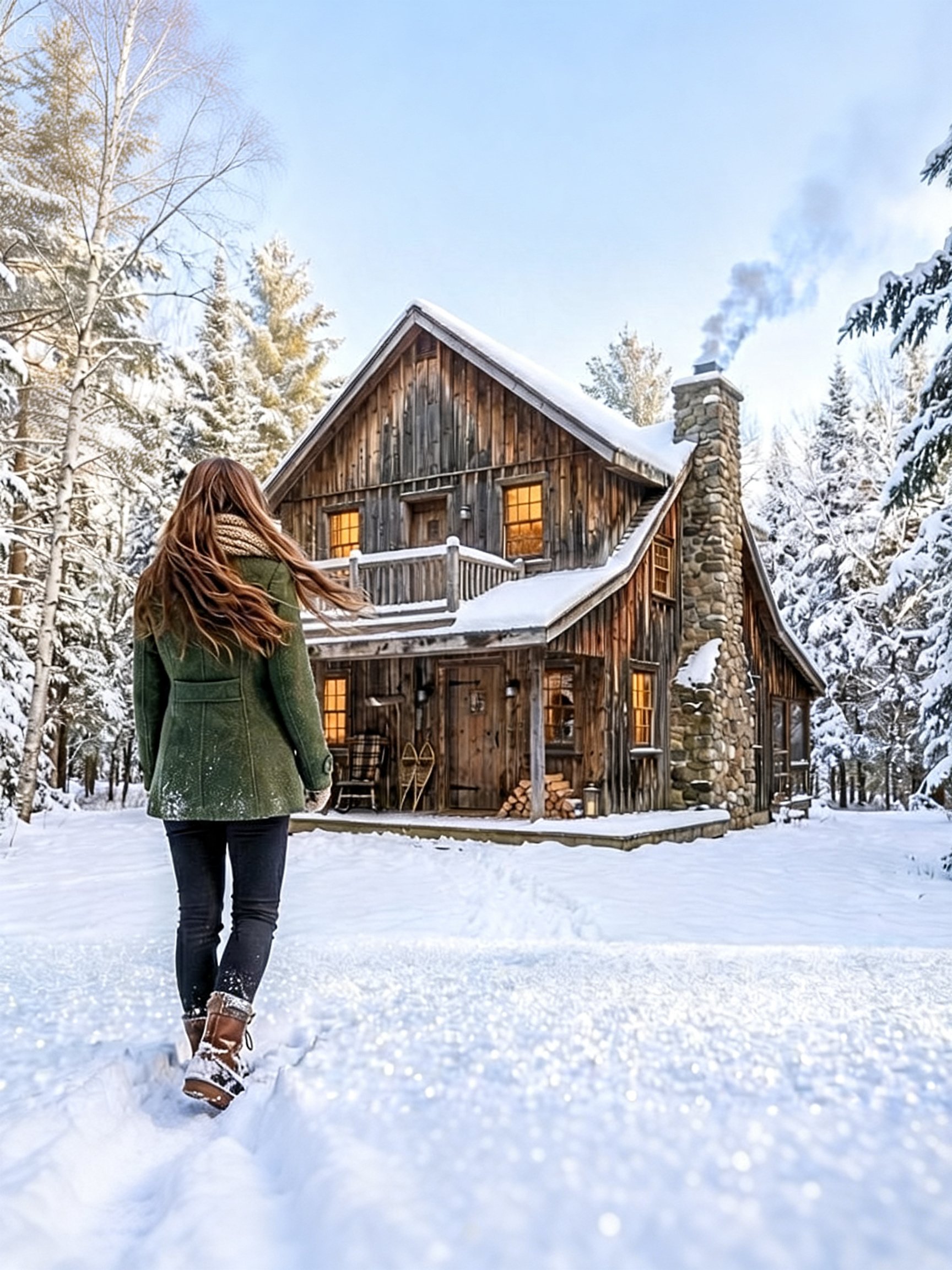
The cabin sat at the end of a narrow dirt road among tall pines. Part of the roof sagged, the porch tilted, and one window was boarded up while another was broken. Snow lay against the walls, and the old boards looked as tired as I felt.
I put down my suitcase and started laughing, then covered my mouth because the sound was turning into a sob. I had spent my last dollar getting there, and this was the place Mom had called a chance. Arthur stood beside me without trying to talk me out of what I was feeling.
“I thought things might finally get easier,” I managed. Arthur looked at the roof before he answered. “Your mother never thought much of easy,” he said, “but she believed in second chances.” Then he took a worn brass key from his coat and placed it in my hand.
He said Mom had asked him to tell me I was stronger than I thought. I didn’t feel strong, but the key was real, and for the first time in weeks I had a door I was allowed to open. I carried my suitcase across the crooked porch and went inside.
Arthur had arranged for an old mattress to be delivered that afternoon. I slept on it in my coat, wrapped in Mom’s scarf, while wind slipped through the gaps around the door. Branches scraped against the windows, but nobody could tell me I had to leave by morning.
In daylight the place looked worse. Cabinets hung crooked, the sink didn’t work, there was a hole in the ceiling, and mice had made themselves comfortable beneath the stove. I stood in the middle of the room and said aloud, “Well, I guess it’s you and me.”
Nancy, who owned the diner, gave me work washing dishes. She paid me cash and sometimes sent me home with leftover pie, which tasted better sitting on the cabin steps than I could have explained. Arthur stopped by a couple of times a week with groceries, tools, or a quiet question about whether I needed anything.
One night after cleaning floors at the diner, I unfolded Mom’s letter again. This time I noticed a line I’d skimmed while I was upset: “There are things beneath the surface that only reveal themselves when you’re ready to see them.” I looked around at the broken furniture and dusty floor, half irritated with myself for searching every word for a clue.
Two evenings later, I moved an old bookshelf near the fireplace to clean behind it. Its feet scraped the boards, and something beneath the floor answered with a hollow thud. I tapped once with my heel, then crouched and found one dark board with a slightly raised corner.
I fetched a screwdriver and worked it carefully into the gap. The board shifted, bringing up a puff of dust, and beneath it was a small wooden hatch. I pulled it open and shone my flashlight down a set of narrow stairs disappearing into darkness.
I stayed kneeling at the opening for a long moment. Mom’s odd sentence had suddenly become something solid under my hands. “What were you keeping down there?” I whispered, and then I stepped onto the first stair.
Part 3 The steps creaked, so I tested each one before putting my full weight on it. At the bottom was a dry room about fifteen feet across, with stone walls, wooden shelves, three crates, and a small oak desk. A blue ceramic mug sat on the desk, decorated with daisies and cracked near the handle.
I knew that mug. Mom had used it for tea so often that I could remember exactly how she curled her fingers around the handle. Seeing it beneath a cabin she’d never mentioned made me feel, for one unsteady moment, as though she’d just stepped out of the room.
Beside the mug lay a worn leather journal with her name on the cover: Martha Brooks. The first page said, “My dearest Sadie, if you found this room, then you finally came home.” I sat at the desk and read the sentence several times before I could turn the page.
Photographs slipped from between the pages. One showed Mom much younger, laughing beside the cabin with a shovel in her hand; another included a man I didn’t recognize. There were drawings of the building, maps, land surveys, and notes in handwriting I knew as well as my own.
The first crate held bundles of documents, the second old family photographs. In the third were tightly sealed glass jars packed with rolled bills: twenties, fifties, and hundreds. I opened one and counted part of it, then stopped, overwhelmed by the sight of money Mom had put away without ever telling me.
My relief wasn’t simple. I’d watched her worry about grocery bills and had sold the things I owned while she was dying. Part of me wanted to ask why she’d let us struggle while this sat beneath the floor, and another part knew I couldn’t ask her anything now.
I kept reading. The journal held entries about tomatoes, pie recipes, repairs, and the years she had spent returning to this place. One late entry, written with an unsteady hand, said she hadn’t wanted to make my life easy; she’d wanted to make sure I never gave up on myself.
I didn’t know whether I agreed with the way she’d done it. But when I closed the journal and looked at her mug, I understood that the cabin wasn’t a last-minute surprise. She had made plans here for years, carrying a private hope through a life I thought I’d seen completely.
I told no one about the room, not even Arthur or Nancy. For the next week I covered the hatch with a rug and went down at night to read, learning that Mom had visited Silver Creek in the summers, worked extra shifts to buy the land, and done much of the cabin’s early repair herself. Her pages made her seem less like someone with all the answers and more like a young woman who had been scared and kept working anyway.
One entry said, “Your worth is measured by what you build after you’ve lost everything.” I could picture her writing it after a long day, probably with that chipped mug beside her. I was still angry about some of her choices, but I stopped thinking of the cabin as a punishment I had to endure.
I used a small portion of the jar money to buy a hammer, planks, shingles, and a secondhand ladder. Arthur arrived in his pickup one afternoon and raised his eyebrows at the supplies. “Did you win the lottery?” he asked, and I told him I was tired of rain finding my mattress.
He offered to help. My first impulse was to say I could manage, but I’d spent too many months proving that I could carry things alone. I told him yes, and the two of us got to work on what we could safely repair, leaving the dangerous roof framing to people with the right experience.
We made mistakes. I bruised my thumb with the hammer, fitted a window the wrong way around before we corrected it, and once slid from the bottom of a ladder into a bush. Arthur laughed, then made sure I wasn’t hurt; after I caught my breath, I laughed too.
People from town began showing up. Nancy brought a casserole, Mrs. Harper from the church delivered blankets, and an older neighbor named Walter appeared with flower seeds because, he said, every home needed something worth looking at. I set the packets on the kitchen sill and realized people were starting to know my name without needing to hear the whole sad story behind it.
By spring, the porch stood straight and the cabin had new windows, paint, and curtains. I planted tomatoes beside the steps because Mom had written so much about growing them. When the first sprouts appeared, I knelt in the dirt and stayed there longer than necessary, brushing soil from a leaf with one finger.
Arthur sat on the porch with coffee one evening and said Mom had always believed I would come. “She used to say you’d build something bigger than this cabin,” he told me. I looked at the place we’d repaired and couldn’t imagine what bigger might mean, but the thought stayed with me.
That was before a black SUV turned onto the dirt road on a Tuesday morning. I was working beside the tomato plants when it pulled up in front of the porch. A man in his mid-fifties stepped out wearing an expensive coat and shoes that didn’t belong in the mud, then looked slowly across the property.
“Miss Brooks?” he asked. He introduced himself as Victor Hayes and said he represented Hayden Ridge Development, a company interested in eco-resorts, luxury cabins, and private communities. Then he said the words that made me stand a little straighter: “We’d like to buy Parcel 27B.”
Part 4 I told Victor the land wasn’t for sale. He seemed to regard that as an opening position, not an answer, and pulled an envelope from his coat. Inside was a check for seventy-five thousand dollars, more than I’d ever held or expected anyone to offer me.
He said I could go back to Denver, buy a place somewhere else, and start over without spending my days fixing an old cabin. I looked at the porch Arthur and I had repaired and the small green tomato plants beside it. Six months earlier the offer might have sounded like rescue; now it sounded like being asked to leave home.
I handed the check back. “I’m not selling.” Victor asked me to think carefully, and when I said I had, something changed in his expression. Before he left, he mentioned that Mom had turned him down years earlier too.
“You knew my mother?” I asked. He said he’d approached her about the property and she hadn’t been interested in discussing it. When I asked what was so special about this land, he hesitated, then said he supposed she had never told me.
I watched him drive away and went straight to the cellar after dark. The journal had maps I hadn’t studied closely, and I worked back through the pages until I found a folded survey marked with a blue line and circles in red ink. Beside the markings Mom had written, “Spring source. Pure water. Protected. Never sell.”
Further notes said my grandfather had found the spring nearly sixty years before. The water came through limestone deep beneath the mountains, and Mom believed it was unusually clean. She’d inherited the land and kept the spring out of public discussion, never formally registering the source as she understood it.
The notes explained why someone might want the property, but they didn’t tell me what legal rights I actually had. Victor had spoken as though he knew the spring was there, and I wanted to know how he had learned about it. The next morning I carried the map and journal into Arthur’s office.
He took one look at the drawing and said, “You found it.” I asked why he hadn’t told me, and he said Mom had asked him to let me discover the place for myself. When I told him Victor had offered seventy-five thousand dollars, Arthur’s expression became serious.
He explained that the spring was part of what made the property attractive, but land ownership and water rights were not quite the same thing under Wyoming law. We would need to review records and any applicable water claims before assuming what I could use, sell, or protect. What mattered that morning was that I owned the parcel, and no developer could simply turn an offer into permission.
I was furious with Mom for keeping so much quiet, and frightened by the idea that someone with more money could find a way around me. Arthur listened without trying to make her secrecy sound noble. He said she had wanted to protect me, though he understood why I wished she’d trusted me sooner.
On the last page of the journal was another note written near the end of her life. Mom warned that the spring might make me wealthy but that money had a way of showing what people valued. “Never let fear make your decisions, and never let money become your home,” she wrote.
I sat with that page for a while. I’d mistaken having money for having a place in the world, probably because losing both had happened so close together. Yet the happiest hour I’d had in months was the afternoon Walter brought flower seeds and we stood in the yard deciding where they might grow.
Arthur asked what I wanted to do. I told him I wasn’t ready to sell, and I wanted to understand the spring without letting strangers decide what happened to it. He agreed to help me sort through what Mom had left and what the records could actually establish.
By early summer, the cabin had flower boxes under the windows and tomatoes climbing stakes beside the porch. I had work at the diner, people I could call, and a house that no longer soaked my bed when it rained. I was beginning to believe the place could support a future, not just shelter me from the past.
Then a certified letter came from Hayden Ridge Development. The company wanted access across my property, invoking public interest, offering compensation, and warning that it might pursue legal action. I read it three times at the kitchen table before setting it down beside Mom’s journal.
Part 5 My first reaction was to put the letter away and hope it disappeared. I’d seen enough official-looking envelopes during Mom’s illness to feel sick at the sight of one. That night I lay awake listening to rain against the roof I’d helped mend, wondering whether it would be easier to take Victor’s money and leave.
I kept remembering Mom working in the small garden outside our Denver apartment. She used to press the soil gently around tomato seedlings and say, “Roots matter, Sadie. You don’t throw them away because storms come.” It wasn’t a legal argument, but it got me out of bed the next morning.
I drove to Arthur’s office with the letter. He read it without making promises, then explained that a company’s demand was not a court order and a claim of public interest did not automatically establish a right to cross private land. He said we needed to examine the deed, surveys, water records, and any basis Hayden Ridge might assert for access.
For weeks, we went through paperwork and questions I hadn’t known how to ask. Arthur helped me understand what the documents did and didn’t prove, and I kept copies and dates in a folder instead of relying on my memory. No one could guarantee the company would give up, but I could answer carefully rather than sign something out of fear.
Victor sent larger offers. The numbers were hard to look at because I knew what that money might have meant when Mom was sick. I didn’t throw the letters away; I read each one, talked it through with Arthur, and decided again that I wasn’t willing to sell.
When Victor came back in person, he seemed annoyed that I hadn’t changed my mind. He stood near the steps and said I didn’t understand what I was turning down. I told him I understood the amount, but I also understood what it felt like to have no place of my own.
“I was homeless six months ago,” I said. “I lost my mother. I slept in a shelter and got here with nothing in my wallet.” His eyes moved toward the repaired cabin, as if he were trying to calculate why I would choose it over a check.
Then I told him, more quietly, “I wouldn’t wish any of that on myself again. But I won’t give up the first home I’ve built since she died.” I didn’t need him to agree; I only needed him to hear that my answer was still no.
He left in the black SUV, and I watched until the sound of the tires faded. It wasn’t a magic ending to the paperwork, and I knew I’d have to keep paying attention to any formal notices. But for once, the possibility of a fight didn’t make me feel powerless.
That night I went down to the cellar, sat at Mom’s desk, and read another line she’d left in the journal: “One day, you’ll realize I wasn’t leaving you land. I was leaving you the chance to discover who you are.” I still wished she’d spoken plainly to me while she was alive. I also knew what I wanted to do with the time I had.
I kept working at the diner and tending the garden as summer went on. Arthur stopped by on Fridays when he could, Nancy saved a slice of my favorite pie, and Mrs. Harper invited me for supper. Walter showed me how to care for roses, and I planted them where people approaching the cabin would see them first.
The town stopped treating me as a visitor with a sad story. I was Sadie, the woman who washed dishes, sometimes got paint on her sleeves, and asked too many questions about growing tomatoes. I could disagree with someone without apologizing immediately, and I was learning to accept help without keeping a private tally of what I owed.
The first snow arrived early the following winter. I stood on the porch with a mug of coffee while the lights from my new windows shone onto the steps. I remembered my first night inside, listening to the wind through the cracks, and felt grateful that this time the roof was holding.
A local newspaper ran a story about the cabin and how I’d come to live there. A regional magazine followed, and then a podcast asked me to talk about starting over. I was embarrassed by the attention and kept pointing out that Arthur, Nancy, Walter, and others had helped with every part worth telling.
People began finding their way up the road. Some brought flowers or asked about the renovation, while others came because they had lost jobs, marriages, or homes and wanted to talk to someone who understood. I couldn’t fix their problems, but I could put on a pot of coffee and listen without asking them to make their stories sound tidy.
Part 6 One afternoon, a young woman named Claire knocked on my door with a duffel bag over her shoulder. She looked about twenty-two and had the worn-out expression of someone who’d been trying not to cry in public. She told me she’d heard about me and asked whether she could sit down for a minute.
I brought her inside, and we talked near the fire. Her father was ill, medical debt had piled up, and an eviction notice had left her unsure where to go. As she spoke, I remembered counting forty-eight dollars beside the shelter radiator and how much effort it had taken to ask anyone for help.
Claire slept on my couch that night. After she’d settled, I carried Mom’s journal to the cellar and sat at the desk with the daisy-painted mug in front of me. I’d thought the cabin was the end of a terrible journey, but it suddenly occurred to me that the space I’d been given could matter to somebody else.
There was an old tool shed behind the cabin. I looked at it the next morning and began asking what it would take to make it safe and livable, not just warm for a few nights. With help and the necessary work to prepare it for guests, I turned it into a tiny cottage with a bed, a small kitchen, and a rocking chair on the porch.
I hung a simple sign by the door: Second Chance Cottage. It wasn’t a business, and I didn’t charge rent. I wanted a place where someone dealing with a hard season could rest while making plans, the way Ms. Reynolds had given me room to breathe when I couldn’t see what came next.
Claire was the first guest. She stayed two weeks, and over time other women came too: a widow who’d lost her home, a young mother leaving an abusive situation, and a woman working on her recovery from addiction. Their needs were different, and I learned that offering a bed meant listening carefully, respecting boundaries, and knowing when someone needed support I couldn’t provide myself.
I asked only that, once they were steady again, they find a way to help someone else. Some people did that with a ride, a meal, a phone call, or an afternoon spent listening. There wasn’t a grand ceremony when anyone left, just folded bedding, a cleaned kitchen, and usually a long hug by the door.
Arthur laughed the first time he saw the sign. “You know this could get out of hand,” he said, looking from the cottage to the cabin. I told him I hoped it would help more people than either of us could count. He smiled and said I sounded like Mom.
I wasn’t sure how I felt about that. Mom had kept secrets that still troubled me, and I would have given anything for one ordinary evening with her when I could ask every question. But she’d also taught me to make room at the table, and I could choose to carry that part of her forward.
The years didn’t turn our little place into something fancy. The tomato plants needed watering, the porch needed another coat of paint now and then, and the cottage needed cleaning between guests. Those ordinary chores were part of what made it a home, for me and for the women who passed through.
Arthur retired but still came by most Fridays. Nancy continued to arrive with pie, and Walter’s roses bloomed in the spring. Claire eventually moved away with plans of her own, and before leaving she hugged me and said, “You gave me my life back.”
I told her, “You did that yourself.” I meant it, just as I meant it when I thanked everyone who had helped me. Sometimes what changes a person’s direction is not a rescue but one place where she can sleep, think, and remember she still has choices.
Final One autumn evening, I visited Mom’s grave overlooking the mountains. Leaves had gathered near the headstone, and I brushed them aside with my sleeve before sitting down. I told her about the cottage, about Claire, and about the roses Walter had taught me to grow.
“You were right about beginning again,” I said. I still missed our Sunday pancakes and the way she used to set a cup of tea beside me without asking whether I wanted one. I told her I wished we’d had more time, and that I was still learning which parts of her advice to follow and which choices I would have made differently.
From where I stood, I could see the valley below. The cabin and the little guest cottage were waiting there, with lights in their windows and work to be done in the morning. I thought about the first day I’d seen that leaning porch and how close I’d come to turning around.
The money in the jars had helped me repair the building, and the spring had made the property valuable enough to attract people who wanted to buy it. Neither was the whole story. What lasted was the home I built with my hands and the people who had offered theirs when mine were shaking.
I arrived in Silver Creek with an empty wallet, believing I had reached the end of everything familiar. I couldn’t bring Mom back or change the months we spent frightened and exhausted. But I could open the door for someone who needed a place to begin, and each time I did, the cabin felt a little more like the promise she’d tried to leave me.
I stayed by the grave until the light started to fade. Then I pulled my coat close, said goodbye, and headed down toward the house where the porch light was on. For the first time in years, going home was a simple, wonderful thing I didn’t have to question.
THE END. I’ve shared the complete story, and I truly hope it touched your heart. If this story moved you, please , like, and share the post. Thank you for reading! ❤️
✓ Lynn R. Adams
I took the envelope back to my narrow bed and read the rest after the shelter lights went out. Mom said she’d prayed I would never need the place, but that one day I might need it more than I needed h…