On my fifth wedding anniversary…
On my fifth wedding anniversary, I found my husband with my sister in our bed. I thought my parents would be horrified, but at dinner they served her favorite meal and asked me to keep the family together….
I build bridges for a living in Raleigh, North Carolina. When a load-bearing connection fails, I don’t get to pretend the damage isn’t there just because repairing it would be inconvenient. Until my fifth wedding anniversary, I never imagined I would have to apply that lesson to my own marriage.
My husband, Daniel, and I had been together eight years. We met at a gallery opening where he was coordinating the event, and I was trying to escape a conversation about a painting I didn’t understand. He made me laugh, we talked for three hours, and three years later we married in a small ceremony with both our families present.
My older sister, Vanessa, was my maid of honor. She is three years older than I am, a senior auditor at a regional accounting firm, and has always been the person my parents bragged about first. They admired her scholarships, her career, even the BMW she loved to mention. I designed bridges that people drove across every day, but somehow that never seemed quite as impressive at our family dinners.
Still, we were sisters. I trusted her with my home, my marriage, and the little ordinary details of my life. About a year before everything happened, she had asked me to keep a sealed box of old office equipment while her condo was being renovated. She insisted I not open it, and I put it in storage without giving it another thought.
Our anniversary fell on a Tuesday. I had arranged to leave my construction site at , buy flowers at the expensive shop Daniel liked, and surprise him before our seven o’clock reservation at the Italian restaurant where he’d proposed. The plan was so simple that I smiled about it during my drive home.
At about three, I pulled into the driveway and saw Vanessa’s car. I figured she had stopped by with an anniversary card, something she’d done before. I carried the flowers inside, set them on the kitchen counter, and called Daniel’s name. Nobody answered.
Then I heard a sound from upstairs. I knew what it was before I reached the bedroom, but some stubborn part of me kept walking, as if getting to the doorway might change its meaning. The door stood open a few inches. My husband was in our bed with my sister.
I stood there counting silently. On four, they noticed me. Daniel grabbed for the sheet, pale and speechless; Vanessa sat up and looked me straight in the face. Then she said, “You always take life too seriously.”
Not “I’m sorry.” Not “We need to talk.” She sounded irritated that I had interrupted something, as if I had walked into the wrong room at the wrong time. I looked at the sheets his mother had given us for our wedding and felt the strange certainty that I would never sleep in that bed again.
I went downstairs, collected my work duffel, and came back for three days of clothes. Daniel tried to say, “Please, just let me—” I raised my hand, and he stopped. By the time I reached the stairs, I could hear him crying. I drove to a downtown Marriott and booked a week.
That night I opened a spreadsheet on my laptop and typed “asset inventory” into the first cell. I listed our bank and investment accounts, house, vehicles, shared credit cards, and the estate my grandfather had left in probate. Grandpa had named me executor years earlier, but I was not going to misuse that responsibility to settle a personal grievance. I needed facts and documents, not revenge fantasies.
By dawn I had mapped our finances. The next morning, I went to my bridge site and tried to focus on a foundation pour. Calls from Daniel and my family kept coming. Around noon my supervisor told me my mother had even called the office, claiming there was an emergency.
I called Mom from the hotel parking lot after work. She asked me to come to my parents’ house for dinner because, she said, “We need to discuss this as a family.” I agreed to seven o’clock. I wanted to know whether they understood what Vanessa had done, and whether anyone was going to say it out loud.
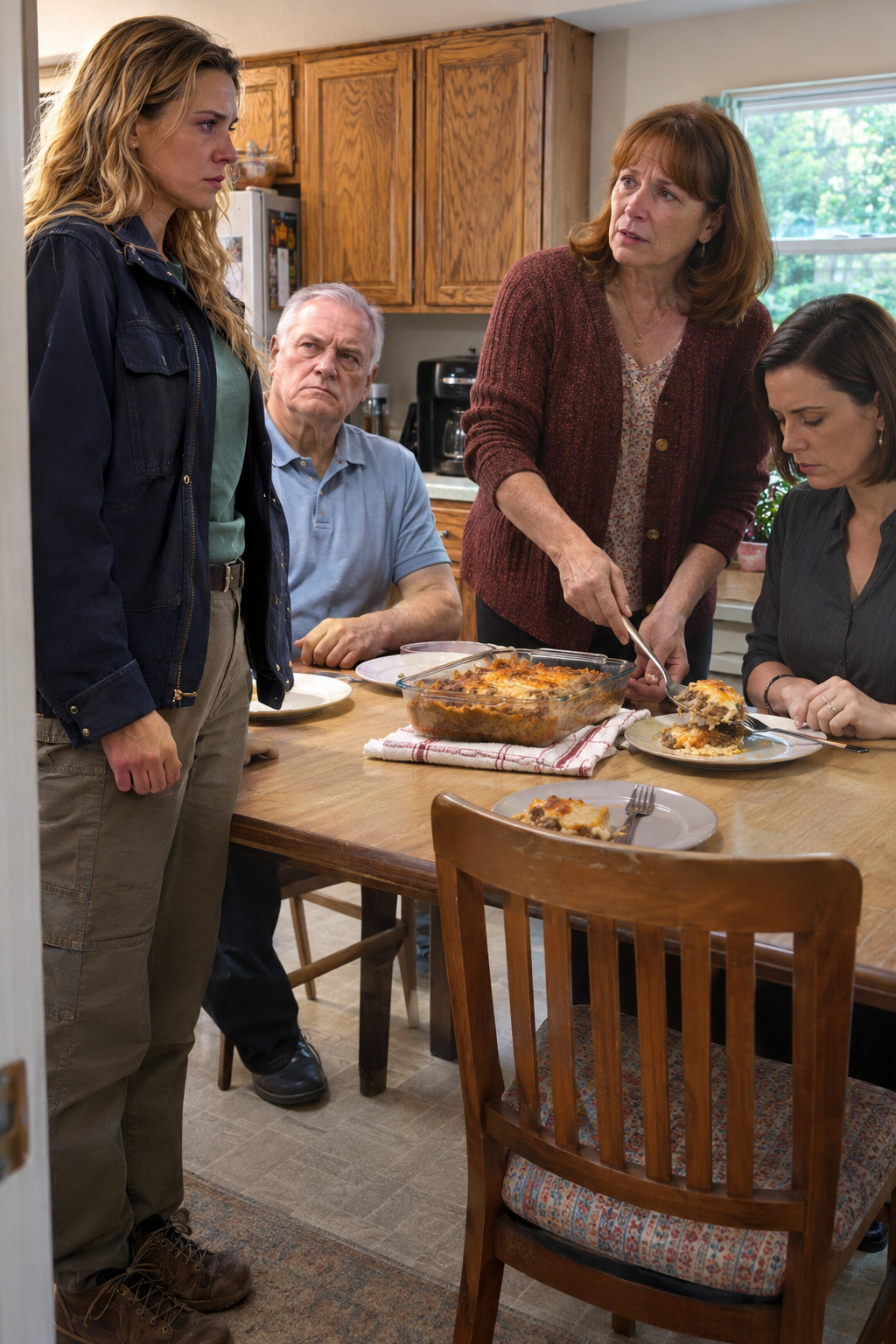
Vanessa’s car was there when I arrived. Mom, Constance, sixty-four, opened the door and reached to hug me, but I stepped aside. Dad, Bernard, sixty-seven, sat at the head of the kitchen table wearing the same stern expression he used when we were kids. Vanessa sat quietly in her usual seat.
The house smelled of beef and onions. Mom had made a casserole with ground beef and cheese, the dish she always prepared when she wanted to comfort someone. As she spooned it into bowls, she said brightly, “I made Vanessa’s favorite. You used to like it too, remember?” Then she served my sister first.
I hadn’t even sat down when Dad announced that we needed to discuss “the situation.” I asked whether that was what we were calling my husband sleeping with my sister in my bed on our anniversary. Mom warned me not to be hostile. Vanessa stared at her dinner and muttered that she’d been meaning to call.
“These things happen,” Mom said. “Marriages have rough patches.” Dad told me anger wasn’t productive. When I asked Vanessa what exactly she had intended to say, Dad cut me off as though I were the one behaving badly.
Then Mom reached across the table. “It was one mistake,” she said. “You’re being dramatic. Your sister feels terrible. Daniel feels terrible. Don’t destroy your marriage over this.” Dad added that they had raised me to value family and work through problems instead of running away.
I looked from my mother’s hand to Vanessa’s barely touched casserole. Vanessa still had not apologized. I asked whether they genuinely expected me to go home, forgive both of them, and pretend I hadn’t seen what I had seen. Mom said family stayed together. Dad said I would ruin my relationship with my sister if I involved lawyers.
What finally made everything clear wasn’t even their defense of Vanessa. It was Mom whispering that a divorce would embarrass the family, that the community might find out, and that I ought to think of our reputation. I realized they were more frightened of gossip than of what had happened to their daughter.
I stood up. Dad ordered me to sit down; Mom asked me to be reasonable. “I caught my sister with my husband,” I told them, “and you made her favorite dinner. You’ve already chosen whose feelings matter.” I said I was done with dinner, with their excuses, and with being told not to trust my own eyes.
Mom followed me to the front door and caught my arm. “You’re going to tear this family apart over one slip,” she said. I freed my arm and looked back at Vanessa, who was still letting our parents speak for her. “I didn’t tear anything apart, Mom. She did. You’re just picking your side.” Then I walked out, unsure what my family would do next but certain I wouldn’t go back to that table. Part 2…..
Here’s what happened next. Back at the Marriott, I opened my laptop and searched for North Carolina divorce attorneys. I read about equitable distribution and a claim I had never expected to consider: alienation of affection. North Carolina still permits a civil suit against a third party who wrongfully interferes with a marriage, but proving adultery alone doesn’t automatically establish every required element. I saved questions for a lawyer instead of assuming I understood the law.
On Monday, I called three attorneys. Two were booked, and the third, Patricia Yoon, had an opening that afternoon. She specialized in high-conflict divorces, and she listened without interrupting as I described what I’d seen, the hotel, and the family’s insistence that I forget it.
Patricia explained that North Carolina required at least a year of separation before an absolute divorce. We could start addressing property and support while living separately, but infidelity didn’t automatically hand me the house or cancel Daniel’s rights to marital assets. A claim against Vanessa was separate, would require evidence of affection in the marriage and wrongful interference, and might take much longer.
I handed over the account statements I’d collected. Patricia asked about messages, witnesses, and where Daniel could be served; I told her his event-planning business operated from a shared office. I signed the retainer and instructed her to handle the filings properly. I wanted a clean record of every decision, even though nothing about this felt clean.
By Wednesday, the property-related and civil papers had been filed, and service was underway. Daniel received papers at his office at two. Seven minutes later he called sobbing about how humiliating it was to be served at work. I ended the call before he could finish blaming me.
Vanessa was served at her auditing firm that afternoon. “We’re sisters,” she said when she called. “You can’t sue me for this.” She accused me of trying to destroy her, then caught herself before calling what she’d done “nothing.” I told her, “You made your choice. Now live with it,” and hung up.
My parents flooded my work phone with messages about the family name, Vanessa’s legal bills, and how ashamed Grandpa would be. I preserved anything Patricia thought might matter and stopped responding. For the first time in my adult life, silence felt like a boundary rather than surrender.
Six weeks later, Daniel and his attorney met with us at a settlement conference. He offered a quick division of our accounts if I dropped the case against Vanessa. Patricia explained that the third-party suit was its own claim, not something Daniel could simply bargain away on her behalf. By then we’d preserved messages spanning eight months, hotel charges, and my account of the anniversary, and Daniel admitted the affair in a signed response.
The property negotiations continued for months. I produced mortgage statements, retirement balances, business valuations, and records of our respective contributions. Eventually we signed a separation and property agreement: I would keep the house, refinance it in my name, and make an agreed cash equalization payment. Daniel would keep his event-planning company and its debts, and neither of us would seek spousal support under the agreement.
It wasn’t the effortless victory people imagine in stories like this. Keeping the house was expensive, and we would remain married on paper until the statutory separation period ended. But every provision had been examined by counsel, and the result was something I could live with.
Daniel’s business was already under strain. In our small professional community, people heard about the affair, and he lost one client after missing planning deadlines and another who declined to renew. He tried posting about being judged for “one mistake,” but that did not fix his finances or restore the marriage.
When he packed his boxes after the settlement, he told me, “You’ve destroyed my life.” I reminded him that he had made his own choices. After the refinance and transfer, I sold the house anyway. I could pay the closing costs; I couldn’t bear another night in that bedroom. I moved into an apartment near my office.
The lawsuit against Vanessa remained unresolved. Her attorney sent settlement proposals, and Patricia reviewed them with me, rejecting those that didn’t address the claim adequately. Then a detail from the divorce discovery started bothering me: in messages with Daniel, Vanessa had referred to an “audit phone,” “cleaning numbers,” and the trouble she’d be in if her firm found an old device.
I remembered the box she’d left with me while clearing her condo during renovations about eighteen months earlier. At the storage unit, I found old manuals, cables, a cracked tablet, and two dead phones. One was a cheap Android with a faded asset sticker from Vanessa’s employer. I photographed everything as I found it, then called Patricia before touching the device again.
She told me not to access the phone or its accounts. Her office consulted employment and privacy counsel, preserved the materials, and offered the firm’s compliance counsel a documented transfer of potentially sensitive company property. The employer accepted the device through counsel. I did not investigate its contents, impersonate anyone, or claim to know what the company would find.
Patricia later helped me make a narrow factual statement describing how the box came into my possession and the concerning messages I’d seen in lawful divorce-related discovery. She warned that none of this proved fraud and that any internal inquiry belonged to the firm and, if appropriate, regulators. I signed the statement; counsel delivered it. That was the end of my involvement.
Weeks later, Vanessa called while I was reading reports at a coffee shop. “Compliance took my old phone,” she said, her voice rough. “They’ve put me on administrative leave. What did you do?” I advised her to speak with her lawyer. She threatened that if she went down, I would too, then hung up after I refused to argue.
The firm’s internal review lasted months. Eventually, a letter disclosed by Vanessa’s attorney in the civil case showed that she had been dismissed. A complaint to the state accountancy board remained pending, and no criminal guilt had been established. My mother left a voicemail saying Vanessa couldn’t get another auditing position and was struggling with her mortgage, all of which she insisted was my fault.
Ten days after the termination, Mom called from an unfamiliar number to say Vanessa was in the hospital after a panic attack that she’d feared was a heart attack. I was relieved to learn she was stable. I told Mom that concern for Vanessa’s health did not make me responsible for her affair or for decisions she’d made at work. Mom repeated “one mistake” and hung up.
Vanessa began leaving drunken messages at night. Some were slurred accusations that I’d taken her job and reputation; one warned, “I know where you live. You can’t hide from me.” The following evening, she waited outside my apartment garage and blocked the entrance. I backed away, called building security, and asked the manager to preserve the camera footage.
Part 3 I gave Patricia the voicemails, footage, and incident report. She explained that a North Carolina civil no-contact order has specific eligibility rules, and that adult siblings don’t automatically qualify for a domestic violence protective order. We considered the applicable criminal complaint and protective conditions rather than pretending a judge could issue any order we requested.
At a hearing in the related criminal matter, Vanessa arrived in wrinkled clothing with dark circles beneath her eyes. Her attorney argued that she was distraught, not dangerous. After reviewing the evidence, the judge imposed no-contact and stay-away conditions while the matter was pending. Vanessa looked at me across the courtroom with a fury I recognized, but I did not speak to her.
The civil claim eventually ended in a confidential settlement without an admission of liability. I agreed on Patricia’s advice. It resolved the lawsuit; it did not make us sisters again. After a full year living apart, Daniel and I obtained our absolute divorce, and I heard through mutual friends that his company had dissolved and he’d moved back to his hometown for an administrative job.
Meanwhile, the engineering consulting practice I’d been building beside my bridge work began to grow. I landed a highway-expansion contract and hired two junior engineers. Some days the work was exhausting, but the challenges came with drawings, inspections, and measurable solutions rather than a family argument that never ended. I blocked my parents’ numbers after Mom called my office.
Several months after the divorce, a certified letter arrived from Caldwell and Associates, the lawyers handling my grandfather’s estate. Grandpa had died eight months earlier at eighty-six, several months after the anniversary. He’d once owned a contracting business, and he’d asked me to serve as executor because he trusted me with records and disliked family fights. His final will had been signed three years before the affair, while he was healthy and managing his own affairs.
I had already read that will when probate began, and I knew the estate inventory indicated net assets of roughly two million dollars. The new letter meant final distribution was approaching, not that some secret inheritance had just been revealed to me. My parents and Vanessa, however, spoke as though they each expected a share; they had been paying Vanessa’s legal fees and counting on money Grandpa had never promised them in a valid will.
I went to Caldwell to review the final accounting. The signed will left sixty percent of the net estate to three charities that had helped Grandpa after his military service, and forty percent to me. He’d given my parents and Vanessa money while alive and had explicitly said those gifts were not to be repeated from his estate. There was no adultery clause, no last-minute change, and no discretion for me to rewrite anyone’s share.
I asked Caldwell to manage beneficiary communications independently, send the signed will and final accounting again, and document all notices and responses. As executor, I had a duty to carry out Grandpa’s instructions, not turn them into leverage for an apology. My relatives could seek legal advice or challenge the will through proper channels. I would not hide a single page.
My father insisted there must be a newer will. Caldwell supplied the execution record and offered to speak with the family’s attorney, but no later will materialized. My relatives received the documents without acknowledging the percentages, then chose to attend the final distribution meeting in person anyway.
That afternoon, I wore my navy suit and arrived at Caldwell’s office at two. Mom sat beside Dad at the long conference table; Vanessa sat across from them, turning a pen in her fingers. Caldwell entered a few minutes later with a portfolio and told us the estate was ready for distribution, its value after taxes and fees standing at $2.1 million.
He read the signed terms aloud: $1,260,000, or sixty percent, for the three named charities; $840,000, or forty percent, for Natalie—that’s me. There were no further residuary bequests to Constance, Bernard, or Vanessa. He reminded everyone that the gifts Grandpa had made during his lifetime were separate and that all parties had been sent the documents before the meeting.
Mom leaned forward, saying Grandpa always believed family came first. Dad insisted he’d heard about another will, and Vanessa stood so abruptly her chair scraped the floor. Caldwell calmly repeated that no later signed will had been produced and that their counsel could advise them of any available challenge. I had not chosen the beneficiaries or the amounts.
“We have nothing,” Mom whispered. She admitted they had remortgaged their house to help with Vanessa’s legal bills and had expected this money to repair the damage. Vanessa came toward me, shouting that I’d destroyed her, and security appeared at the doorway. I stood with my copy of the papers and let Caldwell handle the room.
“You wanted family loyalty,” I told them. “So did I.” When Mom reached toward me, I said Grandpa had made his decision years before my marriage fell apart, and I wasn’t going to bargain away his wishes for their approval. Vanessa shouted about one mistake again. I reminded her that she had made a choice in my bed, and Grandpa had made his own decisions about his estate while he was alive.
At the door, Dad called after me that we were family. I turned just long enough to remind him of the casserole and the night he’d called me dramatic for refusing to excuse betrayal. Then I walked out. No one stopped me, and I hadn’t taken a penny from them that the signed will said was theirs.
In my truck, I received a text from an unfamiliar number. It contained photos of my apartment building, my floor, and my door, followed by “We need to talk. We’re not done.” I believed it came from Vanessa, who had already been ordered not to contact me. I saved it, forwarded it to Patricia, and drove away rather than responding.
Final The calls resumed that night. I saved the threatening ones, silenced the rest, and went to bed. Three days after the meeting, on Saturday morning, the doorbell rang and someone began pounding. Through the peephole I saw Mom, Dad, and Vanessa outside my apartment.
Mom begged me to talk; Dad admitted they’d made a mistake; Vanessa apologized over and over. I stood six feet back from the door and listened without unlocking it. Eventually they left. I arranged for the building’s footage to be preserved and gave it to Patricia because Vanessa was subject to the court’s conditions.
Daniel contacted me once about an old business debt. I referred him to Patricia and ended the call. My engineering firm won more of the highway-expansion work, allowing me to hire two additional engineers and a contract administrator. We lost some bids, won others, and spent too many weekends in the office, but the business grew because we kept showing up and doing the work.
Three months after the estate meeting, Mom emailed to say Dad had suffered a health scare and that they were selling their house. She apologized. I read the message and did not reply. I could hope he recovered without reopening a relationship in which my pain had always been negotiable.
A year later, my firm employed twelve people and had signed its largest contract yet, a municipal bridge replacement. I had moved to a new downtown apartment with a better view and no family photographs on the walls. I went to the gym at six, reached the office by eight, and spent afternoons visiting sites. I had begun sleeping through the night again.
When coworkers asked whether I was close to my family, I simply said we didn’t talk. I didn’t need to recite what happened or convince anyone to approve of my boundaries. I knew that if I’d gone back to that dinner and agreed to call it “one mistake,” I would have lost something no settlement or inheritance could replace: the right to believe my own eyes.
One Friday evening, a junior engineer stopped me at the office door. A few people were going to dinner at a new place on Fifth Street, and he wanted to know whether I was coming. I looked at the bridge drawings pinned above our conference table, at my firm’s name beside the names of engineers I’d trained, and said, “Yeah. I’m in.”
Outside, my team was laughing about whose turn it was to pay. I walked over and joined them. Nobody asked me to excuse someone, finance someone, or pretend that something terrible hadn’t happened. They simply made room for me at the table.
THE END. I’ve shared the complete story, and I truly hope it touched your heart. If this story moved you, please , like, and share the post. Thank you for reading! ❤️
✓ Lynn R. Adams
On my fifth wedding anniversary, I found my husband with my sister in our bed. I thought my parents would be horrified, but at dinner they served her favorite meal and asked me to keep the family toge…