On her wedding day, Georgia Bennett discovers that her fiancé has brought a thirty-year land deal to the altar
Part 2: The ranch’s future is hidden inside a black folder
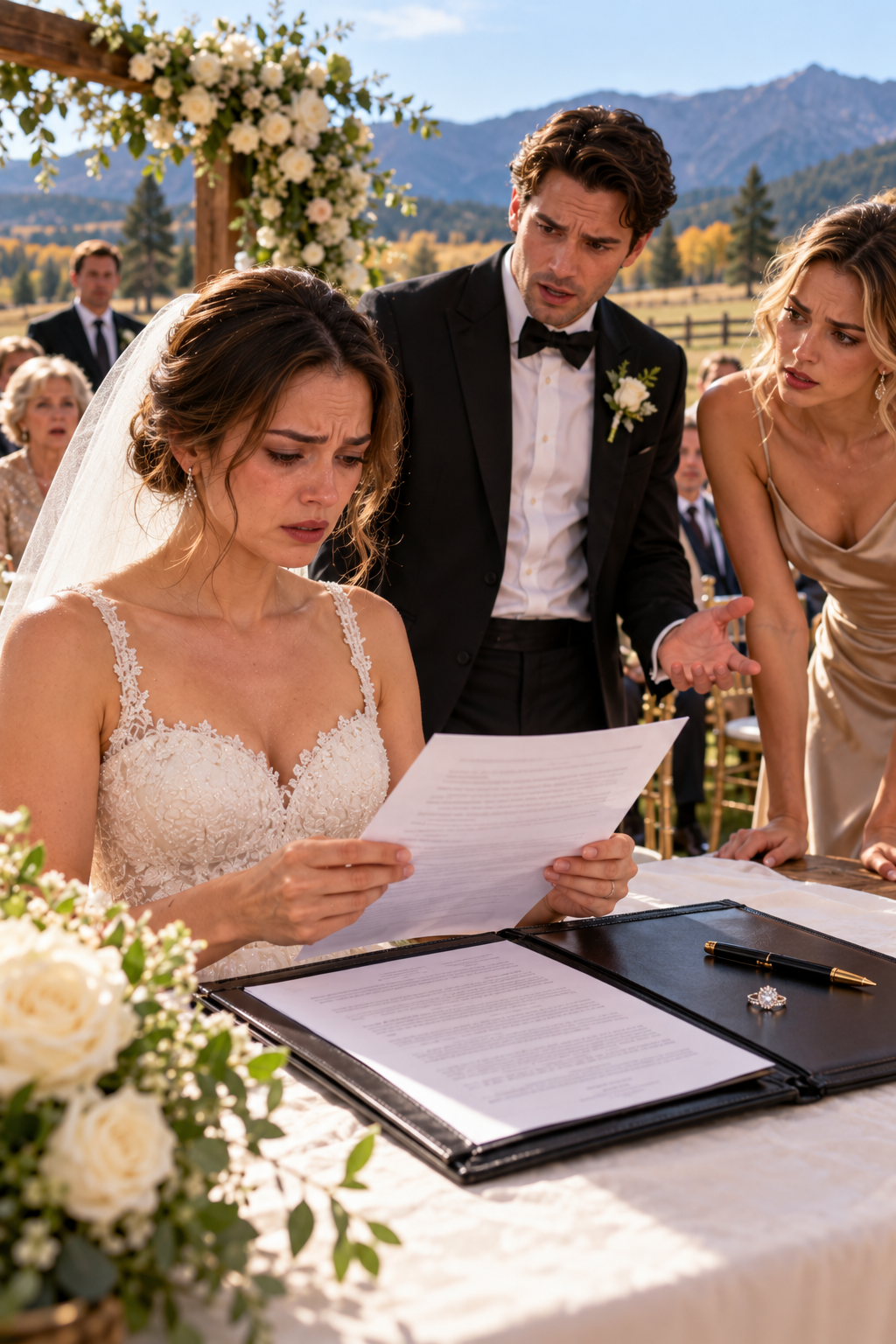
The guests quieted as I turned through the agreement, searching for the terms Nolan had never shown me. The document gave Larkin Development control over a broad section of land, including the eastern pasture and the creek area. It also offered Paige’s company an option to purchase part of the ranch at a price based on a valuation I had not independently reviewed. Paige said her advisers had examined the number, but they were her advisers, not mine. I told her I wanted my own attorney to read every page before I considered signing.
Nolan rubbed his forehead and asked why I always assumed something was wrong. I answered that I was not assuming anything; I was asking for a normal review of a major property agreement. His family’s attorney had already looked at it, he said, and I replied that his family’s lawyer did not represent me. He glanced at the guests, the photographer, and the officiant, calculating the scene he had expected to avoid. The wedding had become a deadline, and he was counting on the fact that I would not want to embarrass everyone by stopping it.
He reminded me how long we had planned the day and how much everyone had invested. I told him that asking me to sign away thirty years of control over my parents’ land was not a wedding formality. “Trust isn’t a substitute for due diligence,” I said, and his easy confidence began to crack. Then he said he could not keep waiting for me to make up my mind. I placed the folder on the small table beside the officiant and answered, “Then don’t.”
I took off the engagement ring and set it on top of the contract. For several seconds, no one moved; a guest lowered her champagne glass, and a chair scraped against the grass. Nolan stared at the diamond as though he could not understand how it had ended up there. I told him the ceremony was canceled because he had made our marriage conditional on an agreement he knew I had not reviewed. Then I turned to the officiant, apologized for the disruption, and asked him to notify the wedding coordinator and catering team.
I told the guests their meal and transportation would be covered, then lifted the hem of my dress and walked toward the ranch house. Diane called after me to stop the nonsense, while Nolan followed and said I had embarrassed him in front of everyone. I reminded him we had discussed my concerns privately for years, and each time I raised one, he told me I was overreacting. “You always end up making me apologize for bringing something up,” I said, “and I’m not doing that anymore.” I went inside, changed out of the dress, and hung it carefully in the closet, unwilling to turn it into something I hated.
Part 3: Six years of small concessions lead to one refusal
My name is Georgia Bennett, and Nolan and I had been together for six years, engaged for nearly two. We met at a Denver charity fundraiser where I helped my father organize a silent auction for an agricultural program. Nolan was there with his family’s real estate investment firm, and he made me laugh within five minutes. He remembered the horses’ names, asked about my parents, and listened when I talked about Red Tale Creek. When he proposed on the ranch porch after helping repair a fence, he told me he wanted to build a life with me, not take me away from mine.
The ranch covered more than seventeen hundred acres in the foothills west of Denver. It had the main house, two barns, guest cabins, grazing land, and a creek winding through the eastern pasture. My parents had built it gradually as a working ranch they could keep in the family, not a luxury resort or a quick sale. After my mother died, my father and I managed it together until his death a year before the wedding. I took over the books and operations, learning that owning land did not mean having cash in the bank.
Our ranch manager, Matteo Alvarez, helped keep the operation steady through boarding clients and weekend riding programs. I learned how to manage seasonal income, negotiate feed orders, schedule repairs, and decide which improvements could wait. Nolan came to family dinners, learned a few horses’ names, and seemed to understand why the ranch mattered. Then Paige became a constant presence, calling Nolan during dinners to ask him to review presentations or texting about investors when we were away. Whenever I objected, he said I misunderstood their friendship and accused me of asking him to abandon someone who had been in his life for years.
I never asked him to abandon Paige; I wanted him to make decisions with me instead of expecting me to fit around his existing commitments. He would promise to do better, then return to the same habits, and I learned to choose my battles. About a year before the wedding, Paige presented a small proposal for renovating two existing cabins, improving the access road, and exploring a few additional guest accommodations. The ranch’s cabins were underused during certain seasons, so a careful expansion seemed worth considering. I told Paige I was not agreeing to a sale, a long-term lease, or exclusive development rights, and she said they were only exploring possibilities.
Four months before the wedding, Paige sent me a short authorization for noninvasive site assessments and visual inspections. It expressly excluded construction, exclusive use, and any transfer of property rights, and it expired after ninety days unless extended in writing. I sent the document to Dana Whitaker, the attorney who had handled the ranch’s property matters for years. Dana confirmed it was limited, and I signed it with an email stating any future proposal would require separate review. Back then, I believed the boundary was clear, because it was written in plain language.
Part 4: A promising proposal grows beyond Georgia’s consent
The consultants examined the terrain and sent Paige a preliminary report about cabin improvements and revenue estimates. I reviewed the report with our accountant, Peter Lawson, and the smaller proposal seemed worth discussing. Then the plans began to grow: a luxury lodge, private event venue, additional roads, and a larger equestrian facility. The development footprint expanded across much of the eastern pasture, and Paige said investors needed long-term control of the land before they would fund construction. I was willing to consider improvements, but not to grant rights on terms I had not seen or approved.
I asked for a complete proposal with an independent valuation, construction and operating budgets, the purchase option, and an explanation of how the project would affect our existing business. Paige promised to send the details, but increasingly discussed the financing with Nolan instead. He began describing the project as the obvious solution to the ranch’s money problems. Rising feed costs, higher insurance premiums, and a failing water pump had tightened cash flow just as the bank’s annual operating-credit review approached. I had thirty-eight days to show how we would cover expenses and keep the ranch stable through winter.
Nolan knew that deadline and knew how fiercely I wanted to protect the property. He said the development payment could relieve the pressure and give us a better future together. I asked what would happen if the project cost more than expected, or if investors wanted to expand beyond the eastern pasture. He told me I could negotiate later, as if long-term control were a small detail that could be adjusted after signing. I wanted to believe that the man who planned to marry me would tell me if he had a financial interest in the deal.
After the wedding was canceled, I ignored the messages that demanded explanations and answered only the people who needed practical information. At eight that evening, I called Matteo and told him the ceremony was off. He paused, said he was sorry, and offered to come over, but I asked him to help me get through the next few weeks instead. The ranch still needed a winter feed order, the pump deposit was due, the insurance payment was coming, and the bank needed an updated forecast. I could not make the deadline disappear by feeling hurt, so the next morning I went to the office above the equipment shed.
Matteo was already there with a clipboard and asked how the wedding had gone. “Canceled,” I said, and he lowered the clipboard before asking whether I wanted to talk. I said not yet, so he told me the north fence needed attention, the pump would arrive Thursday, and he needed approval for the feed order. The supplier’s bulk rate required one large delivery that would consume too much cash before the pump and insurance were paid. We negotiated three scheduled deliveries at the same per-ton price with a twenty-percent deposit, preserving cash for the urgent repairs.
Part 5: Georgia builds a plan without surrendering the land
The revised feed order was not a spectacular discount, but it changed when the money was due. Matteo checked the storage capacity, and three deliveries would keep the feed dry without crowding the equipment shed. Once the supplier sent the new terms in writing, I approved the order and opened the ranch’s financial spreadsheet. Boarding was stable, guided rides earned good seasonal revenue, and cabin rentals were inconsistent. We were not losing money on every transaction; the problem was that major expenses arrived before some seasonal income.
I sorted the next thirty-eight days into bills that had to be paid, expenses that could safely wait, and income we could reasonably increase. Animal care, payroll, insurance, the pump, and essential repairs belonged in the first category. We could delay a cosmetic cabin renovation and postpone one nonessential equipment purchase without creating larger costs. The weekend riding lessons were already full, and clients had asked about small group trail rides. A few careful changes to scheduling and cabin reservations could help without requiring a major construction project.
I called Dana and explained what had happened beneath the flower arch. She asked whether I had signed a development agreement, lease, purchase option, or anything granting exclusive rights. I told her I had signed only the two-page authorization for noninvasive assessments, and she asked me to send every proposal, email, and version of the project documents. Dana wanted to separate the ranch’s land agreement from its operating credit; I did not have to solve one problem by accepting the other. I found the authorization and the email where I had explicitly said it did not approve a development plan or transfer property rights.
The original proposal covered two cabins and improved trail access, while the newer one, dated six weeks earlier, covered much of the eastern pasture. It promised thirty years of operating rights and a purchase option I had never approved. I also found a spreadsheet with a substantial line called “transaction success compensation,” though that copy did not name the recipient. Emails showed Paige pressing for a decision before month’s end and asking Nolan whether I would agree. His response read, “I’m working on it. She needs to understand that the project won’t wait forever.” It was not proof of wrongdoing, but it showed he knew I had not consented and was trying to secure my agreement.
I forwarded the messages to Dana and called Kendra Mills, my loan officer at Front Range Community Bank. She had managed the ranch’s credit for three years and understood the seasonal nature of its income. I asked whether a short extension might be possible while we finalized the annual review, explaining that the outside financing was no longer moving forward. Kendra said she could not promise an extension before the credit team reviewed the numbers, but losing outside financing did not automatically mean the ranch could not renew. I looked out at the eastern pasture, where the creek cut between yellowing cottonwoods, and remembered my father refusing to sell a strip because it would sever the creek from the rest of the ranch.
Part 6: The records reveal an interest Nolan kept hidden
My father had once told me, “Sometimes the most expensive thing you can sell is the thing you don’t know how to get back.” I understood those words differently now, with the eastern pasture visible beyond the equipment shed. The land connected the creek to lower grazing fields and gave us options for future improvements. If I signed without understanding the consequences, I could lose more than a few acres. That afternoon Nolan called repeatedly, then texted that I could not destroy everything over one disagreement.
I replied that ranch questions should go through Dana and there was nothing left to arrange about the wedding. Nolan called again, accusing me of embarrassing everyone by putting the contract in front of our guests. I reminded him he had brought it to the wedding and made the marriage conditional on my signature. He said Paige had invested a tremendous amount of work, and I answered that her work did not make her the owner of my land. He insisted I did not trust him, but trust was not the issue; I had asked to have a contract reviewed, and he had refused.
Dana continued reviewing the records and found that Paige’s company had described the ranch to investors as having provided preliminary support. Another presentation suggested the landowner’s participation would be secured as part of closing. Neither statement meant I had approved the agreement, Dana said, and we needed to distinguish the company’s claims from what I had actually authorized. She compared the project budget with the detailed compensation schedule and found the recipient of the success fee. Nolan was listed as a commercial adviser to Larkin Development, with an $85,000 payment tied to closing the land agreement and related financing.
I sat in silence as Dana explained what the documents showed. Nolan had presented himself as a person helping solve my financing problem while standing to benefit if I signed. The payment alone did not prove wrongdoing; a success fee could have a legitimate business explanation. But he had not disclosed his financial interest while urging me to approve a contract that affected my family’s land. I asked Dana to verify the arrangement and request corrections to any materials suggesting the ranch had already granted long-term rights.
A week later, Paige came to the ranch in high heels that were clearly unsuited to the muddy ground. She asked whether we really had to turn the proposal into such a mess, and I asked what she wanted to discuss. She said she wanted to help me run the ranch more successfully, so I asked why her investors had been told I agreed to an exclusive development arrangement. Paige called it a projection and said Nolan expected I would agree. I answered that his expectation was not a promise from me, and her company’s expenses did not obligate me to accept its terms.
Part 7: An investor meeting forces the project into daylight
Paige said she had spent a year on the project, hired planners, paid consultants, and secured investor interest. I acknowledged the work but reminded her that I had authorized only an initial assessment, not a thirty-year agreement or purchase option. She asked whether I could manage the ranch on my own when I had not even solved the financing problem. I admitted the financing remained uncertain, but said that did not give her the right to make decisions for me. When she warned that I would regret throwing away the only serious offer I had received, I told her any mistake I made would be mine to own.
A few days later, Dana told me Larkin Development was preparing an investor presentation that still described the ranch as entering project preparation. Some materials suggested the eastern pasture was available for development, although the company had no signed lease, purchase option, or long-term use rights. I asked whether I could attend the meeting as the owner whose property was being presented. Dana said we could ask to attend and clarify the facts, without speculating about anyone’s intent. We organized the original authorization, the email defining its limits, the revised proposal, and messages showing no commitment had been given.
On Thursday, I wore a navy suit and carried a folder containing the documents and a one-page timeline. Dana met me in the hotel lobby and reminded me to let the records do the work. Inside, Paige stood beside a screen showing the ranch’s topography, proposed guest accommodations, and equestrian facilities. She described a rare opportunity to develop a luxury destination, then told the investors the ranch had given preliminary support and only final business arrangements remained. I waited for her to finish before introducing myself as Red Tale Creek Ranch’s owner.
I explained that I had authorized a limited, noninvasive site assessment and visual inspection. That permission had expired, and it did not grant construction rights, exclusive operating rights, a lease, or an option to buy any part of the property. I handed the original authorization and my email to the meeting organizer. Paige interrupted to say we had discussed the project, and I agreed that we had discussed a proposal. “Discussing a proposal isn’t the same as approving it,” I said, while an investor compared the contract on the screen with the document in his hands.
One investor asked whether Paige’s company had obtained a signed development agreement, and Paige hesitated before admitting it had not. I said I was not opposed to every form of development, but the materials had to reflect the rights actually obtained. If I considered a project later, I would need an independent valuation, a complete budget, clear land boundaries, and a contract reviewed by my own attorney. Nolan stood and said there was no need to make things more difficult, but I told him I was clarifying the status of my own property. The investors paused the presentation pending review of the land rights, costs, valuations, and financial interests tied to closing.
Part 8: The ranch survives on numbers it can prove
Dana and I left the meeting without celebrating, because no one had declared the project dead or accused anyone of a crime. The investors had simply asked for documentation and suspended their decision until they understood exactly what rights were secured. That evening, I returned to the office to work on the bank’s latest request. Kendra needed a revised cash-flow forecast, equipment invoices, and a clearer breakdown of expected revenue for the coming quarter. Peter and I removed every projection that depended on a luxury development we did not own or control.
Instead, we included additional weekend riding sessions, better use of existing cabins, revised boarding prices, and more consistent booking arrangements. We also identified expenses we could postpone without creating larger costs later. The plan did not promise rapid growth or a dramatic increase in property value; it was simply a realistic way to keep the ranch operating. A few days later, Kendra called to offer a conditional 180-day extension while the bank evaluated the annual renewal. It required monthly cash-flow reports and adherence to the revised budget, and it was not a guarantee of permanent renewal.
I asked Dana to review the extension before signing, and this time I understood the terms, conditions, and consequences. A month later, heavy snow canceled riding sessions and some cabin bookings failed to materialize. I reported the missed revenue, refunds, rescheduled sessions, feed schedule, and pump invoice instead of sending a vague explanation. Kendra said the income was below the midpoint of the projection, but the cost controls were holding. The ranch was still under pressure, but the bank was judging actual operations rather than a resort shown in a presentation.
Larkin Development’s project changed direction when investors learned that the company lacked signed rights to the eastern pasture. The purchase option required a new valuation, and the investors wanted more information about costs and Nolan’s role as commercial adviser. Paige’s company paused the parts of the plan that depended on the ranch, while Dana handled formal communications. I focused on the business: Matteo scheduled a limited expansion of weekend riding programs, Peter tracked costs, and we contacted existing clients before spending money on advertising. We were not transforming the ranch overnight, but we were building income from services we already knew how to provide.
A month after the investor meeting, Nolan came to the barn while I was checking a shipment of riding equipment. He said he knew he had handled the wedding badly and should not have pressured me to sign in front of everyone. When I asked what else he had done wrong, he admitted he had made me feel as though Paige came first. He said he thought the agreement would help the ranch, move Paige’s project forward, and give us a better future together. I asked whether he had considered that I might not want that future, and he frowned as if the question had never occurred to him.
Part 9: Georgia keeps the ranch and chooses her own future
I reminded Nolan that I had asked why I had to sign on the wedding day, why I could not have my own lawyer review the contract, and why a deal involving my parents’ land was being treated like a formality. He had answered by saying we would not marry unless I signed. He lowered his head and said he thought I would eventually agree. That hurt more than his excuses, because he had assumed I cared more about keeping him than about keeping the right to decide for myself. I told him I had wanted to marry him, but not someone who believed pressure would eventually make me surrender my judgment.
He asked whether I could give him another chance, and I said I needed someone who would not treat my refusal as an obstacle to overcome. Then I asked whether he planned to tell me about the $85,000 advisory fee. His expression changed as he admitted it was compensation for connecting Paige with the financing group and helping structure the project. He had not told me because he knew I might become suspicious, though he insisted he was not paid to persuade me personally. I told him the fee did not prove wrongdoing, but concealing it while pressing me to sign had kept me from evaluating his advice.
He said he thought the development would solve my financing problem, and I answered that a project might help in the short term without being right for me. For once, he did not turn my answer into an argument. He asked whether we could start over, and I told him I could not return to the person I had been before the wedding. If he changed, he would have to do it because he believed change was right, not because I promised to wait for him. He nodded, said he hoped I would not regret it, and left the barn without asking me to soften my decision.
A few weeks later, Larkin Development formally withdrew the original ranch plan because investors would not fund a project without clear land authorization. The withdrawal did not prove that anyone had committed a crime, but it meant the ranch would not be part of the proposal as presented. Winter was hard: a water line needed repair, feed prices rose, and weather forced us to reschedule writing sessions. By spring, the extra sessions covered their direct costs, cabin bookings had grown more consistent, and the revised staff schedule reduced last-minute problems. The numbers were modest, but they were real, and the ranch no longer depended on hoped-for development income.
The bank completed its review after receiving our financial statements and operating results. The renewal still required regular reporting and compliance with the loan terms, but Kendra confirmed that the credit committee had accepted the plan because it was supported by actual results. I set aside money for the next scheduled repair instead of spending it on improvements we did not yet need. A few weeks later, workers hung the restored wooden sign above the main house: Red Tale Creek Ranch. My parents had built a place worth protecting, and the responsibility to decide what happened to it had always belonged to me.
That evening, I walked alone to the creek as late sunlight turned the water gold between the stones. I thought of the black folder, the ring on top of it, and Nolan telling me that we could marry if I signed. I had believed I was losing a relationship, but I had refused to trade my family’s property and my judgment for a promise that someone would keep choosing me. I could be afraid, make mistakes, and worry about bills without handing another person the right to decide my future. In the morning, the ranch would need me at six to inspect the north fence, and this time I would stay because I had chosen to.
✓ Lynn R. Adams
Part 2: The ranch’s future is hidden inside a black folder The guests quieted as I turned through the agreement, searching for the terms Nolan had never shown me. The document gave Larkin Development…