On a Saturday morning, a neighborhood association president called 911 to report
Part 2: Margaret’s assumptions harden into a campaign of warnings
Within a week, Margaret had photographed Sarah’s truck from several angles and written down its license plate. She asked our neighbor Helen Park whether she knew what was happening at the new property, then questioned two other residents in similar ways. Helen said she had met us briefly and thought we seemed perfectly nice. Margaret thanked her, but the smile on her face made clear that she did not consider this answer sufficient. She checked the county assessor’s website, found Sarah’s name listed on the property, and stopped searching before she found any context.
Margaret began watching our mailbox from the sidewalk during her morning walks. She did not open our mail, but she noted which envelopes arrived and what return addresses appeared on them. She photographed Sarah outside from her own driveway or across the street and asked our mail carrier, Pete, if he knew anything about the residence. Pete told her he could not share private information, even when she reminded him that she was the HOA president. He kept walking, and Margaret left a message for the real estate agent who had handled our sale.
I noticed her car slowing down and her phone lifting whenever Sarah worked in the yard. Each time, something tightened in my chest, the feeling of being watched by someone who had already decided what she would see. Sarah would touch my arm and tell me not to waste energy on it. She had managed a department of more than two hundred officers and civilian staff; she knew how to recognize a pointless confrontation. Still, I worried that ignoring Margaret would only encourage her to escalate.
The first official notice appeared beneath our front door on a Tuesday. It claimed that the grass on the left side of our driveway exceeded the four-inch maximum. Sarah measured it, took a timestamped photograph with a ruler beside the blades, and emailed Margaret a polite request for clarification. Two days later, another violation arrived, claiming our recycling bins had been placed too close to the street. Sarah checked the rules, measured the distance, and sent back another photograph showing that the bins had been correctly placed before the deadline.
The third notice cited the county-issued truck in our driveway as a prohibited commercial vehicle. Sarah read the letter twice and called me into the kitchen. I laughed at the claim, then stopped when I saw how carefully she was studying the language. She found the association’s own definition, which explicitly excluded government fleet vehicles, and sent it to Margaret with a request to correct the notice. Six days passed without a reply, then a fourth notice arrived about a sidewalk crack on the public right-of-way. The municipality was responsible for that section, not us.
Part 3: A flower bed becomes the scene of Margaret’s public accusation
In the weeks that followed, Margaret’s attention shifted from notices to rumor. A neighbor named Gerald Whitmore called to say he had heard her discussing our home at the community pool. She had told several residents she was investigating whether the people living there had a legitimate right to be on the property. Gerald sounded embarrassed to be delivering the message, and Sarah thanked him warmly. She asked about his tomatoes, which broke the tension, and they ended the call talking about late-season gardening. I watched her return to the rose bed and wondered how much longer Margaret could keep pushing without someone finally pushing back.
The morning that answered that question was the last Saturday in September. Sarah had bought rust-colored mums and trailing purple flowers the day before, planning to replace the tired summer annuals in the planters by our front door. Before eight, she was outside in jeans and a flannel shirt, kneeling on the porch step with a small trowel. She removed the faded plants and set them in a cardboard box, humming to herself as she worked. The morning was cool, the sunlight thin, and the yard smelled like damp earth and the first hint of fall.
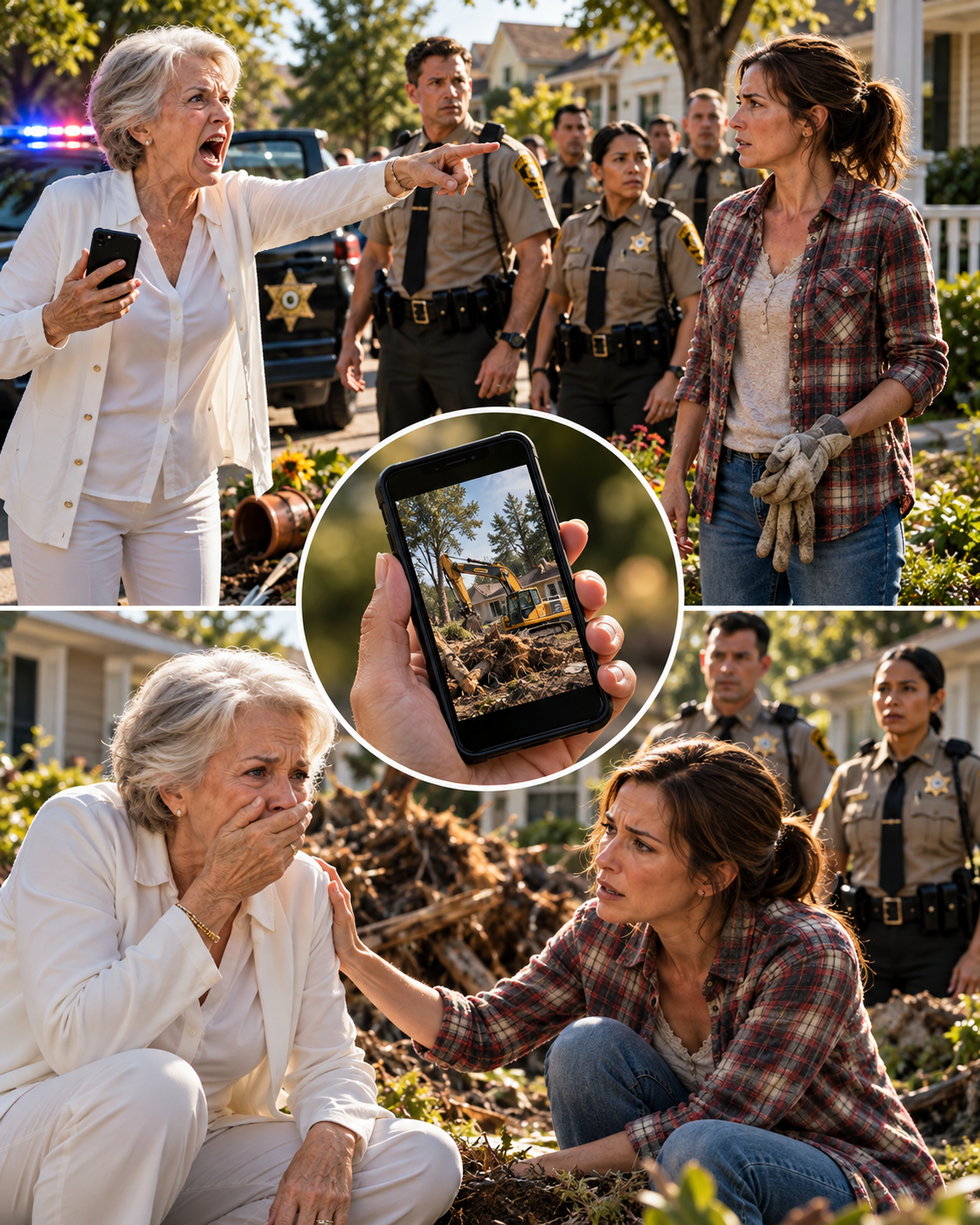
Margaret was walking her small white dog, as she did every Saturday at that hour. She stopped at the edge of our front walk and watched Sarah for a moment, then raised her phone and began recording. She did not call out a greeting or ask what Sarah was doing. Instead, she spoke to her camera about an unknown woman who had repeatedly appeared at the property without permission. She said she had been documenting the situation for months and would now contact authorities. A couple of neighbors slowed down along the sidewalk when they heard her voice.
I saw the scene through the front window and stepped onto the porch. “Margaret,” I said, trying to get her attention. She kept the phone raised and told me she had already called the authorities, then asked me to stay where I was. Sarah paused with the trowel in her hand and looked over at me. When she saw Margaret, the phone, and the small group gathering nearby, she became very still. She pressed the soil around the new mum, set down the trowel, and slowly removed her gloves.
She folded the gloves together and held them in one hand while she waited. Sarah did not raise her voice, move toward Margaret, or try to take the phone. The dog’s leash hung loose, and the white animal sniffed the edge of the walk, unaware that a dispute was unfolding. Margaret continued speaking into the camera as if the words themselves could turn her suspicion into proof. I stood beside Sarah, wishing I could undo the months of hostility by saying the one thing that would make the morning stop. Then the first patrol car turned onto our street.
Part 4: Six deputies arrive and recognize the woman in the garden
The deputies arrived within four minutes of one another, three patrol cars pulling to the curb without sirens. Six officers stepped out, and the neighbors gathered along the sidewalk shifted to make room. Margaret immediately walked toward the first deputy, white dog trotting beside her and phone still recording. She told them there was a woman on the property who might be trespassing. She said she had never been able to confirm that Sarah had a legal right to be there and had photographs going back to July.
The first deputy, a young man named Castillo, looked past Margaret toward the porch. He saw Sarah and stopped. The second deputy noticed her, too, then murmured something to Castillo. Their expressions changed from routine attention to careful recognition. One by one, all six approached the porch, their posture straightening as they came closer. Deputy Reyes, a woman who had served the department for nine years, spoke first. “Good morning, Sheriff,” she said.
The words landed across the street like a stone dropped into still water. Margaret stopped walking, and even the dog paused. The neighbors went quiet enough that I could hear a car pass on the next street over. The phone in Margaret’s hand tilted toward the ground, though it kept recording. She looked at Sarah in her old jeans and gardening shirt, then at the deputies who had just greeted her. For the first time since we had moved in, Margaret seemed to realize that the picture she had assembled might be missing something important.
Sarah nodded to the deputies and asked if everything was all right. Castillo answered respectfully, “Yes, ma’am,” working to keep his face composed. Margaret recovered enough to insist there had been a mistake. She pointed toward Sarah and said she had documented suspicious activity for months. Reyes turned to her and asked, calmly, “Do you know who this is?” Margaret said she knew what she had seen: a woman appearing repeatedly on a property without clear permission.
“This is Sheriff Sarah Mercer of the Callaway County Sheriff’s Department,” Reyes said. “This is her home. We work for her.” The sentence was plain and factual, but the silence that followed carried the weight of eleven years of assumptions. Margaret tried to dismiss it, saying the county sheriff would not be living in that neighborhood without someone telling her. She asked to see identification, and Sarah turned to me. “Daniel, would you mind bringing my wallet out? It’s on the counter.” I went inside and returned in less than a minute.
Sarah opened the wallet and held out her identification. Margaret studied it, as if searching for a detail that could restore her certainty. She had none. “The truck has county plates,” she said, reaching for the last complaint she had made. Sarah told her the governing documents specifically exempted government fleet vehicles from the commercial vehicle rule. She had cited the relevant section in her reply on September ninth and offered to send the page again. A neighbor covered his mouth, while someone else made a sound that was nearly a laugh.
Part 5: Sarah’s restraint exposes the weakness beneath Margaret’s authority
Margaret looked at the phone still recording, then at the deputies and the neighbors who had gathered at her invitation. She had expected agreement, perhaps even applause, from people who shared her concern. Instead, she saw expressions of surprise and discomfort from residents who had been asked to witness her accusation. “I was protecting the neighborhood,” she said, and the certainty in her voice had begun to fade. Reyes quietly pointed out that Margaret had called 911 on the sheriff at her own home. The sentence was simple, but there was no way to pretend it had not happened.
Sarah pulled her gloves back on and bent to pick up the next flower. She placed it carefully into the empty planter, pressing the soil around its base with two fingers. Then she looked at Margaret, not unkindly, and said she understood that Margaret believed she was looking after the neighborhood. But she lived there, and this was her home. If Margaret had a concern in the future, Sarah asked her to come to the door and speak with her directly. “I’m usually home on weekends,” she said, then gathered the cardboard box and went inside.
The deputies confirmed that no trespass had occurred and that Sarah was the property owner. They took statements from those present, including Margaret, who repeatedly referred to the photographs she had collected. The officers did not argue with her or raise their voices. They made a record of the call and reminded her that emergency services should be used for actual emergencies. The neighbors dispersed slowly, carrying with them the image of Margaret’s phone still recording the moment her accusation collapsed.
In the days afterward, the sheriff’s office and the association’s board reviewed what had happened. The false 911 report was the obvious starting point, but the inquiry quickly widened. Investigators learned Margaret had photographed Sarah for months, questioned neighbors and county employees, checked the vehicle registration, and reviewed property records. Her own documentation showed that she had gathered information contradicting her suspicion and chosen to ignore it. One investigator described the pattern as “willful blindness,” a phrase that fit the record.
Residents began coming forward with their own experiences. Gerald had received eleven violation notices in three years, seven of which he contested; five were later withdrawn without explanation. His backyard statue, invisible from the street behind a six-foot fence, had somehow earned a violation. Helen Park said Margaret once tried to remove her from a meeting after she voted against raising dues. The Harwells said Margaret had contacted their landlord with claims about regulations they were not breaking. When the actual rules were reviewed, the notices did not hold up.
Each story seemed manageable by itself, which was why residents had handled them alone. Together, they described the same pattern: a person with a little authority learned that people would rather comply than fight. The cost of resistance had seemed larger than the cost of moving a bin, paying a fine, or avoiding a meeting. Margaret had interpreted silence as proof that she was right. The Saturday morning in our yard made the cost of that silence visible to everyone.
Part 6: Residents compare years of notices and remove Margaret from office
Twelve days after the 911 incident, the HOA board called an emergency meeting. The session lasted nearly three hours and was attended by eight residents who were not board members but had come to describe their own experiences. Their accounts were detailed and strikingly consistent. Margaret sat through most of the testimony without speaking, listening as residents described notices that had been withdrawn, meetings they had been discouraged from attending, and rules applied selectively. When she finally spoke, she insisted that she had acted within the rules and that the violations were legitimate.
By the end of the meeting, the board voted five to one to remove Margaret as president. She remained on the board briefly while the association reviewed its procedures, but she no longer had authority to issue notices or direct enforcement. The process did not erase what had happened, and some residents were still uncomfortable speaking in front of the people who had once disciplined them. But for the first time, the association had to answer questions from residents who had learned to bring documents, dates, and copies of the rules. That shift mattered more than any speech.
The legal case took longer to resolve. Margaret retained an attorney, and the false-report charge was eventually reduced after she completed community mediation and issued a formal written apology to Sarah. The letter was careful and clearly attorney-reviewed, but it was also specific. Margaret acknowledged that she had made assumptions about Sarah based on her appearance and her truck, and that those assumptions were not supported by evidence. She admitted they had caused harm. She did not use the word “sorry,” but she used “regret” four times.
The HOA also underwent a structural review. New procedures required every violation notice to include photographic evidence and a citation to the exact rule in question. Any disputed notice would be reviewed by a three-person panel rather than by one board member alone. The association elected a new president, Marcus Webb, a software engineer who had lived in the neighborhood for four years. When I asked what qualified him for the job, he said his main qualification was that he found HOA work genuinely boring. I told him that sounded promising.
Sarah did not attend the meetings or speak to the local paper. When the new board asked her twice to share her perspective, she politely declined both times. She thanked Marcus when he told her the neighborhood appreciated her patience and said she hoped the revised rules would make things easier for everyone. Neighbors began stopping by our house in ones and twos. Helen brought banana bread, and the Harwells brought flowers from their garden and apologized for staying quiet earlier. Sarah accepted their gestures warmly and told them they did not owe her anything.
Gerald became a regular presence over the fence between our vegetable gardens. In late October, he and Sarah spent forty minutes comparing winter mulch, tomato varieties, and the stubbornness of late-season fruit. Margaret’s house went on the market in November, and she left before the sign was even installed. A young couple, Amanda and Jake, bought it with their baby and a golden retriever named Biscuit. Their dog greeted everyone on the street with noisy enthusiasm, and the neighborhood felt a little less tense.
Part 7: The neighborhood rebuilds trust through small acts of attention
Sarah was outside trimming hydrangeas the morning Amanda moved in. Amanda came out with her baby on one hip and Biscuit straining at the leash. She said hello, and Sarah said hello back. They talked for ten minutes about the walking trail, the nearest grocery store, and which streets were easiest to navigate with a stroller. When Amanda went inside, Sarah returned to the hydrangeas. I watched from the kitchen window and felt something in my chest loosen for the first time in months.
I kept thinking about the September morning and the neighbors who had watched from the sidewalk. Many of them had their own stories about notices that made no sense or meetings that felt predetermined. They were not bad people, and they had not been eager to support Margaret’s treatment of us. But the machinery of small authority can make resistance feel more difficult than compliance. Pay the fine and it goes away; move the bins and avoid another knock; say nothing at the pool and skip the uncomfortable conversation. That is how silence can grow without anyone deciding they want it.
What changed on that Saturday was not Margaret’s certainty. It was that the consequences of her assumptions became visible in front of the people she had been trying to persuade. Six deputies arrived, recognized Sarah, and called her “Sheriff” while Margaret’s phone recorded every second. No one could tell themselves afterward that the accusation had been harmless or that Margaret had simply been checking on the neighborhood. The truth was suddenly public, and the residents had to reconsider what they had accepted as normal.
The next spring, Sarah planted a row of sunflowers along the fence near the Harwells’ yard. They grew nearly seven feet tall, yellow and a little ridiculous, leaning toward each other whenever the afternoon wind picked up. Helen Park said they were the most cheerful thing she had seen in the neighborhood in years. Amanda brought the baby over to look at them, and the child reached out with both hands toward the nearest flower. Sarah knelt and showed her how to touch the petals without pulling them loose.
The baby watched Sarah with the serious wonder small children bring to whatever has captured their attention. Sarah looked back with that same steady focus, as if the moment deserved the whole of her attention. I stood on the front step and thought of the first week in the new house, the slowing car, the violation notices, and the 911 call. All of it had led to something as ordinary as a woman teaching a child how to touch a sunflower. That ordinary moment felt like the neighborhood learning how to be a community again.
Gerald brought a bag of late-season zucchini one Sunday, and Sarah traded him a jar of tomato sauce she had canned through September. They stood at the gate talking about the neighborhood and the kind of place they wanted it to become. Gerald admitted that he had been embarrassed to complain about Margaret because it felt like confessing that someone with a laminated rulebook had gotten the better of him. Sarah told him that knowing when to ask for help was one of the smartest things a person could do. He nodded, looked down at his shoes, and said he would try to remember that.
Part 8: A garden, a baby, and a quieter definition of strength
Helen became one of the most vocal advocates for the HOA’s procedural reforms. She attended meetings, brought the governing documents with highlighted passages, and asked specific questions about how policies were being applied. Marcus told me she had already caught two proposed actions that did not meet the new evidence standard. She was not confrontational; she was prepared. After years of informal authority, that preparation changed the tone of the room. She had taught for thirty-two years and knew how to ask a question that required an honest answer.
The Harwells built raised beds along their back fence the following winter. Amanda brought seed packets for tomatoes, beans, and several kinds of squash, though she admitted she had never gardened before. Sarah spent an afternoon explaining the difference between determinate and indeterminate tomatoes while the baby sat in the grass, studying dandelions. By July, the Harwells had more zucchini than they knew what to do with. They left bags on three neighbors’ porches, including one household they had barely spoken to before. A thank-you note appeared on their door the next morning.
That September, Sarah canned three kinds of tomatoes: a beefsteak variety she had grown for years, a Roma she had switched to after a blight, and a yellow heirloom she was trying for the first time. The kitchen smelled of garlic and basil for two weekends. She gave jars to Gerald, Helen, the Harwells, and Marcus, who looked genuinely surprised that anyone would offer him something without wanting a favor in return. “It’s just tomatoes,” she told him. He thanked her three times, and she smiled.
I thought often of the people whose small decisions had helped us through the year. Deputy Reyes had spoken two calm words that changed the morning. Pete had refused to share our private information and kept walking. Gerald made a call even though he was unsure whether we wanted to hear from him. Helen had said we seemed perfectly nice when she barely knew us. None of those acts was dramatic, but each one reflected a choice to tell the truth rather than repeat someone else’s suspicion.
Sarah never gathered the neighborhood to deliver a lesson. She went back to the garden, planted bulbs before the frost, and tended them with the same gloves and small trowel she had used before the accusation. I had watched her do this for fourteen years, and I knew I would watch her for as many more as I was lucky enough to have. She understood the difference between power and authority, between a title and character, between declaring who you are and showing it through the way you treat people. Her badge stayed in a drawer on weekends.
In April, daffodils and hyacinths bloomed along the front walk. The hyacinths smelled extraordinary on warm afternoons, and Sarah showed Amanda’s baby how to bend close and smell one without crushing the stem. The child laughed, Sarah laughed, and the street briefly became nothing more complicated than a place where people lived, grew things, and paid attention to each other. That was all Sarah had ever wanted from our home. It was also the kind of community she had quietly helped build.
The deputies had not arrived to punish Margaret, and Sarah never used her office to settle a neighborhood dispute. What changed the outcome was that the truth became impossible to ignore, and residents finally compared what they had seen. Margaret had mistaken quiet for permission and appearance for evidence. The apology and reforms could not make the months of suspicion disappear, but they gave the neighborhood a way to move forward. Sarah returned to her garden, and the people around her began paying closer attention.
Margaret had been looking for a woman who needed a badge to be legitimate. What she found was a sheriff who did not need to announce her authority in order to act with it. Sarah had been the same person in the garden as she was in the office: patient, direct, and unwilling to bend the facts to suit someone else’s version of reality. That consistency had been invisible to Margaret because she had never tried to know her. On the September morning when the deputies greeted Sarah as Sheriff, the neighborhood finally saw what had been there all along.
The sunflowers returned the next summer, taller than before, and Biscuit barked at them as if they were strangers. Amanda’s baby toddled along the fence while Sarah showed her how to touch the petals gently. The new board met, the rules were applied with evidence, and residents began speaking to one another at the mailbox. There was no grand ceremony, only the ordinary work of building trust one conversation at a time. Sarah kept tending her yard, and the neighborhood grew into the place we had hoped to find.
✓ Lynn R. Adams
Part 2: Margaret’s assumptions harden into a campaign of warnings Within a week, Margaret had photographed Sarah’s truck from several angles and written down its license plate. She asked our neighbor…